Last week a 33-year-old patient opened a folder in front of her camera, two minutes into a video consultation.
Inside the folder: 14 lab reports. AMH. AFC. Day-2 FSH. Day-2 LH. Day-2 Estradiol. TSH. Free T3. Free T4. Anti-TPO antibodies. Prolactin. Vitamin D. Vitamin B12. HbA1c. Anti-Mullerian Hormone (yes, ordered twice from two different labs). Plus an HSG report and a semen analysis.
She had been to three different doctors over six months. Each one had ordered a few more tests. Nobody had sat down with her and explained what the whole picture meant. She had spent close to ₹22,000. She was more anxious than when she started.
This is the situation a lot of Indian women find themselves in when they begin trying to conceive and the period doesn’t bring the news they were hoping for. Lab tests get ordered. Numbers get circled in red. Doctors get changed. And the woman in the middle of it is told, eventually, that she should probably consider IVF.
I want to write something different here.
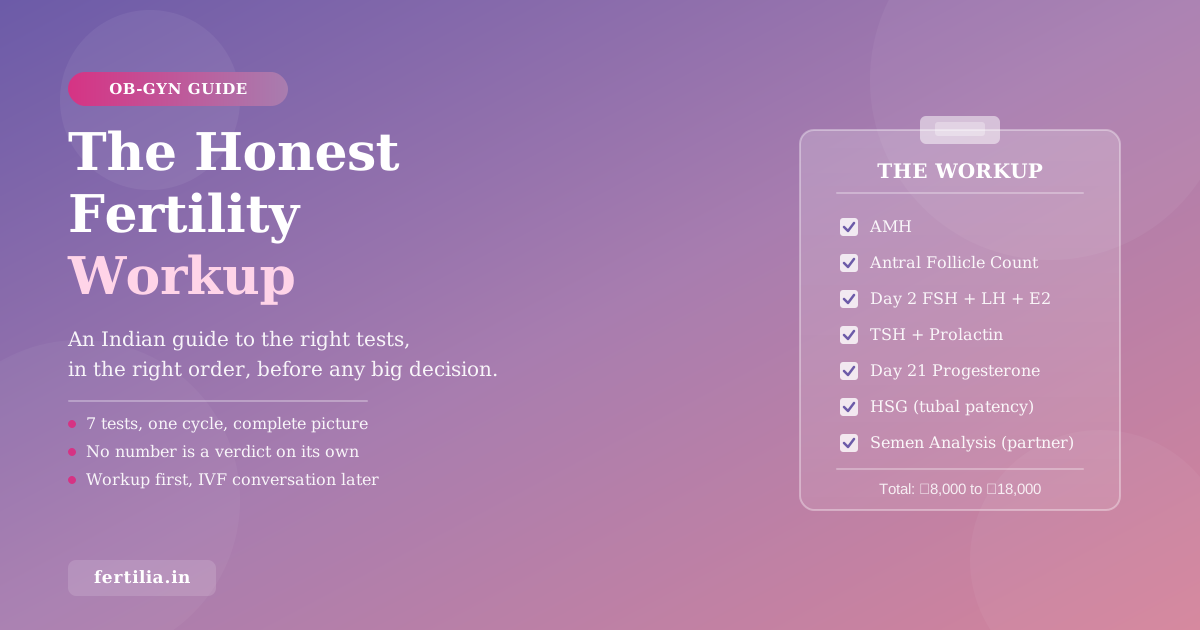
This guide is the workup I actually do in my practice. It is the smallest set of tests that gives a complete picture. It tells you what each result means, what it does not mean, and what an OB-GYN does after the workup is in hand. The goal is not more tests. The goal is the right tests, read together, before any big decisions get made.
Why This Matters
Three things are true about fertility testing in India right now.
First, the tests are inexpensive and easy to access. A complete workup can be done at any major lab (Thyrocare, Dr. Lal PathLabs, Metropolis, Redcliffe) for under ₹4,000 to ₹5,000.
Second, individual numbers get over-interpreted. A single AMH reading is shown to a woman and she is told her chances of natural conception are low. This is medically incomplete.
Third, the workup is what changes a panicked conversation into a clear next step. When you can see all seven layers of your reproductive picture at once, the answers usually become obvious, and most of the time the answer is not “do IVF immediately.”
I have looked after women with AMH below 1 who conceived naturally inside three months. I have looked after women with AMH above 4 who needed real medical help because something else in the workup was off. The number that ends up mattering depends on the rest of the picture.
So here is the workup. In order.
Layer 1: Age and Cycle History (No Lab Required)
Before any test, two questions.
How old are you? And what do your periods look like?
These two answers, taken together, frame everything that follows.
A 28-year-old with regular monthly cycles and a low AMH is in a very different position from a 38-year-old with irregular cycles and the same AMH. Age is the single strongest predictor of egg quality. Cycle regularity is a window into whether you are ovulating consistently.
In clinical practice, this is the conversation that should happen before any blood is drawn. If your gynec ordered tests before asking these questions in detail, ask her to revisit them with you when the results come in.
Some specific things I look at:
- Cycle length (under 21 days or over 35 days suggests an ovulation issue)
- Cycle predictability (do they come on the same day each month within a 3-4 day window?)
- Period flow (very heavy or very light flow points in different directions)
- Mid-cycle signs (cervical mucus changes, mild ovulation pain)
- Time spent trying (under 6 months at any age, vs. 12 months under 35, vs. 6 months over 35)
For more on cycle tracking and what each phase means, our Cervical Mucus Guide for TTC and Track Ovulation: 5 Methods cover this in depth.
Layer 2: AMH (Anti-Mullerian Hormone)
This is the test that has become a household name in Indian fertility conversations, and the one most often misunderstood.
AMH is produced by the small follicles in your ovaries. It is a rough indicator of how many follicles you have available right now. It is useful. It is also frequently misread as a “fertility verdict,” which it is not.
What AMH does tell us: quantity. Roughly. With variation of 15 to 30 percent between months and between labs.
What AMH does not tell us: egg quality, whether you are ovulating, whether your tubes are open, or whether your partner’s sperm is healthy.
Cost in India: ₹1,400 to ₹2,900 across major labs. Can be done on any day of the cycle (though Day 2-4 is most consistent). For a full breakdown of pricing across cities and labs, see AMH Test Cost in India 2026.
Normal ranges vary by age. We have written a separate decade-by-decade guide for Indian women, since population norms differ from Western reference ranges: AMH Normal Range by Age: What Indian Women Should Know.
If your AMH has come back low and you are wondering what that means for your chances of conceiving without IVF, read this next: Low AMH and Pregnancy: Can You Still Conceive Naturally?.
If you have already received a low number and are looking for what to do about it: How to Increase AMH Levels Naturally.
The takeaway from this layer: never make a major fertility decision based on AMH in isolation.
Layer 3: Antral Follicle Count (AFC)
AFC is the second leg of ovarian reserve testing, and in my opinion the more useful one in many cases.
A transvaginal ultrasound is done between Day 2 and Day 5 of your cycle. The sonologist counts the small resting follicles (2-10 mm) in each ovary. The total across both ovaries is your AFC.
Where AMH gives us a circulating hormone level, AFC gives us a direct visual count. The two should agree. When they disagree, AFC is usually the better picture because it shows what is actually present in the ovary at that moment.
Cost in India: ₹800 to ₹2,000 (a routine transvaginal ultrasound).
Normal ranges by age, approximate guideline:
- Under 35: good = 12 or more, fair = 6 to 12, low = under 6
- 35 to 40: good = 8 or more, fair = 4 to 8, low = under 4
- Over 40: any countable resting follicles is a useful starting point
The other thing the AFC scan tells us, which AMH cannot, is whether your ovaries look polycystic. If you have a high antral follicle count (more than 25 across both ovaries) along with high AMH, that pattern points to PCOS rather than high fertility.
How to read your AFC ultrasound report in detail: Antral Follicle Count (AFC): How to Read Your Ultrasound.
Layer 4: Day 2 or Day 3 Hormonal Panel
A blood test taken on Day 2 or Day 3 of your cycle (counting Day 1 as the first day of full menstrual flow, not spotting). This panel typically includes:
- FSH (follicle stimulating hormone)
- LH (luteinizing hormone)
- Estradiol (E2)
These three tell us how hard your brain is working to recruit a follicle that month.
A normal Day-2 FSH (typically under 10 mIU/mL) on a low AMH is reassuring. It means your ovaries are still responding to a normal level of brain signal. A high Day-2 FSH on a low AMH tells us the brain is having to push much harder than it should, which is a different clinical picture.
LH is paired with FSH because their ratio matters. In PCOS, LH is often higher than FSH at baseline (the LH:FSH ratio is reversed). In hypothalamic suppression (very low body weight, very high stress), both are low.
Estradiol on Day 2 should be low (under 80 pg/mL). A high estradiol on Day 2 can artificially suppress FSH and give a falsely reassuring picture.
Cost in India: ₹1,200 to ₹2,500 for the combined panel.
Timing is essential. If your gynec orders this in the middle of your cycle, the values will be uninterpretable. Ask specifically for Day 2 or Day 3.
Layer 5: TSH and Prolactin (the Thyroid + Pituitary Pair)
These two are ordered together because they are connected, and both affect ovulation.
TSH (Thyroid Stimulating Hormone) is the number to check first. If you are already on thyroid medication, the preconception target is under 2.5 mIU/L. Many Indian women have a TSH between 2.5 and 4.5 which their general physician calls “normal” and a fertility clinician will want to look at more closely: on levothyroxine, the dose is adjusted to reach that target; not on treatment, whether to start depends on your anti-TPO antibody status rather than the TSH number alone (ATA 2017). Subclinical hypothyroidism is one of the most missed causes of difficulty conceiving in Indian women.
Add free T3, free T4, and anti-TPO antibodies to the panel. Anti-TPO antibodies indicate autoimmune thyroid disease and can affect implantation and miscarriage risk even when TSH is in the lower range.
Cost: ₹800 to ₹1,500 for the full thyroid panel.
Prolactin is the pituitary hormone that rises in pregnancy and breastfeeding. When it is high outside of those situations, it suppresses ovulation. A high prolactin is a real and treatable cause of fertility difficulty, and it is also commonly missed in initial workups.
Causes of high prolactin in women trying to conceive include certain medications (particularly antipsychotics, antiemetics like domperidone, some antidepressants), thyroid imbalance, prolactinoma (a benign pituitary tumour), and stress. The first step is figuring out which one.
Full guide: High Prolactin in Women: Causes, Symptoms & Fertility.
Cost: ₹400 to ₹800 for a single prolactin test. Should be done in the morning, ideally before 11 AM, on a relaxed visit (recent breast examination or stress can give a falsely high reading).
Layer 6: Day-21 Progesterone
This is the test that confirms whether you actually ovulated this cycle.
“Day 21” is shorthand. What it really means is 7 days before your next expected period. If your cycle is 28 days, that is Day 21. If your cycle is 32 days, the right day is Day 25.
A progesterone level above 3 ng/mL confirms ovulation. A level above 10 ng/mL suggests a well-formed corpus luteum and a healthy luteal phase. A level under 3 ng/mL means you did not ovulate that cycle.
One test is not enough to make a luteal phase diagnosis. We typically repeat across two or three cycles before drawing conclusions.
The full explanation, including what to do with your result and how to time the test correctly for your cycle length, is here: Day-21 Progesterone: Did You Actually Ovulate This Cycle?.
Cost: ₹300 to ₹800 per test.
Layer 7: HSG (Tubal Patency)
The HSG (hysterosalpingogram) is the test that confirms whether your fallopian tubes are open. Without open tubes, the egg and sperm cannot meet, and no amount of hormonal optimisation will result in natural conception.
It is a 15-minute procedure done in the X-ray department of a hospital or imaging centre. A small amount of contrast dye is passed through the cervix and the spread of dye through the uterus and tubes is watched on X-ray. Cramping is common but brief. Most women are home within the hour.
It should be timed for after your period has ended but before ovulation (typically Day 6 to Day 12 of your cycle).
Cost in India: ₹2,500 to ₹6,000 depending on the centre.
What the report says matters as much as whether you had the test. “Bilateral spillage seen” is the result you want. “Cornual block”, “loculated”, “hydrosalpinx”, and “contrast extravasation” all mean something different.
We have written a full walkthrough of how to read your HSG report and what each radiologist term means: How to Read Your HSG Report: An OB-GYN’s Walkthrough.
For the underlying condition of tubal blockage, including causes and what to do next: Blocked Fallopian Tubes: Causes, Signs & Fertility Impact.
Plus One: Semen Analysis (The Partner’s Workup)
Conception is a 50-50 contribution. A complete fertility workup that does not include a semen analysis is not a complete workup.
This is a simple test. Your partner provides a semen sample after 2 to 5 days of abstinence (no shorter, no longer). The sample is analysed against WHO 2021 reference values:
- Volume: 1.4 mL or more
- Sperm concentration: 16 million per mL or more
- Total motility: 42 percent or more
- Progressive motility: 30 percent or more
- Morphology: 4 percent normal forms or more
Cost in India: ₹500 to ₹1,500.
Many Indian men are reluctant to do this test because of cultural assumptions that fertility is “the woman’s responsibility.” This is incorrect both medically and ethically. Up to 40 percent of fertility difficulty has a male factor contribution, and the test takes one morning. If your partner has not done a semen analysis yet, that should change before any further female workup is added.
If the semen analysis is abnormal: How to Increase Sperm Count: Evidence-Based Guide.
What the Complete Workup Looks Like
Here is the full picture at a glance.
| Test | When in the cycle | Approximate cost (₹) | What it tells you |
|---|---|---|---|
| AMH | Any day | 1,400 - 2,900 | Ovarian reserve (quantity) |
| AFC (transvaginal ultrasound) | Day 2 - Day 5 | 800 - 2,000 | Resting follicle count, ovary structure |
| Day-2/3 FSH + LH + Estradiol | Day 2 - Day 3 | 1,200 - 2,500 | Brain-ovary signalling balance |
| TSH + free T3 + free T4 + anti-TPO | Any day | 800 - 1,500 | Thyroid function and autoimmunity |
| Prolactin | Morning, any day, fasted | 400 - 800 | Pituitary signalling |
| Day-21 progesterone | 7 days before expected period | 300 - 800 | Ovulation confirmation |
| HSG | Day 6 - Day 12 | 2,500 - 6,000 | Tubal patency, uterine cavity |
| Semen analysis (partner) | Any time, 2-5 days abstinence | 500 - 1,500 | Male factor assessment |
Total complete workup: roughly ₹8,000 to ₹18,000 depending on the lab and city. Most women can complete the whole panel within one menstrual cycle if it is planned properly.
💜 Want help planning the right order for these tests? Message Dr. Suganya’s team on WhatsApp and we will help you sequence the tests across one cycle, at the right lab, at the right cost.
What’s Not on This List (and Why)
Several tests are commonly ordered in India that I do not include in the routine workup, because they do not change clinical decisions for most women.
Karyotype testing (parental chromosomal analysis). Useful in recurrent miscarriage (two or more losses), not in routine fertility assessment.
Thrombophilia panels (Factor V Leiden, MTHFR, antiphospholipid antibodies, lupus anticoagulant, etc). The current NICE fertility guideline (NG257, 2026, which replaced CG156) and RCOG guidance do not include these in routine fertility workup or after a single miscarriage. They are appropriate in specific clinical situations (recurrent miscarriage, prior thrombotic event), not as a screen.
IgG food sensitivity tests. Not validated for any medical condition. We have written about this separately: IgG Food Sensitivity Test in India: What It Really Shows.
Inhibin B. AMH and AFC have replaced inhibin B in modern ovarian reserve assessment. Inhibin B adds cost without adding decision-relevant information for most women.
Routine endometrial biopsy. Not part of fertility workup unless there is a specific reason (abnormal uterine bleeding, suspicion of endometritis, recurrent implantation failure).
Anti-ovarian antibodies, anti-zona pellucida antibodies. No clinical validation, no decision impact. Skip.
If a lab packages any of these into their “complete fertility panel” at a high price, you can usually decline the add-ons and stick to the core list above.
When to Do the Full Workup
The standard medical definition of infertility is 12 months of trying to conceive without success in women under 35, or 6 months in women 35 or older. Below those thresholds, you do not yet meet the formal criteria.
But that does not mean you have to wait.
If you are over 35, start the workup at the 6-month mark. Time matters more after 35.
If your cycles are clearly irregular (longer than 35 days, very heavy, very painful, or with mid-cycle spotting), start the workup right away. You don’t need to wait 12 months to investigate something that is obviously off.
If you have known conditions that affect fertility (PCOS, thyroid disease, endometriosis, prior pelvic surgery, prior pelvic infection, prior chemotherapy or radiation, severe menstrual disruption), start sooner.
If your partner has any of the male-factor risk indicators (prior testicular surgery or trauma, mumps after puberty, smoking, heavy alcohol, certain medications, varicocele history), do the semen analysis early.
If you are about to start the fertility journey and just want a baseline, doing the workup electively is also reasonable. Many couples find that a clean workup at the start of TTC removes a lot of background anxiety.
What Happens After the Workup
This is the conversation patients tell me they often do not have with their previous doctor.
Once the workup is in front of us, there are typically four possible clinical paths:
Path 1: Everything looks good. The recommendation is to keep trying naturally with optimised timing for another 3 to 6 months. Most women in this group conceive naturally. We track cervical mucus, urinary LH, and intercourse timing. If you are over 35 or have been trying for over 12 months, we may also begin lifestyle and supplement support in parallel.
Path 2: One specific issue is identified. Examples: subclinical hypothyroidism, high prolactin, vitamin D deficiency, mild PCOS, an abnormal semen analysis. We treat the specific issue, optimise for 3 months, then reassess. A surprisingly large percentage of women who come to me with a “fertility problem” actually have one specific treatable issue that has been hiding in plain sight.
Path 3: Multiple findings, but no single dominant issue. This is where lifestyle-based fertility support genuinely earns its place. Insulin resistance, weight, sleep, stress, nutritional deficiencies, alcohol, and partner-side optimisation all matter when no single test is dramatically off but the overall picture has friction. Our 90-day fertility program is built specifically for this group.
Path 4: A finding that suggests assisted reproduction. Severe tubal blockage. Severely abnormal semen analysis. Premature ovarian insufficiency with very high FSH. Repeated unsuccessful timed intercourse over 6 to 12 months in a patient over 38. In these situations, IUI or IVF is genuinely the right next conversation, and an honest clinician will say so directly.
The fourth path exists. We do not pretend it does not. But the first three paths are far more common than the fourth, and skipping straight to IVF without a complete workup is a decision most women would not make if they had seen the whole picture first.
If you are weighing the IVF decision specifically, this guide is for you: Do You Need IVF? An OB-GYN’s Honest Decision Framework.
A Note on the Lifestyle Layer
A formal fertility workup looks at hormones and anatomy. It does not look at how you eat, how you sleep, how stressed you are, or how much you move. Yet these factors meaningfully shift the picture in 3 to 6 months for most women.
I am not going to repeat the lifestyle protocol in detail here. We have written it elsewhere:
- How to Improve Egg Quality: Diet, Supplements & Lifestyle
- Fertility Foods for Women: An Indian Diet List
- Hormone-Balancing Morning Routine: An OB-GYN’s Guide
- How to Conceive Naturally: A Couple’s Complete Guide
The short version: the same Indian foods your grandmother cooked (haldi, jeera, methi, til, ragi, dal, palak, amla, dahi, ghee) align very well with what the evidence supports for fertility. The newer, processed pattern of eating is what works against you. The lifestyle layer is real, and it sits underneath every blood test in the workup above.
What I Tell Patients in Closing
If you are at the start of your fertility journey and feeling overwhelmed, here is what I tell every woman who brings me that folder of reports:
The whole picture matters more than any one number.
Most fertility difficulty in young to mid-thirties Indian women has a specific, treatable explanation. The workup above finds it in most cases.
A complete workup does not mean a complicated treatment. Most often, it means clarity, and clarity is what we want before we make any big decision.
And the women I see with low AMH numbers who conceive naturally inside our program (one of whom you can read about here: How Deepa Conceived Naturally with AMH 0.62) usually share one thing in common. They did the workup. They saw the whole picture. They worked through the lifestyle layer. And then their bodies did what they were always capable of doing.
💜 Ready to do the workup with someone who will read it with you? Message Dr. Suganya’s team on WhatsApp and we will help you get the right tests done, at the right time in your cycle, and walk through the results together.
If you would like the full lifestyle plan that runs alongside the workup, you can download Dr. Suganya’s Guide to Getting Pregnant (free), or read about her 90-day Fertility program which combines the workup with the lifestyle layer for women who want a structured plan.
Explore Each Part of the Fertility Journey in Depth
This workup is the map. These are the detailed walkthroughs for the tests, the costs, and the questions women ask most while trying to conceive.
The tests, in plain language
- AMH normal range by age
- AMH vs AFC: which ovarian reserve test tells you more
- Antral follicle count (AFC): reading your ultrasound
- Day 3 FSH, LH and estradiol: what they show
- Day-21 progesterone: did you ovulate this cycle?
- Follicular study (folliculometry): what the scan tracks
- Endometrial thickness: normal ranges through the cycle
- How to read your HSG report
- Semen analysis: what your report means
- Semen analysis: what to do with borderline numbers
What the workup costs in India
- The full fertility workup cost, broken down
- AMH test cost
- HSG test cost by city
- Hysteroscopy cost by city
- IUI cost per cycle by city
- IVF cost: an honest breakdown
- Egg freezing: cost, process and age
- Sperm freezing: cost and storage
Can I conceive naturally with…
- Conceiving after 35 without IVF
- With fibroids
- With one blocked tube
- With endometriosis, without IVF
- With a thin endometrium
- With low AMH
- With PCOS, step by step
Ovulation, timing and the two-week wait
- Ovulation symptoms: how to know you are ovulating
- How to track ovulation
- Your fertile window and how to use it
- Cervical mucus guide for trying to conceive
- The two-week wait after IUI or transfer
- Luteal phase defect: signs, tests and support
When treatment is the right call
- IUI vs IVF: which one you actually need
- Do you need IVF? An honest decision framework
- IUI success rates: per cycle, age and diagnosis
- IVF success rates by age
- Preparing your body for IUI or IVF
- Which doctor for infertility: gynaec, RE, or both?
Improving your odds naturally
- Seven evidence-based ways to boost fertility
- How to improve egg quality
- How to increase AMH levels naturally
- Thyroid and fertility: how it affects conception
- How to increase sperm count
- Fertility yoga for conception
Frequently Asked Questions
What is the minimum set of fertility tests every woman should do before considering IVF? AMH, AFC (transvaginal ultrasound on Day 2-5), Day-2 FSH + LH + Estradiol, TSH + free T3 + free T4 + anti-TPO, prolactin, Day-21 progesterone, HSG, and partner’s semen analysis. Total cost in India is roughly ₹8,000 to ₹18,000. This is the workup that lets you have a complete conversation with any fertility specialist.
For more on this, read our guide on Fertility Workup Cost India 2026. How long does the full fertility workup take to complete? Most of the workup can be completed within one menstrual cycle if planned properly. Day-2 hormonal panel and AFC scan on Day 2-5, HSG between Day 6-12, Day-21 progesterone in the second half of the cycle, AMH/TSH/prolactin on any day, semen analysis on any day. One cycle, one folder of complete results.
Can I get all these tests from one lab package? Most large Indian labs (Thyrocare, Dr. Lal PathLabs, Metropolis, Redcliffe) sell a “fertility panel” that covers most of the blood tests. The HSG and AFC ultrasound have to be done at an imaging centre or hospital separately. Compare the panel contents against the list above and decline any add-ons that are not on the core list.
Do I need a referral from a doctor to do these tests? For lab blood tests in India, no. You can walk into any lab and request them. For HSG and ultrasound, most imaging centres prefer (and some require) a doctor’s prescription. If you want to do the workup electively before seeing a fertility specialist, your regular OB-GYN can give the prescription.
Should my partner do his semen analysis first or last in the workup? First is fine, last is fine. The point is that it happens. Many couples make the mistake of completing the entire female workup, finding nothing wrong, and only then thinking about the partner. The semen analysis is the cheapest single test in the workup and tells you 50 percent of the picture in one go. There is no good reason to leave it until the end.
What if my AMH is low but everything else is normal? This is one of the most common scenarios I see in clinic. A low AMH on a normal age, regular cycles, normal Day-2 FSH, confirmed ovulation, open tubes, and normal semen analysis is not, on its own, a reason to rush into IVF. We have written a detailed answer to this question here: Low AMH and Pregnancy: Can You Still Conceive Naturally?.
My doctor wants to skip the workup and go straight to IUI or IVF. Is that ever the right call? Sometimes yes, usually no. If you are over 38 with very low AMH, severely abnormal semen analysis, both tubes blocked on HSG, or have been trying for more than 18 months despite optimisation, then accelerating to assisted reproduction can be the right move. If none of those apply, a complete workup first is the medically sound approach. You are entitled to ask any clinician why they are recommending what they are recommending, and to get a second opinion if the answer does not satisfy you.
For more on this, read our guide on When to Get a Second Opinion for Fertility or PCOS.