A patient joined a consultation recently holding her transvaginal ultrasound report up to the camera. She had done the scan on Day 3 of her cycle, as her doctor had instructed. Near the bottom of the two-page report, in the ovaries section, it read:
“Right ovary: 2.9 x 2.2 cm. Antral follicles: 5. Left ovary: 3.1 x 2.3 cm. Antral follicles: 4. Total AFC: 9.”
She had circled the 9 and written next to it: “Is this low?”
She had found two different sources online giving two different reference ranges. One said 9 was fine for her age. The other placed her in “low reserve.” She came in more confused than she had been before the scan.
This guide is the explanation I gave her that day: what AFC measures, why the day of your scan matters enormously, how to read the ovaries section of an Indian sonography report, what the ranges mean at different ages, and when AFC and AMH do not agree.
What AFC Actually Is
AFC stands for antral follicle count. It is the number of small resting follicles visible in both ovaries on a transvaginal ultrasound scan.
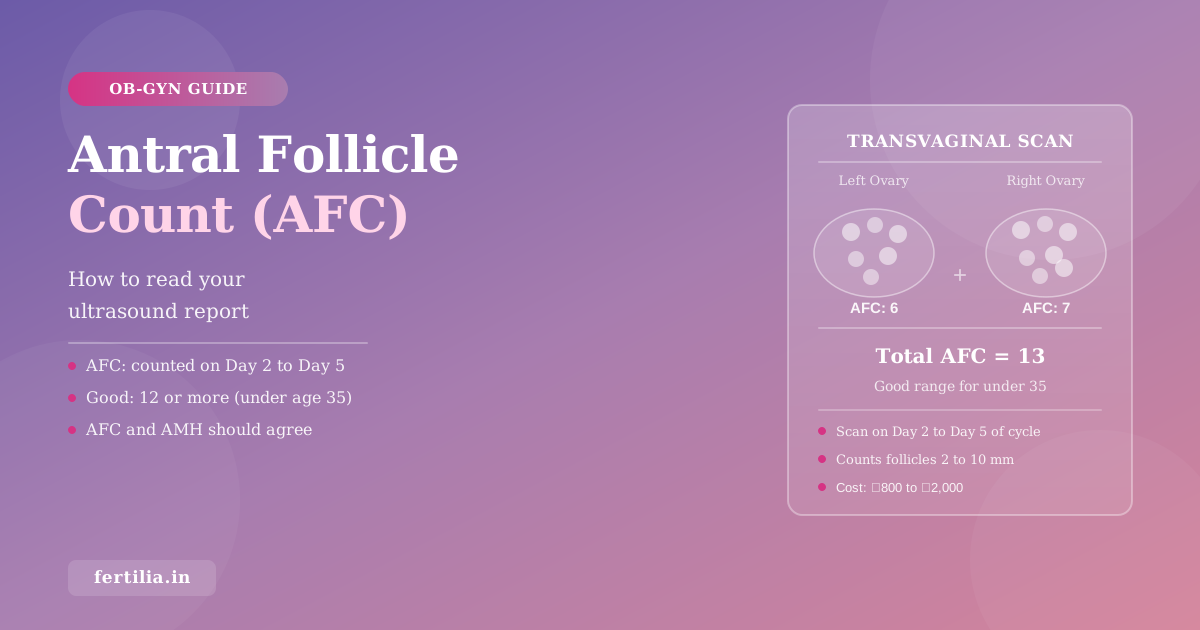
The follicles counted are antral follicles: fluid-filled sacs, typically 2 to 10 mm in diameter, present in the ovaries at any point in the cycle. These represent the early-development cohort that could be recruited in a future ovulation cycle. The sonologist counts every follicle in that size range in each ovary, then adds them together for the total AFC.
A transvaginal ultrasound (TV scan) is used because the probe sits much closer to the ovaries than an abdominal probe. A routine abdominal scan will not reliably count follicles in the 2 to 5 mm range.
Where AMH gives a circulating hormone level that correlates with ovarian reserve, AFC gives a direct visual count of what is present in the ovary at that moment. Research by Hansen et al. (2011, Fertility and Sterility) confirmed AFC as a reliable ovarian reserve marker, and Almog et al. (2011, Fertility and Sterility) published age-stratified reference ranges that remain the clinical standard.
For how AFC fits into the complete fertility picture, see The Honest Fertility Workup: An OB-GYN’s Indian Guide.
The Cycle Day Matters
This is the detail most patients are never told, and the one that causes the most misinterpretation.
AFC must be done between Day 2 and Day 5 of your cycle. Day 1 is the first day of full menstrual flow, not spotting.
In those early days, the ovaries are at their most resting. No dominant follicle has been recruited yet. Every follicle visible is genuinely a resting antral follicle, which is exactly what we want to count.
If the scan is done later, say Day 8 or Day 10, one or two follicles will already have been recruited as the dominant follicle for that cycle. The dominant follicle grows rapidly toward 18 to 22 mm by ovulation. Including it inflates the AFC count. Excluding it requires a judgment call that not every sonologist makes consistently.
What this means in practice: if your scan was done outside the Day 2 to 5 window, the number on your report may not reflect your actual reserve. I ask for a repeat scan at the correct time before drawing any conclusions in those situations.
Normal AFC Ranges by Age
AFC reference ranges vary by age because ovarian reserve naturally declines over time. Here are the approximate guidelines based on Almog et al. (2011) age-stratified data and current ESHRE clinical practice:
| Age group | Good AFC | Fair / Intermediate | Low AFC |
|---|---|---|---|
| Under 35 | 12 or more | 6 to 12 | Fewer than 6 |
| 35 to 40 | 8 or more | 4 to 8 | Fewer than 4 |
| Over 40 | Any countable resting follicles is a clinically useful starting point |
Two important notes. First, the “low” categories are starting points for a clinical conversation, not a verdict. A 31-year-old with AFC 5 and regular cycles, confirmed ovulation, open tubes, and a normal partner semen analysis is in a very different position from a 39-year-old with the same number.
Second, the ESHRE Bologna criteria (Ferraretti et al., Hum Reprod 2011), which define poor ovarian response for IVF purposes, require at least two of three features: advanced maternal age or another risk factor, a previous poor response, and an abnormal ovarian reserve test. For that last one, the abnormal-test threshold is an AFC below about 5 to 7 (or AMH roughly 0.5 to 1.1 ng/mL). Note that this applies to IVF planning, not to natural conception assessment, and that no single number puts you in the category on its own.
If your AFC is in the fair range, complete the rest of the workup before drawing conclusions. For what a lower reserve means for natural conception, see Low AMH and Pregnancy: Can You Still Conceive Naturally?.
How to Read Your Sonography Report
Indian sonography reports follow a broadly consistent format. Understanding the structure helps you find the AFC information and put it in context with the rest of the findings.
A typical transvaginal ultrasound report for fertility assessment has these sections:
Patient and procedure details: Your name, age, date of scan, cycle day if recorded, and probe type used. Many Indian centres note “transvaginal” or “TV scan” here. If the cycle day is not recorded, check your own calendar.
Uterus findings: The size of your uterus in centimetres, the endometrial thickness in millimetres, and any notes on fibroids, polyps, or adenomyosis. Endometrial thickness on Day 3 is typically 4 to 6 mm. This is background context at an AFC scan, not the primary concern.
Right ovary: The dimensions in centimetres, the number of antral follicles counted, and any other observations such as cysts or a dominant follicle already forming. A typical line reads: “Right ovary: 3.2 x 2.4 cm. 6 antral follicles seen. No other significant findings.”
Left ovary: The same information for the left side.
Other pelvic findings: Any free fluid, any tube observations (tubes are not normally visible unless something is wrong), and any other structures of note.
Conclusion or Impression: The radiologist’s summary. This may say “AFC: 9 (R: 5, L: 4). Normal uterus. Both ovaries without significant pathology,” or it may simply list measurements and leave interpretation to the referring clinician.
The AFC is always the sum of both ovaries. If the report gives individual counts, add them. “Right: 5, Left: 4” means total AFC 9. Some reports give the total directly; others leave the arithmetic to you.
What “Polycystic Appearance” Means
If your report includes “polycystic appearance” or “polycystic morphology,” this is not the same as a PCOS diagnosis.
A polycystic-appearing ovary means the ovary shows multiple small follicles arranged around the periphery, or the follicle count in one ovary is high (the commonly used threshold is more than 12 follicles in a single ovary). This pattern can appear in women with PCOS and in women without it.
The diagnosis of PCOS requires at least 2 of the 3 Rotterdam Criteria: irregular or absent periods, clinical or biochemical androgen excess, and polycystic morphology. Morphology alone is one criterion out of three. If your cycles are regular and you have no androgen excess signs, polycystic morphology on a scan does not mean you have PCOS.
For how insulin resistance connects to PCOS and what the distinction means for treatment, see Insulin Resistance and PCOS: Signs, Diet and What to Do.
When AFC and AMH Disagree
AMH and AFC should largely agree, since both measure ovarian reserve from different angles. Research by Broekmans et al. (2010, Fertility and Sterility) established the expected concordance between the two. When they diverge, the scenario tells you something specific:
For more on this, read our guide on AMH vs AFC. Low AMH, normal AFC: AFC is usually the more accurate picture. AMH can fluctuate by 15 to 30 percent between draws, and older immunoassays used at some Indian labs are known to read lower than newer generation tests. If your AFC looks normal for your age but your AMH came back low, consider repeating the AMH at a standardised lab (Thyrocare, Redcliffe, Metropolis) in the early follicular phase.
Normal AMH, low AFC: Most likely a scan done outside the Day 2 to 5 window, or counted by an operator without fertility-specific experience. A 2 to 5 mm follicle is easy to miss. Ask for a referral to a specialist fertility centre for a repeat scan at the correct time.
Both low: The clearest indicator of genuinely reduced ovarian reserve. Warrants a complete workup including Day-2 FSH and a direct conversation about the clinical picture. For evidence-based steps to support ovarian health, see How to Increase AMH Levels Naturally.
Both high: High AMH and high AFC together in a woman trying to conceive often point toward a PCOS pattern rather than an exceptionally high reserve. Your cycle regularity and androgen markers will clarify. For the AMH reference guide by decade, see AMH Normal Range by Age: What Indian Women Should Know.
For confirming ovulation alongside reserve assessment, the Day-21 Progesterone test is the logical next piece.
What AFC Predicts (and What It Does Not)
What AFC reliably predicts: Response to ovarian stimulation in IVF. This is the best-validated use in the clinical literature. A woman with AFC 4 will typically produce fewer eggs in an IVF stimulation cycle than a woman with AFC 15. It also helps identify a PCOS pattern when combined with high AMH and irregular cycles, and gives a broad sense of reserve to frame the fertility conversation.
What AFC does not predict: Egg quality. A follicle visible on ultrasound tells us nothing about whether the egg inside is chromosomally normal. Egg quality is primarily age-driven, not count-driven. For the lifestyle and nutritional factors that support egg quality alongside reserve, see How to Improve Egg Quality: Diet, Supplements and Lifestyle.
AFC also does not predict time to natural conception or whether you will conceive at all. Ovulation, tubal patency, and partner factors carry equal or greater weight for natural conception. AFC is one layer in a seven-layer picture.
The Indian Sonography Context
Not all AFC scans are equal.
Counting 2 to 5 mm follicles in both ovaries requires specific training and time. A scan done in 10 minutes at a general radiology centre handling hundreds of non-fertility scans daily will produce a different result from a 25-minute scan by an experienced reproductive sonologist at a dedicated fertility centre.
If your AFC came back surprisingly low and the clinical picture does not fit (regular cycles, normal AMH, under 33, no other concerns), ask your OB-GYN for a referral to a specialist centre for a repeat Day 2 to 5 scan. The cost of a transvaginal ultrasound at a specialist centre ranges from approximately Rs. 800 to Rs. 2,000. That is a small investment before making any significant clinical decision based on a single count.
💜 Got your AFC report and want to understand what it means for your full picture? Message Dr. Suganya’s team on WhatsApp and we will help you read it in context.
An AFC number on a sonography report is a starting point, not a verdict. Used correctly (Day 2 to 5, by an experienced operator, read alongside AMH and your age), it is one of the most useful pieces of a fertility assessment. Used in isolation or from a scan done at the wrong time, it is frequently over-interpreted in both directions.
If you want guidance on which foods support egg health alongside your reserve picture, Dr. Suganya’s Foods to Improve Egg Health is a free India-specific resource.
To work through your full fertility picture with Dr. Suganya, including AFC, AMH, cycle history, and lifestyle factors together, the 90-day Fertility Program is designed exactly for that.
💜 Ready to understand your full fertility picture, not just one number? Message Dr. Suganya’s team on WhatsApp and we will help you see the whole picture together.
Frequently Asked Questions
What is a good AFC for getting pregnant? For women under 35, an AFC of 12 or more is considered good, 6 to 12 is intermediate, and fewer than 6 is low. For women 35 to 40, the thresholds shift: good is 8 or more, fair is 4 to 8, low is fewer than 4. Even a “low” AFC does not mean conception is impossible. Women regularly conceive naturally with AFC values in the lower range when the rest of the fertility workup is reassuring.
Can AFC change from month to month? Yes, within a small range. AFC can vary by a few follicles between cycles depending on the exact cycle day the scan was done and the experience of the sonologist. The underlying reserve does not change dramatically month to month, but the count can appear slightly different. Two consistent Day 2 to 5 scans by experienced operators are more reliable than a single measurement.
Is an AFC of 6 too low to conceive? An AFC of 6 for a woman under 35 is in the lower end of the intermediate range. It is not categorically too low to conceive naturally. Whether it is concerning depends on your age, cycle regularity, AMH, Day-2 FSH, and how long you have been trying. This is exactly the kind of number that needs full workup context around it, not a standalone interpretation.
What does “polycystic ovary” on my scan mean? It means the ovary shows a high number of small follicles (often more than 12 in one ovary) or a characteristic peripheral arrangement. It is not a PCOS diagnosis on its own. PCOS requires at least 2 of the 3 Rotterdam Criteria: irregular periods, androgen excess signs, and polycystic morphology. If your cycles are regular and androgens are normal, you may not have PCOS. Ask your OB-GYN to review all three criteria together.
AFC vs AMH: which is more accurate? Neither is definitively more accurate in isolation. AMH is a blood test available on any cycle day; AFC is a direct visual count best done on Day 2 to 5. AFC is less affected by assay variation between labs. AMH is more accessible and less operator-dependent. When they agree, the picture is clearer. When they disagree, understanding the reason matters more than choosing one number over the other.
Can AFC be done on any day of the cycle? No. AFC should be done between Day 2 and Day 5, counting Day 1 as the first day of full menstrual flow. Outside this window the count is unreliable because a dominant follicle may already be recruited, distorting the resting count. If your scan was done outside this window, a repeat on Day 2 to 5 is the correct next step before drawing conclusions.
Does AFC predict whether I will get pregnant? AFC predicts ovarian response to IVF stimulation reliably, but it does not predict natural conception rates or time to pregnancy. Research consistently shows AFC alone does not determine whether or how quickly a woman conceives naturally. Egg quality, ovulation, tubal patency, and partner factors all matter as much or more. AFC is one layer of the fertility picture, not the whole story.