A 31-year-old patient came to my clinic last month with a single line written on a piece of paper. Her previous doctor had handed it to her at the end of a five-minute appointment.
“AMH 1.2. Consider IVF.”
That was the whole conversation.
She was 31. Her cycles were regular. Her partner had never had a semen analysis. There was no HSG report. No prolactin. No Day-21 progesterone. The Day-2 FSH was not in the file. Her age, her cycle history, the lifestyle context, her partner’s parameters: none of these had been part of the IVF recommendation.
She came to me with a folder thinner than mine after a single visit, and a decision in front of her worth ₹2,00,000.
This is the situation a lot of Indian couples find themselves in. The question is not whether IVF is a good option, because in the right hands and for the right couple, IVF is excellent medicine. The question is whether you are the right couple at the right time. And answering that question well takes more than five minutes and a single hormone reading.
This is the framework I use in my clinic. It is not a position against IVF. It is a framework for figuring out when IVF is the next correct step, and when it is not yet.
The Real Question Most Couples Are Asking
When a couple sits across from me asking “do we need IVF?”, they are usually asking one of three things underneath.
Am I out of options.
Am I out of time.
Is this what a careful doctor would actually recommend for someone in my exact situation.
I want to answer the third one. Because once that is clear, the first two answer themselves.
The framework below is built around one principle: a complete workup before any big decision. If you have not yet read our Honest Fertility Workup guide, please start there. The decisions in this post all assume that workup is in your hands. If it is not, then the next step is not IVF. The next step is the workup.
When IVF Is the Right Answer
Let me be direct. There are clinical situations where IVF is unambiguously the right next step, and any honest OB-GYN will say so without hedging.
Both fallopian tubes are blocked or severely damaged. Confirmed on HSG, and ideally re-confirmed on laparoscopy with chromopertubation. If the egg and sperm cannot meet through the natural route, IVF is how they meet. Read more about tubal blockage at Blocked Fallopian Tubes: Causes, Signs & Fertility Impact and what your HSG report is telling you at How to Read Your HSG Report.
Severely abnormal semen analysis. Azoospermia, severe oligospermia, or sperm parameters that cannot be optimised by lifestyle changes alone. ICSI (intracytoplasmic sperm injection, a form of IVF) is often the only viable path. WHO 2021 reference values define what “severe” means. A first abnormal semen analysis should always be repeated 4-6 weeks apart before drawing conclusions. The realistic recovery window for sperm parameter improvement is 3 months because spermatogenesis takes that long.
Age over 38 to 40 with reduced ovarian reserve and 6 to 12 months of unsuccessful timed intercourse. Time matters more after 38. Egg quality is age-driven. If the workup is complete, the optimisation window has been used, and conception has not happened, accelerating to IVF is reasonable. Note that “reduced ovarian reserve” is a clinical picture, not just one AMH number. See AMH Normal Range by Age for how to interpret what reduced reserve actually looks like at your specific age.
Recurrent unexplained miscarriages (3 or more) with embryo screening indicated. PGT-A (preimplantation genetic testing for aneuploidies) is often the highest-impact intervention here, and PGT-A requires IVF. The decision is genetic, not infertility-related in the usual sense.
Severe endometriosis with adhesions affecting tubal-ovarian anatomy. When the pelvic anatomy is distorted enough that egg pickup or fertilisation is mechanically compromised, IVF bypasses the problem.
Genetic indications requiring PGT-A or PGT-M. A known parental genetic condition (cystic fibrosis carrier status, BRCA mutations, thalassaemia, Huntington’s) where embryo selection is desired requires IVF as the vehicle for PGT.
Couples needing donor sperm, donor eggs, or surrogacy. Same-sex female couples, single women, couples after early ovarian failure, women without functional uteri, all routes through IVF.
When one or more of these applies to your situation, the decision is clear. The next step is to find a good IVF centre and a clinician you trust. Our job in primary care is to confirm the indication and refer you well, not to delay.
When IVF Is Often Not Yet the Right Answer
This is where I see most of the avoidable IVF recommendations in Indian outpatient practice. The pattern is consistent.
A woman comes in with a low AMH or a slightly off hormonal panel. The doctor who ordered the test sees the number and recommends IVF immediately. The complete workup never happened. The lifestyle window was never used. Time was never given. The IVF recommendation arrives before the diagnosis is complete.
Here is when an IVF recommendation deserves a pause and a second conversation.
The complete workup has not been done. This is the most common scenario by far. AMH alone is not a complete workup. AMH plus AFC is not a complete workup. The complete workup is the seven layers described in the Honest Fertility Workup post, plus the partner’s semen analysis. If those are not all in front of you, the recommendation is premature.
The cause is a specific, treatable issue. Subclinical hypothyroidism with TSH between 2.5 and 4.5. High prolactin, often from a common Indian medication like domperidone. Vitamin D deficiency, which affects 70 to 90 percent of urban Indian women. Mild PCOS where ovulation can be induced. Mild male factor that responds to a 3-month lifestyle intervention. In each of these, treating the specific cause for 3 months often resolves the picture.
Time has not yet been given. The formal medical definition of infertility is 12 months of trying in couples under 35, or 6 months in couples 35 and over. If you are 28, have regular cycles, normal workup, and have been trying for 5 months, you are not in the clinical category of infertility. You are in the category of “be patient.” IVF is not the answer.
The lifestyle layer has not been addressed. This is the largest, most under-utilised intervention in Indian fertility care. Insulin resistance. Weight. Sleep. Stress. Nutritional deficiencies including vitamin D and B12. Alcohol. Partner-side optimisation. None of these show up on a hormonal panel directly, but all of them shift the picture meaningfully in 90 days. Our guides on improving egg quality and the hormone-balancing morning routine cover this in detail.
The trigger was one number, alone. A low AMH on its own, with everything else normal, is not a reason for IVF in a young woman with regular cycles. Read Low AMH and Pregnancy: Can You Still Conceive Naturally? for what one low number actually does and does not mean.
I want to be clear: I am not saying IVF is wrong in any of these situations. I am saying that if you do the workup first and then still need IVF, you will be going in with a complete picture, a clear reason, and a much better expected outcome. IVF will still be there in 6 months if that is what the workup ultimately concludes. It very rarely becomes the wrong call for waiting through one structured 90-day optimisation cycle first.
💜 Got an IVF recommendation that doesn’t quite sit right? Message Dr. Suganya’s team on WhatsApp and we will walk through your workup with you and help you figure out if IVF is the right next step at this point.
The Three-Tier Decision Framework
Once your workup is complete and your partner’s semen analysis is in hand, here is the framework I use in clinic.
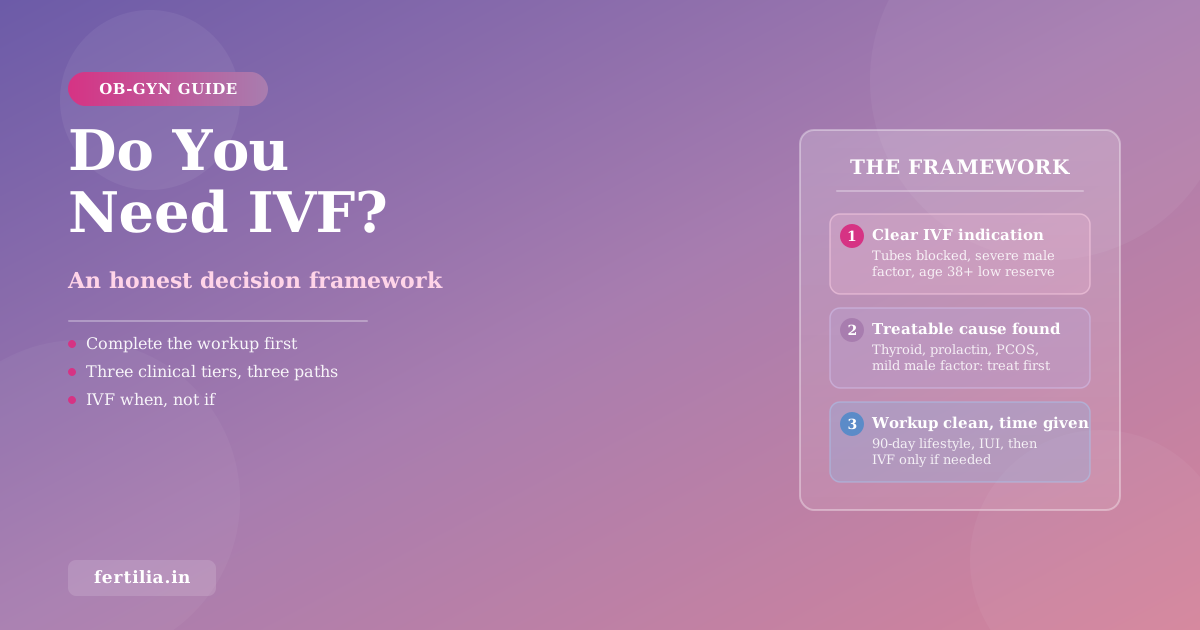
Tier 1: Clear medical indication for IVF
If you are in any of the situations from “When IVF Is the Right Answer” above, you are Tier 1. The decision has been made by your workup. Your next step is to find a good IVF centre. The lifestyle layer still matters because it improves IVF outcomes, but it does not change the underlying need.
A practical note for Tier 1 couples: do not over-shop IVF centres. Pick one with good outcomes data, a clinician you can communicate with, and a clear plan. Switching centres mid-cycle costs you time and continuity. Indian IVF outcomes vary by centre and by clinician within centres. Word-of-mouth in our medical community is usually more reliable than glossy websites.
Tier 2: Workup incomplete, or one specific treatable cause
Complete the workup if not done. Treat the specific cause for 3 months. Re-evaluate after that window.
Examples I see often:
- Woman with TSH 3.2, otherwise normal workup, 8 months trying: treat thyroid for 3 months, achieve TSH below 2.5, give 3 cycles of timed intercourse. Most conceive in this window.
- Couple with mild oligospermia (sperm count 12 million/mL): 3 months of zinc, antioxidants, lifestyle changes, varicocele assessment if indicated. Repeat semen analysis. Many improve into the normal range.
- Woman with confirmed PCOS and irregular cycles: 3 months of inositol, low-GI diet, weight optimisation if needed, ovulation tracking. Often, ovulation returns and conception follows. If not, ovulation induction (letrozole, clomiphene) before considering IVF.
Tier 2 typically resolves with simpler interventions than IVF. When it does, you have saved time, money, and the medical exposure of an IVF cycle. When it does not, you move to Tier 3 or Tier 1 depending on what the new findings show.
Tier 3: Workup is clean, age and reserve still favourable, time has been given
This is the tier where lifestyle-based fertility optimisation genuinely earns its place. You have a clean workup. Your age is reasonable. Your reserve is acceptable. Your partner is fine. You have been trying for a meaningful period.
The intervention here is a 90-day structured optimisation. Not a “try harder” period. A clinical lifestyle protocol covering insulin sensitivity, sleep, stress, weight, nutritional deficiencies, and partner-side support. Many couples in this tier conceive within the optimisation window. For those who do not, the next step is usually IUI (intrauterine insemination) before IVF, especially in younger couples with no specific indication for IVF. See IUI vs IVF: When Do You Really Need It for the comparison.
Our 90-day fertility program is built specifically for Tier 3 couples. The program does not replace the workup. It works alongside it.
The Lifestyle Layer Window
A formal fertility workup looks at hormones and anatomy. It does not look at how you eat, how you sleep, how stressed you are, or how much you move. Yet these factors meaningfully shift the picture in 3 to 6 months for most women.
The 90-day window matters because of biology. Follicles develop over a 90 to 120 day cycle. Sperm develop over 75 to 90 days. Any change in your or your partner’s environment, nutritional or otherwise, takes that long to register in the next round of egg and sperm production. Faster reassessments tend to miss the real effect.
Practical elements of the 90-day window:
- Correct any nutritional deficiencies. Vitamin D first (test, then correct), then B12, iron, folate.
- Address insulin resistance if present. Low-GI Indian diet, regular movement, resistance training 2 to 3 times a week, sleep.
- Sleep 7 to 8 hours nightly with a consistent bedtime. Most under-stated lever in Indian fertility.
- Stress management. Pranayama, yoga nidra, or simple daily walks. The cortisol-fertility connection is real.
- Indian fertility foods. Haldi, til, alsi, amla, palak, methi, moong dal, rajma, dahi, ghee. See Fertility Foods for Women: An Indian Diet List.
- Partner-side optimisation. Heat exposure, smoking, alcohol, semen-friendly diet. See How to Increase Sperm Count.
- Cycle tracking. Cervical mucus and ovulation methods.
This is not a substitute for medical treatment when the workup shows a specific indication. It is the foundation underneath whatever else happens.
A Real Conversation From Clinic
Let me walk through one composite case so the framework becomes concrete.
A couple in their early 30s comes in. She is 32, partner is 34. She has been trying for 8 months. Her cycles are regular. She has had two doctors. The first ordered AMH only, found 1.1, recommended IVF. The second added Day-2 FSH (normal), TSH (3.1), and prolactin (28), recommended IVF.
When she came to my clinic, here is what we did.
We completed the workup. Day-21 progesterone, full thyroid panel (anti-TPO included), AFC ultrasound, HSG, vitamin D, B12, HbA1c, semen analysis. Total cost: about ₹14,000. Two visits over one cycle.
For more on this, read our guide on Egg Freezing Cost in India 2026. Findings: TSH 3.1 (technically normal for the general population but high for someone trying to conceive), mild Vitamin D deficiency (24 ng/mL), normal AFC at 10, HSG showed bilateral patent tubes, Day-21 progesterone confirmed ovulation, semen analysis normal with mild teratozoospermia (morphology 3 percent normal forms).
Plan: thyroid optimisation to target TSH below 2.5, Vitamin D correction with weekly D3 60,000 IU for 8 weeks, lifestyle protocol for the couple including partner-side antioxidants and a 90-day no-alcohol period for him, cycle tracking, and three structured cycles of optimised timed intercourse.
Outcome: she conceived in cycle 3 of the optimisation window. Pregnancy confirmed, ongoing.
Was IVF wrong for her? It would not have been wrong, in the sense that IVF would have likely worked for her too. But it would have cost ₹2,00,000 more than the path we took, exposed her to ovarian hyperstimulation risk, and missed the actual diagnosis (subclinical hypothyroidism with mild Vit D deficiency in a fertile couple needing only optimisation).
For more on this, read our guide on IVF Cost India 2026. This pattern is more common than the IVF-first conversation in India usually acknowledges.
The Cost-Time Calculus
Let me put numbers on the framework, because cost is a real factor and pretending it is not does not help anyone.
| Approach | Cost (₹, India 2026) | Time | Success rate (estimated) |
|---|---|---|---|
| Complete workup, no treatment yet | 8,000 to 18,000 | 1 cycle | Diagnostic only |
| Workup + treat specific cause + 3 cycles timed intercourse | 25,000 to 45,000 | 3 to 6 months | High if cause is identified |
| Workup + 90-day lifestyle optimisation + 3 IUI cycles | 50,000 to 90,000 | 6 months | 30 to 50 percent cumulative |
| IVF cycle (1 fresh cycle) | 1,80,000 to 2,80,000 | 1 month | 35 to 45 percent per fresh cycle |
| IVF cumulative across 2 to 3 cycles | 4,00,000 to 8,00,000 | 6 to 12 months | 60 to 75 percent cumulative |
For a Tier 2 or Tier 3 couple, the cost-effective and medically sound approach is to use the lower-cost interventions first. For a Tier 1 couple, IVF is the right starting point and the cost is the cost of the right treatment.
When to Stop Optimising and Move to IVF
The optimisation window is not infinite. Here is when to stop and move to assisted reproduction.
- Over 35, completed 90 days of optimisation plus 3 to 6 cycles of optimised timed intercourse with confirmed ovulation, not pregnant: move to IUI then IVF.
- Under 35, completed 6 months of optimisation plus structured cycles, not pregnant: extend to 9 months, then IUI then IVF.
- A new finding emerges during the workup or follow-up (tubal block on repeat scan, deteriorating semen analysis, dramatic AMH drop): re-tier and act accordingly.
- The couple’s mental and financial readiness for the next step. This is real. Some couples want to know they tried everything before IVF; some couples want to accelerate. Both are reasonable.
Time matters and so does process. The aim is not to keep anyone from IVF when IVF is right. The aim is to make sure that when IVF is the next step, it is for the right reason, with the right preparation, and with the best possible expected outcome.
What I Tell Patients in Closing
If you have been told to consider IVF and you are not sure whether it is the right step, here is what I tell every couple in that situation.
A good fertility plan is built from the workup outwards, not from the recommendation backwards.
The doctor who gives you a recommendation should be able to walk you through every layer of your workup, what each result means, and why IVF specifically is the right answer at this point. If they cannot do that in 20 minutes of unhurried conversation, the recommendation may be premature.
You are entitled to ask. You are entitled to a second opinion. The Indian fertility community works together, and getting a careful workup-first opinion before committing to IVF is not disloyal to your previous doctor. It is normal medical practice.
And finally: IVF is excellent medicine when it is right. My job is not to keep anyone away from IVF if they need it. My job is to make sure that the couples I see make this decision well, with complete information, and at the right point in their journey.
💜 Considering IVF and want a workup-first opinion? Message Dr. Suganya’s team on WhatsApp and we will help you figure out which tier you’re in, complete any missing workup, and plan the next step that fits your situation.
If you would like the structured 90-day lifestyle plan that runs alongside the workup, you can download Dr. Suganya’s Guide to Getting Pregnant (free), or read about her 90-day Fertility program which combines a complete workup with the lifestyle layer for couples who want a structured path.
Frequently Asked Questions
How do I know if I really need IVF? You know when your complete fertility workup (the 7 layers plus your partner’s semen analysis) has been done and the results point to one of the clear IVF indications: both tubes blocked, severely abnormal semen, age over 38-40 with reduced reserve and 6-12 months of unsuccessful trying, recurrent miscarriage with embryo screening indicated, severe endometriosis with anatomical distortion, or a genetic indication for PGT. If you have not yet completed the workup, the question of IVF is premature.
Is IVF the only option for low AMH? No. Low AMH on its own is not a reason for IVF in a younger woman with regular cycles. The Steiner 2017 JAMA study found no significant difference in natural conception rates between low-AMH and normal-AMH women aged 30-44 trying without ART. AMH measures quantity, not quality. Many women with AMH below 1 conceive naturally when the rest of their workup is clean. Read Low AMH and Pregnancy: Can You Still Conceive Naturally? for the detailed answer.
Can I try naturally before IVF? In most cases, yes. If your workup is clean (no tubal block, no severe male factor, no severe endometriosis), and you are under 38, a 90-day optimisation window followed by 3 to 6 months of optimised timed intercourse is medically sound. IUI is the next step if natural conception does not happen. IVF after that, only if needed.
How long should I try before IVF? The formal definitions: 12 months in couples under 35 (or 6 months in couples 35 and over) of unprotected, optimally timed intercourse without conception. But this assumes a complete workup has been done. If your workup is incomplete or you are in Tier 2 (treatable cause found), follow the treat-and-reassess pattern first.
Is IVF guaranteed to work? No. The success rate of one fresh IVF cycle in good candidates is roughly 35 to 45 percent in Indian centres. Cumulative success across 2 to 3 cycles is 60 to 75 percent. The remaining 25 to 40 percent of couples do not conceive even after multiple cycles. This is one of the reasons we recommend completing the workup and using the optimisation window first: it improves the underlying picture in both natural-conception and IVF scenarios.
What is the cost of IVF in India in 2026? A single fresh IVF cycle costs roughly ₹1,80,000 to ₹2,80,000 in major Indian centres, depending on city and centre. Cumulative across 2 to 3 cycles, expect ₹4,00,000 to ₹8,00,000. This excludes additional procedures like ICSI, PGT-A, or frozen embryo transfers, each of which adds to the total.
Should I do IUI before IVF? For most Tier 3 couples (clean workup, time given, no specific IVF indication), yes. IUI is significantly less expensive (₹15,000 to ₹35,000 per cycle), less invasive, and uses your natural ovulation or mild stimulation. Success rates are lower per cycle than IVF (10 to 20 percent for IUI vs 35 to 45 percent for IVF), but for the right couple, 3 IUI cycles is a reasonable step before escalating. For Tier 1 couples with a clear IVF indication, IUI is usually skipped.