Last Tuesday a 33-year-old patient held two printouts up to her camera, one in each hand.
The first was her AMH result from a major Indian lab: 1.4 ng/mL. The second was a reference table from an American fertility clinic website. That site listed “normal AMH” as 1.0 to 3.5 ng/mL, with no age breakdown and no lab-specific context. Her result appeared to fall in range. But another site she had checked listed a completely different “normal” bracket. A third had a decade-by-decade table built from Western clinic data, at labs she had never heard of.
She had spent forty minutes trying to figure out whether her number was reassuring. The problem was not her number. The problem was the reference table.
Most AMH charts online were not built for Indian women. They present a single “normal range” that treats a 25-year-old and a 38-year-old identically, which is clinically meaningless.
This guide gives you what those charts do not: a decade-by-decade AMH reference for Indian women, honest context about Indian-population data, and the clinical framework for reading your number by age.
What AMH Actually Measures
AMH (Anti-Mullerian Hormone) is produced by granulosa cells, the cells surrounding each small antral follicle in your ovaries. More small follicles means a higher AMH reading. It is a real-time proxy for ovarian reserve: roughly how many eggs are currently in your pool.
What it does not measure: egg quality, ovulation status, whether your tubes are open, or your partner’s fertility. For the full biology and what AMH tells us about natural conception, read: How to Increase AMH Levels Naturally and AMH Test Cost in India: Complete Guide.
The one thing to hold for this guide: AMH declines naturally with age because the total pool of primordial follicles decreases over a woman’s reproductive life. The decline is gradual and continuous. The same number at 27 and at 40 carries completely different weight.
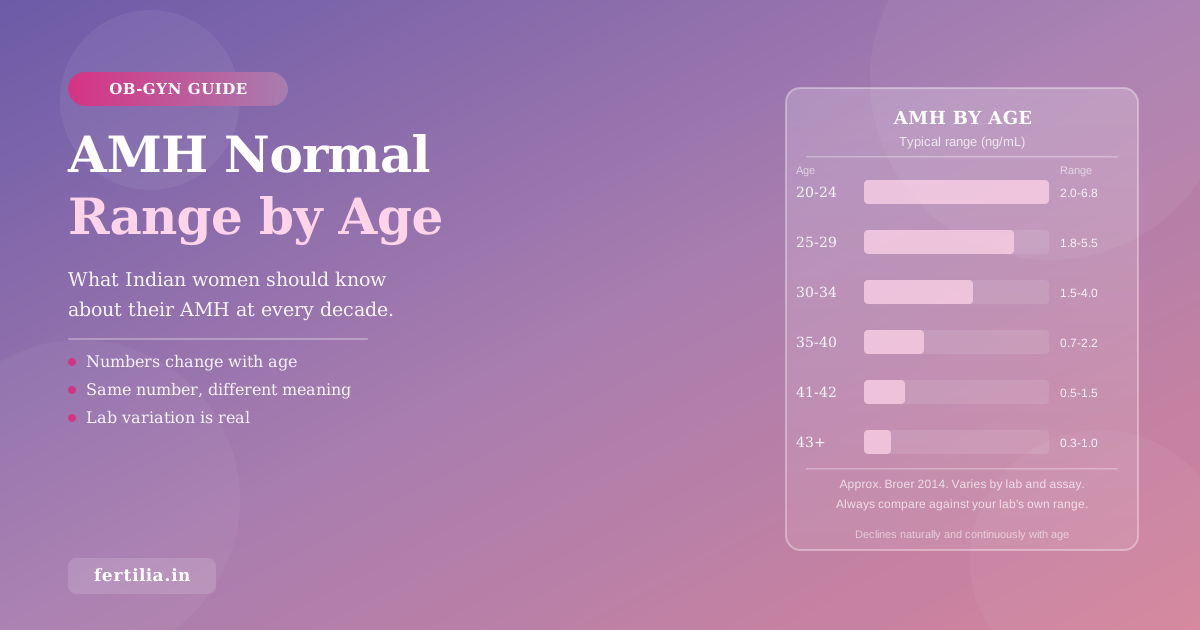
AMH Decade-by-Decade Reference Table (Indian Context)
The following ranges are based on Broer et al. (2014, Human Reproduction Update) and Almog et al. (2011, Fertility and Sterility), adjusted for Indian-population context where relevant evidence is available. These are approximate population ranges, not absolute cutoffs. Every lab calibrates its reference values to its own assay, and your result should be read against your specific lab’s reported range alongside your age. That said, a decade-by-decade framework is far more useful than a single un-stratified bracket.
| Age group | Typical range (ng/mL) | Low | Very low | Notes |
|---|---|---|---|---|
| 20 to 24 | 2.0 to 6.8 | below 1.0 | below 0.5 | Values above 6.8 may suggest a PCOS pattern |
| 25 to 29 | 1.8 to 5.5 | below 1.0 | below 0.5 | Peak reproductive years |
| 30 to 34 | 1.5 to 4.0 | below 1.0 | below 0.5 | Gradual decline becomes noticeable |
| 35 to 37 | 1.0 to 3.0 | below 1.0 | below 0.5 | Age-specific reading becomes more important |
| 38 to 40 | 0.7 to 2.2 | below 0.7 | below 0.4 | Reserve decline accelerates in this bracket |
| 41 to 42 | 0.5 to 1.5 | below 0.5 | below 0.3 | What was “low” at 32 is average at 41 |
| 43 to 45 | 0.3 to 1.0 | below 0.3 | below 0.2 | Natural conception still possible |
| Above 45 | Often below 0.5 | Not meaningful in isolation | Not meaningful in isolation | Perimenopause transition range |
Source: Broer et al. 2014 (Human Reproduction Update); Almog et al. 2011 (Fertility and Sterility); adjusted for Indian context. Lab-specific reference ranges may differ.
Three things I want to flag about this table.
First, these are population distributions, not minimum requirements for conception. A 34-year-old with AMH 1.2 sits below the centre of her typical range, but she has not crossed any biological threshold that closes her options. What matters is how her number fits with the complete clinical picture.
Second, the “low” and “very low” columns are not synonyms for “cannot conceive naturally.” They are markers that indicate the workup should be more thorough and the timeline conversation more active. Steiner et al. (2017, JAMA) found no statistically significant difference in natural conception rates between low-AMH and normal-AMH women aged 30 to 44 trying without assisted reproduction.
Why Indian Women May See Slightly Different Numbers
Some published data suggests AMH values may differ between ethnic groups. Iglesias et al. (2014) found signals of lower median AMH in South Asian women compared to age-matched Caucasian women in the United States, though the South Asian sample sizes were small. A 2018 systematic review in the Journal of Assisted Reproduction and Genetics found similar patterns.
The practical implication: the ranges above, derived primarily from Western population data, may sit slightly above the actual distribution for Indian women. A result at the lower boundary of a Western reference range may be closer to the Indian median.
A large, well-designed normative AMH study in an Indian-specific population does not yet exist. If your result sits at the lower edge of a Western range and your cycles are regular, do not automatically conclude you are below normal. Indian population data, when it arrives, may revise these numbers downward.
What “Low for Your Age” Means Clinically
This is the section that consistently surprises patients, because the same number tells completely different stories depending on when in life it appears.
A 32-year-old with AMH 0.8 ng/mL: her result sits below the typical range for her age group (1.5 to 4.0). Her reserve is lower than average for a 32-year-old. This warrants a complete workup: antral follicle count on Day 2 to 5, Day-2 FSH and estradiol, TSH, prolactin. It is a reason to be thoughtful about timing and to optimise what is within her control. On its own, it is not a reason to move straight to IVF.
A 42-year-old with AMH 0.8 ng/mL: her result sits in the middle of the typical range for her age group (0.5 to 1.5). Her reserve is actually above average for a 42-year-old. The clinical conversation is not “your reserve is concerningly low” but “your reserve is holding well for your age.”
Same number. Completely different clinical meaning.
Un-stratified “normal range is 1.0 to 3.5” charts are unhelpful for exactly this reason. They compress a decade of biological change into one bracket.
The clinical principle: always interpret AMH in the context of your age. And always pair it with antral follicle count, which gives you the direct visual picture of the same reserve through a different measurement approach. A detailed guide on AFC: Antral Follicle Count: How to Read Your Ultrasound.
For the broader framework of what a low result means for your chances of conceiving naturally: Low AMH and Pregnancy: Can You Still Conceive Naturally?.
What High AMH Can Mean
A result above the typical range for your age also deserves attention, though the clinical interpretation differs entirely from a low result.
In women of reproductive age, elevated AMH (above approximately 6.8 ng/mL, particularly under 35) most often signals polycystic ovary syndrome (PCOS). In PCOS, the normal process of follicle selection and dominance is disrupted. More small antral follicles accumulate than usual, each contributing to the circulating AMH level, so the aggregate reading is elevated.
An elevated AMH in PCOS is not a fertility advantage. It reflects follicle accumulation in the context of impaired selection. Anovulation, the absence of regular ovulation, is one of the more common fertility barriers I see in clinic, and it frequently accompanies elevated AMH in PCOS.
If your AMH is elevated and you have any combination of irregular periods, acne, unwanted hair growth, or difficulty managing weight, a PCOS evaluation is worth completing. The insulin resistance pattern that often drives PCOS is frequently the treatable factor: Insulin Resistance and PCOS: Signs, Diet and What to Do.
If your AMH is elevated and your cycles are completely regular with no PCOS symptoms, the high result is less clinically urgent. Some women simply have a larger resting follicle pool. The main consideration for IVF in women with very high AMH is ovarian hyperstimulation syndrome (OHSS) risk, which a fertility specialist accounts for in protocol design.
Lab Variation: Why Two AMH Tests Can Give Different Numbers
One of the more frustrating things I hear from patients: they tested AMH at two different labs within a few weeks and received meaningfully different results. Sometimes the gap is large enough to change the apparent clinical story. This is real, documented, and has a technical explanation.
AMH is measured by immunoassay platforms. The most commonly used in India are the Beckman Coulter Access AMH assay and the Roche Elecsys AMH assay. These two platforms use different antibodies and different calibrators. Studies comparing them have found systematic differences of 10 to 20 percent in certain AMH level ranges, with the direction of the difference depending on the specific value being measured.
In practice: 1.2 ng/mL on a Beckman platform and 1.5 ng/mL on a Roche platform could come from the same blood sample on the same day. Neither is wrong. They are simply not directly comparable.
Other sources of variation within the same person:
Oral contraceptive use. Combined OCPs suppress AMH by 20 to 30 percent in many women. A test taken while on the pill underestimates the underlying reserve. For a more accurate baseline, test 6 to 8 weeks after stopping.
Vitamin D status. A review of Indian studies documented widespread vitamin D deficiency across different ages, sexes, and urban and rural settings (Ritu and Gupta, Nutrients, 2014, PMID 24566435). That review does not establish that deficiency makes an AMH result underestimate ovarian reserve. Discuss a confirmed deficiency with your doctor without assuming it explains a low AMH result.
Cycle day. AMH is more stable across the cycle than FSH, but some studies show modestly higher values in the early follicular phase. Day 2 to 4 is the most consistent window.
The practical implication: for any follow-up comparison, test at the same lab every time. If your two results came from different labs, they are not directly comparable, and the gap alone should not drive clinical decisions. Full guide to Indian labs and costs: AMH Test Cost in India: Complete Guide.
💜 Got two AMH results that don’t agree with each other? Message Dr. Suganya’s team on WhatsApp and we can walk through what the discrepancy actually means for your clinical picture.
When to Repeat the Test
For most women, once is enough to inform a clinical decision, provided it is interpreted correctly against age and the full workup.
Situations where a repeat may be discussed with your doctor: when AMH and AFC strongly disagree (AFC is often the more reliable anchor); when tracking a structured fertility program (an annual repeat is reasonable); and when the first test was taken on combined oral contraceptives (retest 6 to 8 weeks after stopping).
One pattern to avoid: testing at multiple labs hoping for a better number, or retesting monthly watching for improvement. AMH has inherent biological variability across short intervals. Frequent repeat testing adds noise, not clarity.
One Number, Not a Verdict
I want to end with the framing I use with every patient who brings me an AMH report, whether the number is low, high, or somewhere in the middle.
AMH tells you one thing: roughly how many small follicles are in your ovarian pool right now. That is a useful data point. It is not your fertility. It is not your story. It is not a ceiling on whether you will conceive. The same number, read in isolation at home against a generic chart, and read in clinical context alongside age, AFC, cycle history, and a complete workup, are two entirely different conversations.
For the broader case that AMH is not a verdict on natural conception: Low AMH and Pregnancy: Can You Still Conceive Naturally?.
For the full fertility workup that reads AMH properly alongside AFC, Day-2 hormones, TSH, prolactin, and partner parameters: The Honest Fertility Workup: An OB-GYN’s Indian Guide.
The number on your report is where the conversation starts. Not where it ends.
If you have your AMH result and want to understand what it means in the context of your specific age, cycle, and clinical picture, I would be glad to walk through it with you.
💜 Have your AMH report and want to know what it means for your age? Message Dr. Suganya’s team on WhatsApp and we will read your full clinical picture together.
You can also download our free Foods to Improve Egg Health guide, which covers diet and lifestyle support for ovarian health specific to Indian women. When you are ready to work through the complete picture with a structured plan: Fertility Program at Fertilia.
Frequently Asked Questions
What is a normal AMH for a 30-year-old? For a woman aged 30 to 34, the typical AMH range (Broer et al. 2014) is approximately 1.5 to 4.0 ng/mL. Below 1.0 is considered low; below 0.5 is very low. These are population reference points, not fertility cutoffs. A result at the lower end warrants a full workup (AFC, Day-2 FSH) but is not automatically a reason to pursue IVF.
Is AMH 2 good? It depends on your age. AMH 2.0 ng/mL is solidly within the typical range for women aged 30 to 37, and above average for women in their early 40s. For a 25-year-old, 2.0 sits at the lower end of her decade’s range. The number is not good or bad in isolation. It is always interpreted against your age-specific bracket.
What AMH is too low for IVF? No universal cutoff makes IVF impossible. Even AMH below 0.3 ng/mL does not preclude IVF: it means fewer eggs retrieved per cycle and a carefully calibrated protocol. The conversation becomes more active when very low AMH combines with elevated Day-2 FSH, very low AFC, and age above 38. The complete workup shapes that decision, not AMH alone.
Can AMH levels go up? AMH readings can vary, but this vitamin D prevalence review does not establish that supplements improve AMH or increase the follicle pool. Ask your doctor how to interpret a changed result alongside the rest of your workup. Full guide: How to Increase AMH Levels Naturally.
Does AMH change with vitamin D levels? The Ritu and Gupta review cited above cannot answer that question: it describes vitamin D deficiency in India, not how treating deficiency changes AMH. If both results are low, ask your doctor to assess each rather than assuming that correcting vitamin D will change your ovarian-reserve result.
How often should I check AMH? Once is enough for most women, provided it is read against your age-specific range alongside AFC and the full workup. Discuss whether a repeat would change your care, particularly if the first test was done on oral contraceptives. The vitamin D prevalence review does not establish a schedule for repeating AMH after supplementation. More frequently than every 3 months adds uncertainty, not clarity.
Is AMH lower in Indian women than in Western reference ranges? Preliminary evidence suggests yes, though the data are not yet definitive. Iglesias et al. (2014) and a 2018 systematic review in the Journal of Assisted Reproduction and Genetics found signals of lower median AMH in South Asian women compared to age-matched Western populations. A value at the lower boundary of a Western reference range may sit closer to the Indian average. Until a large Indian-population normative study exists, the decade-by-decade ranges here provide a reasonable reference point, with the understanding they may slightly overestimate typical Indian values.