A 29-year-old woman brought an HSG report to a video consultation. She had been trying to conceive for sixteen months. She read the line out to me and said: “The radiologist said both my tubes are blocked. Does this mean I can never have a baby?”
In her case, the answer was no. The “bilateral blockage” on her report was a false positive caused by tubal spasm during the test, a well-documented phenomenon that happens in anxious patients. Her repeat sonosalpingography showed both tubes were open.
But this conversation happens every week in my practice, and not always with such a reassuring outcome. Tubal factor infertility is one of the most common causes of difficulty conceiving, accounting for approximately 25 to 35 percent of all diagnosed female infertility cases worldwide. The good news is that the diagnosis is rarely as final as it initially sounds.
This post covers:
- What fallopian tubes do and why they matter for conception
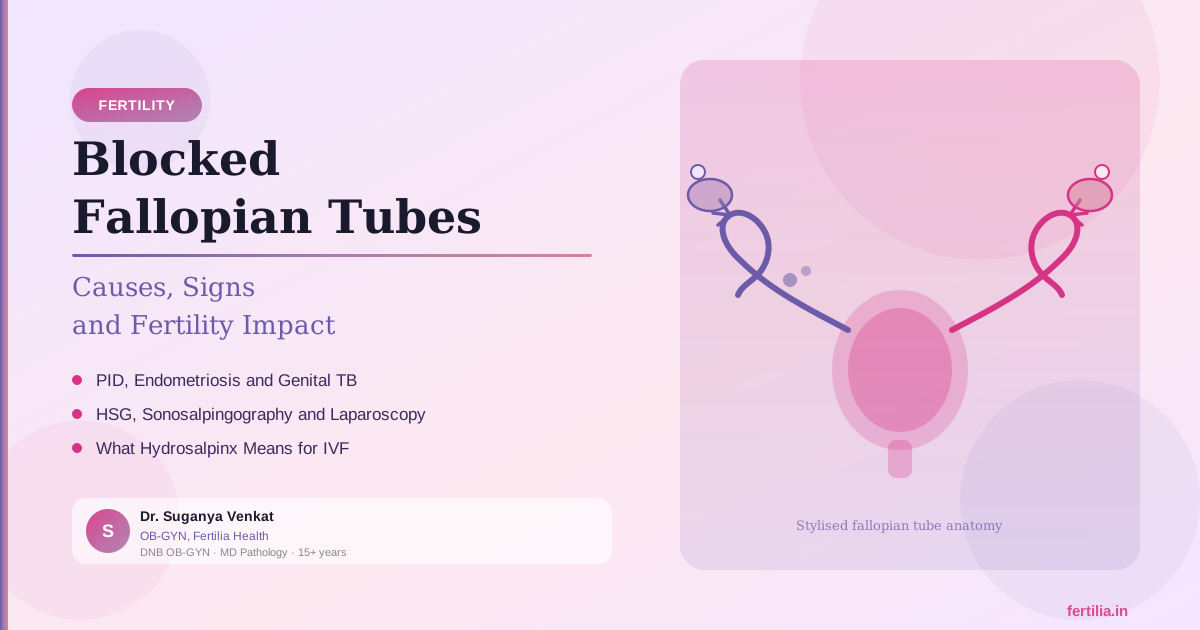
- Five causes of tubal blockage, including one that is underdiagnosed in India
- Why tubal blockage rarely causes symptoms until you try to conceive
- How to get an accurate diagnosis, and when to question a first result
- What hydrosalpinx means and why it requires a specific approach
- Your realistic options: natural conception, surgery, or IVF
What Fallopian Tubes Actually Do
Each woman has two fallopian tubes, one on each side. They are thin, muscular channels connecting each ovary to the uterus, roughly 10 to 12 cm long.
When you ovulate, the tube closest to that ovary sweeps the released egg inside using finger-like projections called fimbriae. The egg travels through the tube’s outer third (the ampulla), which is where fertilisation actually happens. If sperm reaches the egg in the ampulla, fertilisation occurs. The resulting embryo spends three to five days travelling through the tube toward the uterus, guided by tiny hair-like cells called cilia.
If a tube is blocked, sperm cannot reach the egg. If both tubes are blocked, natural conception is not possible. If tubes are partially blocked or structurally damaged, a fertilised egg may implant inside the tube rather than in the uterus. This is how ectopic pregnancies occur, and why any suspicion of tubal damage is worth investigating early. Our guide on ectopic pregnancy signs and what to expect explains the warning signs in detail.
Five Causes of Tubal Blockage
1. Pelvic Inflammatory Disease (PID)
PID is the most common cause of tubal infertility globally. It is an infection of the uterus, tubes, and surrounding structures, most often caused by bacteria such as Chlamydia trachomatis or Neisseria gonorrhoeae ascending from the cervix.
The difficult thing about PID is that it is frequently silent. A woman may have no fever, no noticeable pelvic pain, no discharge. The infection resolves, but it leaves behind scar tissue inside and around the tube. Westrom L, in a landmark cohort study published in the American Journal of Obstetrics and Gynaecology (1975, PMID 1130710), found that infertility rates were approximately 12.8 percent after one episode of PID and rose to 35.5 percent after three episodes. The scarring is cumulative.
In India, this problem is amplified by low rates of STI screening and cultural barriers to gynaecological care. NFHS-5 (2019-21) data shows that many women in India have never undergone a gynaecological examination. Subclinical PID often goes undetected and untreated for years, leaving tubal scarring as its only trace.
2. Genital Tuberculosis
This cause is particularly important in India and is underdiagnosed even in specialist settings.
India carries approximately 26 percent of the global TB burden (WHO Global TB Report 2023). Mycobacterium tuberculosis can spread from the lungs to the reproductive organs through the bloodstream, and when it reaches the fallopian tubes, it causes progressive fibrosis and severe structural damage. Unlike PID, genital TB tends to destroy the tube’s architecture completely rather than causing focal blockage.
A woman may have had pulmonary TB years earlier, completed her treatment, and considered herself cured, with no awareness that her reproductive organs were also affected. Genital TB is estimated to account for 5 to 10 percent of tubal factor infertility in India, with higher rates in regions where TB is more prevalent.
If your tubes are blocked and you live in a TB-prevalent region, your doctor will typically include a Mantoux test, a chest X-ray, and sometimes an endometrial biopsy in the initial workup.
3. Endometriosis
When endometrial tissue (the lining normally found inside the uterus) grows outside the uterus, it can implant on the fallopian tubes, on the ovaries, or in the pelvic cavity. This tissue bleeds with each cycle, causing inflammation, adhesions, and progressive scarring that can distort or block the tubes over time.
Endometriosis accounts for approximately 15 to 20 percent of female infertility, and tubal involvement is one of several mechanisms through which it affects fertility. Our dedicated post on endometriosis and fertility covers the full clinical picture.
4. Previous Pelvic Surgery
Any surgery in the lower abdomen or pelvis carries a risk of adhesions: bands of scar tissue that form as the body heals. Appendectomies, fibroid removal (myomectomy), ovarian cyst surgery, and previous surgery for an ectopic pregnancy can all affect tubal anatomy and mobility. The risk depends on the type of surgery, whether any infection occurred afterward, and individual variation in how scar tissue forms.
5. Congenital and Structural Causes
A smaller proportion of women have structural abnormalities of the tubes that are present from birth, or develop polyps and occlusions from chronic uterine infections. These are less common but become relevant when other causes have been excluded.
Why Most Women Have No Symptoms
This is the most important practical point in this entire post: tubal blockage is usually completely silent.
The tubes do not have the same pain receptors as the uterus. A woman can have bilateral tubal blockage caused by PID or TB, never experience a single noticeable symptom, and find out only when she tries to conceive and cannot.
The exception is hydrosalpinx (described in detail below), where chronic fluid accumulation in a blocked tube can cause a dull, persistent ache on one side of the lower abdomen, or occasionally an unusual watery discharge.
Irregular periods, on their own, are not caused by tubal blockage. The tubes play no role in hormonal cycling or menstruation. If you have both irregular periods and difficulty conceiving, those are likely two separate issues running in parallel, and both deserve investigation. PCOS, thyroid dysfunction, and elevated prolactin are the most common causes of irregular cycles in this age group.
How Tubal Blockage Is Diagnosed
Hysterosalpingography (HSG)
HSG is the most widely available first-line test. A small amount of dye is injected through the cervix into the uterus while an X-ray is taken. If the tubes are open, the dye flows through and spills into the pelvis. If blocked, the dye stops at the point of obstruction.
For more on this, read our guide on HSG Test Cost India 2026. HSG is useful and widely available, but it is not infallible. A meta-analysis by Swart P et al. published in Fertility and Sterility (1995, PMID 7641899) found that HSG has a sensitivity of approximately 65 percent and a specificity of 83 percent for detecting tubal occlusion. It misses a proportion of true blockages and, importantly, it produces false positives. Tubal spasm at the cornual (uterine) end, which commonly happens in anxious patients, can mimic proximal blockage on the X-ray. This is why a suspicious HSG result should generally be followed up with sonosalpingography or laparoscopy before making any definitive decisions.
There is also an interesting therapeutic dimension to the HSG test itself. Some women conceive in the months following an HSG, possibly because the dye flushes minor debris or breaks up soft adhesions inside the tubes. This effect is documented more consistently with oil-soluble contrast media than with water-soluble media.
Sonosalpingography (SSG / HyCoSy)
This is an ultrasound-based alternative where saline or foam is infused through the cervix. The tubes are visualised on ultrasound in real time. It avoids radiation, is often better tolerated, and is increasingly available in well-equipped gynaecology clinics across India. For many women, SSG is now used as the initial screening test before deciding whether laparoscopy is needed.
Diagnostic Laparoscopy with Chromopertubation
If HSG or SSG suggests blockage, or the results are inconclusive, laparoscopy is the definitive investigation. A camera is inserted into the abdomen under general anaesthesia, and the surgeon directly visualises the tubes, checks for adhesions, and injects dye to confirm whether each tube is open. Laparoscopy also allows simultaneous treatment: adhesions can be released, and in some cases, blocked tubes can be opened at the same time.
Not sure what your HSG report means? Tubal reports often use technical language that is easy to misread. WhatsApp Dr. Suganya directly if you want a plain-language explanation of your result before your next clinic appointment.
Hydrosalpinx: When a Blocked Tube Becomes a Specific Fertility Obstacle
Hydrosalpinx is a specific subtype of tubal blockage that deserves its own section.
When a tube is chronically blocked at its outer (distal) end, fluid accumulates inside and causes the tube to swell and distend. On ultrasound, it appears as a fluid-filled, sausage-shaped structure near the ovary. Hydrosalpinx is most commonly caused by previous PID, less often by endometriosis or previous surgery.
Hydrosalpinx affects fertility in two ways. The obvious one: the tube is blocked and cannot function. The less obvious but more clinically significant one: the accumulated fluid can drain backward into the uterine cavity, particularly around the time of embryo transfer in IVF cycles. This fluid is embryotoxic and significantly reduces implantation rates.
A randomised controlled trial by Strandell A et al., published in Human Reproduction (1999, PMID 10548619), showed that surgical removal of a hydrosalpinx (salpingectomy) before IVF significantly improved clinical pregnancy rates compared to proceeding with IVF while the hydrosalpinx was still present. Current guidelines from both the American Society for Reproductive Medicine (ASRM) and the European Society of Human Reproduction and Embryology (ESHRE) recommend salpingectomy or proximal tubal occlusion before IVF if a hydrosalpinx is identified.
If your fertility specialist has identified hydrosalpinx and is recommending surgery before IVF, this is evidence-based guidance, not overly cautious advice.
Your Treatment Options
Natural Conception with One Open Tube
If only one tube is blocked, natural conception remains possible. The open tube can pick up eggs from either ovary, because ovulation does not strictly alternate sides every cycle. Many women with unilateral (one-sided) tubal blockage conceive naturally, particularly when the blockage is mild and other fertility factors are good. Your fertility specialist may recommend monitoring ovulation and timed intercourse for a few cycles before escalating.
For more on this, read our guide on Can I Conceive Naturally with One Blocked Tube?.
Tubal Surgery
Surgery is most useful in specific situations:
Proximal tubal occlusion (blockage near the uterus, at the point where the tube enters the uterine wall): This can sometimes be addressed through selective salpingography, where a thin catheter is guided through the uterus into the tube under X-ray guidance, or through hysteroscopic cannulation. Success rates depend on the underlying cause.
Distal tubal blockage without hydrosalpinx: Laparoscopic salpingostomy (creating a new opening at the blocked end) gives reasonable success rates when the tube wall itself is healthy and the blockage is mild.
Adhesion release: If adhesions from PID or endometriosis are distorting tube position without permanently damaging the tube itself, releasing them laparoscopically can restore more normal anatomy and improve natural conception rates.
The critical question before choosing surgery is: how damaged is the tube wall itself? A tube that is simply adhered in the wrong position may function well once freed. A tube whose inner walls have been destroyed by severe PID or TB scarring will not function even if surgically opened. Your surgeon’s assessment of tube wall quality, typically made visually during laparoscopy, guides this decision.
IVF (In Vitro Fertilisation)
IVF bypasses the fallopian tubes entirely. Eggs are retrieved directly from the ovaries, fertilised in the laboratory, and the embryo is placed directly into the uterus. For bilateral tubal blockage with significant tube damage, IVF is the most reliable path to conception and is often more cost-effective than repeated failed surgeries.
If you are weighing IUI versus IVF for your specific situation, our guide on when IUI is appropriate versus when IVF is needed walks through the clinical decision criteria in detail.
Anti-TB Treatment When Indicated
If genital tuberculosis is confirmed as the cause of tubal damage, completing a full course of anti-TB treatment is the first step, even if it will not reverse the existing structural damage. This prevents ongoing infection from affecting the uterus and is required before any fertility treatment is considered. Once TB is treated and the endometrium assessed, the fertility management plan is made accordingly.
Supporting Your Reproductive Health Through Diet
No food unblocks a fallopian tube. Scar tissue and structural damage require medical management. Saying otherwise is both inaccurate and unkind to women who deserve honest information.
What Indian foods can do is support overall reproductive health, reduce systemic inflammation, and provide the micronutrients that matter for egg quality and hormonal balance.
Haldi (turmeric) contains curcumin, which has well-documented anti-inflammatory properties. A daily cup of haldi in warm milk, or haldi used generously in cooking, is a reasonable low-risk habit for most women.
Amla (Indian gooseberry) provides an exceptional concentration of vitamin C, approximately 600 mg per 100g, which supports immune function and acts as an antioxidant that protects cells from oxidative damage.
Palak (spinach) and methi (fenugreek) provide folate, iron, and magnesium. Folate is critical before and during early pregnancy to support neural tube development, and iron matters especially for women with heavy cycles.
Dahi (curd) and chaas (buttermilk) support the gut and vaginal microbiome, which emerging research links to reproductive immune function.
These foods belong in every woman’s regular diet, for fertility and for general health. They do not replace, and should not delay, appropriate medical investigation and management.
For a deeper look at egg quality and the nutritional and lifestyle factors that genuinely affect it, read our guide on how to improve egg quality through diet, supplements, and lifestyle.
Starting fertility investigations can feel overwhelming, especially when a diagnosis like tubal blockage comes up before you expected it. If you would like a conversation with Dr. Suganya about what your results mean, what the next investigation should be, or whether IVF is the right path for you, WhatsApp her here. You can also download the free fertility guide for a step-by-step explanation of what the complete fertility workup involves. And if one tube is open and a natural attempt is reasonable, the 90-day Fertility program adds structured preparation while you work through the picture together.
For more on this, read our guide on The Honest Fertility Workup.
Frequently Asked Questions
Can blocked fallopian tubes cause irregular periods?
No. Tubal blockage does not cause irregular or absent periods. The fallopian tubes play no role in hormonal cycling or menstruation. If you have both irregular periods and difficulty conceiving, these are almost certainly two separate issues running in parallel: an ovulatory or hormonal problem causing the cycle irregularity, and a tubal issue affecting conception. Both deserve separate investigation and treatment.
Can I get pregnant with one blocked fallopian tube?
For more on this, read our guide on Can You Get Pregnant With One Ovary or One Fallopian Tube?. Yes, it is possible. The open tube can pick up eggs from either ovary in most cycles. Many women with unilateral blockage conceive naturally, particularly if the other fertility parameters (ovulation, egg reserve, sperm count) are normal. Your fertility specialist may recommend ovulation monitoring and timed intercourse, or intrauterine insemination (IUI), before considering IVF. The decision depends on your age, how long you have been trying, and any other factors identified in the workup.
Is there any natural remedy that can unblock fallopian tubes?
No. Herbal supplements, castor oil packs, abdominal massage, or any other home remedy cannot dissolve scar tissue or repair structural damage inside a fallopian tube. These claims circulate widely online but have no clinical evidence to support them. A blocked tube caused by PID scarring, hydrosalpinx, or TB fibrosis requires medical evaluation and, where treatment is possible, surgical or assisted reproductive management. Getting an accurate diagnosis is the most useful first step, and it opens options rather than closing them.
How does the HSG test work, and does it hurt?
A thin catheter is inserted through the cervix into the uterine cavity. Contrast dye is injected while an X-ray is taken. Most women feel cramping similar to moderate menstrual cramps during the dye injection. The discomfort is usually brief (the injection takes under two minutes) and settles quickly. Taking ibuprofen or paracetamol 30 to 60 minutes before the test is commonly recommended. If the test shows a suspicious result, your doctor will likely recommend a follow-up sonosalpingography or laparoscopy before drawing conclusions.
What is hydrosalpinx and how is it different from a regular blocked tube?
In a regular blocked tube, the tube is obstructed but not necessarily distended. In hydrosalpinx, the tube has been chronically blocked at its outer end, causing fluid to accumulate and the tube to swell noticeably. The accumulated fluid creates an additional problem beyond the blockage: it can drain backward into the uterus around the time of embryo transfer in IVF cycles, creating a hostile environment for implantation. For this reason, hydrosalpinx is managed more aggressively than a simple blockage, with salpingectomy (tube removal) or proximal occlusion typically recommended before IVF is attempted.
Should I have surgery first or go directly to IVF?
This depends on several factors: the type and severity of blockage, your age, whether the tube wall itself is structurally healthy, other fertility factors such as egg reserve and sperm parameters, and how long you have been trying. Surgery makes most sense for proximal blockages, mild adhesions in younger women with otherwise good fertility parameters, or unilateral distal blockage where the tube wall is healthy. For bilateral severe blockage, significant tube wall damage, or when a fertility specialist advises more direct management, IVF is often the more reliable path. A reproductive specialist who has reviewed your full workup is best placed to make this recommendation for your situation.
I had TB years ago. Could it have affected my tubes?
Yes, it is possible, even if you completed full anti-TB treatment. Genital tuberculosis can damage the tubes silently, without any gynaecological symptoms, and treatment of pulmonary TB does not reverse damage already done to the reproductive organs. If you have a history of TB, live in a high-TB-burden region, and have been unable to conceive, mention your TB history to your gynaecologist. A workup that includes a Mantoux test, chest X-ray, and endometrial assessment is standard in this situation. Finding genital TB does not mean pregnancy is impossible, but it changes the treatment approach significantly.