A woman joined a video consult with me last month and held her phone up to the camera before she had even said hello.
“Doctor, my AMH is 0.8. Is it over for me?”
She was 31 years old. Her periods came every 28 days. She had been trying to conceive for four months. One blood test, taken at a lab on her way home from work, had convinced her that her fertility was over.
I see a version of this scene several times a week. AMH has become a household name in Indian fertility conversations. The anxiety around a low result is real. Women come to a consult having already read two or three articles online, and in almost every case the conclusion they have reached is darker than the clinical picture actually justifies.
This guide is the conversation I have with women like her. Not reassurance for its own sake, but the actual clinical framework for reading a low AMH result: what it tells us, what it does not, and what the number means for your chances of conceiving naturally.
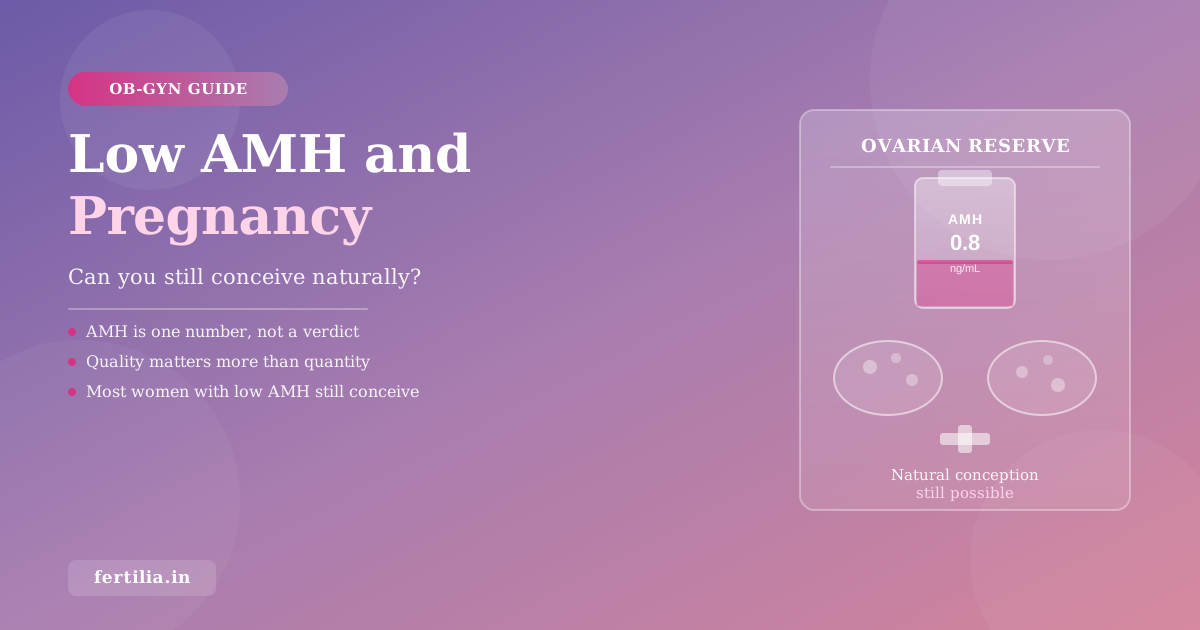
Can you get pregnant naturally with low AMH? In most cases, yes. AMH measures the quantity of eggs in your remaining pool, not their quality, and not your ability to conceive. Conception needs one healthy egg per cycle, not a large reserve. A 2017 JAMA study found no significant difference in natural conception rates between women with low AMH and those with normal AMH. A low number is a reason for a proper workup and an honest timeline conversation, not a verdict that pregnancy is off the table. The rest of this guide explains exactly how to read your number.
What “Low AMH” Means, and What It Does Not
AMH stands for Anti-Mullerian Hormone. It is produced by the small follicles in your ovaries. Think of it as a rough measure of how many resting follicles you have available right now. The more resting follicles, the higher the reading.
That is the one thing AMH measures: quantity. Roughly.
Here is what AMH does not measure:
- Whether those eggs are chromosomally healthy (egg quality)
- Whether you are ovulating regularly
- Whether your fallopian tubes are open
- Whether your hormones, thyroid, or pituitary are in balance
- Whether your partner’s sperm parameters are healthy
- Whether modifiable factors like vitamin D deficiency or insulin resistance are working against you
And here is the evidence most women with low AMH never hear.
In 2017, Steiner et al. published a landmark study in JAMA (PMID 29049585) following women aged 30 to 44 trying to conceive naturally without assisted reproduction. They compared conception rates between women with low AMH (below 0.7 ng/mL) and normal AMH. Finding: no statistically significant difference in natural conception rates between the two groups.
The reason is logical once you understand what AMH measures. Conception needs one healthy egg per cycle. AMH tells us the size of the pool. It tells us nothing about the quality of the eggs in that pool. And quality, not quantity, is what determines whether a cycle results in pregnancy.
This does not mean AMH is meaningless. A very low AMH in a woman of 41 is a different picture from the same number in a woman of 29. But AMH in isolation, without the rest of the clinical picture, is not a fertility verdict.
You can read how AMH testing works, which labs to use in India, and when to get tested in our separate guide: AMH Test Cost in India: Complete Guide.
The Numbers Women Search For: 0.5, 0.8, and 1.0
I want to address these directly, because these are the values women look up online and deserve a graded, honest response.
AMH 1.0 ng/mL: Mildly reduced. For a woman in her mid-to-late twenties, this sits at the lower end of normal. For a woman in her mid-thirties, it is consistent with her age range. Most women at this level have regular cycles and will conceive naturally given adequate time and a clean rest-of-workup. This number alone is not a reason to rush to IVF.
AMH 0.8 ng/mL: Moderately reduced. A full workup is worth completing to see the whole picture. In my Indian patient group, many women at this level have regular ovulatory cycles, normal antral follicle counts, and no other identifiable barrier to conception. The assessment matters far more than the number.
AMH 0.5 ng/mL: Significantly reduced. Time matters more at this level, particularly as age increases. The priority of a complete workup is higher. Natural conception still happens (see the case below).
AMH below 0.3 ng/mL: Very low. The clinical conversation becomes more active: AFC, Day-2 FSH, age, and cycle pattern all need to be in hand before any conclusions are drawn. Natural conception remains possible but the margin narrows.
| AMH level (ng/mL) | Clinical reading | First step |
|---|---|---|
| 1.0 to 1.5 | Mildly reduced | Full workup; natural conception very plausible |
| 0.7 to 1.0 | Moderately reduced | Workup plus age assessment; no urgency |
| 0.3 to 0.7 | Significantly reduced | Workup with priority; lifestyle optimisation; timeline conversation |
| Below 0.3 | Very low | Active clinical review; AFC and FSH essential |
| 0.1 or below | Critically low | Honest, individualised review; natural conception still occurs but is less common; IVF or, in some cases, donor eggs enter the conversation |
These are not cutoffs. They are a framework for the conversation that should follow the blood test, not the end of it. If your result is a very low figure like 0.1 or 0.07, it does not mean zero eggs, and women at these levels do still conceive, but the clinical conversation is more active and time-sensitive, which is exactly why the full workup below matters more than the single number.
If you also want the practical side of fertility, our guides on thin endometrium and natural conception and the honest fertility workup sit alongside this one.
The Seven-Layer Assessment: What I Look At Alongside AMH
When a woman brings me a low AMH report, that number tells me one thing. What I need is seven, before I form any clinical view.
1. Antral Follicle Count (AFC). A transvaginal ultrasound on Day 2 to 5 shows the actual resting follicles visible that day. Where AMH is a circulating hormone level, AFC is the direct visual count. A woman with AMH 0.7 and AFC of 9 to 10 is in a different position from one with AMH 0.7 and AFC of 2. Full guide: Antral Follicle Count: How to Read Your Ultrasound.
2. Day 2 or 3 FSH and Estradiol. These tell us how hard the brain is pushing to recruit a follicle each cycle. A normal FSH (under 10 mIU/mL) alongside low AMH is reassuring: the ovaries are still responding to a normal signal. A high Day-2 FSH alongside low AMH means the brain is already working much harder than it should, which is a meaningfully different picture.
3. Age. Always. Age is the single strongest predictor of egg quality, and egg quality determines whether a cycle produces a viable pregnancy. I cover this in the next section.
4. Cycle history. Are periods coming every 25 to 35 days, predictably? Regular ovulatory cycles on a low AMH are genuinely reassuring. Irregular cycles alongside low AMH tell a different story. Confirming ovulation with a Day-21 progesterone test is one of the most useful next steps.
5. Lifestyle and metabolic factors. A 2014 review found widespread vitamin D deficiency in Indian studies covering different ages, sexes, and settings (Ritu and Gupta, Nutrients, PMID 24566435). That review does not establish that treating deficiency raises AMH. B12, thyroid function, insulin resistance, BMI, sleep, and stress all have measurable effects on how existing follicles develop. These are modifiable. AMH is not.
6. Partner parameters. Conception is a 50-50 contribution. Low AMH alongside a healthy semen analysis is a very different picture from low AMH with concurrent male factor. A semen analysis costs under Rs 1,500 at most Indian labs and should not be deferred. Full workup guide: The Honest Fertility Workup: An OB-GYN’s Indian Guide.
7. Time and history. Has she been trying for three months or three years? Prior conceptions? Treatments tried? A woman with low AMH who has been trying for four months has a different clinical priority from one trying for 18 months with optimised timing. Time already spent shapes what comes next.
Only after all seven layers does a clear clinical picture emerge. The AMH number alone almost never tells me what to recommend.
Why Age Matters Far More Than the AMH Number
This is the clinical principle I most want women with low AMH to hold.
Egg quality is overwhelmingly driven by age, not by quantity.
A 28-year-old with AMH 0.7 has fewer eggs, but most of them are chromosomally normal. The quality is there. The question is just how many cycles it takes to find the right one.
A 41-year-old with AMH 2.5 has more eggs available, but the average quality is lower because she is 41. More eggs does not mean more good eggs when age is the dominant quality variable.
Cimadomo et al. (2018, Frontiers in Endocrinology, PMID 30008696) describe age as the primary determinant of egg quality and chromosomal abnormality rates across IVF cycles. The same relationship holds naturally. Younger eggs are far more likely to be chromosomally normal regardless of how many are in the reserve.
Practically: a 30-year-old with AMH 0.8 and regular cycles has very good reasons to expect natural conception with a proper plan. A 39-year-old with the same AMH has a more active timeline conversation ahead (more on that in our guide on conceiving after 35 without IVF).
For a decade-by-decade breakdown of what AMH values actually look like for Indian women: AMH Normal Range by Age: What Indian Women Should Know.
What Helps When AMH Is Low
If your AMH is below 1, here is what the evidence supports over a three-month window.
Fix vitamin D first. Test your 25-OH vitamin D level at any major Indian lab for under Rs 500. If you are deficient, the regimen most Indian clinicians use is 60,000 IU of vitamin D3 weekly for 8 to 12 weeks, followed by a repeat test. Confirm the dose and duration with your own doctor before you start, and retest rather than continuing indefinitely. Vitamin D receptors are present in granulosa cells, so correcting a deficiency is a sensible step while you work on the rest of the picture.
Add CoQ10. Coenzyme Q10 at 200 to 400 mg daily (ubiquinol form, with a fat-containing meal) supports mitochondrial function inside follicle cells. Small trials in poor ovarian responders have reported improved follicle metrics. Allow at least 3 months: follicle development runs on a 90 to 120 day cycle.
Build an anti-inflammatory diet pattern. Daily haldi in cooking, a serving of palak or methi, amla in any form, a bowl of dahi, and a portion of rajma or moong dal gives you the anti-inflammatory and antioxidant profile the evidence supports for ovarian health. Reduce ultra-processed food and refined sugar. Not a perfect diet: a consistently better pattern across months.
For the full evidence-based guide with supplement dosing, safety notes, and Indian food lists: How to Increase AMH Levels Naturally. For egg quality specifically: How to Improve Egg Quality: Diet, Supplements and Lifestyle.
You can also download our free guide: Foods to Improve Egg Health.
💜 Want a personalised plan based on your AMH and full clinical picture? Message Dr. Suganya’s team on WhatsApp and we will walk through the right steps for your specific situation.
A Real Case from Our Clinic
Deepa came to us at 35 with an AMH of 0.62 ng/mL. She had completed multiple ovulation induction cycles, none of which had resulted in pregnancy. An earlier doctor had told her that IVF was her only realistic option going forward.
She did not want to give up on natural conception. She wanted to try everything within her control first.
When we looked at her full picture, the AMH was one layer of a complicated story. She was sleeping 4 to 6 hours a night, managing chronic stress from work and a young child, and eating a diet too calorically restricted for her body to feel safe reproducing. Her husband Arjun had a total cholesterol of 264 mg/dL, a level associated with oxidative stress in semen.
We built a 90-day plan: sleep target of 7 to 8 hours, nourishment over restriction using Indian foods she already cooked (ragi, rajma, palak, dahi, ghee), gradual movement from 2,000 steps to 10,000, and daily stress reduction. Arjun worked on his metabolic health alongside her.
At the end of three months: a positive pregnancy test. Natural conception. No fertility medication. AMH 0.62.
In Deepa’s own words: “We began this programme simply wanting to bring a healthy change into our lives. Life had its own beautiful surprise for us. We are overjoyed to share that our second pregnancy journey has begun, naturally and happily within just three months.”
Her full case, including the lab reports and clinical detail before and after: How Deepa Conceived Naturally with AMH 0.62.
Names changed for privacy; shared with permission, and her full case with lab reports is linked above.
When Low AMH Genuinely Does Mean Considering IVF
I have spent most of this guide explaining why a low AMH number is not automatically a reason for IVF. I want to be equally clear about when the conversation genuinely shifts.
The clinical picture becomes more active about assisted reproduction when several of these apply together:
Age is above 38 and AMH is very low (below 0.3 ng/mL). The window for natural conception is narrow and time carries a real biological cost.
Day-2 FSH is consistently elevated. High FSH alongside low AMH means the brain is already pushing at maximum effort. That changes the prognosis.
AFC is very low (below 3 to 5 across both ovaries). When AFC confirms the AMH signal, the conversation is better grounded.
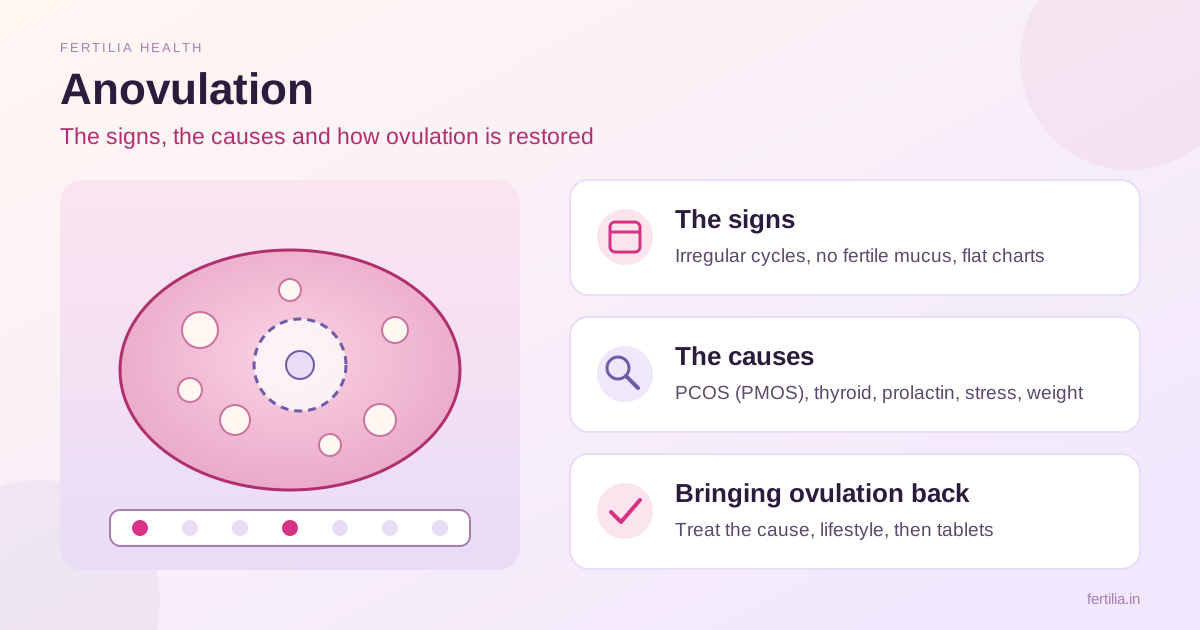
Ovulation is absent or consistently disrupted. Anovulation removes the natural conception mechanism. Medical ovulation support becomes the starting point.
Six to twelve months of unsuccessful timed intercourse after a complete workup. In my clinical judgement, once a woman over 35 has completed an optimised natural attempt of six months to a year without success, that is when the assisted-reproduction conversation genuinely shifts.
When IVF is genuinely the right conversation, an honest clinician will say so clearly. Our guide to that decision specifically: Do You Need IVF? An OB-GYN’s Honest Decision Framework.
Most women I see with a low AMH result are not in the IVF-now category. The number is real, the worry it triggers is understandable, but the conclusion that “my fertility is over” is almost never what the full clinical picture shows.
AMH is one signal in a seven-layer picture. Most women in their late twenties and thirties with low AMH have a genuine, evidence-supported path to natural conception once the rest of the picture is properly assessed.
The lab report is where the conversation starts. Not where it ends.
If you would like a practical starting point, our free Foods to Improve Egg Health guide covers diet and lifestyle specifically for low ovarian reserve. When you are ready to look at the full picture with someone who will read all seven layers alongside you: Fertilia Fertility Program.
💜 Low AMH on your report? Let’s look at the whole picture together. Message Dr. Suganya’s team on WhatsApp and we will walk through what your number actually means for your specific situation.
Frequently Asked Questions
Can I conceive with AMH 1? Yes. AMH 1.0 is mildly reduced, not dramatically low. Most women at this level with regular cycles and a healthy partner conceive naturally. Steiner et al. (2017, JAMA) found no statistically significant difference in natural conception rates between low-AMH and normal-AMH women aged 30 to 44 trying without assisted reproduction.
Is AMH 0.5 too low for pregnancy? No. AMH 0.5 is significantly reduced and warrants a complete workup, but natural conception still happens at this level. Deepa, whose case is linked above, had AMH 0.62 and conceived naturally at 35 without fertility medication. Age, AFC, Day-2 FSH, and cycle regularity all shape what the number means in context.
Does low AMH mean early menopause? No. Low AMH means reduced ovarian reserve for your current age. Early menopause (premature ovarian insufficiency) is a separate diagnosis: very elevated FSH, absent periods, and estrogen deficiency symptoms. Many women with low AMH have completely regular cycles. A proper workup will clarify exactly where you stand.
Can low AMH be reversed? The underlying follicle count cannot be increased. But AMH readings vary between tests and between labs, and in some women correcting a deficiency has been followed by a higher reading. Even if the number does not move, the quality of existing follicles can be meaningfully supported over a 90-day window.
How long does it take to get pregnant with low AMH? The Steiner 2017 JAMA data shows cumulative conception rates are comparable between low-AMH and normal-AMH women trying naturally. Practically: complete the workup, address what is modifiable, confirm ovulation is happening, and allow at least 3 to 6 months of structured effort before reassessing. Time depends on age, cycle regularity, and the rest of the picture.
Should I freeze my eggs with low AMH? Egg freezing is a planning conversation worth having with your OB-GYN, especially if you are in your early thirties and not yet ready to conceive. Lower AMH means fewer eggs per retrieval cycle, but the decision depends on age, AFC, and personal timeline, not AMH alone. It is a proactive option, not an emergency.
Is IVF the only option with low AMH? For most women in their late twenties and thirties with low AMH: no. Steiner 2017 (JAMA) does not support an automatic pivot to IVF based on AMH alone. IVF becomes the right conversation when low AMH is combined with age above 38, elevated FSH, very low AFC, absent ovulation, or prolonged unsuccessful natural conception after a full workup. For most women with no other barriers, a structured natural conception plan is the medically appropriate starting point.