One of the most common questions I get from women who are trying to conceive is: “Should I be paying attention to my vaginal discharge?”
The honest answer is: yes. Very much so.
What most women have been told to ignore as a normal bodily function is actually one of your body’s most precise fertility signals. Cervical mucus changes in a predictable pattern across your menstrual cycle, and reading those changes correctly can tell you which days you are most likely to conceive without a single kit, app, or gadget.
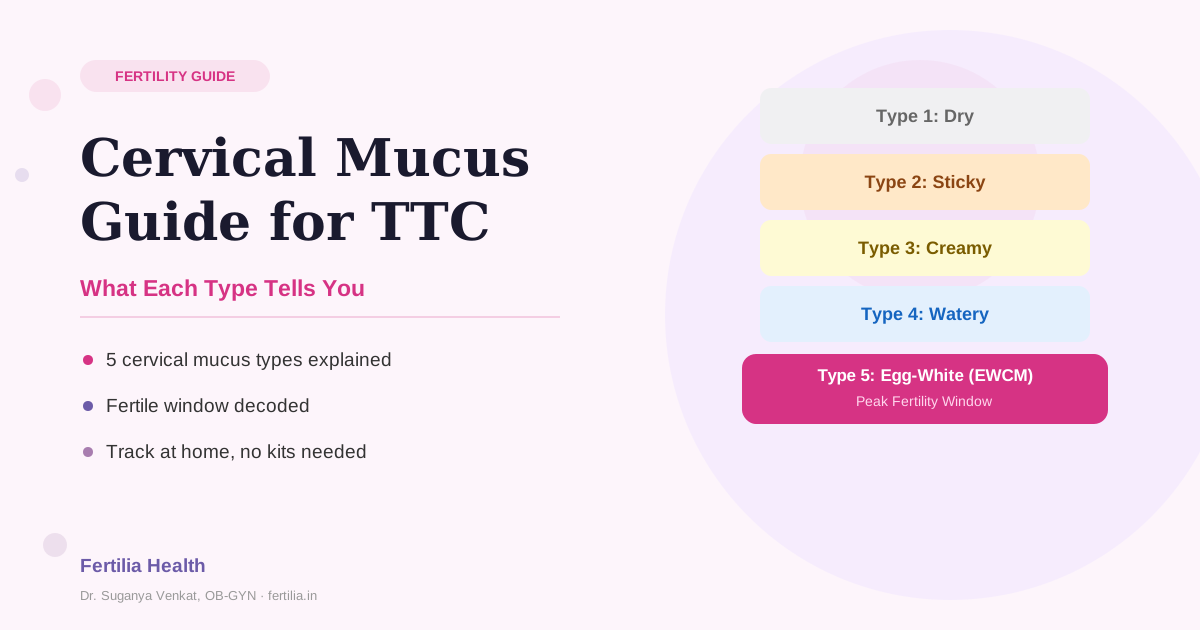
This post walks you through all five types, what each one signals, how to observe and track them at home, and what can interfere with this natural fertility tool.
What this post covers:
- What cervical mucus is and why it changes
- The five types and what each means
- How to check correctly (step-by-step)
- Which days are your most fertile
- What affects mucus production
- When to combine with other methods
- FAQ
What cervical mucus is and why your body makes it
Cervical mucus is fluid produced by glands inside your cervix, the narrow lower portion of the uterus that opens into the vagina. The amount, texture, and consistency of this fluid change across your menstrual cycle in direct response to the hormones your ovaries produce.
In the days following your period, estrogen is low and little mucus is produced. As your cycle progresses and a follicle matures in preparation for ovulation, estrogen rises steadily. This rising estrogen stimulates the cervical glands to produce more fluid. The fluid gradually becomes thinner, clearer, and more stretchy, reaching its most fertile form right around the time of ovulation.
After ovulation, progesterone takes over and the mucus quickly becomes thick, opaque, and sticky again. This creates a natural plug that blocks sperm from entering the uterus.
This is not incidental. Fertile-quality cervical mucus serves a specific purpose: it nourishes sperm, protects them from the acidic vaginal environment, and helps guide them toward the egg. A 2004 study in Human Reproduction by Bigelow and colleagues found that the presence of fertile-quality cervical mucus on the day of intercourse was a better predictor of conception than calculated timing based on calendar methods alone (Bigelow et al., Hum Reprod. 2004;19(4):889-892; PMID 14990542). Your body has been signalling your fertile days all along. Learning to read the signal is the skill.
The five types of cervical mucus
Type 1: Dry or nothing
When it occurs: Immediately after your period ends, and again in the days after ovulation
What it looks like: You feel dry. Nothing appears on the tissue when you wipe. No visible discharge.
Fertility signal: Not a fertile day. Sperm cannot survive in a dry environment. They would not reach the egg even if intercourse occurred.
Type 2: Sticky
When it occurs: A few days after your period ends, in the early part of your follicular phase
What it looks like: Small amounts of thick, pasty, or flaky discharge. If you press it between your thumb and index finger, it breaks apart rather than stretching. It may be white or yellowish.
Fertility signal: Low fertility. Sperm survival is minimal. The cervical plug is still firmly in place.
Type 3: Creamy
When it occurs: Several days before ovulation, as estrogen begins its upward climb
What it looks like: Smooth, lotion-like discharge. White or cream-coloured. It does not stretch when you press it between your fingers. It may look similar to hand cream.
Fertility signal: Approaching fertility. Some sperm may survive for a short time. Noticing creamy mucus is a signal that ovulation is coming within the next several days, so it is worth paying attention.
Type 4: Watery
When it occurs: A few days before ovulation
What it looks like: Clear, thin, and very wet. It may feel like you are leaking. The wetness is noticeable without needing to wipe, and the discharge can look almost like water.
Fertility signal: You are entering your fertile window. Sperm can survive well in this environment and may remain viable until ovulation occurs.
Type 5: Egg-white cervical mucus (EWCM)
When it occurs: One to two days before ovulation and on the day of ovulation itself
What it looks like: Transparent, slippery, and stretchy. When you press it between your thumb and index finger and slowly pull them apart, it stretches one or more centimetres without breaking. It resembles raw egg white in both appearance and feel.
Fertility signal: Peak fertility. This is the window when you are most likely to conceive. Sperm can survive for three to five days in egg-white mucus, which creates several days of potential conception before ovulation completes. A 2006 study by Scarpa and colleagues confirmed that the presence of egg-white cervical mucus on the day of intercourse was an accurate marker of the most highly fertile days in the cycle (Scarpa et al., Eur J Obstet Gynecol Reprod Biol. 2006;125(1):72-78; PMID 16154254).
How to observe your cervical mucus
There is nothing complicated about checking cervical mucus, but it takes a few days to feel confident about what you are seeing.
When to check: Check once or twice a day. The best time is after going to the toilet. Before you wipe, take a piece of toilet paper and lightly wipe the opening of your vagina. Look at what appears on the tissue. Alternatively, after washing your hands thoroughly, you can use a clean finger.
What to do with what you find: Press the discharge between your thumb and index finger. Note the colour. Note whether it is sticky, pasty, lotion-like, thin, or stretchy. Pull your fingers apart slowly and see if it stretches.
How to record it: Keep a simple daily note. A phone notes app or a small notebook works well. Write the day of your cycle and describe what you saw: D (dry), S (sticky), C (creamy), W (watery), EW (egg-white). After two or three cycles, you will start seeing your own pattern.
An important note for Indian climates: India’s warm weather means women often feel more generally moist throughout the day, which can be confused with cervical mucus. Additionally, dehydration (especially common in Indian summers) can reduce mucus production and make the transition to egg-white mucus harder to detect. Drink at least two to two and a half litres of water daily throughout your cycle. Coconut water, chaas (buttermilk), and rasam all count toward your daily fluid intake and are especially helpful during the pre-ovulation phase.
Your fertile window and when to try
Cervical mucus tracks your fertile window more accurately than a calendar because it responds to what is actually happening in your body, not to a predicted date based on average cycle lengths. This matters especially for women with irregular cycles, PCOS, or cycles that vary from month to month.
The classic teaching in reproductive medicine is that a woman is fertile from five days before ovulation through ovulation day. This is because sperm can survive inside the female reproductive tract for up to five days when fertile-quality cervical mucus is present (Wilcox et al., N Engl J Med. 1995;333:1517-1521; PMID 7477165). The egg, once released, is viable for 12 to 24 hours.
What this means practically:
- When you first notice watery mucus, your fertile window is opening or about to open.
- Having intercourse every one to two days during the watery and egg-white phases gives sperm the best chance of being present when the egg is released.
- The single most fertile day is commonly the last day you see egg-white mucus before it returns to sticky or dry. This is often called peak day.
You do not need expensive kits or apps to identify this window. Your body is already communicating it.
Want guidance on reading your cycle and timing conception? Message Dr. Suganya on WhatsApp for a 15-minute clarity call.
Talk to Dr. Suganya about your fertile window and cycle tracking.
What can affect your cervical mucus
Cervical mucus patterns are reliable, but several factors can reduce production or change mucus quality:
Antihistamines and decongestants: Cold and allergy medications that dry nasal secretions often reduce cervical mucus in the same way. If you take these regularly during the pre-ovulation phase, speak with your doctor about timing or alternatives.
Clomiphene citrate (Clomid): This ovulation-induction medication is commonly prescribed for PCOS and irregular cycles. It has a paradoxical effect on cervical mucus: while it helps trigger ovulation, it can reduce mucus production and quality. Women on Clomid who are trying to conceive may benefit from additional vaginal estrogen support or closer monitoring. Raise this with your doctor if you notice a dry or sticky pattern throughout your cycle while on Clomid.
PCOS: Irregular estrogen patterns in PCOS can disrupt the normal mucus progression. You may not see a clear egg-white stage, or the peak may be harder to identify. This does not make tracking useless; it means mucus tracking works best in combination with ovulation predictor kits or ultrasound monitoring. For a complete step-by-step plan for conceiving with PCOS, see our post on PCOS and pregnancy: how to conceive naturally.
Vaginal infections: Bacterial vaginosis or yeast infections can change the appearance and smell of discharge, making it harder to read cervical mucus accurately. If your discharge has an unusual smell, a green or grey colour, or causes itching, see your doctor before trying to interpret mucus patterns.
Lubricants: Most commercial vaginal lubricants, including saliva, can be harmful to sperm and can also interfere with mucus observation. If you use lubricant during the fertile window, choose a sperm-friendly option (such as Pre-Seed) or ask your doctor.
Dehydration: Inadequate fluid intake reduces mucus production. In Indian summers and dry seasons, this is a genuine issue. Staying well hydrated throughout your cycle is one of the simplest things you can do to support healthy cervical mucus.
Age: Research by Dunson and colleagues found that the length and predictability of the fertile window decreases with age (Dunson et al., Hum Reprod. 2002;17(5):1399-1403; PMID 11980771). Women over 35 may have shorter or less distinct mucus phases. If you are over 35 and struggling to identify a clear egg-white phase across several cycles, speak with an OB-GYN who can combine mucus tracking with ultrasound follicle monitoring.
When to combine cervical mucus with other methods
Cervical mucus tracking is a powerful tool on its own. It becomes even more reliable when combined with:
Basal body temperature (BBT): Temperature rises slightly after ovulation, confirming that ovulation has occurred. Mucus tells you when ovulation is approaching; BBT confirms it has happened. Together, they give you a complete picture. See our complete ovulation tracking guide for how to combine both methods.
Ovulation predictor kits (OPKs): These detect the luteinising hormone (LH) surge that triggers ovulation. A positive OPK typically appears 24 to 36 hours before ovulation. When your OPK is positive and your mucus is egg-white, that is your most fertile window.
Ovulation symptoms: Some women notice one-sided pelvic pain, breast tenderness, or increased libido around ovulation. These symptoms tend to appear alongside the egg-white phase and can serve as additional confirmation. Read more in our post on ovulation symptoms and what they mean.
For a comprehensive guide to the full natural conception process for both partners, see our post on how to conceive naturally: a couple’s complete guide.
When to see a doctor: If you have been trying to conceive for 12 months (or six months if you are over 35) without success, even when timing intercourse during the egg-white phase, please speak with an OB-GYN. Similarly, if you never see egg-white mucus across several cycles, that is worth investigating, as it may point to an ovulation issue, hormonal imbalance, or a need for closer monitoring.
Ready to get personalised guidance on your cycle and fertile window? Dr. Suganya works with women across India over video call.
Book a consultation with Dr. Suganya to understand your mucus patterns and fertility in detail.
Timing is one piece of the bigger picture in Dr. Suganya’s Fertility program.
Frequently asked questions
Can I check cervical mucus from inside the vagina rather than wiping?
Yes. Many women check from inside the vaginal opening rather than from the tissue after wiping. Both methods work equally well. If checking internally, wash your hands thoroughly first. Some women find they get a cleaner, more representative sample this way. Use whatever method feels most comfortable and consistent for you, so you can compare observations accurately across days.
What if I see brown or pink mucus?
Light brown or pinkish mucus that appears around the middle of your cycle may be ovulation spotting, which occurs when the follicle ruptures and releases the egg. This is normal and often appears alongside or just after egg-white mucus. If you see heavy bleeding, bleeding outside the expected time in your cycle, or discharge with an unusual smell, see your doctor.
What if I never see egg-white mucus?
If after tracking for two to three cycles you do not see a clear egg-white stage, it does not necessarily mean you are not ovulating. Some women produce only small amounts of EWCM, or it passes quickly and is easy to miss. Using an OPK alongside mucus tracking can help identify your fertile window more precisely. If OPKs also show no LH surge across several cycles, that is worth discussing with a doctor who can arrange a follicle tracking ultrasound.
Is it normal to have more discharge during early pregnancy?
Yes. After conception, progesterone and then human chorionic gonadotropin (hCG) cause an increase in vaginal discharge. This early pregnancy discharge is typically white or cream-coloured, odourless, and thin. It is called leukorrhea. It is not the same as fertile cervical mucus and appears throughout pregnancy rather than in a cycle-specific pattern.
Can I track cervical mucus if I have PCOS?
Yes, but the patterns may be less predictable than in women with regular cycles. With PCOS, estrogen can fluctuate without a single clear ovulation event, meaning you may see multiple patches of egg-white mucus across a cycle, or an unusually long creamy phase. Combining mucus tracking with OPK monitoring and, where needed, ultrasound follicle tracking gives the most accurate picture for women with PCOS.
Does breastfeeding affect cervical mucus?
Yes. While breastfeeding, especially in the first few months, estrogen levels are suppressed. You may see little or no cervical mucus. This is one reason exclusive breastfeeding provides some natural protection against pregnancy in the early postpartum months. However, ovulation can return before your first postpartum period, so mucus tracking alone may not provide adequate warning. If you are postpartum and actively trying to avoid or achieve pregnancy, speak with your doctor about appropriate monitoring options.
How is cervical mucus tracking different from using a fertility app?
Fertility apps calculate your fertile window using your cycle length data and an algorithm. They are predicting when ovulation will likely occur, based on past patterns. Cervical mucus is your body reporting what is happening right now, in real time. For women with regular cycles, both may align well. For women with variable cycle lengths, PCOS, or irregular periods, real-time mucus tracking is significantly more accurate than algorithmic prediction. Use an app as a journal to record your daily observations rather than as the primary source of your fertile window timing.