Vaginismus involves involuntary tightening of the muscles around the vaginal opening when penetration is attempted or anticipated. It can make intercourse, tampon insertion or a pelvic examination painful or difficult, even when you want penetration to be possible. Treatment can include education, pelvic-floor relaxation and coordination, gradual insertion practice, and psychological support, selected according to your assessment. Other causes of pain may need treatment too.
If it feels as though your body closes before you can do anything about it, that experience deserves to be taken seriously. You do not have to keep attempting something painful to establish that you need help. The NHS vaginismus guidance describes this as an automatic response outside your conscious control.
I’m Dr. Suganya Venkat, an OB-GYN with more than 15 years of clinical experience and the clinical lead at Fertilia. This guide explains symptoms, possible causes, assessment and treatment evidence. It also covers questions that can be difficult to raise at home: what to tell your partner, whether an examination can wait, and how to discuss pregnancy when intercourse is difficult.
Go to the section you need:
- Symptoms and primary versus secondary vaginismus
- Causes and the pain-fear-tension cycle
- Other conditions that can cause similar pain
- How diagnosis and examination work
- Treatment options and the research
- Recovery and partner support
- Fertility and finding care
- Frequently asked questions
Vaginismus symptoms and types
Symptoms may include tightening, burning or stinging at the vaginal opening, difficulty allowing entry, and fear of the pain that an attempt might cause. The pattern can differ between activities: intercourse may be difficult even if a tampon is possible. Some women find any vaginal entry difficult. These are reasons for assessment, not a checklist that confirms the diagnosis at home (Chalmers, 2024, Australian Journal of General Practice, PMID 38316477).
Intercourse and the feeling of a barrier
You may describe a closing or guarding sensation, or feel that penetration meets a barrier. That description helps a clinician understand what happens. It does not establish that the vaginal opening is absent, or rule out a skin, tissue or anatomical cause. Tell the clinician whether pain starts before touch, at the entrance, deeper inside, or afterwards.
Vaginismus does not necessarily prevent arousal or enjoyment of other sexual contact. Wanting closeness while finding penetration difficult is possible; the muscle response does not tell a partner whether you love or desire them (NHS).
Tampons, menstrual products and examinations
Difficulty with a tampon can be the first reason someone notices the problem, before intercourse has ever been attempted. Cervical screening or another vaginal examination may also be difficult. You can seek care for these concerns whether or not you are sexually active, married or planning pregnancy.
If you use a menstrual cup, describe what happens during insertion and removal rather than assuming every difficulty has the same cause. Likewise, tell the clinician about an examination that hurt or had to stop. You do not need to repeat an attempt before the appointment just to provide a better description.
Primary and secondary vaginismus
Primary, or lifelong, vaginismus describes difficulty from the first attempts at vaginal penetration. Secondary, or acquired, vaginismus develops after a period of comfortable penetration. The history helps guide assessment: a change after childbirth, an infection, surgery or menopause-related dryness may need attention alongside muscle guarding.
These labels do not determine how quickly you will improve or which treatment you must have. The history, symptoms and any coexisting conditions matter more than a label alone. The lifelong/acquired distinction and relevant history are discussed in Chalmers’ clinical review.
In the World Health Organization’s ICD-11 classification, sexual pain-penetration disorder is grouped under HA20. Clinicians also use terms such as vaginismus and dyspareunia when discussing symptoms and assessment.
What causes vaginismus?
There is no single established cause that explains every case. Physical discomfort, previous painful experiences, fear of penetration and beliefs about sex can contribute in different ways. Some women have a history of sexual trauma; others do not. An inability to identify a specific trigger does not make the symptoms less real (NHS).
One useful explanation is the pain-fear-tension cycle. Pain, or the expectation of pain, can lead to fear and guarding. A later attempt then feels more difficult, reinforcing the expectation that penetration will hurt. Chalmers’ review describes this fear-avoidance model. It is a way of understanding contributing factors, not proof that every person’s symptoms began with anxiety.
Muscle tension also does not mean the muscles are especially strong. Pelvic-floor assessment can consider relaxation, tenderness, strength and coordination. A 2024 expert consensus on high-tone pelvic-floor dysfunction describes muscles that can be tight and weak, and recommends relaxation-focused physiotherapy for that condition (Torosis et al., Obstetrics & Gynecology, PMID 38387036). That broader pelvic-floor guidance should not be mistaken for a fixed protocol for everyone with vaginismus.
Marriage, privacy and pressure
If sex was rarely discussed while you were growing up, it may be difficult to find the words for this now. In an Indian household, questions about consummation or pregnancy may add another layer of pressure. You can tell your clinician about these circumstances without being told that your culture, relationship or personality is the diagnosis.
A consultation can begin with plain descriptions: “Entry hurts,” “I tense before an examination,” or “We have not been able to have intercourse.” You do not need to explain the mechanism yourself. Nor does treatment require finding a traumatic event in your past.
What can look like vaginismus?
Painful penetration is not automatically vaginismus. The term dyspareunia means pain associated with intercourse; it describes a symptom rather than one particular cause. Muscle guarding can also coexist with another condition. A useful assessment asks what needs treatment, rather than making you choose between a purely physical or purely psychological explanation.
The following possibilities are described in the MSD Manual’s clinical overview of genito-pelvic pain/penetration disorder and Chalmers’ review. They are examples, not a self-diagnosis table.
- Vulvodynia or provoked vestibulodynia: pain around the vulva or vaginal entrance, sometimes triggered by light touch. Pelvic-floor tension can be present too. A clinician may use gentle cotton-swab touch to locate tenderness.
- Infection, irritation or a skin condition: itching, discharge, skin changes, fissures or soreness may prompt examination and appropriate tests. Conditions such as lichen sclerosus need treatment directed at the skin; a dilator alone does not address them.
- Dryness and menopause-related tissue changes: friction, tissue sensitivity and discomfort may need their own assessment and treatment. Improvement with lubricant does not, by itself, rule vaginismus in or out.
- Pain after childbirth or surgery: describe tears, repairs, scars and when symptoms began. Scar-related pain and pelvic-floor difficulties can require different elements of care.
- Conditions associated with deeper pelvic pain: endometriosis, pelvic inflammatory disease, fibroids and pelvic-floor dysfunction are among the possibilities. Pain location helps guide the assessment but does not establish a diagnosis on its own.
- Anatomical differences or narrowing: occasionally there is a structural reason for difficulty with entry. A sensation of “hitting a wall” is not enough to distinguish this from muscle guarding.
Tell the clinician about bleeding, ongoing itching or discharge, pain outside penetration, or a change in symptoms. These details help decide whether examination or tests would alter the plan. The purpose is to find appropriate care, not to make you investigate every condition on this list.
How is vaginismus diagnosed?
Diagnosis involves your history and an assessment for other causes of pain or penetration difficulty. There is no single blood test that confirms vaginismus. Tests, when indicated, investigate possibilities raised by your symptoms and examination; normal results do not automatically establish vaginismus (MSD Manual).
A clinician may ask:
- Has comfortable penetration ever been possible?
- Where is the pain, and when does it start or stop?
- Does the difficulty occur with a tampon, a finger, intercourse, an examination, or several of these?
- Are there skin, vaginal, bladder or bowel symptoms?
- What treatments have you tried, and what happened?
- What would you like to become easier or more comfortable?
Medical, sexual and relationship history can all be relevant. You can ask to speak without a partner or family member present. These topics are drawn from the assessment framework in Chalmers’ review.
Does diagnosis require a painful internal examination?
You should not be asked to endure a painful examination to prove the problem. Discuss each step, its purpose and how you will signal a pause or stop. Assessment may begin with external inspection. Gentle examination of the entrance or pelvic-floor muscles may help when appropriate and tolerated. A speculum examination is not automatically necessary simply because symptoms suggest vaginismus.
Chalmers advises stopping when signs of distress appear, and postponing a speculum examination when it cannot be tolerated. If an examination cannot be completed, the clinician should explain what remains uncertain and how assessment can continue. Inability to tolerate the examination alone does not rule out another cause of pain.
An online consultation can begin the history and discussion, but it cannot provide palpation or hands-on examination. Local assessment may be needed separately. For a fuller explanation of appointments, see what happens in vaginismus therapy.
You can ask before deciding to book. Message Fertilia about an online consultation with Dr. Suganya. A short description is enough to begin; you do not need to send intimate photographs or arrive with a diagnosis.
Vaginismus treatment options
Treatment is chosen around the assessment, contributing factors and your goals. Education, pelvic-floor work, gradual exposure and psychological support can be combined; this does not mean everyone needs every component. The NHS and Chalmers’ review describe these approaches.
Education and pelvic-floor therapy
Understanding anatomy and the involuntary response can make treatment easier to follow. Pelvic-floor physiotherapy may focus on awareness, relaxation and coordination, with physical assessment or manual techniques where appropriate. A generic strengthening routine is not a substitute for knowing what your muscles need. Ask what each exercise is intended to help.
Gradual insertion practice and dilators
Vaginal trainers, often called dilators, may help you practise vaginal entry gradually. Some approaches use fingers instead. The starting point, equipment and progression should suit the individual; a calendar or the number printed on a device does not establish readiness.
Do not force insertion to reach a milestone. Ask the clinician how to handle pain, distress or uncertainty, and how they will review practice. The NHS guidance describes initial therapist guidance followed by exercises at home. Guided home treatment is different from being expected to diagnose and manage everything alone.
Psychological and psychosexual support
This can address fear of pain, avoidance, distress, beliefs about penetration or relationship difficulties when they contribute. Cognitive behavioural and exposure-based approaches may be used. Psychological care can run alongside investigation or treatment of physical pain; a referral does not mean the pain is imaginary.
For appointments, consent and the different clinician roles, use the therapy-session guide. It explains the process without prescribing a universal home schedule.
Medicines, Botox and surgery
Medication may be appropriate for a coexisting condition, such as an infection or menopause-related tissue symptoms. It is important to ask which diagnosis a proposed treatment addresses.
Botulinum toxin has been used in selected refractory cases. Surgery may be considered for particular tissue or structural diagnoses, rather than automatically for muscle guarding. The MSD clinical overview describes these distinctions. A grade number or a fixed number of weeks is not enough to decide that you need a procedure. Ask about evidence, benefits, risks and alternatives for your presentation.
What do treatment-success figures mean?
Research describes benefits from several treatments, but the studies differ in who they included and how they measured improvement.
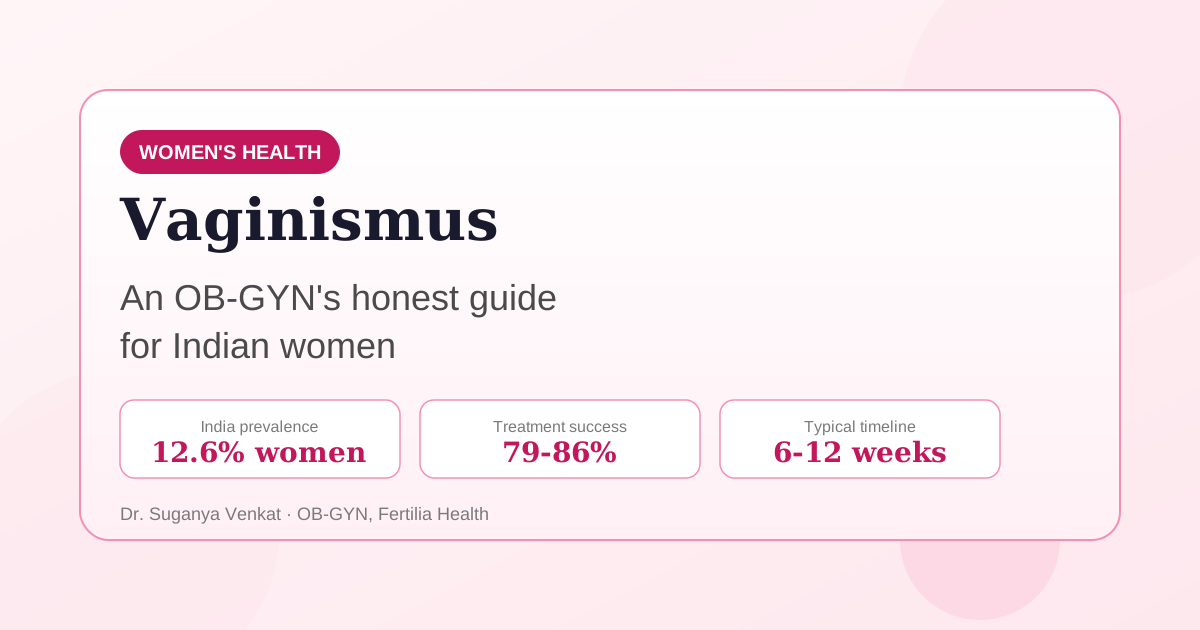
Maseroli and colleagues’ 2018 review analysed 43 observational studies involving 1,660 women separately from three randomised trials involving 264 women (PMID 30446469). The observational estimate was 79% completing penetrative intercourse (95% confidence interval 74-83%). That outcome did not necessarily mean pain-free intercourse. The estimate was 82% in the moderate- or strong-quality observational studies, not in a higher-quality trial subgroup. The lack of comparison groups limits what these results tell us about treatment effects. The separate randomised-trial analysis was imprecise and did not find a statistically significant difference from waiting-list controls.
Zulfikaroglu’s 2026 review included 18 studies with 863 participants and reported benefits across several treatment categories (PMID 41148166). Its authors concluded that integrated approaches appear promising. However, diagnostic criteria and outcome definitions varied. The pooled percentages are not a head-to-head demonstration that one approach is superior or equivalent to another, cannot predict an individual’s outcome, and do not provide a reliable personal recovery percentage from a severity grade.
What does research show about online treatment?
Guided online treatment has also been studied. A 2017 pilot trial compared an internet-based program with a waitlist, with written feedback from an eCoach. Some secondary penetration-related outcomes improved, but the primary between-group intercourse result was not statistically significant (PMID 28161080). A larger 2021 trial reported intercourse in 31 of 100 women receiving guided online treatment versus 13 of 100 waiting-list participants at 12 weeks. Pain and several other symptoms also improved. At six months, the proportions reporting intercourse were 29% and 20%, and that difference was no longer statistically significant (PMID 34843312).
Neither online trial compared treatment with face-to-face care. These findings do not establish equivalence, pain-free recovery for most women, or effectiveness of unsupported self-treatment. They are findings from specific research programs, not Fertilia’s own outcome data.
Recovery and partner support
Recovery can mean less pain, less fear, greater comfort with an examination, or the intimacy you want. Discuss what matters to you rather than accepting intercourse as the only measure. The Maseroli review calls for better outcome measures than penetrative sex alone.
The studies above do not establish one recovery timetable for everyone. A program’s scheduled duration should not be presented as a promised time to pain-free intercourse.
Ask how progress is reviewed, what happens if the plan needs changing and how further care would be arranged. Do not judge yourself against a size-by-week chart or someone else’s experience.
How a partner can help
The NHS makes partner involvement optional. If you want your partner involved, these are useful things to discuss together or with your clinician:
- Agree that stopping is respected. An invitation to touch is not permission to continue when it becomes painful or unwanted.
- Keep affection separate from a penetration attempt. Ask what closeness feels welcome without assuming it must lead to intercourse.
- Ask what support is wanted. Listening, making time for an appointment or giving privacy may be more useful than monitoring exercises.
- Avoid progress deadlines. Repeated questions about the next dilator size or when intercourse will happen can feel like an assessment rather than support.
- Join an appointment only by invitation. You can attend alone or ask for part of the conversation privately.
A partner should not insert a device, set your pace or treat pain as something to push past. If you feel pressured or unsafe, you can ask for an individual conversation about support; a joint session is not an obligation. These are consent and communication principles, not a promise that partner involvement will improve a measured treatment-success rate.
Vaginismus, fertility and finding care
Vaginismus can make intercourse difficult, but the diagnosis does not tell us whether other fertility factors are present. If pregnancy is your goal, raise it at the assessment rather than waiting to finish a vaginismus program. The ASRM’s 2021 committee opinion on fertility evaluation includes sexual dysfunction among reasons for timely evaluation and considers both partners when applicable.
Discuss how fertility assessment and sexual-pain care can be coordinated for your circumstances. Natural conception, IUI and IVF are not a hierarchy of personal success or failure, and no route or pregnancy timeline can be promised from a vaginismus diagnosis alone.
Online care in India and enquiries from abroad
Fertilia offers doctor-led online vaginismus treatment, with Dr. Suganya coordinating medical care, psychosexual support from psychiatrist Dr. Sandhiya Loganathan and pelvic-floor care from physiotherapist Dr. Maitri Daga. The service is structured over 12 weeks with follow-up; your treatment needs and progress are individual.
Fertilia consultations are online only; the team does not offer walk-in appointments. Local examination or hands-on care may be needed separately. If you are outside India, tell the team where you are physically located and confirm whether the proposed care can be offered there before booking. An international price does not establish eligibility in every country.
When comparing costs, ask for the included appointments, equipment, follow-up and separately arranged care in writing. The program page carries Fertilia’s current price. This overview does not estimate a universal total or how many sessions everyone needs.
Frequently Asked Questions
Is vaginismus permanent?
Treatment can help, but the studies cited here do not establish a universal pain-free recovery rate or deadline. The 79% figure in the 2018 review describes completion of penetrative intercourse in observational studies, not necessarily absence of pain (PMID 30446469). Improvement can be assessed against your own goals as well as symptoms.
Can I have vaginismus if I can use a tampon?
Yes, the difficulty can vary by activity. Being able to insert a tampon does not rule out a problem with intercourse, and difficulty with a tampon alone does not confirm vaginismus. Describe the different situations during assessment.
Why has penetration become painful after being comfortable before?
An acquired pattern may involve secondary vaginismus, another cause of pain, or both. Tell your clinician about dryness, childbirth or surgery, infections and changes in other symptoms. Do not assume a new problem is simply anxiety or the same as a previous episode.
Can vaginismus be diagnosed without a speculum examination?
Symptoms do not automatically require a speculum examination. History and other appropriate assessment may guide care. If any examination is declined or cannot be tolerated, discuss what remains uncertain and the alternatives. Difficulty tolerating an examination is not a stand-alone diagnostic test.
Can I treat vaginismus at home?
Guided home treatment has been studied, but this does not mean every woman can safely diagnose and manage the condition alone. The online trials used eCoach support and compared treatment with waiting lists, not face-to-face care (Zarski 2017, PMID 28161080; Zarski 2021, PMID 34843312). What support or examination you need is a separate clinical assessment.
How long does vaginismus treatment take?
There is no single timetable. A 12-week service package is not a guarantee of recovery in 12 weeks. Ask how your clinician will assess progress, adjust care and plan follow-up if symptoms remain.
Can I get pregnant with vaginismus?
Pregnancy is possible, but individual fertility factors and the difficulty with intercourse need consideration together. Raise your pregnancy goals early so appropriate fertility evaluation and vaginismus care can be planned without assuming one must finish before the other.
Asking about care
You can begin with the concern you have today, whether that is pain, an examination you are worried about, or difficulty with intercourse. Ask Dr. Suganya about an online assessment. This article is general information; your clinician can help work out which parts apply to you.