Many women send me this message on WhatsApp a day or two after their wedding: “Doctor, the first night was very painful and nothing happened. Is this normal?” They send it quietly, usually late at night, while the rest of the household assumes everything went smoothly.
It is one of the most common questions I receive from newly married women in India. And the answer matters enormously because the wrong response, “just try again, it gets better,” is only sometimes right. Other times it leads to months of repeated painful attempts, a growing dread, and a marriage where physical intimacy has become something to fear rather than seek.
So here is the honest OB-GYN answer: some pain or difficulty on the first attempt is common and usually resolves on its own. But a body that physically closes off, where penetration feels impossible and the fear increases with each attempt, is describing something entirely different. That is vaginismus, and it needs a different response entirely.
This post is part of Fertilia’s complete guide on vaginismus for Indian women. If you are arriving here for the first time, the full clinical overview is here.
💜 If that second pattern is the one that fits you, knowing early is good news. Vaginismus is common and very treatable, and starting sooner usually means a shorter, gentler path. Read on to tell the two apart, or if you would rather simply ask, message Dr. Suganya on WhatsApp. When you are ready, Fertilia’s online vaginismus treatment program walks you through it over 12 weeks, with a team beside you.
📘 Would you rather read about this privately first? You do not have to message anyone to begin. Download Dr. Suganya’s free 39-page guide, Navigating Vaginismus, and read it quietly, in your own time. It walks through what is normal, what is not, and the gentle path most women take. Get the free guide →
What Is Normal on the First Attempt?
The first attempt at penetration can involve discomfort. Here is what falls within the normal range.
Some friction or burning sensation. Vaginal lubrication takes time to build, especially when both partners are nervous. Inadequate arousal time is the single most common reason the first attempt is uncomfortable. The body is not broken. It simply has not had enough time or stimulation to prepare.
A small amount of bleeding. Not every woman bleeds, and the amount varies widely from person to person. But minor spotting from a small tear at the vaginal opening is not unusual. It should resolve within a few hours.
A feeling of tightness or unfamiliarity. The body does not automatically accommodate what it has not encountered before. Some initial tightness as the pelvic floor muscles learn to release is expected, particularly when anxiety is part of the picture.
Resolution within 2-3 attempts. With adequate time for arousal, sufficient lubrication, patience, and a calm environment, most women who experience first-attempt discomfort find that the second or third attempt is noticeably easier. The body learns. The muscles relax. The anxiety decreases as the unfamiliar becomes familiar.
If this describes your experience, and each attempt has been somewhat less uncomfortable than the last, your body is doing what it is designed to do.
When It Is Not Just a First-Time Adjustment
Vaginismus is different. It is not discomfort that softens with practice. It is the involuntary tightening of the pelvic floor muscles at the vaginal entrance, a reflex contraction that the conscious mind cannot override. Women describe it as hitting a wall. The body pulls back before you can stop it. The pain, if penetration is forced, is sharp and burning. Afterwards there is often a residue of fear about trying again.
For more on this, read our guide on Painful Sex After Delivery. The crucial difference between normal first-time adjustment and vaginismus is the direction of the trend. With normal adjustment, each attempt becomes a little easier. With vaginismus, the difficulty stays the same or increases. The fear that penetration is impossible grows. The anticipation of pain begins before anything has happened, sometimes hours before an attempt.
Vaginismus is only one of the reasons sex can hurt. If your pain does not fit the first-time picture at all, for example if it began after months or years of comfortable intimacy, or comes with burning, itching, or deep pain, our guide to why sex hurts and the full range of causes walks through the other possibilities and what helps.
5 Signs It Is Vaginismus, Not a First-Time Adjustment
These five questions help me distinguish the two in a consultation. Read through them honestly.
1. Tampons have never worked. Before your wedding, were you ever able to insert a tampon comfortably? If tampons have always been impossible or associated with significant pain, your vaginal muscles have been in a guarded state long before marriage came into the picture. The wedding night simply made the pattern visible in a new context. This is a meaningful clinical indicator.
2. The spasm is involuntary, and you cannot relax through it. You have heard the instruction “just relax.” You have tried. You breathe slowly, you consciously attempt to release the tension, and yet the muscles lock regardless. That involuntary quality - a reflex your will cannot override no matter how much you want it to - is the defining feature of vaginismus. It is not stubbornness or insufficient effort. It is a protective reflex operating below the level of conscious control.
3. It has gotten worse, not better, after several attempts. If you have attempted penetration three or four times and each attempt has been more frightening than the last, the trend is going in the wrong direction. The painful attempts themselves are adding to the protective response. The nervous system is learning that penetration equals pain, and it is tightening the guard accordingly. This is the mechanism by which waiting and trying harder makes things worse, not better.
4. Gynaecological exams have been impossible or very distressing in the past. A pap smear involves inserting a small speculum. If previous gynaecological exams have been extremely difficult, very painful, or had to be abandoned, this matters. Vaginismus does not discriminate between a medical instrument and a partner. If the speculum triggers the same involuntary spasm, that tells me a great deal about the underlying pattern.
5. Fear is escalating, not settling. With normal first-time unfamiliarity, anxiety around sex typically decreases as the unknown becomes known. With vaginismus, the anxiety tends to grow with each attempt. The anticipation of the next attempt fills the preceding days with dread. Intimacy as a concept becomes charged with fear rather than possibility. If your fear is increasing and not settling, that pattern itself is clinically significant.
If three or more of these describe your experience, I would not wait and hope it resolves on its own. Vaginismus is a treatable condition, and earlier treatment means a shorter and smoother path.
The Suhagraat Context - You Are Not the Only One
In India, the wedding night carries enormous cultural weight. Many families assume “it will happen naturally.” Some women have been told by older relatives that first-night pain is expected. Others have received no information at all, only the unspoken pressure to manage something no one has explained.
If your wedding night was painful and intercourse was not possible, and you are now dreading the next attempt, you are not alone. You are not failing at something others do effortlessly.
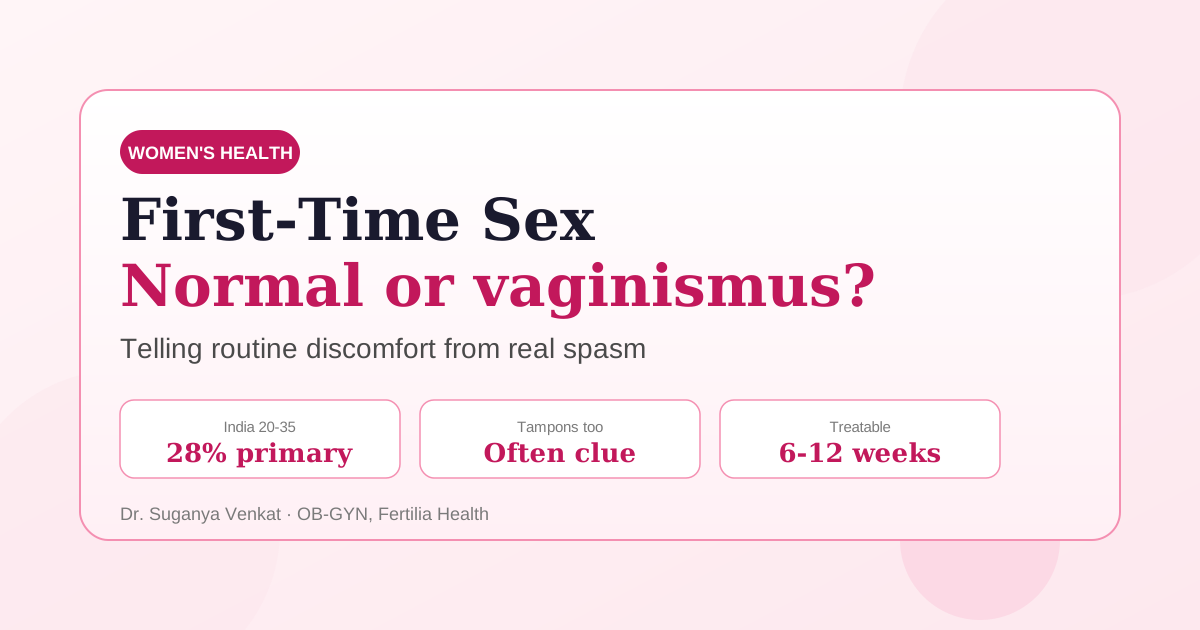
A hospital-based study in Belagavi, Karnataka, used a convenience sample of 160 married, sexually active women aged 20-35; 500 women had been approached. The authors reported 28% primary and 30% secondary vaginismus in that participating sample (Bulbuli & Kokate, Journal of South Asian Federation of Obstetrics and Gynaecology, 2024, DOI 10.5005/jp-journals-10006-2395). The selected sample and limited participation mean these figures cannot tell us how common vaginismus is among Indian women generally. You do not need a population statistic to justify asking for help with your own symptoms.
For more on this, read our guide on Period Pain (Dysmenorrhea). A larger population study of 84,644 currently married Indian women found that 12.6% reported persistent dyspareunia (pain during intercourse) (Padmadas SS et al., 2006, Journal of Sexual Medicine, PMID 16409224). The silence does not reflect the true prevalence. It reflects the shame that has been attached to the conversation. That shame is not yours to carry.
What to Do in the First Week
If the first few attempts have been painful and the pattern is not improving, here is what I recommend before your first consultation.
Stop trying to push through it. Every forced painful attempt trains the nervous system further into the protective reflex. Pausing intercourse for a few weeks while you seek proper support is not giving up. It is removing the source of re-sensitisation. Clinically, this is the correct decision.
Talk to your partner. This conversation is not easy, but it is necessary. Your partner does not need to understand vaginismus fully. They need to understand one thing: that this is not about them, it is not a choice you are making, and the path forward involves both of you. A partner who responds with frustration or pressure makes the condition worse. A partner who responds with patience is genuinely part of the treatment.
Begin gentle body familiarisation. Before any formal clinical protocol starts, the first step is becoming comfortable with your own body without performance pressure. Gentle perineal massage, warm baths, and slow diaphragmatic breathing directed towards the pelvic floor are starting-point techniques that reduce sensitisation. Step-by-step detail is in the 12-week home dilator protocol guide.
Contact a doctor soon, without waiting 6 months. The instinct is to give it more time, to try a few more times, to hope the next attempt will work. I understand that instinct completely. But the evidence says early treatment is easier treatment. The longer painful attempts accumulate, the more the protective reflex is reinforced. If the first 3-4 attempts have followed the pattern described above, that is the signal to seek help now, not later. If you are not sure who to approach, how to choose a vaginismus doctor in India explains what to look for, and what treatment typically costs is laid out step by step so the money question does not hold you back.
💬 You do not have to figure this out alone. If you are not sure whether what you are going through is ordinary first-time discomfort or something that needs a little support, you are welcome to simply ask me. It is one of the most common questions women bring to me, and no question is too small. Message Dr. Suganya
📘 Want the full picture in one place? Download Dr. Suganya’s free 39-page Navigating Vaginismus: Information, Support, and Recovery. It explains what is normal, what is not, and the structured path most women walk. Get the guide →
Prefer Instagram? Comment PAINLESS on any @fertilia.health post and we’ll DM you the guide directly.
What Not to Do
Do not push through pain. Every painful attempt reinforces the neural association between penetration and harm. Repeated painful intercourse is not treatment - it makes the condition harder to treat.
Do not accept “just relax” as a complete answer. If this is the third or fourth attempt that has felt impossible, being told to relax and try again is incomplete clinical guidance. The presentation of vaginismus is distinct from first-time unfamiliarity, and that distinction matters for what you do next.
Do not keep it from your partner. Suffering alone while performing normalcy creates a second layer of distress on top of the physical one. Your partner deserves to know.
Do not wait 12 months. Treatment at 12 months works - the research is clear. But treatment at 6 weeks is shorter, simpler, and involves far less accumulated fear. The door is open now.
The Fertility Timeline - You Have Time
When vaginismus becomes apparent in the first weeks of marriage, one of the earliest anxieties - especially in India - is about conception. If this is happening, how will we conceive? How long can this go on before fertility is affected?
Here is the answer: you have time.
A structured vaginismus treatment programme typically runs 8-12 weeks. Starting promptly means that within 3 months the condition is resolved and intercourse for conception is possible. Tracking your ovulation accurately now means that when treatment is complete, you will know exactly which days to target.
You do not need to have painful sex tonight to protect your fertility. For women whose timeline has specific pressures, alternatives exist - but most women reading this post do not need to go there yet. For the full picture: Vaginismus and Fertility: Can You Get Pregnant?
The Family Pressure Question
“When will you give us good news?” Some women face this question within weeks of their wedding. Sometimes within days.
If extended family, in-laws, or your own parents are asking about conception timelines, please hear this clearly: that conversation is not your obligation to have right now. You are not required to disclose what is happening with your body to anyone except your doctor and your partner. “We are enjoying married life and will let you know when there is news” is a complete sentence and it is enough.
The pressure to conceive quickly is real in many Indian families. It does not change the clinical reality: forcing painful attempts does not speed up the path to pregnancy. It lengthens it. The fastest path to conception is treating the underlying condition properly and completely, and then timing intercourse well.
If the pattern of failed attempts has persisted for longer than 6 months, the specific dynamics of unconsummated marriage in the Indian context - including how to think about longer timelines and what options exist - are addressed at Unconsummated Marriage: What Indian Doctors See and What Works.
What the Evidence Says About Treatment Outcomes
A systematic review and meta-analysis of 43 observational studies (n=1,660 women) and 3 randomised controlled trials found an overall treatment success rate of 79%, rising to 82% in the higher-quality studies (Maseroli E et al., 2018, Journal of Sexual Medicine, PMID 30446469). Critically, the review found that age, duration of the condition, whether it was primary or secondary, and partner involvement did not significantly predict outcome. Women treated early do well. Women treated after years of the condition also do well.
One of the fears that keeps women from seeking help is the feeling that they have waited too long. They have not. The door is not closed after 6 months or 2 years.
The treatment path most commonly used combines pelvic floor relaxation with progressive dilator therapy and, where needed, psychosexual support. Full detail in the 12-week dilator protocol. If you are unsure whether you have vaginismus or a different type of pelvic pain, the clinical distinction is explained at Dyspareunia vs Vaginismus: How Doctors Tell Them Apart.
Frequently Asked Questions
Does first-time sex hurt for every woman? No. Many women feel little or no pain the first time, especially with enough arousal, good lubrication, and a relaxed, unhurried setting. Others feel some stretching, burning, or tightness that eases over the next two or three attempts. What is not part of the normal range is pain severe enough to stop penetration, or pain that grows worse with each attempt rather than settling. That pattern points more toward vaginismus and is worth checking.
How many days does first-time sex pain last? For most women, soreness from a minor stretch or a small tear at the opening settles within a few hours to two or three days, and each later attempt is more comfortable than the last. If the pain is still the same or worse after several attempts over a couple of weeks, or a wall-like tightness keeps stopping penetration, that is no longer ordinary first-time adjustment and deserves a proper look.
Is it normal for the first time to be very painful? Some discomfort on the first attempt is common. Factors include lubrication that builds with adequate arousal time, unfamiliarity, and mild muscle tension. Normal first-time discomfort resolves within 2-3 attempts as the body relaxes into the experience. What is not within the normal range is pain that stays the same or worsens across attempts, a spasm that stops penetration completely, and fear that escalates rather than settling.
Why does first-time sex burn or sting? Most often because the tissues were not ready. Lubrication builds with arousal, and a nervous first attempt cuts that time short, so the skin at the opening drags and stings. A little burning that eases over the next two or three attempts is ordinary. Burning that stays the same or worsens, or comes with a wall-like tightness that stops penetration, points more toward vaginismus or a skin or infection issue, and is worth a check.
Is some bleeding and pain normal the first time? A small amount of spotting from a minor tear at the opening is common and usually settles within a few hours. Heavy bleeding, bleeding that recurs with every attempt, or pain sharp enough to make penetration impossible is not the ordinary first-time pattern and deserves a proper look.
What if tampons have never worked for me? This is an important clinical indicator. If you have never been able to insert a tampon without severe pain or complete inability to insert it, vaginismus or a closely related condition has likely been present since puberty, long before marriage. This is called primary vaginismus. It is very treatable. It also means the wedding night experience was not a failure - it was a predictable outcome that was never going to resolve on its own without the right support.
How long does treatment take? Most women complete a structured 8-12 week programme and achieve comfortable penetration within that timeframe. Progress is rarely linear - there are weeks of clear improvement and weeks that feel slower. Consistency with the home component is the single factor most under your control.
Should we try again before seeing a doctor? If the first two or three attempts fit the pattern described in this post (no improvement across attempts, involuntary spasm, escalating fear, or complete inability to achieve penetration), my recommendation is to stop attempts and seek a consultation before trying again. Repeated painful attempts that follow the vaginismus pattern are not practice. They are reinforcement of the reflex, and they make the treatment path longer.
Will vaginismus affect our ability to conceive? Vaginismus prevents the intercourse required for natural conception, but most women complete treatment within 8-12 weeks and can then time intercourse well. For women whose timeline has additional pressures, alternatives exist and are worth discussing with a gynaecologist. Full detail at Vaginismus and Fertility: Can You Get Pregnant?
What should I tell my partner? Tell them honestly: that there is a medical reason for the difficulty, that it is not their fault and not yours, and that there is a clear treatment path. Research on vaginismus consistently identifies partner response as one of the most important variables in treatment. A partner who understands is genuinely part of what makes treatment work.
If what you are feeling does turn out to be vaginismus, it is very treatable. Fertilia’s online Vaginismus Recovery Program walks you through it gently, over 12 weeks, with a team beside you.
💬 Whatever you are feeling right now, you are not broken and you are not the only one. If you would like to know whether what you are experiencing is normal first-time adjustment or something worth looking at more closely, a short message is enough to begin. No pressure, no judgement - just a doctor you can ask. Message Dr. Suganya on WhatsApp
Dr. Suganya Venkat - OB-GYN with 15+ years of clinical experience. DNB OB-GYN (GKNM, Coimbatore) · MD Pathology (CMC Vellore) · MBBS with 5 Gold Medals (SRMC).