You have been married 8 months. Or 14 months. Or 4 years. Intercourse has not happened. The questions from family have started, or stopped, or never came. The shame is real and it does not need to keep being yours.
I see couples in this situation every month. Some come at month eight, pushed by the first wave of conception pressure. Some come after three years, when the silence between them has grown heavier than the problem itself. Some arrive at year five, when one spouse has reached a private limit and the other finally agreed to try. All of them say the same thing when they sit down: “We thought we were the only ones.”
You are not. Unconsummated marriage is a medical presentation with documented causes and a very high treatment success rate. This post explains what I see clinically, what the evidence shows, and exactly what the next step looks like.
📘 Want to understand this privately, before any appointment? You do not have to explain anything to anyone yet. Download Dr. Suganya’s free 39-page guide, Navigating Vaginismus, and read it quietly, in your own time. It lays out the causes and the treatment path in one place. Get the free guide →
What Is Unconsummated Marriage?
The clinical definition is precise: unconsummated marriage (UCM) is the inability to have penetrative intercourse, despite attempts, in a couple who has consented to consummation. This is not a difficult honeymoon or a stressful wedding night. It is a pattern that persists across multiple attempts over weeks or months and does not resolve with more time alone.
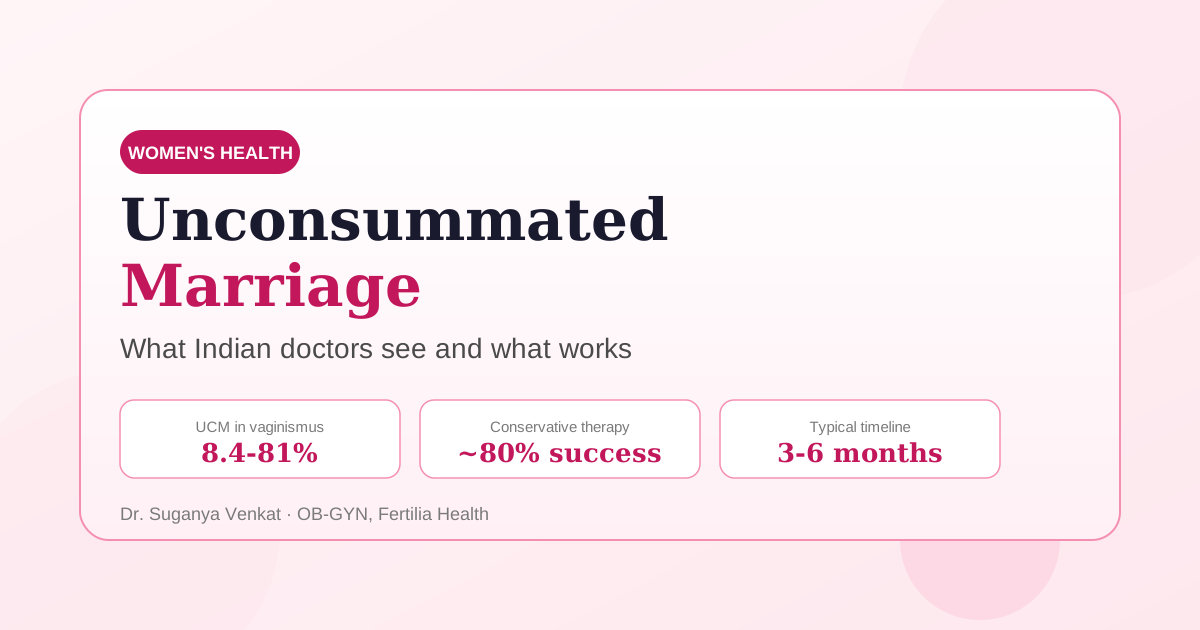
A systematic review by Krishnappa et al. (2023, Journal of Sexual Medicine, PMID 37952223) examined 27 case reports and case series on UCM. In eight studies that included both men and women, vaginismus accounted for 8.4% to 81% of the reported causes. The studies were of low-to-intermediate overall quality and were not population surveys. These figures describe the couples in those reports; they do not tell us how common UCM is in India. For more on what vaginismus is and how it works, start with the full guide: Vaginismus: Symptoms, Causes & Treatment in India.
The picture also includes the male side. Erectile dysfunction (ED) - the inability to achieve or maintain an erection sufficient for intercourse - is the leading male-side cause. Critically, in a significant proportion of couples, both factors coexist. One partner’s difficulty creates anxiety in the other. Over time, both contribute to the pattern. The Krishnappa et al. review reported contributions from both male and female factors in some cases, supporting an assessment that considers both partners. UCM is most accurately understood as a couple’s presentation.
When Indian Couples Come In - and Why They Wait
The timing follows a recognisable pattern. Most couples arrive in one of three waves.
Month 6 to 12. Conception pressure begins. Either the couple wants to start a family, or extended family has started asking. The urgency of “we should be pregnant by now” finally overrides the embarrassment of explaining why.
Year 2 to 3. Early hints have become explicit pressure. Family gatherings are uncomfortable. One or both spouses has been carrying the weight privately. The accumulated strain pushes them to seek help.
Year 5 or later. One partner has reached a quiet limit. The marriage has settled into something that functions logistically but not intimately. The other partner agrees to try because the alternative is clearer now.
All three presentations are valid. There is no “too late” for this. In the largest review of vaginismus treatment, how long the problem had been present did not significantly affect the outcome (Maseroli E et al., 2018, PMID 30446469), so a couple presenting at year five did not do worse in that analysis than one presenting in year one.
Why It Happens: The Causes That Matter
There is rarely a single cause.
For the female partner, vaginismus is by far the most common finding. The pelvic floor muscles tighten involuntarily at the anticipation of penetration, sometimes before any touch has occurred. This is not a choice and it is not a sign of not wanting the partner. It is a learned protective response the body has developed - sometimes from a specific trigger (a painful first attempt, a frightening medical procedure, prior trauma), sometimes with no traceable history.
For more on this, read our guide on Primary vs Secondary Vaginismus.
For more on this, read our guide on Painful Sex After Delivery. For the male partner, situational performance anxiety is the most common trigger for ED in UCM. This is different from the ED caused by cardiovascular or metabolic disease that we see more commonly in older men. In a young, otherwise healthy man, erection may be possible in other contexts but disappears when penetration is attempted. The body has learned to associate the attempt with failure.
In many couples, the two reinforce each other. She tenses. He notices and loses the erection. She wonders if it is her fault. He wonders if it is his. Neither says this aloud. The next attempt starts with more anxiety than the last.
Partnership factors can also be independent causes. Marriages where physical attraction is absent, or where both partners felt significant external pressure to marry, can present with UCM where neither has a diagnosable physical condition. The body does not cooperate with obligation. Naming this honestly is part of good clinical care.
What the Evidence Shows About Treatment
The numbers are encouraging, with one honest caveat. Across vaginismus generally, treatment led to successful intercourse in about 79% of women, rising to 82% in the better-quality studies (Maseroli E et al., Journal of Sexual Medicine, 2018, PMID 30446469, a systematic review of 43 observational studies and 3 RCTs, n=1,924). In the studies that specifically enrolled couples with an unconsummated marriage, the success rate was lower, about 68%, or roughly two in three. The review also found that age, how long the vaginismus had been present, whether it was primary or secondary, and whether the partner was involved did not significantly affect the outcome, and that no single approach was superior to the others.
A 2026 meta-analysis by Zulfikaroglu et al. (PMID 41148166, 18 studies, n=863) found similarly strong results: combined psychosexual therapy 86%, pelvic floor physiotherapy 85%, Botox 85%, and dilator therapy alone 78%. Multiple treatment pathways work. The best one is the one the couple follows through on.
For UCM specifically, the dilator protocol is the standard starting point for the female partner. The week-by-week guide is at Vaginismus Exercises at Home: The 12-Week Dilator Protocol. For the male partner, a urologist or sexual medicine physician evaluates the ED - usually through history and a structured questionnaire - and starts treatment if needed. In many cases, treating her vaginismus alone is enough: when penetration becomes possible, his situational anxiety resolves. When the ED is significant or long-standing, treating both simultaneously produces the best outcomes.
💬 You don’t have to navigate this alone. I discuss UCM with couples over WhatsApp every week. Message Dr. Suganya
📘 Want a guide you can read together as a couple? Download Dr. Suganya’s free 39-page Navigating Vaginismus: Information, Support, and Recovery. Section 8 is written specifically for the partner’s role in recovery, including what helps and what to avoid. Get the guide →
Prefer Instagram? Comment PAINLESS on any @fertilia.health post and we’ll DM you the guide directly.
A 4-Step Framework for What to Do Next
Step 1: Name it as a medical issue, together. When UCM is framed as a moral failure or as evidence that something is permanently wrong, the anxiety it carries compounds. The reframe - this is a recognised medical presentation with a known treatment pathway - changes how the couple relates to the problem. You are not broken. You have a condition. Conditions can be treated.
Step 2: Schedule the right appointments. For her: an OB-GYN who is comfortable with sexual medicine. The assessment is gentle and does not require a full internal examination if discomfort is severe - a good clinician evaluates only what is necessary. For him: a urologist or andrologist if ED is part of the picture. Some clinics in larger Indian cities now see couples together in a single sexual medicine consultation, which removes the logistical awkwardness of two separate referrals.
Step 3: Follow through on conservative treatment. The dilator protocol for vaginismus is home-based, private, and effective. It does not require hospitalisation or surgery. A structured 12-week program is the standard starting point. For situational ED, first-line treatment is typically oral medication combined with psychosexual support, and response rates are high. Counselling adds a meaningful layer for many couples - a therapist trained in sex therapy helps re-approach intimacy without the history of failed attempts pressing on every new one.
Step 4: Reassess at 3 to 6 months. Most couples see meaningful progress within this window. If penetration has been achieved, the focus shifts to making it consistent and comfortable. If significant barriers remain, second-line options - pelvic floor physiotherapy, Botox for refractory vaginismus, intensive couples therapy - are discussed with the treating clinician.
What NOT to Do
Do not wait for it to resolve on its own with more time. Vaginismus and anxiety-based ED both have a learned component. Time without intervention tends to reinforce the pattern, not dissolve it.
Do not use alcohol or attempt intercourse under pressure. Attempting penetration when either partner is uncomfortable adds a layer of negative association that the body does not forget. It does not treat the cause.
Do not assume one partner is at fault. This framing damages the relationship while leaving the medical problem untouched. UCM is a couple’s presentation. Both partners are assessed. Neither is to blame.
Do not begin IUI or IVF before addressing UCM. Both procedures require vaginal access. More importantly, UCM - not a fertility disorder - is why conception has not occurred. Treat the UCM first. Fertility workup comes after, if and when it is needed.
The Conception Conversation
If you are also worried about not being pregnant, I want to be direct: treating the UCM is the correct first step, and it usually resolves the fertility question.
Intercourse has not occurred, so conception has not been possible - this is not a fertility disorder. Once vaginismus or ED is treated and intercourse becomes possible, conception typically follows on a normal timeline for the couple’s age and health.
If you have been married more than two years and are over 30, a basic fertility assessment alongside UCM treatment is reasonable - not because something is certainly wrong, but because it gives you information while treatment is underway. The Honest Fertility Workup: An OB-GYN’s Indian Guide explains what that involves. IUI or IVF is the fallback for couples where fertility problems co-exist with UCM, not the starting point. You can also read Vaginismus and Fertility: Can You Get Pregnant? for the fuller picture on this specific question.
The Family Conversation
There is no obligation to disclose. Most couples don’t, and that is entirely reasonable.
If family pressure is adding to the anxiety - if questions about pregnancy have become frequent or explicit - a single non-specific response usually works: “We are working with a doctor on some health matters. We will share news when we have it.” This stops most lines of questioning without disclosure.
The support that actually helps tends to come from outside the family: a trusted friend who knows, a couples counsellor, or a clinician who has seen this presentation before.
The Legal Angle
UCM can be grounds for annulment in India under the Hindu Marriage Act, 1955. Section 12(1)(a) permits an annulment petition on grounds that the marriage has not been consummated owing to the impotence of the respondent.
I include this only because couples occasionally arrive having heard about it and wondering whether the medical or legal path is the right one. For the vast majority, the medical path is the right one. Treatment works. Marriages are saved. For a smaller number, where the marriage was not workable for reasons that extend beyond the physical, the legal route may eventually be relevant - and that is a decision for the couple and their legal counsel, not their gynaecologist.
The existence of a legal exit does not mean the medical path has failed, and taking the medical path does not close the legal option. They are independent of each other.
Where to Find Help in India
- OB-GYN with sexual medicine interest: the standard first appointment for the female partner. Ask specifically whether the clinic sees UCM couples and does dilator counselling. Not every gynaecologist has the time or the training for this.
- Urologist or andrologist: for the male partner when ED is prominent. Sexual medicine subspecialists in urology are available in Chennai, Mumbai, Bengaluru, and Hyderabad.
- Pelvic floor physiotherapist: increasingly available in metro areas. Adds significant value when vaginismus is severe or when the dilator protocol has stalled.
- Sex therapist or couples counsellor: the relational layer. CBT-trained sex therapists are available in person in most large cities and online across India.
Choosing among these providers is its own task. How to choose a vaginismus doctor in India covers what to ask and the red flags that signal an outdated approach, and vaginismus treatment cost in India breaks down what each step costs so you can plan.
If you are earlier in the story - if penetration has been painful or impossible from the very first attempt - First-Time Sex: Painful and Normal, or Vaginismus? is the right read before this one.
Frequently Asked Questions
How common is unconsummated marriage? The studies cited here cannot give a reliable population estimate. Krishnappa et al.’s UCM review (2023, Journal of Sexual Medicine, PMID 37952223) examined case reports and case series rather than a representative sample of marriages. Bulbuli and Kokate’s separate study was about vaginismus, not UCM prevalence: it reported rates of primary and secondary vaginismus in a hospital-based convenience sample of married women in Belagavi (Journal of South Asian Federation of Obstetrics and Gynaecology, 2024, DOI 10.5005/jp-journals-10006-2395). The two percentages describe separate categories rather than a range, and neither study tells us the proportion of Indian marriages that are unconsummated.
Does how long it has been affect treatment success? Not measurably. The Maseroli 2018 systematic review (PMID 30446469) found that the duration of vaginismus did not significantly affect treatment outcome, so couples presenting at year four or five did not do worse in that analysis than those presenting in the first year.
Do both partners have to attend appointments? Not always at the outset, but treatment is more effective when both are involved. If the male partner has ED as part of the picture, he needs his own evaluation. A shared understanding of the treatment plan reduces the anxiety both partners bring to every attempt.
Will the doctor just tell us to relax? A gynaecologist trained in sexual medicine will not. “Just relax” is not a treatment for vaginismus. The muscular spasm is involuntary - advising someone to relax their way through it is like advising someone to relax through a leg cramp. Effective treatment is a graduated desensitisation program with dilators, and in some cases physiotherapy or medication.
How is unconsummated marriage treated? Treatment depends on the underlying cause. When the female-side cause is vaginismus (the most common female-side reason), the standard ladder is graded dilator therapy plus pelvic floor down-training, with psychosexual support if anxiety is a major driver, effective for about two in three women in studies of unconsummated marriage, and around 80% across vaginismus more broadly (Maseroli E et al., 2018, PMID 30446469). That review did not measure how long treatment takes; in my practice it is typically 8 to 12 weeks. When the male-side cause is ED, a urology assessment guides treatment. Where both partners contribute, both are evaluated and treated in parallel. Surgery is rarely needed. The first step is a consultation with a clinician who treats vaginismus and ED routinely; from there the plan is built around what your specific examination shows.
Is surgery ever needed? Rarely as a first step. The 12-week dilator protocol achieves intercourse in the large majority of vaginismus cases. Botox injections are usually reserved for severe or treatment-resistant cases; across the studies that used botulinum toxin, the Zulfikaroglu 2026 meta-analysis (PMID 41148166) found a pooled success rate of 85%, and most protocols do not require general anaesthesia. Surgical options exist but are not the standard first-line approach.
How much does treatment cost in India? For most couples, far less than the packages advertised online. The conservative pathway that resolves vaginismus in the large majority of cases (a consultation, a dilator set, and some guided physiotherapy) usually totals under Rs 25,000, and often under Rs 15,000. Botox, the expensive end of the ladder, is rarely needed. The full step-by-step breakdown is in vaginismus treatment cost in India.
What if only one of us wants to seek help? The partner who is motivated can start. For the female partner, beginning the dilator protocol and having a consultation provides information and a path forward regardless of the other partner’s immediate involvement. For the male partner, a urologist’s evaluation is independent. Often one partner’s progress creates enough change in the dynamic that the other becomes more willing to engage.
When vaginismus is the barrier, it is usually very treatable. Fertilia’s online vaginismus treatment in India works through it gently over 12 weeks, with a handoff to the fertility team afterward if conception is the goal.
💬 If this is describing your marriage, you do not have to keep carrying it alone. I am a WhatsApp message away. Message Dr. Suganya