If you have searched for vaginismus treatment in India recently, you have almost certainly encountered hospital pages and advertisements presenting Botox as the answer. The framing is appealing: one appointment, a simple injection, and the muscles relax. The price tag, somewhere between Rs 30,000 and Rs 60,000, sounds reasonable if you have been struggling for years.
Here is what the evidence actually shows. Botox does work for vaginismus. The 85% success rate you will read about is real and comes from published research. But it is a grade 3 to 4 intervention on the Lamont classification scale, used after conservative therapy has been given a genuine trial. When Botox is used as a first step, before dilator training or pelvic floor physiotherapy, it produces temporary relief without addressing the underlying neural pathway that drives the spasm. The muscles return to their previous state within three to six months. Without the learning that conservative therapy builds, many women find themselves back at the beginning.
This post explains the mechanism, the grading system, what the evidence base actually looks like, and the questions you should ask before agreeing to an injection.
What Botox Does (and Does Not Do) for Vaginismus
Botulinum toxin type A temporarily blocks the release of acetylcholine at the neuromuscular junction. When injected into a muscle, it prevents the nerve signal that causes that muscle to contract. The effect is not permanent: the nerve terminal regenerates, and full muscle function returns within three to six months.
In vaginismus, Botox is injected into the bulbocavernosus and, depending on the clinical picture, the puborectalis muscles at the vaginal opening. The goal is to reduce the resting tone of these muscles enough that dilator training can begin without the reflexive spasm blocking progress. The injection creates a therapeutic window.
This is the key distinction that hospital marketing tends to skip. Botox reduces the physical barrier. It does not change the learned fear-spasm-pain cycle that has often developed over months or years of attempted and failed penetration. A woman who receives Botox without concurrent dilator training and psychological support will, in most cases, find that when the Botox wears off the spasm returns.
Pacik and Gruber (2017, Journal of Sexual Medicine, PMID 28363809) followed 241 women treated for vaginismus with a protocol combining Botox injection with immediate post-injection progressive dilator therapy. Their data showed that outcomes were significantly better when the injection was followed by structured dilator work, and that the combination, not injection alone, was what produced lasting results. Botox creates the opening. Structured therapy fills it with learning.
The Lamont Grading System
Vaginismus is graded using the Lamont classification, which describes what happens during attempted examination or penetration.
Grade 1: Perineal and vaginal spasm that can be relieved with reassurance during examination. The woman retains some voluntary control over the response.
Grade 2: Perineal and vaginal spasm that persists throughout the examination despite reassurance. Introital tension is present but examination remains possible with patience.
Grade 3: Buttock elevation. The pelvic floor contracts and the pelvis lifts away from the examining table. Examination is difficult.
Grade 4: Withdrawal reaction. The woman moves away from the examining hand or speculum, adducts the thighs, and may become distressed during attempted examination.
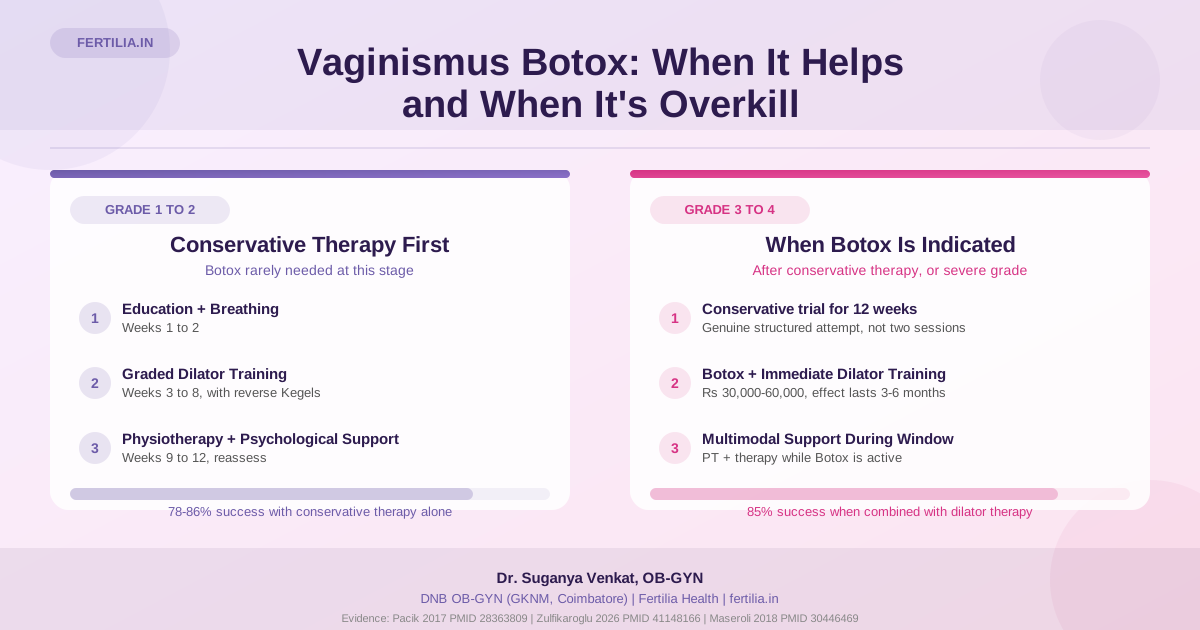
Grade matters for treatment planning. For grade 1 and grade 2 presentations, conservative therapy with dilator training, pelvic floor physiotherapy, and psychological support typically resolves vaginismus without procedural intervention. The evidence for conservative therapy is strong.
Zulfikaroglu et al. (2026, PMID 41148166), a systematic review and meta-analysis covering multiple treatment modalities, reported combined psychosexual therapy at 86% success, pelvic floor physiotherapy at 85%, and structured dilator programs at 78%. These results are comparable to Botox’s 85%, and conservative approaches address the underlying drivers rather than creating a window for that work to happen in.
Botox is a reasonable option from grade 3, or in grade 2 cases where a fair, consistent trial of conservative therapy has not produced adequate progress. There is no fixed number of weeks that defines that point for every woman. That phrase, “genuine trial,” still matters: two sessions with a physiotherapist or a few attempts with dilators before requesting an injection is not the same as a structured, sustained program.
What the Evidence Actually Shows
The 85% figure for Botox comes from Zulfikaroglu et al. (2026, PMID 41148166) and refers to outcomes within multimodal treatment protocols that included injection as one component alongside dilator training and psychological support. It is not a standalone injection statistic.
The published evidence base for Botox in vaginismus, while consistently positive, is of moderate quality. Large-scale randomised controlled trials are limited. A 2023 systematic review by Parenti et al. (PMID 38353087) examined botulinum toxin injections in the vulva and vagina across multiple conditions and noted that while clinical outcomes are generally favourable for pelvic floor hypertonicity, the evidence for vaginismus specifically is dominated by observational series and smaller prospective studies rather than high-quality RCTs.
This does not mean the treatment is ineffective. It means the evidence for conservative therapy, particularly structured dilator programs (Zarski et al. 2017, PMID 28161080) and combined psychosexual approaches, is supported by stronger controlled trial designs. These treatments are recommended as first-line partly because their evidence base is more robust.
Maseroli et al. (2018, PMID 30446469) described a multimodal approach in which conservative therapy preceded procedural intervention and reported that 79% of women achieved pain-free penetration. The multimodal sequence, timed correctly, produced better outcomes than any single modality in isolation.
💬 Questions about treatment options? Dr. Suganya sees vaginismus patients across India via telehealth. The first step is a private conversation. Message Dr. Suganya on WhatsApp
📘 Want the full treatment ladder in one place? Download Dr. Suganya’s free 39-page Navigating Vaginismus: Information, Support, and Recovery. Section 7 covers the full conservative-first treatment ladder, including when Botox fits and when it doesn’t. Get the guide →
Prefer Instagram? Comment PAINLESS on any @fertilia.health post and we’ll DM you the guide directly.
The Conservative Pathway That Should Come First
Evidence-based guidelines from ISSVD (International Society for the Study of Vulvovaginal Disease) and clinical practice across tertiary centres recommend conservative therapy as the starting point for vaginismus at any grade. The pathway, in practical terms, looks like this.
Weeks 1 to 2 are focused on education and pelvic floor awareness. Understanding what vaginismus is, why the spasm happens, and what it is not (not a structural abnormality, not a permanent condition, not a sign of disease). Breathing exercises, perineal massage, and gentle familiarity with the anatomy reduce the anticipatory fear that amplifies the spasm. Many women experience a measurable reduction in anxiety at this stage alone.
Weeks 3 to 8 involve graded dilator training. Beginning with the smallest size that is comfortable and progressing when the body is ready. Reverse Kegels and pelvic floor relaxation techniques are central to this phase. The muscles need to learn to release, and that learning takes consistent repetition, not force. Reverse Kegels and pelvic floor down-training are explained in detail in the accompanying post.
Weeks 9 to 12 involve integrating dilator progress with partner involvement where relevant, addressing the fear-spasm cycle through psychological support, and reassessing readiness for attempted penetration.
If a genuinely structured conservative program has been given a fair, sustained trial and severe spasm still blocks progress, Botox is a clinically appropriate next step. The injection is not a failure of the conservative pathway. It is a tool that removes the physical barrier when the barrier is too strong for voluntary relaxation to address alone. What is not supported by the evidence is Botox as the first appointment, scheduled before any dilator training or physiotherapy has been attempted.
Costs, Duration, and What the Procedure Involves
In India, Botox for vaginismus typically costs between Rs 30,000 and Rs 60,000 per session. The range reflects the number of units used, the clinic setting, and whether local or general anaesthesia is chosen. Most procedures take less than thirty minutes. Recovery is generally straightforward.
The effect lasts three to six months. During that window, the injected muscles cannot generate the same degree of reflexive spasm. This is when structured dilator training must happen. If the Botox window is used for consistent therapy, the neurological learning that occurs during those months can persist after the Botox clears. This is the mechanism by which Botox can produce lasting change. It depends entirely on what happens during those months.
If the window is not used for structured training, the spasm typically returns when the Botox wears off. A second injection may be offered at the same cost, and the same cycle repeats.
This cost-benefit calculus is worth thinking through. A full conservative pathway, including dilator set, pelvic floor physiotherapy, and psychological support, typically costs less than Rs 25,000 in total. If conservative therapy resolves vaginismus, no injection is needed. If it does not, Botox follows a pathway that has already established the dilator training necessary to make the injection effective. Skipping conservative therapy to go directly to Botox saves neither time nor money over a twelve-month horizon for most women.
Questions to Ask Before Agreeing to Botox
If a doctor or clinic is recommending Botox at your first or second visit, these questions are worth asking before you agree.
Have I had a genuine trial of conservative therapy? If you have not attempted a structured dilator program with physiotherapy guidance, ask whether starting there first would be appropriate.
What is my Lamont grade? If this has not been discussed, ask. Grade 1 and 2 typically responds to conservative therapy without injection. Grade 3 and 4, or grade 2 that has genuinely not responded to conservative therapy, is the more supported indication for Botox. The grade informs the decision rather than deciding it, and there is no fixed number of weeks that defines a failed conservative trial.
What is the plan after the injection? If the protocol does not include dilator training and physiotherapy during the three to six months the Botox is active, the results are unlikely to be lasting. Ask for a structured follow-up plan.
Does your practice offer the full multimodal pathway? Some clinics can provide or coordinate the complete care pathway, including physiotherapy and psychological support. Others offer injection and discharge. The difference in outcomes is significant.
What does the procedure involve? Local vs general anaesthesia, number of units, injection points, post-procedure care instructions, and what to expect in the first few days.
These are not difficult questions. Any evidence-based practitioner will welcome them.
Collaborative Care: The Three-Part Team
Vaginismus responds best to coordinated care across three disciplines.
The gynaecologist assesses severity, rules out other causes of painful penetration (vulvodynia, endometriosis, pelvic inflammatory disease, hormonal atrophy from breastfeeding or menopause), and manages procedural interventions like Botox when the indication is clear. The honest OB-GYN guide to vaginismus covers the full diagnostic picture.
The pelvic floor physiotherapist guides dilator training, teaches reverse Kegels and down-training techniques, and provides manual therapy for muscle release. For women who cannot access in-person physiotherapy, structured home dilator programs with remote guidance are a validated alternative. Zarski et al. (2017, PMID 28161080) demonstrated that internet-supported self-therapy for vaginismus achieved outcomes comparable to in-person physiotherapy.
The psychologist or sex therapist addresses the fear-spasm-pain cycle, trauma history if present, relationship factors, and the anxiety that has often accumulated over years of attempted penetration. Unconsummated marriage and the psychological dimension is covered separately if that context applies.
No single practitioner covers all three dimensions well. A gynaecologist who only does injections, a physiotherapist without medical coordination, or a therapist without connection to the physical treatment team will each produce partial results. Coordinated care across all three produces the most durable outcomes, and that coordination can happen via telehealth if geography is a barrier.
A Note on Collaborative Framing
Hospital chains that lead with Botox are not practising bad medicine. Botox is an effective tool and a legitimate clinical option. The concern is not with the treatment but with sequencing: when women with grade 1 to 2 vaginismus are offered injection before conservative therapy, they are being offered a more expensive, more invasive step first, when a cheaper, well-evidenced pathway would likely produce the same result or better.
The goal of this post is not to criticise any particular practitioner or institution. It is to give you the information needed to ask the right questions and understand what clinical guidelines actually recommend. If Botox is right for you based on your grade and treatment history, it is a good option. If it is being offered before conservative therapy has been tried, knowing that gives you the foundation to ask why.
Botox sits late on the treatment ladder. Most women resolve vaginismus with the conservative, structured work that comes first, which is exactly what Fertilia’s structured online vaginismus treatment is built around.
💬 Ready to understand your specific situation? Dr. Suganya offers telehealth consultations for vaginismus and painful intercourse across India. A structured conversation can clarify whether conservative therapy, Botox, or a combination is the right starting point for you. WhatsApp Dr. Suganya
Frequently Asked Questions
How much does vaginismus Botox cost in India?
A single Botox session for vaginismus typically costs Rs 30,000 to Rs 60,000 in private practice, including the injection, the clinician’s fee, and the anaesthesia (local or short general). The wide range reflects the dose used, whether it is done in a clinic or hospital setting, and the city. Conservative therapy that resolves vaginismus in the large majority of women, consultation, dilator set, and physiotherapy, typically totals under Rs 25,000 and often under Rs 15,000; the full step-by-step breakdown is in vaginismus treatment cost in India. Botox is the expensive end of the ladder, not the starting point.
Is Botox for vaginismus safe?
Yes. Botulinum toxin type A is a well-established agent used in multiple medical specialties. Serious adverse events in the context of vaginismus injections are uncommon. The most frequently reported side effects are temporary local discomfort, bruising, and in rare cases temporary urinary symptoms if the injection affects muscles near the urethra. These resolve as the Botox clears over subsequent weeks.
Does the vaginismus injection hurt?
Most procedures are done under local or short general anaesthesia. The injection itself is not painful when anaesthesia is adequate. Post-procedure discomfort is typically mild and resolves within twenty-four to forty-eight hours. Most women return to daily activities the same day or the following day.
How many Botox sessions are needed for vaginismus?
For women who combine the injection with structured dilator training during the active period, a single session is often sufficient for lasting improvement. Women who receive Botox without concurrent therapy are more likely to need repeat injections when the effect wears off. There is no fixed number of sessions; the deciding factor is whether the treatment window is used productively.
Can Botox cure vaginismus permanently?
Botox creates a temporary window, not a permanent cure. Whether that window leads to lasting resolution depends on the dilator training and psychological work that happens during it. Women who use the Botox period to build consistent dilator progress and address the fear dimension often achieve outcomes that persist after the Botox clears. The treatment, not the injection alone, is what produces lasting change.
Is Botox for vaginismus available in government hospitals in India?
It is not routinely available in government hospital settings. Botox for vaginismus is primarily a private-sector intervention. Dilator training, pelvic floor physiotherapy, and psychological support are all accessible at lower cost and are effective for most women without requiring a hospital setting.
I have been doing dilators for twelve weeks without progress. Should I consider Botox?
If you have followed a genuinely structured twelve-week dilator program with consistent effort, progressing through sizes as tolerated, and remain unable to advance, yes. This is precisely the indication Botox is supported for. A consultation with a gynaecologist experienced in vaginismus would be the appropriate next step to assess your Lamont grade and discuss sequencing.
My doctor recommended Botox at my first appointment. Should I be concerned?
Not necessarily, but ask the questions listed above. If your presentation is grade 3 to 4, if you have already attempted conservative therapy, or if there are specific clinical reasons why conservative therapy is not appropriate for you, a Botox recommendation at a first visit may be justified. If none of those factors apply, asking about a conservative pathway first is reasonable, and a second opinion is always within your rights.
Related reading: The 12-week dilator protocol for vaginismus | Dyspareunia vs vaginismus: how doctors tell them apart | Painful sex after delivery