You finally have a name for what you have been experiencing. You know it is vaginismus. Now you are searching for a doctor who actually understands it.
This is where many Indian women get stuck. Vaginismus is documented in gynaecological textbooks, but not every clinic has the training, the time, or the team to treat it well. Some women spend years cycling through appointments where they are told to “just relax,” given lubricants, or pushed toward procedures without a proper assessment. Others find a doctor who understands the condition, treats it conservatively, and sees real results within a few months.
A historical Indian survey of 84,644 currently married women found that 12.6% reported pain during intercourse. The data were collected in 1998-1999 and published by Padmadas and colleagues in the Journal of Sexual Medicine in 2006 (PMID 16409224). This measured dyspareunia, not vaginismus prevalence. It should not be presented as a current estimate of vaginismus in India.
This post gives you the questions to ask before committing to a provider, the red flags that suggest an outdated approach, and a clear picture of what a proper first consultation should involve.
What this post covers:
- Why vaginismus needs a specific approach, not just any gynaecologist
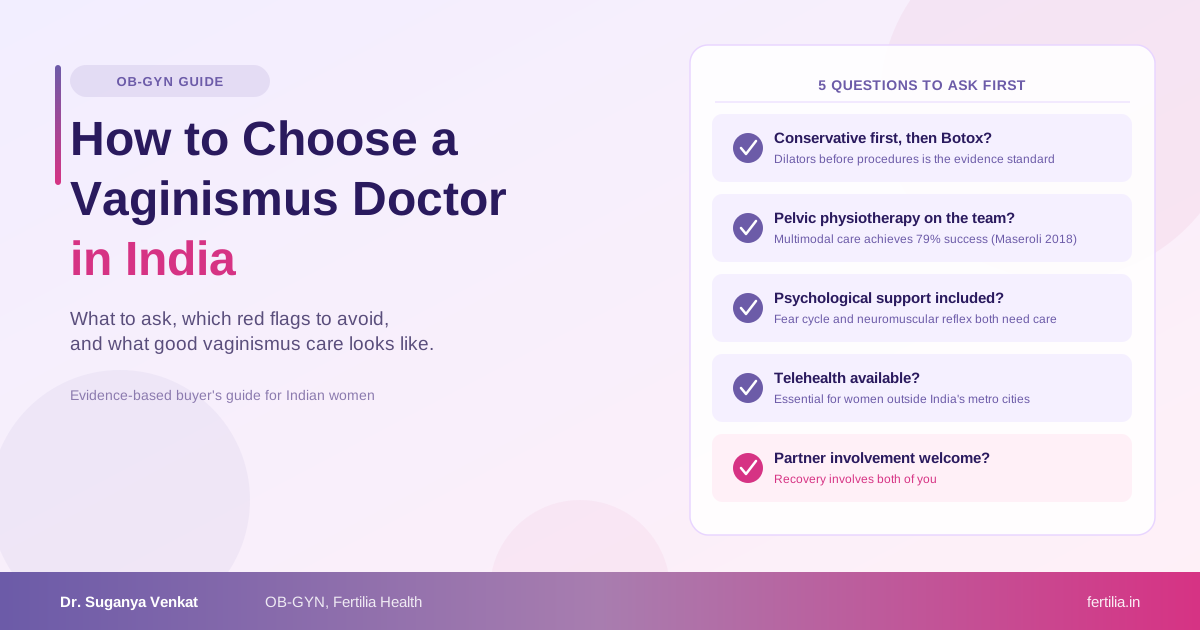
- Five questions to ask before your first appointment
- Signals that should prompt a second opinion
- What a good first consultation actually involves
- The role of pelvic physiotherapy and psychological support
- Telehealth as a genuine option for women outside metros
Why Vaginismus Needs a Specific Approach
Most OB-GYN training focuses on obstetrics, surgical procedures, reproductive endocrinology, and systemic conditions. Sexual pain disorders receive limited attention in postgraduate curricula, which means that some practitioners are genuinely well-prepared to manage vaginismus while others will default to approaches that do not work: dismissing the condition as anxiety, prescribing lubricants without assessing the muscle component, or recommending procedures before attempting conservative therapy.
The field has also moved forward significantly. The DSM-5 (2013) merged vaginismus and dyspareunia into a unified category called genito-pelvic pain/penetration disorder (GPPPD), reflecting evidence that the two conditions overlap in most patients. Clinicians working with an older framework may not recognise that vaginismus has both a neuromuscular component (the involuntary pelvic floor spasm) and a psychological component (the anticipatory fear that sustains the reflex) that both need to be addressed.
What this means practically: the question is not whether a doctor is qualified. The question is whether their approach to vaginismus matches what the current evidence supports. You can assess this before your first appointment.
Five Questions to Ask Before Booking
You do not need to wait for a consultation to evaluate a provider. A phone call to the clinic coordinator, a WhatsApp message, or a short email can give you enough information to decide whether the approach is a good fit.
“Is your first-line treatment conservative, or do you recommend Botox early?”
The evidence-based starting point for grade 1 to 2 vaginismus is a progressive dilator program combined with pelvic floor physiotherapy and psychological support. Botox is a grade 3 to 4 intervention, used when a fair, consistent trial of conservative therapy has not produced adequate progress; there is no fixed number of weeks that defines that point for every woman. A 2026 systematic review by Zulfikaroglu reported benefits across several treatment categories, but the included studies used different diagnostic criteria and outcome definitions (PMID 41148166). Their pooled rates do not establish equivalent outcomes. It is one tool among several. A clinic that recommends it in the first consultation, before a structured conservative trial, is skipping steps that the evidence supports.
“Do you work with a pelvic floor physiotherapist?”
Vaginismus is primarily a neuromuscular condition. Pelvic floor physiotherapy (a specialised field distinct from general physiotherapy) involves assessment and progressive manual techniques to desensitise the pelvic floor and retrain the reflex. Maseroli and colleagues’ 2018 review estimated that 79% of women in observational studies completed penetrative intercourse after treatment (PMID 30446469). The studies used different therapies, and this outcome did not necessarily mean pain-free intercourse. The result does not establish that a multidisciplinary program is superior to a single-specialty approach.
A good vaginismus practice either has a pelvic floor physiotherapist on the team or has a clear referral pathway to one. If the answer is “we don’t usually involve physio,” that tells you something important about how the treatment is structured.
“Is psychological support part of the program, or an optional add-on?”
Vaginismus involves both a neuromuscular reflex and a psychological component: anticipatory fear, learned avoidance, relationship dynamics, and cultural messaging about sex all shape the cycle of spasm and withdrawal. A multidisciplinary review by van Lankveld and colleagues (2010, Journal of Sexual Medicine, PMID 20092455) supports comprehensive assessment of both components. Psychological approaches such as CBT and mindfulness can support treatment by addressing anxiety, the fear-pain cycle and body awareness; they are potentially helpful components rather than universal requirements.
A practice that addresses only the physical component, without any provision for the psychological side, will typically produce slower results or see relapse once treatment ends. This does not mean you need a full-time psychiatrist embedded in the team. It means there should be some provision: a referral pathway to a psychologist with sexual health experience, a sex therapist, or at minimum, structured education about the fear-pain cycle that you can work through independently.
“Can my partner be involved in the treatment?”
Vaginismus affects both partners. A partner who understands the condition and the treatment process (and who is not inadvertently creating pressure around milestones) is a meaningful part of recovery. Van Lankveld et al. (2010) noted that partner involvement in therapy is associated with better outcomes. Ask whether the clinic provides anything for partners: a joint session, printed guidance, or a video resource. The specific format matters less than whether the practice sees it as relevant at all.
“Do you offer telehealth consultations?”
This matters especially in India, where pelvic-floor-aware gynaecological care is concentrated in a small number of cities. The initial assessment, treatment planning, education about the dilator protocol, and ongoing check-ins during the treatment phase are all manageable via video or phone. The 2017 Zarski trial tested guided online treatment against a waitlist, not against face-to-face treatment; its primary between-group intercourse result was not statistically significant (PMID 28161080). A larger 2021 trial found benefits at 12 weeks, including improvements in pain and a greater proportion reporting intercourse, although the intercourse difference was not statistically significant at six months (PMID 34843312). Neither study establishes equivalence to in-person care.
Looking for an OB-GYN who treats vaginismus with a structured, evidence-based approach? Dr. Suganya Venkat consults via WhatsApp from anywhere in India. Message her now and she will tell you what the right next step looks like for your situation. Start a conversation
📘 Want a complete reference to bring to any consultation? Download Dr. Suganya’s free 39-page Navigating Vaginismus: Information, Support, and Recovery. It gives you the vocabulary and the questions to ask any clinician you evaluate. Get the guide →
Prefer Instagram? Comment PAINLESS on any @fertilia.health post and we’ll DM you the guide directly.
Signals That Suggest a Second Opinion
These are not intended as a list of bad doctors. They are patterns that suggest an approach that is either outdated or not matched to the current evidence for vaginismus care.
Botox or surgery as the opening recommendation. These are later-stage interventions that follow a genuine conservative trial. If they are recommended at the first consultation without discussion of a structured 8 to 12 week protocol first, it is reasonable to ask why conservative therapy is being skipped and what evidence supports that particular sequencing.
“You just need to relax and try harder.” Vaginismus is an involuntary reflex. The levator ani and related muscles contract without the woman’s conscious control, often against her explicit intention to relax. A provider who frames the condition as purely a relaxation failure has not engaged with the neuromuscular mechanism.
“This is psychological, not physical.” Vaginismus is classified as a medical condition in both DSM-5 and ICD-11. Psychological factors contribute to it and deserve clinical attention, but they do not mean the physical component is absent. The most effective treatment addresses both together, not one instead of the other.
A consultation too brief for a proper history. A genuine vaginismus assessment covers the reproductive and sexual history, the circumstances in which pain occurs, whether any penetration (tampons, self-examination, gynaecological exams) has ever been possible, the relationship context, and a physical examination conducted at the woman’s pace with her consent. This takes time. A seven-minute appointment that ends with a prescription or procedure plan is not a complete assessment.
No mention of pelvic physiotherapy or the dilator protocol. A treatment plan that does not reference either of these, for any grade of vaginismus, is missing the core components of evidence-based care. The 12-week dilator protocol is the standard conservative pathway. Physiotherapy is the multimodal addition that improves outcomes. Both should appear somewhere in the plan.
What a Good First Consultation Looks Like
A thorough first consultation for vaginismus typically covers the following.
A detailed history. The doctor asks when the problem started, whether it was always present or developed after a period of pain-free penetration (a distinction that shapes the treatment approach), what has been tried before, and whether there are associated symptoms like vulvar burning, deep pelvic pain, or urinary urgency.
A respectful physical examination. For vaginismus specifically, experienced practitioners conduct the examination slowly, explaining each step, allowing the woman to direct the pace, and stopping when she indicates discomfort. The goal is not to override the spasm. The goal is to observe the involuntary reflex, assess the degree of pelvic floor involvement, and classify the presentation using the Lamont grading system (grade 1: spasm present but controllable on examination; grade 4: complete avoidance, no examination possible). Grade 3 and 4 presentations may not have a full internal examination in the first appointment.
A treatment plan specific to your situation. This means a plan that reflects your Lamont grade, your goals (whether that is pain-free intimacy, conception, or pelvic examination tolerance), your access to pelvic physiotherapy, and your relationship circumstances. A treatment plan should name specific steps and a realistic timeline. A generic handout is not a plan.
Honesty about what to expect. Most women with grade 1 to 2 vaginismus who complete a structured 12-week program report significant improvement. Grade 3 to 4 presentations take longer but respond to the same conservative pathway. Your provider should be able to describe what the process involves and what progress looks like at each stage.
Finding Care Across India
Pelvic-floor-aware gynaecological care is most consistently available in Bengaluru, Chennai, Mumbai, Delhi, Hyderabad, and Pune. In Tamil Nadu, Coimbatore and Madurai have private clinic networks where sexual pain presentations are seen regularly. Outside these cities, availability varies.
Online directories like Practo and Lybrate list gynaecologists by specialty but do not filter by vaginismus experience. Searching a consultant’s name and reading patient reviews for mentions of “sexual pain,” “pelvic floor,” or “painful intercourse” gives more useful signal than directory tags.
For women outside metros, a telehealth consultation for the assessment, treatment planning, and dilator protocol guidance, combined with a referral to a local physiotherapist for hands-on work where one is available, is an effective model. The guided online trials cited here used waiting-list comparators; they do not establish that online and in-person treatment are equally effective.
Dr. Suganya Venkat at Fertilia conducts telehealth consultations for women across India, and runs a structured online vaginismus treatment program for women who want medical, psychosexual, and pelvic floor support coordinated in one plan. An initial WhatsApp conversation before a formal appointment allows you to describe your situation and understand the approach before committing. If cost is part of the decision, vaginismus treatment cost in India breaks down what each step of care typically costs.
Frequently Asked Questions
Can a general gynaecologist treat vaginismus, or do I need a specialist?
Yes, many general gynaecologists treat vaginismus effectively, especially grade 1 to 2 presentations. What matters is whether the practitioner uses a conservative-first approach with dilators, pelvic physiotherapy, and attention to the psychological component. A formal “sexual medicine specialist” label is not required. If your current gynaecologist is knowledgeable, supportive, and using evidence-based methods, you do not need to seek anyone else. If you have been dismissed or given unhelpful advice, a second opinion is reasonable.
What is the difference between a gynaecologist, a pelvic floor physiotherapist, and a sex therapist? Do I need all three?
Not always. For mild presentations, a gynaecologist and a structured dilator program are often sufficient; for moderate-to-severe presentations, or where there is significant anxiety, all three contribute meaningfully to the outcome. The three roles address different parts of the condition. A gynaecologist assesses, diagnoses, manages any associated medical factors, and oversees the treatment plan. A pelvic floor physiotherapist works directly on the neuromuscular component using hands-on desensitisation techniques. A sex therapist or psychologist addresses the fear conditioning, relationship dynamics, and anticipatory anxiety.
How many appointments should I expect before treatment begins?
A comprehensive assessment and treatment plan can typically be completed in one or two consultations. The first appointment covers history and physical examination. A second, if needed, confirms the treatment plan. Treatment itself, meaning the dilator protocol and physiotherapy sessions, happens over weeks to months. If you are several consultations in without a clear plan, that is worth raising directly.
Will I need to see the doctor throughout the treatment, or only at the beginning?
Both. The initial assessment and treatment plan happen at the start. Ongoing check-ins, typically every three to four weeks during the active phase, allow for protocol adjustments, progress assessment, and troubleshooting if you stall. For women doing the dilator program at home, these check-ins are where most of the clinical guidance happens.
Does vaginismus affect fertility?
When vaginismus prevents penetration entirely, it makes natural conception difficult. But vaginismus itself does not damage the ovaries, uterus or hormones. It also does not tell us whether other fertility factors are present, so fertility evaluation and vaginismus care can proceed alongside one another when appropriate. Women with vaginismus can conceive once penetration becomes possible following treatment, though neither natural conception nor a particular timeline can be promised. Assisted conception options also exist when needed, and an already-indicated IVF or IUI pathway is not excluded by vaginismus.
Is telehealth treatment as effective as in-person care?
The cited studies do not establish equivalence. They compared guided online programs with waiting lists, not face-to-face treatment (Zarski 2017, PMID 28161080; Zarski 2021, PMID 34843312). Online treatment can support education and guided practice. Whether a local examination or hands-on treatment is also needed depends on your assessment.
What questions should I ask a potential provider at the first call?
Ask whether they treat conservatively before recommending Botox, whether they work with pelvic floor physiotherapy, whether psychological support is part of the program, whether your partner can be included, and whether telehealth is available. The answers tell you more than a specialty listing or a directory profile. A provider who gives thoughtful, specific answers to these five questions is almost certainly approaching the condition with the right framework.
One option that fits the telehealth model described above is Fertilia’s online Vaginismus Recovery Program, which combines the medical assessment, psychosexual support, and guided pelvic floor work into one coordinated 12-week plan, delivered entirely online.
Ready to speak with a doctor who has treated vaginismus across all four Lamont grades? Dr. Suganya Venkat sees women across India via WhatsApp consultation. Message her to describe where you are and what you have tried, and she will outline a clear next step. Message now
Finding the right doctor for vaginismus takes one honest conversation with someone who understands the condition. Most women who have cycled through dismissive appointments carry the assumption that they are somehow difficult to treat. They are not. Vaginismus responds well to a properly structured approach across all grades. The clinical literature is consistent on this.
If you have not had that conversation yet, or if past appointments left you without a real plan, the next step is simply to find a provider who will give you one.
For background on the condition itself, the complete guide to vaginismus covers the diagnosis, grading, and treatment pathway in detail. For understanding what the treatment process involves, the 12-week dilator protocol and the role of reverse Kegels explain the mechanics of conservative therapy step by step.