If you have searched for vaginismus treatment cost in India, you have probably seen one of two things. Either an aggregator page that asks for your phone number and promises a “price estimate”, or a clinic package quoting somewhere between Rs 80,000 and Rs 3,00,000 for a complete program. Neither tells you what you are actually paying for, or whether you need all of it.
For more on this, read our guide on Pap Smear Cost in India. Here is what those pages leave out: vaginismus is treated in steps, and most women never reach the expensive end of the ladder. The cost depends entirely on how far up the steps you need to go, and the majority of women resolve it with the first two or three. This post breaks down what each step costs in India in 2026, what most women actually need, and what you can safely skip.
Why “One Big Number” Is Misleading
The packages you see advertised work backwards. They assume the most intensive version of treatment, bundle every possible component together, and present the total. That total is real for a small number of women with severe, long-standing vaginismus. For most women it is a significant overestimate.
Vaginismus is an involuntary tightening of the pelvic floor muscles, often functioning as an automatic protective response, not a structural problem that needs surgery. Because of that, the evidence-based pathway is a sequence: you start with the simplest, least expensive step, and you only move up if you need to. The consistent finding across the treatment literature is that conservative, low-cost approaches work for the large majority of women: structured dilator programmes, pelvic floor physiotherapy, and psychosexual therapy all have good success rates, and combining them does better than any one alone. I have deliberately not put precise percentages on each step, because the published figures come from small studies with different definitions of success and quoting them to one decimal place would give you false confidence. The point that matters is this: the expensive end of the ladder exists for the minority who need it, not as the starting point.
So the useful question is not “what does the package cost”. It is “what does each step cost, and how far am I likely to go”. Let us break that down.
The Treatment Ladder, Step by Step
Step 1: Gynaecologist consultation and diagnosis
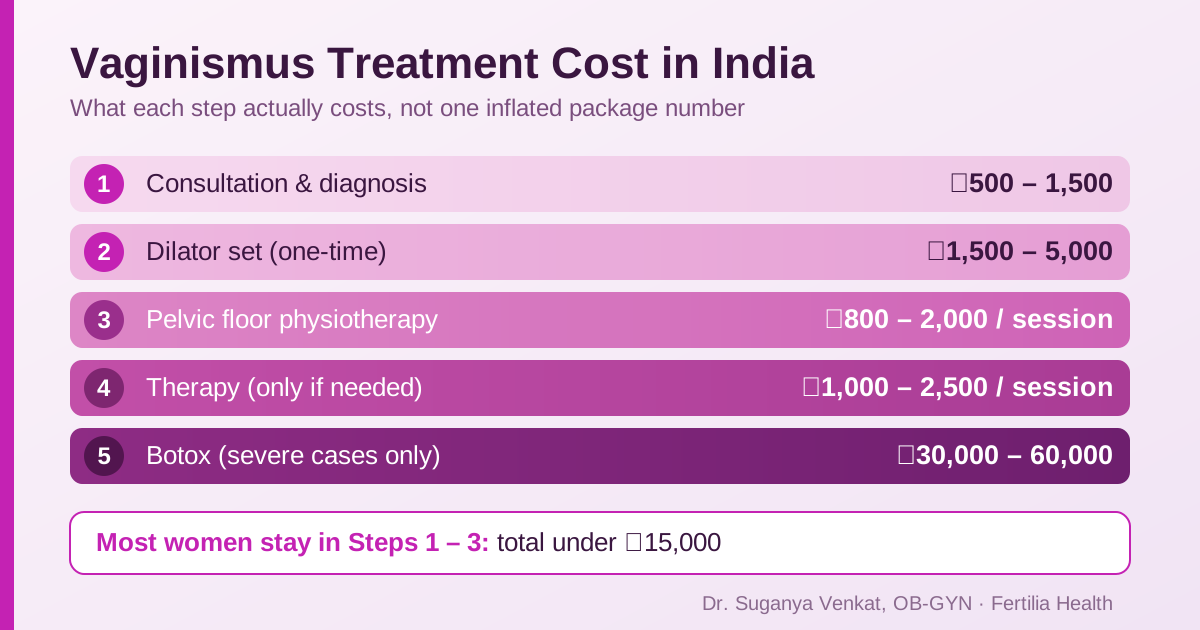
Typical cost: Rs 500 to Rs 1,500 (telehealth often at the lower end).
Every pathway starts here. A gynaecologist confirms that the problem is vaginismus and not another cause of painful penetration such as vulvodynia, infection, or hormonal dryness from breastfeeding or menopause. This distinction matters, because the treatment is different. Our guide on how doctors tell dyspareunia and vaginismus apart explains what that assessment involves.
A first consultation with a gynaecologist in India typically runs Rs 500 to Rs 1,500, with metro specialist clinics at the higher end. Online consultations are often less. If you are deciding who to see, our post on how to choose a vaginismus doctor in India covers what to look for.
Step 2: A vaginal dilator set
Typical cost: Rs 1,500 to Rs 5,000 (one-time purchase).
A graduated set of medical-grade dilators is the core tool of conservative treatment, and it is a one-time cost. Standard silicone sets run Rs 1,500 to Rs 5,000. Premium branded or vibrating sets cost more, in the Rs 8,000 to Rs 15,000 range, but they are not necessary for good results. A basic medical-grade set is what the evidence is built on. Our guide on vaginal dilators in India, sizes and where to buy covers the options in detail.
For many women, the consultation plus a dilator set, used with the right technique, is the entire treatment. The 12-week dilator protocol walks through exactly how to use them, and reverse Kegels and pelvic floor down-training explains the relaxation technique that makes dilator work effective.
Step 3: Pelvic floor physiotherapy
Typical cost: Rs 800 to Rs 2,000 per session; a usual course is 6 to 8 sessions.
A pelvic floor physiotherapist guides dilator progression, teaches down-training, and provides hands-on muscle release. Specialist women’s-health physiotherapy in metro cities runs Rs 800 to Rs 2,000 per session, and Rs 500 to Rs 1,200 in tier-2 cities. A typical course is 6 to 8 sessions rather than open-ended, so the realistic spend here is Rs 5,000 to Rs 16,000.
Importantly, in-person physiotherapy is not the only option. A randomised controlled pilot trial by Zarski and colleagues (2017, J Sex Med, PMID 28161080) tested internet-based guided self-help for women with sexual pain-penetration difficulties and found it improved outcomes compared with a waitlist control. That is genuinely useful, but it is worth being precise about what it does and does not show: it was not a head-to-head comparison against in-person physiotherapy, so nobody can tell you the two are equivalent. For women who cannot easily reach a pelvic floor specialist, a structured home programme with remote guidance is a reasonable, lower-cost route with trial support behind it.
Step 4: Psychosexual therapy (only if fear or anxiety is the main driver)
Typical cost: Rs 1,000 to Rs 2,500 per session; needed only for some women.
When anxiety, a frightening past experience, or relationship distress is driving the spasm, a few sessions with a sex therapist or counsellor help break the fear-spasm-pain cycle. Online psychosexual counselling in India runs Rs 1,000 to Rs 2,500 per session, with package rates available. This step is not universal. Many women resolve vaginismus without it. It is added when the clinical picture calls for it, particularly in cases linked to an unconsummated marriage.
Step 5: Botox (only for severe cases or after a genuine conservative trial)
Typical cost: Rs 30,000 to Rs 60,000 per session.
This is the expensive end of the ladder, and it is where the advertised packages get their big numbers. Botox temporarily relaxes the pelvic floor muscles to create a window for dilator training. It is a reasonable option for grade 3 to 4 vaginismus, or for grade 2 that has genuinely not responded to a structured 12-week conservative program. It is not a first step. Our detailed post on when Botox helps and when it is overkill explains the evidence and the sequencing. The key point for budgeting: most women never reach this step.
💬 Not sure which step you need? Dr. Suganya reviews vaginismus cases across India via telehealth and can tell you where to start before you spend on anything. Message Dr. Suganya on WhatsApp
📘 Want a complete reference before you spend on anything? Download Dr. Suganya’s free 39-page Navigating Vaginismus: Information, Support, and Recovery. It covers what each step is for, so you know what you’re paying for at every stage. Get the guide →
Prefer Instagram? Comment PAINLESS on any @fertilia.health post and we’ll DM you the guide directly.
What Most Women Actually Spend
Here is the same information as three realistic scenarios, so you can see where you are likely to fall.
| Scenario | What it includes | Realistic total |
|---|---|---|
| Most women | Consultation + dilator set + a few physio sessions or a guided home program | Rs 8,000 to Rs 15,000 |
| Added therapy | The above + psychosexual counselling sessions | Rs 15,000 to Rs 25,000 |
| Severe / treatment-resistant | Conservative pathway + Botox | Rs 40,000 to Rs 75,000 |
The pattern is clear. The conservative pathway that resolves vaginismus for the large majority of women totals under Rs 25,000, and often under Rs 15,000. The Rs 80,000 to Rs 3,00,000 figures you see advertised assume the severe scenario and bundle in services many women do not need. They are not wrong for everyone, but they are not the starting point, and they should not be the number that frightens you away from getting help.
What You Should Not Be Paying For
A few things are worth flagging, because money-intent searches often surface them.
Surgery. Primary vaginismus does not need surgery. There is no operation that “fixes” the muscle reflex, and any page suggesting a surgical cure for ordinary vaginismus is not following evidence-based practice.
Vaginal “tightening” or laser treatments. These are marketed heavily and have nothing to do with treating vaginismus. They address a problem you do not have.
Unregulated online “kits” and supplement stacks. Vaginismus is treated with technique and time, not pills. Spend on a good dilator set and proper guidance, not on packages promising a quick chemical fix.
A genuine treatment plan is transparent about which step you are on and why. If a quote does not break down what you are paying for, that is your cue to ask, exactly as our stepwise breakdown here is designed to help you do.
How Fertilia Structures This
The reason aggregator pages quote a single inflated number is that breaking the cost down honestly does not sell a package. Our approach is the opposite. The first consultation with Dr. Suganya is Rs 399, and it exists to tell you where on the ladder you actually are before you spend on anything else. From there, the structured 12-week program coordinates the three-part team most women need, the gynaecologist, the pelvic floor guidance, and psychological support when it applies, with ongoing direction over WhatsApp.
For most women that means the conservative pathway, done properly, at a fraction of the advertised package cost. For the minority who need Botox, it means reaching that step only after conservative therapy has built the dilator training that makes the injection work, rather than paying for it first. This is the same care, sequenced so you pay for what helps rather than for a bundle.
If you would prefer the three layers coordinated for you rather than assembled yourself, Fertilia’s online vaginismus treatment program is a flat ₹30,000 for the 12-week program (US $500 for international patients), with the dilator set purchased separately. That is above the do-it-yourself pathway in the table, and the difference is the coordination: a gynaecologist, a psychiatrist who specialises in vaginismus, and a certified pelvic floor physiotherapist working from one plan, with weekly one-on-one sessions and daily WhatsApp support, instead of three separate clinicians you find, brief, and manage on your own.
💬 Want a clear answer on what your treatment will cost? Start with a Rs 399 telehealth consultation with Dr. Suganya. She will map out which steps you need and what each one costs, before you commit to anything. WhatsApp Dr. Suganya
Frequently Asked Questions
Is vaginismus treatment expensive in India?
For most women, no. The conservative pathway that resolves vaginismus in the large majority of cases, a consultation plus a dilator set plus some physiotherapy guidance, typically totals under Rs 15,000, and often less if you use a structured home program. The high figures of Rs 80,000 to Rs 3,00,000 you see advertised assume the most intensive treatment, including Botox, which most women never need.
How much does a vaginal dilator set cost in India?
A medical-grade graduated set costs Rs 1,500 to Rs 5,000 and is a one-time purchase. Premium branded or vibrating sets run higher, around Rs 8,000 to Rs 15,000, but they are not necessary. A basic medical-grade set is what conservative treatment is built on.
Is vaginismus treatment covered by health insurance in India?
Coverage is inconsistent. Most outpatient costs, consultations, dilators, and physiotherapy sessions, are usually paid out of pocket, as they are for many outpatient conditions in India. If Botox is medically indicated and done in a hospital setting, some policies may consider it, but this varies by insurer and policy. Check with your provider before assuming coverage.
Can I treat vaginismus at home cheaply?
To a large extent, yes, with the right guidance. A dilator set used with a structured protocol and proper relaxation technique resolves vaginismus for many women. Research supports remotely guided home dilator therapy as comparable to in-person physiotherapy. The cost-effective route is a proper diagnosis first, then a guided home program, with in-person physiotherapy added only if you are not progressing.
How much does it cost at a government hospital?
Government hospital consultation and physiotherapy fees are very low, often Rs 50 to Rs 300, but pelvic floor and psychosexual services for vaginismus are not consistently available across government facilities. Where they are available, they are the most affordable option. Where they are not, a structured private or telehealth program is the practical alternative.
Does Botox cost more in the long run?
It can, if it is used first. Botox lasts three to six months, and if the window is not used for dilator training, the spasm tends to return and a repeat injection may be needed at the same Rs 30,000 to Rs 60,000 cost. Used correctly, after conservative therapy has built dilator progress, a single session is often enough. Skipping the conservative steps to go straight to Botox usually saves neither time nor money over a year.
What is the cheapest effective path?
A proper diagnosis (Rs 500 to Rs 1,500), a medical-grade dilator set (Rs 1,500 to Rs 5,000), and a structured, guided home protocol. This combination, done consistently, resolves vaginismus for a large share of women for under Rs 8,000. Adding a few physiotherapy or counselling sessions if needed keeps most complete treatments under Rs 25,000.
Related reading: Vaginismus: an OB-GYN’s honest guide for Indian women | The 12-week dilator protocol | When Botox helps and when it is overkill | How to choose a vaginismus doctor in India