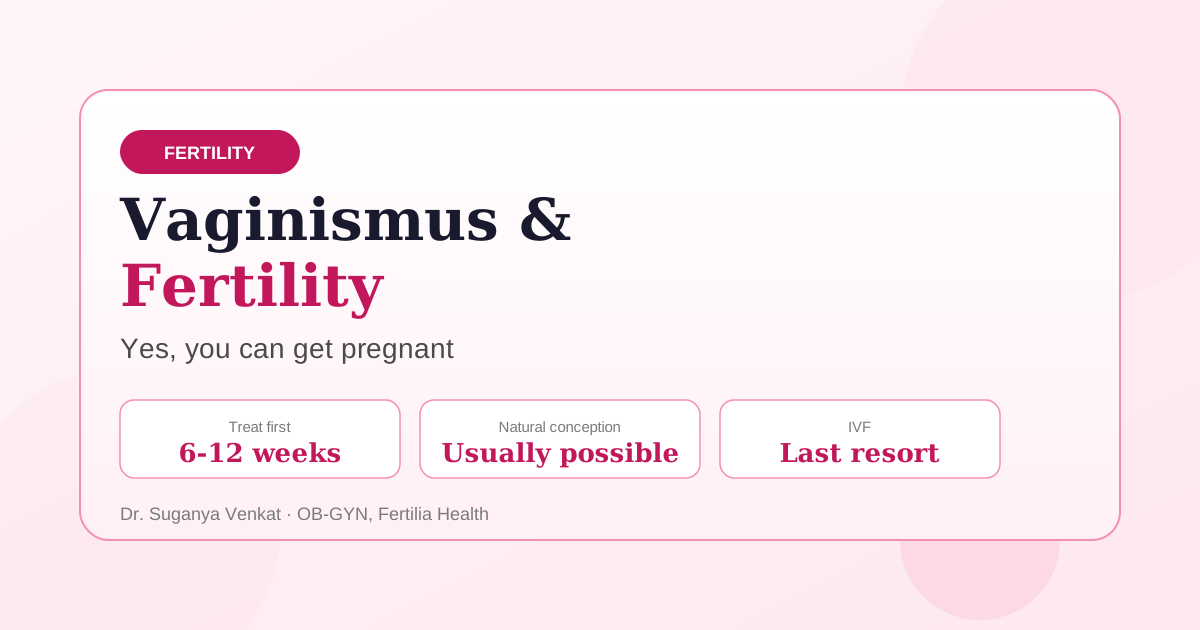
You searched “vaginismus and pregnancy” because the conception clock is ticking and intercourse isn’t happening. Here is the honest clinical answer: yes, pregnancy is very much possible with vaginismus, and there is more than one route to it. For many women, treating the vaginismus is the best starting point. And fertility evaluation does not have to wait for treatment to finish: when it happens is shaped by your own wishes, your age, how long you have been trying, and any known fertility factors in either partner.
I want to spend some time on that phrase “for many women,” because it is doing a lot of work. For many women with vaginismus who have no other fertility problem, treatment comes first and natural conception follows. But vaginismus can make intercourse difficult or impossible without telling us whether other fertility factors are present, which is why the workup runs alongside treatment rather than after it. There are also specific situations where assisted reproduction makes sense sooner, and those deserve a clear walk-through too.
What I will not do is tell you the answer is IVF just because that is the shortest path to a consultation. You deserve the full picture first.
Why Most of What You Find Online Points You Straight to a Clinic
Search “vaginismus and infertility” or “can you get pregnant with vaginismus” and look at what ranks. Most of it comes from IVF centres. Their pages are thoughtful and medically accurate, but they are written from the perspective of clinics whose core offering is assisted reproduction. So the recommended path tends to move quickly from “vaginismus makes intercourse difficult” to “IUI or IVF is a solution.”
That is not wrong for everyone. But it is not the right first answer for most women with vaginismus who have no other fertility issue.
The reason this matters: vaginismus is one of the most treatable conditions in women’s health. A structured 12-week protocol involving pelvic floor physiotherapy, graduated dilator exercises, and psychosexual support achieves pain-free intercourse in 80 percent or more of women. Once intercourse is possible, a couple with no other fertility factor is in the same position as any other couple trying to conceive. What treating vaginismus cannot do is tell you whether other fertility factors are present; that is what the basic workup is for, and it can run alongside treatment.
The cost comparison alone is worth pausing on. Vaginismus treatment - pelvic floor physiotherapy plus dilator set plus a few psychosexual sessions - runs roughly Rs 5,000 to Rs 25,000 over 8 to 12 weeks. A single IVF cycle runs Rs 1.5 lakh to Rs 3 lakh, requires daily injections, and the embryo transfer itself involves a vaginal speculum exam - the same procedure that is already difficult with vaginismus. Jumping straight to IVF without treating the vaginismus first does not remove the physical challenge; it moves it to a different point in the process.
What the Evidence Actually Shows
Treatment success rates
A 2018 systematic review and meta-analysis by Maseroli et al. (PMID 30446469) analysed 43 observational studies and 3 randomised controlled trials involving over 1,900 women with sexual pain disorders including vaginismus. The overall treatment success rate - defined as achieving comfortable penetration or intercourse - was 79 percent, rising to 82 percent in higher-quality studies. Crucially, age, duration of vaginismus, whether it was primary or secondary, and partner involvement did not significantly predict outcome. A woman who has had vaginismus for 10 years is not more difficult to treat than one who has had it for 1 year.
A 2026 meta-analysis by Zulfikaroglu et al. (PMID 41148166) looked specifically at different treatment modalities across 18 studies and 863 women. Combined psychosexual therapy achieved 86 percent success, pelvic floor physiotherapy 85 percent, CBT 82 percent, and dilator therapy alone 78 percent. The review’s pooled figures come from studies with varying diagnostic criteria and outcome definitions, and do not provide a reliable personal recovery percentage from a severity grade. A structured guided self-help programme produced meaningful improvement even after a mean vaginismus duration of 6 years (Zarski 2017, PMID 28161080).
The unexplained infertility connection
A study published in the International Journal of Reproduction, Contraception, Obstetrics and Gynecology found that a meaningful proportion of women presenting to infertility clinics with “unexplained infertility” - normal ovarian reserve, normal tubes, normal semen analysis - had unrecognised vaginismus as the primary explanation for not conceiving. Because the condition is not always disclosed (shame, privacy, the assumption the doctor already knows), it goes undetected. When it is treated, the “infertility” resolves. This is not a rare edge case. It is a systematic gap in how fertility workups are conducted.
The 3-Step Path When You Are Worried About Both Vaginismus and Fertility
If you have vaginismus and conception is on your mind, here is how I approach it clinically.
Step 1: Confirm the diagnosis
Not all painful penetration is vaginismus. Deep pain during sex can point to endometriosis. Burning at the entrance can point to provoked vestibulodynia or a skin condition. A gynaecologist needs to do a careful history and examination before you commit to a vaginismus treatment programme. If there is any uncertainty, a pelvic physiotherapist who specialises in pelvic floor disorders is part of the workup, not just the treatment. See dyspareunia vs vaginismus: how doctors tell them apart for how the differential diagnosis works in practice.
Step 2: Start treatment AND do a basic fertility workup in parallel
Start the 12-week dilator and pelvic floor protocol immediately. Do not wait until the fertility workup is complete. See the 12-week dilator protocol for the full structured approach.
At the same time - not instead - do the basic fertility workup:
- AMH and antral follicle count (ovarian reserve)
- Day 2 FSH, LH, and oestradiol
- TSH and prolactin
- Semen analysis for your partner
- HSG to check tubal patency (can usually be done with a small catheter and local anaesthetic; discuss your vaginismus with the radiologist beforehand)
The reason to do these in parallel rather than sequentially: if treatment goes well and intercourse is possible at week 8 or 10, you want to start trying immediately with the full picture already in hand. You do not want to spend another 6 weeks waiting for results. See the honest fertility workup: an OB-GYN’s Indian guide for exactly which tests matter and which are not worth ordering at this stage.
Step 3: Reassess at week 12
At the 12-week mark, two things are usually clear: whether intercourse is now possible, and what the fertility workup showed.
If intercourse is possible and the workup is normal, start tracking ovulation and try naturally for 6 to 12 months. Most couples in this position conceive. See how to track ovulation: an Indian woman’s guide and how to conceive naturally: a couple’s complete guide for the practical steps.
If intercourse is not yet consistently possible at week 12, that does not mean give up on treatment. For many women, the milestone comes at week 14 or 16. But if the fertility workup shows a genuine time-sensitive issue - low AMH with high FSH, or a tubal block, or significant male factor - then IUI becomes a reasonable bridge while treatment continues.
IUI for Vaginismus: When It Makes Sense
Intrauterine insemination (IUI) does not require intercourse. The process: your partner provides a semen sample (collected via masturbation at the clinic). The sample is washed and concentrated in the lab to select the most motile sperm. On the day of ovulation, that concentrated sample is inserted through the cervix using a thin, soft catheter, directly into the uterine cavity. The procedure takes a few minutes.
IUI does require a speculum examination and cervical access, which can itself be difficult with significant vaginismus. An experienced gynaecologist can help by using the smallest speculum available, asking you to lie on your side rather than in the standard lithotomy position, applying topical lidocaine gel to the entrance, and proceeding slowly with a pause-and-breathe approach. For most women, IUI is manageable even before vaginismus is fully resolved.
IUI is a reasonable choice when:
- You have been working through the 12-week protocol in good faith for at least 12 weeks and intercourse is not yet consistently possible
- The fertility workup shows a time-sensitive finding (AMH genuinely low for age, or you are 38 and the workup suggests diminishing reserve)
- There is a coexisting fertility issue that means treating vaginismus alone would not be enough (for example, mild to moderate male factor where IUI with washed sperm improves the odds)
- You have a medical reason where conception is genuinely time-critical (for example, an upcoming chemotherapy regimen)
IUI success rates run roughly 10 to 20 percent per stimulated cycle for women under 35 with no other fertility issues. It is a reasonable middle path: less intensive than IVF, accessible without full intercourse, and fully compatible with continuing vaginismus treatment in parallel.
A Note on Self-Insemination
Some couples practise at-home insemination: the partner provides a sample into a collection cup and the woman uses a needleless syringe to deposit it near the cervix at ovulation. It is legal, private, and sometimes effective. It is worth knowing about, but it is not the recommended first move: home insemination skips the sperm-washing step and places sperm in the vaginal vault rather than the uterine cavity, so per-cycle success rates are lower than clinic IUI. It can serve as a bridge while waiting for an IUI appointment. It should not replace the treatment pathway.
The IVF Calculus: Honest Numbers
IVF is a remarkable technology. For the right indication - blocked tubes, severe male factor, failed IUI cycles - it is often the correct answer and I am glad we have it.
For a woman whose only fertility barrier is vaginismus and who has no other fertility issue, IVF carries costs that are worth thinking through carefully before committing:
- Rs 1.5 lakh to Rs 3 lakh per cycle, with most couples needing 1 to 3 cycles
- Daily hormone injections for 10 to 14 days per cycle
- Egg retrieval under sedation or general anaesthesia
- Vaginal ultrasound monitoring and embryo transfer - both involving the same vaginal access that is challenging with vaginismus
- Emotional and relationship cost that is difficult to quantify but very real
The per-cycle success rate is roughly 30 to 40 percent under age 35 and lower thereafter. A woman who treats her vaginismus and conceives naturally spends Rs 10,000 to Rs 25,000 over 3 to 4 months. A woman who goes straight to IVF may spend Rs 3 to 6 lakh over 6 to 12 months - and still need to manage the vaginismus during the IVF process itself.
IVF is the right choice when intercourse is not achievable after sustained treatment and the fertility workup indicates it is time. It is not the first choice for most women with vaginismus and no other fertility problem.
💬 You do not have to figure out the fertility and vaginismus question alone. I see women in exactly this situation every week. Message Dr. Suganya on WhatsApp and we can work through the right sequence for you.
📘 Want the full picture before our conversation? Download Dr. Suganya’s free 39-page Navigating Vaginismus: Information, Support, and Recovery. The chapters on diagnosis, treatment, and the partner’s role will give you the vocabulary to make the consultation more useful. Get the guide →
Prefer Instagram? Comment PAINLESS on any @fertilia.health post and we’ll DM you the guide directly.
Pregnancy and Delivery: What Vaginismus Does and Does Not Mean
Vaginismus does not prevent vaginal delivery. The spasm that responds to voluntary penetration does not function the same way during labour, where involuntary uterine contractions drive the process. Many women find that pregnancy itself reduces the muscular guarding as the pelvic floor adapts.
A caesarean section is not automatically required because of vaginismus. “She has vaginismus therefore C-section” is not a clinical rule. Most women with treated vaginismus deliver vaginally. Antenatal examinations can be done with the same accommodations used throughout treatment: smallest speculum, topical lidocaine, lateral position, slow pace.
The Pattern I See Most Often in Clinic
A woman comes to us having tried to conceive for 18 months. Intercourse has not been happening regularly because of vaginismus - sometimes she has disclosed this to her fertility doctor and sometimes she has not. She has been quoted for IVF. She starts the structured 12-week dilator and pelvic floor protocol. By week 8, intercourse is possible. She conceives naturally within 4 months of starting regular timed intercourse.
This is the pattern for women with vaginismus and no other fertility issue who get the right treatment in the right sequence. The fertility workup done in parallel came back normal. IVF was never needed.
The women who do IUI or IVF are those for whom the workup found a genuine time-sensitive issue alongside the vaginismus, or those who tried the full protocol and needed more time. Both paths are valid. The point is to make the decision with full information, not to default to the most intensive option simply because it is available.
For the broader framework on vaginismus - what it is, how it is graded, and why treatment works - start with the OB-GYN’s honest guide to vaginismus.
For the treatment protocol in full detail, go to the 12-week dilator protocol.
If you have been in a marriage that has not been consummated and the fertility question is becoming urgent, what Indian doctors see in unconsummated marriages covers the clinical and cultural layers. Vaginismus accounts for 8.4 to 81 percent of unconsummated marriages globally depending on the study setting (Krishnappa 2023, PMID 37952223) - a wide range that reflects how differently it is reported across cultures.
For a real case study showing the conservative-first approach applied to unexplained infertility, read case study: unexplained infertility, conceived naturally.
Frequently Asked Questions
Can a woman with vaginismus get pregnant naturally?
Yes, many women do. Vaginismus affects penetration; it does not itself damage ovulation, tubal function, uterine health, or the ability to carry a pregnancy. But it also does not tell us whether other fertility factors are present in either partner, which is why a basic workup runs alongside treatment. For couples whose workup is normal, natural conception is the usual outcome once intercourse is comfortable, though no one can honestly promise a particular timeline in advance.
How do you get pregnant if you have vaginismus?
For most couples with no other fertility issue, the route is to treat the vaginismus and conceive naturally. Run a basic fertility workup (AMH, partner semen analysis, hormone panel) in parallel during the dilator and pelvic floor work, so by the time intercourse is comfortable both partners already know whether anything else needs attention. If the workup shows a time-sensitive finding such as low AMH or a male factor, IUI (which does not require intercourse) is a reasonable bridge while vaginismus treatment continues. And couples for whom IVF or IUI is already indicated on independent fertility grounds are not excluded from that path because of vaginismus: the two care tracks can run in parallel.
How long does vaginismus treatment take before we can try to conceive?
A structured 12-week programme combining graduated dilator exercises, pelvic floor physiotherapy, and psychosexual support achieves pain-free intercourse in over 80 percent of women (Maseroli 2018, PMID 30446469; Zulfikaroglu 2026, PMID 41148166). Many women reach the milestone by week 6 to 8; others need longer, and that is normal. Start the protocol now and run the fertility workup in parallel - by the time intercourse is comfortable, both pieces of information are ready. You do not have to wait for treatment to finish before the fertility conversation starts.
Do IVF clinics always recommend IVF for vaginismus?
No, not always, but the framing tends to move in that direction because assisted reproduction is the clinical toolkit fertility centres offer. IVF clinics are not wrong to offer IUI or IVF as a solution: for vaginismus with coexisting fertility issues, or after sustained failed treatment, assisted reproduction is genuinely the right path. The gap is not that IVF is being recommended wrongly - it is that treatment of the vaginismus itself is sometimes skipped. The conservative-first sequence described above does not conflict with IVF clinics; it just asks that the vaginismus be treated first for women who have no other fertility issue.
Does IUI work for vaginismus?
Yes. IUI does not require intercourse. A sperm sample is collected by the partner, washed, and inserted through the cervix with a thin catheter. The procedure does require a speculum exam, which an experienced clinician can accommodate with the smallest available equipment, topical lidocaine, and a slow approach. IUI is a reasonable bridge when the fertility workup shows a time-sensitive finding or when a full treatment course has not yet resolved the vaginismus.
Does vaginismus mean I cannot deliver vaginally?
No. Vaginismus affects voluntary penetration, not the involuntary uterine contractions and cervical dilation of labour. Many women find that vaginismus improves during pregnancy. Vaginal delivery is possible for most women with vaginismus. Whether to plan a vaginal birth or a caesarean section depends on the overall obstetric picture, not on vaginismus alone.
Can women with vaginismus have a normal pregnancy?
Yes. Vaginismus affects voluntary penetration, not conception, implantation, or the way a pregnancy progresses. Many women find that pregnancy itself reduces the muscular guarding as the pelvic floor adapts. Antenatal examinations and scans can be done with the same accommodations used throughout treatment: the smallest speculum, topical lidocaine, a lateral position, and a slow pace. Tell whoever is providing your antenatal care early, so those adjustments are planned rather than improvised on the day.
What if my fertility workup shows low AMH?
Low AMH changes the timeline calculus. If AMH is genuinely low for your age, waiting 12 weeks and then trying naturally for 6 to 12 months may not be the right plan. Running the workup in parallel with treatment (Step 2 above) gives you this answer early. The numbers either confirm you have time, or tell you to move to assisted reproduction sooner. This is a decision based on actual test results, not on age alone.
Is home insemination a good option for vaginismus?
It is an option, not the most effective one. Home insemination uses unwashed semen in the vaginal vault, which has a lower per-cycle success rate than clinic IUI with washed sperm placed directly into the uterus. It can serve as a bridge while waiting for an IUI appointment. It should not replace the vaginismus treatment pathway or the evidence-based fertility workup.
If pregnancy is your goal, you can discuss both at your assessment: Fertilia’s online Vaginismus Recovery Program coordinates vaginismus care and fertility evaluation alongside one another when appropriate, rather than making you finish one before starting the other.
💬 Fertility with vaginismus is not a closed door. If you want to work through your specific situation - whether treatment comes first, whether to do the workup now, or whether IUI is the right bridge for you - message Dr. Suganya directly on WhatsApp. The conversation is private, no pressure, and starts where you are.