The question every woman with vaginismus is really asking
You’ve probably already Googled the condition. You may have read that it’s “treatable” and “not your fault.” You may have been told to “relax.” None of that tells you what to actually do on a Tuesday evening when you’re sitting on the bathroom floor wondering where to start.
This post is for that moment.
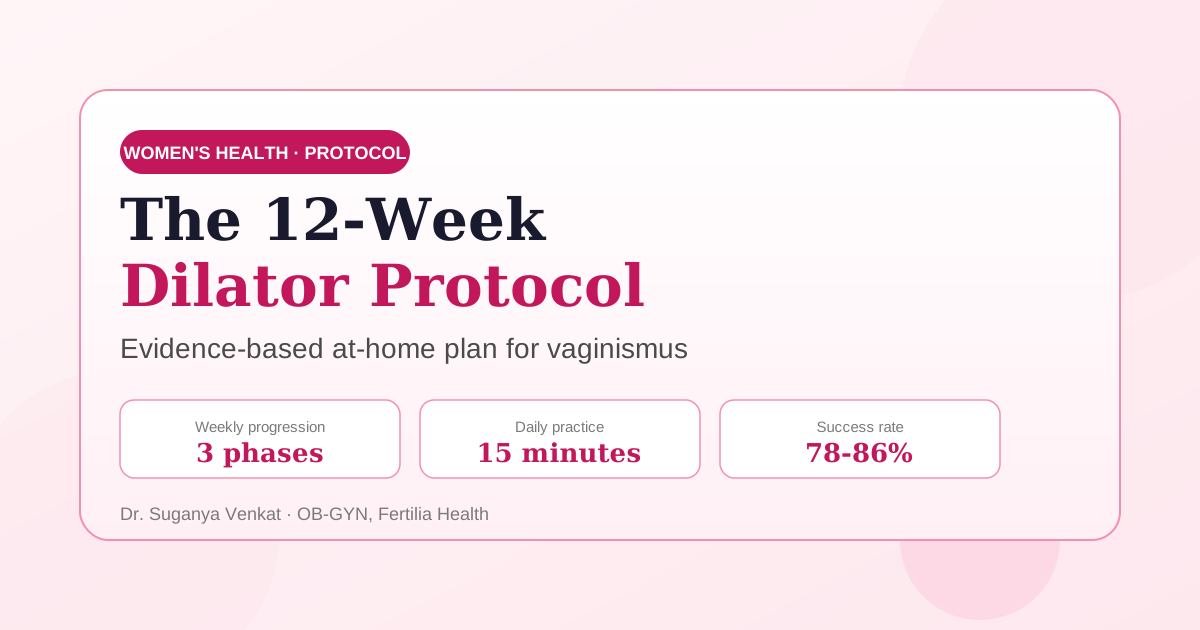
The research on vaginismus treatment reports benefits, but it does not validate one home protocol for everyone. Maseroli and colleagues’ 2018 review estimated that 79% of women in observational studies completed penetrative intercourse after treatment; this did not necessarily mean pain-free intercourse (PMID 30446469). The 82% subset consisted of moderate- or strong-quality observational studies, not higher-quality trials. A 2026 review reported different pooled success rates across treatment categories, with differing diagnostic criteria and outcome definitions (PMID 41148166). Neither review establishes a success percentage for the particular 12-week schedule on this page.
For the full clinical picture of vaginismus, including how it is diagnosed and what causes it, start with my comprehensive OB-GYN guide to vaginismus in India. This post focuses purely on the protocol: what to do, in what order, and what to do when it stops working.
Step 0: Know your starting grade (Lamont-Pacik grading)
Before choosing a starting dilator size, it helps to honestly assess where you are. The Lamont-Pacik clinical grading system is widely used in practice:
- Grade 1: Pelvic floor spasm you can feel, but you remain still on the table (or at home). You are aware of the tightening.
- Grade 2: Spasm plus visible tightening of the thighs and buttocks. The tension travels beyond the pelvis.
- Grade 3: Spasm plus buttock lift - the hips come off the surface involuntarily during examination or attempted insertion.
- Grade 4: Spasm plus buttock lift plus dorsal arching of the spine and a retreat response (pulling away from contact entirely).
Grades 1 and 2 typically start at dilator Size 1 or Size 2, depending on how much body awareness you already have. Grades 3 and 4 begin with body mapping and breathing work before any dilator is introduced - the protocol below is structured with this in mind.
The evidence reviewed here does not establish a universal success percentage by grade for this home protocol. Grade-specific results from a selected clinician-treated cohort should not be presented as a personal prediction for someone practising at home.
The 12-week protocol
Phase 1: Foundation (Weeks 1-2)
The goal here is not insertion. The goal is to stop the anticipatory alarm signal that fires before any contact happens.
Diaphragmatic breathing (5 minutes every morning):
Lie flat on your back, knees bent, feet on the floor. Place one hand on your chest and one on your belly. Breathe in through your nose for a count of four, directing the breath so only your belly hand rises - your chest hand stays still. Breathe out through slightly parted lips for a count of six. This activates the parasympathetic nervous system and is the foundation of all pelvic floor work.
Practice this every morning for two weeks before adding anything else. It sounds too simple. It is not.
Body mapping:
In private, with a mirror if you are comfortable, spend five minutes simply looking at your external anatomy without any goal of insertion. The aim is to reduce the startle response that many women with vaginismus experience on visual contact alone. This is part of the desensitisation progression.
Pelvic floor awareness - the reverse Kegel:
Most women have heard of Kegel exercises. Vaginismus treatment is almost the opposite. You are not training your pelvic floor to squeeze harder. You are training it to release on command.
For more on this, read our guide on Painful Sex After Delivery.
For more on this, read our guide on Primary vs Secondary Vaginismus. To practise a reverse Kegel: breathe in, and as you exhale, consciously imagine letting your pelvic floor drop, open, or “blossom downward.” Picture the sensation of the moment just before you sit down on a very warm surface - a gentle releasing rather than a bracing. This is the muscular movement that enables progressive dilator use.
By the end of Week 2, you should be able to produce this release while breathing out, reproducibly. That is all Phase 1 asks.
Introduction to your smallest dilator (no insertion yet):
Hold the smallest dilator (typically Size 1, roughly the width of a fingertip) in your hand. Warm it in your hands for a few minutes. Rest it gently against your inner thigh while practising the breathing. The goal is simply that your body associates its presence with calm rather than alarm.
Phase 2: Graded progression (Weeks 3-8)
This is the core of the protocol. How often and for how long you practise is guided by your comfort and, in a supported program, reviewed with your physiotherapist. Starting every other day gives the body time to recover between sessions; daily practice is not harmful, but it has not been shown to be superior, and no trial has established one cadence as clearly better than another (Melnik et al., Cochrane Database of Systematic Reviews, 2012, PMID 23235583). Session length builds gradually, guided by comfort, with no fixed minimum. What matters is regular practice sustained across weeks. If a session begins to feel like something you dread, take a day off and return when it feels manageable.
Position: Lie on your back, knees bent, feet flat. Use a pillow under your hips if that feels more comfortable. Ensure you have privacy, warmth, and no time pressure.
Lubrication: Use a water-based lubricant and follow the instructions provided with your dilator set for cleaning and compatible products. Apply generously to both the dilator tip and the vaginal opening before each session. Manufacturers differ on which other products are compatible with their materials, so the leaflet that came with your set is the authority, not a general rule.
Session structure for each size:
- Two minutes of diaphragmatic breathing. Consciously practise the reverse Kegel on each exhale.
- Apply lubricant.
- At the vaginal opening, rest the dilator tip (do not insert). Breathe for one minute.
- On an exhale with a deliberate pelvic release, allow the tip to enter just slightly. Do not push. Let gravity and your own release do the work.
- Hold at whatever depth is comfortable. Breathe. Stay for 5-10 minutes at that depth.
- Remove. Rest. Note how you feel.
Progression rule - this is the most important rule in the protocol:
Move to the next size when insertion of the current size is consistently comfortable, your breathing stays relaxed, and there is no significant pain or distress. You do not progress by reaching a set number of minutes or sessions. If a session feels forced, that is a signal to stay at the current size. There is no schedule pressure. Week 5 looks different for every woman.
A typical progression for someone starting at Grade 1-2: Size 1 for 2 weeks, Size 2 for 2 weeks, Size 3 for 1-2 weeks, Size 4 by Week 8. Someone starting at Grade 3-4 may spend 3 weeks at Size 1. Both paths are valid.
💬 You don’t have to figure this out alone. I see vaginismus consultations on WhatsApp every week and can help you personalise this protocol to your situation. Message Dr. Suganya
📘 Want the full picture in one place? Download Dr. Suganya’s free 39-page Navigating Vaginismus: Information, Support, and Recovery. It covers the mechanism, differential diagnosis, treatment ladder, partner’s role, and recovery markers. Get the guide →
Prefer Instagram? Comment PAINLESS on any @fertilia.health post and we’ll DM you the guide directly.
Phase 3: Penetration practice (Weeks 9-12)
By Week 9, most women who have followed the protocol are comfortable with a dilator size that approximates typical penetration. Phase 3 introduces actual penetration attempts, but with very specific structure.
Recommended first position: spooning
The receiving partner lies on their side, the penetrating partner behind. This position allows the receiving partner to control depth and pace entirely, keeps pelvic floor muscles more relaxed than missionary, and removes the visual performance element that increases anxiety.
Tip-only rule:
For the first two to four attempts, only the tip enters - defined as less than 2 cm depth. Breathe through it. Release. Then stop. No pressure to continue to full depth in a single session. Progression from tip-only to mid-depth to full depth follows the same logic as the dilator sizing: stay at each step until it feels unremarkable.
Communication script:
Before any attempt, agree with your partner on a word that means “stop completely and immediately” without explanation needed. Many couples find it easier to use a neutral word unrelated to sex. This removes the in-the-moment negotiation that increases anxiety for both people.
Troubleshooting: when you stall
Stalling is normal. Here is how to respond to each pattern:
Pain returns at a size that was previously comfortable: Drop back one size. Spend three to four sessions there again. Stalling usually signals either a tissue response (worth ruling out with a clinician visit if it persists) or accumulated anticipatory anxiety. Dropping down is not failure - it is correct protocol management.
Anxiety rises before sessions, making it hard to start: Return to Phase 1. Spend a week doing only breathing and no dilator work. The nervous system needs a reset, not a push through. The 2017 guided online trial reported improvements in some secondary outcomes, but not a statistically significant between-group difference in its primary intercourse outcome (PMID 28161080). It did not isolate which component of treatment caused improvement or compare online with in-person care.
Partner is pushing the pace: This is one of the most common stall causes I hear about in consultations. The protocol works on your timeline, not your partner’s. Involving your partner in reading the protocol (so they understand the spooning position, the tip-only rule, the reverse Kegel) shifts them from an impatient bystander to an active part of the solution. If that conversation is difficult, a single couples session with a sex-positive therapist is often more useful than months of solo practice under relational pressure.
What NOT to do
-
Do not try to push through pain. Pain is a signal, not a barrier to overcome with willpower.
-
Do not use standard Kegels as your primary exercise. Squeezing a pelvic floor that already over-contracts makes the condition worse. Reverse Kegels and breathing are the correct tools.
-
Do not guess at lubricant compatibility. Use a water-based lubricant and follow the instructions provided with your dilator set for cleaning and compatible products.
-
Do not attempt penetration before you are comfortable at the equivalent dilator size. The spooning protocol in Phase 3 is not a shortcut past Phase 2.
-
Do not try to complete Phase 2 in a week. Twelve weeks should not be treated as a biological requirement or recovery deadline. The studies cited here do not validate that duration for every woman.
When to seek a clinician (do not wait past these)
Home practice handles the majority of cases. See a doctor or pelvic floor physiotherapist if:
- You have stalled for more than two weeks at the same dilator size despite consistent practice.
- You have burning or stinging that persists after sessions rather than during them - this may indicate a coexisting condition like vulvodynia or lichen sclerosus. Read more on how doctors tell dyspareunia and vaginismus apart.
- Memories or emotions connected to past trauma are surfacing during sessions. Stop the exercise that brings this up and speak to a clinician or your care team; you should not be asked to continue something that feels unsafe. Depending on your assessment, psychological support may run alongside the physical work or ahead of it. That is an individual clinical decision, not a fixed sequence.
- You are trying to conceive and the timeline matters to you. The protocol is fully compatible with fertility planning - see vaginismus and fertility: can you get pregnant? for the specifics. Our complete guide to conceiving naturally may also be helpful once penetration is comfortable.
If you would rather start with a clinician than go it alone, how to choose a vaginismus doctor in India covers what to ask and the red flags to avoid.
For dilator sizing, brands available in India, and where to buy discreetly online, see vaginal dilators in India: sizes, how to use, and where to buy.
India-specific considerations
Dilator kits are available online in India through discrete packaging - search for “vaginal dilator set India” on Amazon.in or through pelvic health suppliers. A full five-size kit typically costs Rs 1,500-3,500 depending on material (medical-grade silicone is worth the higher price). For how that fits into the total cost of treatment, see vaginismus treatment cost in India. Government hospital pelvic physiotherapy departments in major cities (Chennai, Mumbai, Bengaluru, Delhi) have started incorporating dilator therapy, often at no cost for follow-up sessions.
The cultural context matters, too. For women in joint families where privacy is difficult, sessions at a time when the house is quiet - often early morning or late afternoon - are more sustainable than forcing an evening routine. If you are newly married and managing the additional pressure of family expectations, the guide for unconsummated marriage speaks directly to that context.
For a comprehensive overview of the condition, causes, and diagnosis, return to the main vaginismus guide for Indian women.
FAQ
What exercises help with vaginismus?
Three, used together. Diaphragmatic (belly) breathing calms the nervous system that drives the spasm. Reverse Kegels, a conscious downward release of the pelvic floor that is the opposite of a standard Kegel, teach the muscle to let go on command. Graded dilator work then retrains the body to accept slow, painless stretch. Standard tightening Kegels are not on the list, because the pelvic floor in vaginismus is already over-tight. The full week-by-week sequence is the protocol above.
Can I do vaginismus exercises without a dilator?
You can start without one. Phase 1 (breathing, body mapping, and reverse Kegels) needs no equipment, and many women spend their first two weeks here. Dilators come in for the graded-progression phase, because they give the body a controlled, predictable stretch to learn from. If buying a set is a barrier, begin the breathing and release work now and add dilators when you can.
How long does the 12-week dilator protocol take to work?
Most women see meaningful progress (comfortable with Size 2-3) within four to six weeks of consistent practice. Full comfortable penetration by Week 12 is achievable for many women with Grades 1-2. Grades 3-4 may take 16-20 weeks. What matters more than calendar time is consistency: regular sessions, week after week, without long gaps.
Can I do this protocol without a partner?
Yes. The entire protocol through Phase 2 is done alone. Phase 3 introduces a partner, but some women complete Phase 3 using a dilator (rather than a partner) as well, particularly when they are not in a relationship or prefer to complete the full progression before involving a partner. Both approaches are clinically sound.
Is dilator therapy painful?
Early sessions may involve mild pressure or discomfort, especially at the beginning of a new size. If insertion causes significant pain or distress, stop, breathe, and do not continue to the next size; bring it to your next session or check-in. Pain that persists after a session is also a signal to stop and reassess. The goal is to work at the edge of comfort, not through pain.
Do I need to see a doctor before starting?
If you have never been examined and are not certain whether you have vaginismus versus another condition causing pain (such as a structural issue or infection), a single clinical review is worthwhile. If you have already been told by a doctor that the cause is muscular/psychological, you can start this protocol with confidence.
What if my anxiety about sessions increases over time, not decreases?
This can happen when the protocol is pursued too aggressively or when there is unaddressed psychological distress connected to the condition. The correct response is to slow down to Phase 1 and, if the pattern continues, to add a few sessions with a sex-positive psychologist or therapist alongside the physical work. The 2026 review reports 82% for the CBT category, not specifically CBT combined with dilators (PMID 41148166). Because studies used different outcomes and definitions, that figure should not be used to predict an individual’s result.
Is the reverse Kegel safe? Can I hurt myself?
For most women, reverse Kegels are gentle: you are not doing anything forceful - it is a conscious release of muscles you already engage and disengage throughout the day (the same motion as when you start urinating). Whether they are right for you depends on your individual assessment; a physiotherapist may advise differently, for example if your pelvic floor is weak rather than tight.
How often should I use dilators?
Starting every other day is a good rhythm: it gives the body time to recover between sessions. Daily practice is not harmful, but it has not been shown to be superior, and no trial has established one cadence as clearly better than another (Melnik et al., Cochrane Database of Systematic Reviews, 2012, PMID 23235583). Regular practice sustained over weeks matters more than hitting an exact number of sessions, so pick a rhythm you can genuinely keep to. If a session starts to feel like something you dread, take a day off and come back when it feels manageable.
How many minutes should I keep a dilator inside?
Session length builds gradually, guided by comfort, with no fixed minimum: much of a session is simply holding at whatever depth is comfortable while you breathe. You move to the next size when the current size feels consistently comfortable, not by reaching a set number of minutes or sessions. If a session feels forced, that is a signal to stay at the current size rather than to push for more time. There is no schedule pressure.
Can this protocol work if I’ve had vaginismus for many years?
Yes. The Maseroli 2018 meta-analysis found that duration of symptoms did not significantly predict treatment outcome (PMID 30446469). Women who had been living with vaginismus for ten years had success rates comparable to those treated within the first year. The nervous system retains plasticity. The protocol works regardless of how long the pattern has been established.
If you would rather not do the protocol alone, Fertilia’s online Vaginismus Recovery Program guides you through these same exercises week by week, with daily WhatsApp support and progress check-ins.
💬 Ready to start, or not sure which phase applies to you? A short WhatsApp consultation can help you match the protocol to your specific situation, including dilator size selection and what to do if you’ve tried before and stalled. Message Dr. Suganya