You are 20 weeks pregnant. The anomaly scan (TIFFA scan) comes back with good news about your baby, but the radiologist marks something on the report: “low-lying placenta” or “anterior placenta previa.” Your doctor tells you to come back at 32 weeks and not to panic.
You go home and Google it. Within ten minutes, you have read about haemorrhage, emergency surgery, and preterm delivery. The panic your doctor told you to avoid has arrived.
Let me tell you what that report actually means. In most cases, a low-lying placenta at 20 weeks is a waiting finding, not a crisis. It resolves on its own as your uterus grows. In the minority of cases where it does not resolve, there is a clear management pathway that has guided millions of women through safe deliveries.
This guide will walk you through exactly what placenta previa is, what the grades mean, what symptoms to watch for, and how your delivery will be planned based on your specific finding.
What Is the Placenta and Why Does Its Position Matter?
The placenta is the organ that forms inside the uterus during pregnancy to supply your baby with oxygen and nutrients through the umbilical cord. Under normal circumstances, it implants in the upper portion of the uterus, either on the front wall (anterior), back wall (posterior), or side walls.
The lower portion of the uterus, called the lower uterine segment, remains relatively thin and passive for most of pregnancy. The cervix, which is the opening of the uterus, sits at the very bottom. For a vaginal delivery to be safe, the passage from the uterus through the cervix must be unobstructed.
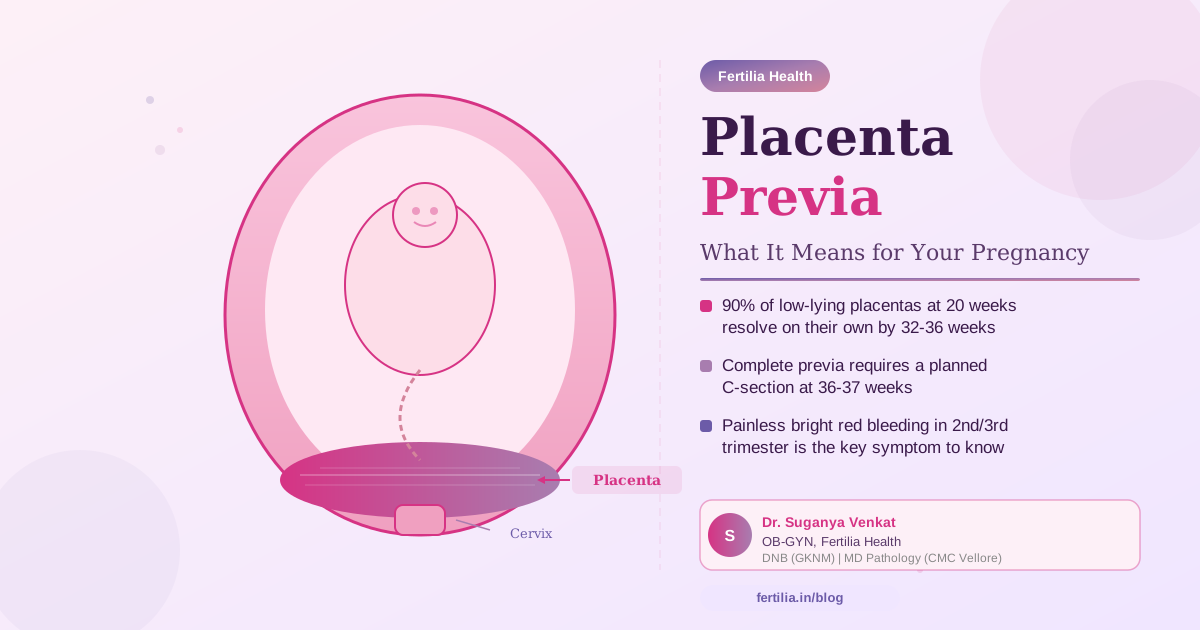
When the placenta implants too low and extends toward or over the cervix, this creates placenta previa. The word “previa” comes from Latin meaning “going before,” because the placenta lies before the baby in relation to the birth canal. If the baby tries to move down through the cervix, the placenta is in the way.
Placenta previa affects approximately 0.5% of pregnancies, or roughly 1 in 200 (Faiz and Ananth, 2003, Obstetrics and Gynaecology). It is more common than most women realise, which is exactly why the TIFFA scan at 18 to 20 weeks includes placental position as a standard check.
The Grades of Placenta Previa Explained
Most Indian hospitals and radiology reports use one of two grading systems. Here is what each term means in plain language:
Low-lying placenta (marginal or type I): The placenta is in the lower uterine segment but its lower edge is within 2 cm of the cervical os without covering it. This is the most common finding and the one most likely to resolve.
Marginal placenta previa (type II): The lower edge of the placenta reaches the edge of the cervical os but does not cross it. Vaginal delivery may still be possible depending on the exact measurement and how things look at 32 to 36 weeks.
Partial placenta previa (type III): The placenta partially covers the cervical os when it is closed. As the cervix begins to dilate in late pregnancy or labour, the cover increases. Vaginal delivery is not safe.
Complete placenta previa (total, type IV): The placenta fully covers the cervical os. This is the most significant grade. Vaginal delivery is not possible. A planned caesarean section is required.
When your report says “low-lying anterior placenta,” it means the placenta is implanted on the front wall of the uterus and its lower edge is within 2 cm of the cervix. When it says “posterior placenta previa,” the implantation is on the back wall. The position (anterior or posterior) tells us about geometry; the grade (low-lying, marginal, partial, complete) tells us about risk.
Why Does Placenta Previa Happen? Risk Factors
The placenta implants wherever the fertilised egg embeds in the uterine lining. If the egg travels quickly to the lower segment before embedding, the placenta forms there. In most cases, there is no single identifiable cause. However, certain factors increase the likelihood:
Previous uterine surgery: A scar in the uterus, whether from a previous C-section, fibroid removal (myomectomy), or uterine curettage (D and C), can disrupt the normal lining of the upper uterus. The fertilised egg may bypass the scarred tissue and implant lower. The more previous C-sections, the higher the risk.
Multiparity: Having had multiple previous pregnancies stretches and alters the uterine lining, making low implantation more likely.
Multiple pregnancy (twins or more): A larger placenta to accommodate two or more babies has a higher chance of extending into the lower segment.
Age above 35: Advanced maternal age is associated with placental abnormalities, including previa.
Smoking: Nicotine interferes with placental development and has been associated with abnormal placental implantation in several studies.
Conceived through IVF: Embryo transfer places the embryo in the uterine cavity, and some data suggests a slightly higher rate of low implantation compared to natural conception.
Having one or more of these factors does not mean you will have placenta previa. Most women with these risk factors have normally positioned placentas. The risk factors simply explain why some women are more likely to receive this finding on their scan.
What the 20-Week Scan Finding Really Means
This is the most important section for the majority of women reading this.
A low-lying placenta at 18 to 20 weeks does not mean you will have placenta previa at delivery.
Here is why. The lower uterine segment does not fully develop until the third trimester. As your uterus grows significantly between 20 and 32 weeks, the area of uterus below the placenta expands. The placenta itself does not move, but the distance between its lower edge and the cervix increases as the surrounding tissue grows. This process is sometimes called “placental migration,” though “relative movement due to uterine growth” is more accurate.
Research shows that approximately 90% of low-lying placentas identified at 20 weeks will have resolved to a normal position by 32 to 36 weeks (Oppenheimer et al., 2007, Journal of Obstetrics and Gynaecology Canada). The closer the placenta is to the cervix at 20 weeks, the less likely it is to fully resolve. A placenta 1 cm from the os is more likely to persist than one that is borderline at 2.1 cm.
The standard protocol in India follows international guidelines: a follow-up scan at 32 weeks (sometimes 28 weeks for complete previa) to reassess the position. If the finding has resolved by that point, you proceed with your birth plan as normal. If it persists, your team makes delivery decisions based on what is seen.
What to do right now: Follow the pelvic rest advice your doctor gives, attend your follow-up scans, and hold off on conclusions until you have the 32-week result.
Talk to Dr. Suganya about your placenta previa finding. She reviews your scan report, explains what your specific grade means, and builds your monitoring plan. Chat on WhatsApp
Symptoms to Know: Painless Bleeding Is the Key Sign
Many women with low-lying placenta have no symptoms at all. The finding is made entirely through the routine anomaly scan. However, as pregnancy progresses, some women will experience:
Painless, bright red vaginal bleeding: This is the hallmark symptom of placenta previa. The bleeding is typically sudden, not associated with pain or cramping, and may stop on its own before recurring. The absence of pain is what distinguishes it from other causes of third-trimester bleeding, such as placental abruption (where the bleeding is painful and accompanied by uterine tightening).
The bleeding occurs because the lower uterine segment, where the placenta is attached, is thin and poorly supported. As the uterus expands and contracts with Braxton Hicks or real contractions, small separations can occur at the placental edge, causing blood to escape through the cervix.
When to go to the emergency department: Any vaginal bleeding after 20 weeks requires evaluation on the same day. Do not wait until your next scheduled appointment. Even if the bleeding stops, you should be assessed. Your team will check foetal heart rate, confirm placental position, and decide whether you need admission or can be monitored as an outpatient.
What not to do: Do not insert anything vaginally (no internal examinations, no intercourse) if you have been told you have placenta previa and you experience bleeding. Do not drive yourself to hospital if you are actively bleeding. Call for help.
Women with known complete or partial previa are advised to live within reasonable distance of a hospital with blood bank and surgical facilities from 34 weeks onward, as a significant bleed can happen quickly and require immediate intervention.
How Placenta Previa Is Managed
Management depends on the grade of previa, the gestational age, and whether you have had any bleeding.
For low-lying or marginal previa without bleeding: The main intervention is pelvic rest: no intercourse, no internal examinations, and reduced strenuous physical activity. You will have a repeat scan at 32 weeks. If the placenta has moved to a safe position, no further restrictions apply.
For partial or complete previa: Pelvic rest continues throughout the pregnancy. You will have repeat scans at 28 and 32 weeks. Anaemia should be monitored and corrected with iron, because any bleeding is more dangerous when your baseline haemoglobin is low. Travel, especially by air, is generally restricted in the third trimester.
If you reach 34 weeks with complete previa and no bleeding, your team will typically discuss elective C-section timing: 36 to 37 weeks is the standard recommendation in most Indian guidelines, balancing the risk of spontaneous preterm bleeding against the risk of prematurity.
If you have a bleeding episode: You will be admitted to hospital. Your team will assess the volume of bleeding, your haemodynamic stability, foetal well-being, and gestational age. In many cases, the bleeding settles with rest and monitoring. Some women with complete previa are admitted from 32 to 34 weeks onward and remain in hospital until delivery for safety.
If the bleeding is heavy or the foetus shows signs of distress, emergency C-section may be needed at whatever gestation you are at. This is why corticosteroid injections (to mature the baby’s lungs) are given at 28 to 34 weeks if preterm delivery is anticipated.
Delivery Planning: Vaginal vs C-Section
Your delivery plan is determined entirely by your placental position at 32 to 36 weeks:
Vaginal delivery is possible when: The lower edge of the placenta is more than 2 cm from the cervical os at the time of delivery assessment. Research consistently shows that a placental edge more than 2 cm from the os carries no additional bleeding risk compared to a normally positioned placenta (Bhide et al., 2003, British Journal of Obstetrics and Gynaecology). Most Indian hospitals use this 2 cm threshold.
C-section is required when: Complete or partial previa persists at 32 to 36 weeks. For complete previa, there is no clinical scenario in which vaginal delivery is safe. The placenta would deliver first and the baby would be at immediate risk. For marginal or partial previa at 1 to 2 cm from the os, your team will discuss the risk-benefit balance with you individually.
If a C-section is planned, the procedure follows the standard process described in our complete C-section guide. The additional factor with previa is that the placenta is in the lower segment where the incision is made. Your surgical team will identify the safest entry point and have blood products available. Haemorrhage is a recognised risk, and this is planned for.
Practical Daily Life with a Low-Lying Placenta Diagnosis
Getting through the weeks between diagnosis and your follow-up scan is often the hardest part. Here is what you can do in the meantime:
Rest, but do not bed-rest entirely: Gentle walking is fine unless you have had bleeding. Complete bed rest is no longer recommended as standard unless there is active bleeding, because it carries its own risks (blood clots, muscle weakness). Rest means no heavy lifting, no vigorous exercise, and no sexual intercourse.
Know the warning signs: Bright red vaginal bleeding, pressure or heaviness in the pelvis, continuous Braxton Hicks that do not stop, or foetal movements that decrease. Any of these warrant a call to your doctor or a visit to the emergency department. Do not dismiss them.
Keep your iron levels up: Your doctor will likely check haemoglobin at each visit. Eat iron-rich Indian foods daily: ragi, jaggery, dates, spinach (palak), rajma, and green leafy vegetables. If your haemoglobin is below 10 g/dL, iron supplements will be prescribed. You want your reserves as high as possible before delivery.
Plan your hospital location: From 28 weeks onward, if your previa is anything more than low-lying, discuss with your doctor whether you should plan to stay in a city with a well-equipped hospital for the last month of pregnancy. This is especially relevant for women in smaller towns or rural areas where blood bank access may be limited.
Understand the journey ahead through pregnancy weeks: For context on what is happening with your baby alongside this finding, our pregnancy week-by-week guide gives you a clear picture of each stage.
FAQ: Placenta Previa
Can I have a normal delivery with a low-lying placenta?
Yes, in many cases. A low-lying placenta diagnosed at 20 weeks resolves in approximately 90% of cases by 32 to 36 weeks. If your follow-up scan confirms the placenta has moved more than 2 cm away from the cervix, vaginal delivery proceeds normally. Only women with persistent partial or complete previa at the time of delivery planning need a C-section.
Is placenta previa dangerous for my baby?
With proper monitoring and planned delivery, outcomes are very good. The risks associated with placenta previa, including preterm birth and anaemia in the mother, are well-managed when identified early through routine scanning. The 20-week TIFFA scan exists precisely to catch this finding in advance, leaving enough time to plan safely.
What does “anterior low-lying placenta” mean on my scan report?
It means the placenta is attached to the front wall of the uterus (anterior), and its lower edge is close to the cervix. The word “anterior” tells the radiologist about position within the uterus; “low-lying” tells them about proximity to the cervix. An anterior low-lying placenta is monitored the same way as any other low-lying placenta.
Can I travel during pregnancy if I have placenta previa?
Short local travel is generally fine for low-lying placenta without bleeding. Long-distance travel, especially by air, is typically restricted from 32 to 34 weeks onward for partial or complete previa. Discuss your specific situation with your doctor before booking any travel after 28 weeks.
Will placenta previa happen again in my next pregnancy?
Having placenta previa in one pregnancy slightly increases the statistical risk in subsequent pregnancies. However, most women who have had placenta previa go on to have normally positioned placentas in later pregnancies. The specific risk depends on what caused the low implantation (e.g., a uterine scar versus no identifiable cause).
I have no bleeding. Does that mean everything is fine?
Absence of bleeding is reassuring and means your current situation is stable. However, it does not change your follow-up schedule. Some women with complete previa have no bleeding until late in the third trimester. Continue attending your scheduled scans and follow pelvic rest guidelines even if you feel completely well.
My first trimester was normal. Why was this not found earlier?
Placental position is not routinely assessed in the first trimester because the lower uterine segment is not yet formed. The uterus at 10 to 12 weeks is entirely above the pelvis, and a full picture of placental position relative to the cervix is only possible once the uterus has grown sufficiently, which is why the anomaly scan at 18 to 20 weeks is the standard detection point. Our first trimester guide explains what is checked at each stage of early pregnancy.
The Bottom Line
A placenta previa finding on your scan is not a catastrophe. It is important information that allows your team to monitor your pregnancy more closely and plan a safe delivery. For most women with a low-lying placenta at 20 weeks, the finding resolves on its own by the time of the follow-up scan at 32 weeks.
For those where it persists: there is a clear, well-established protocol. Pelvic rest, monitoring scans, iron optimisation, and a planned C-section at the right gestational age produce excellent outcomes for mothers and babies. Thousands of Indian women navigate this finding every year with full, healthy pregnancies.
The most important thing you can do right now is attend your follow-up appointments, avoid anything that increases bleeding risk, and talk to your doctor when you have questions.
Have questions about your placenta previa report? Dr. Suganya Venkat reviews your specific scan findings, explains what the grade means for your delivery, and helps you plan your pregnancy safely. Chat on WhatsApp
Dr. Suganya Venkat is an OB-GYN with a DNB from GKNM Hospital, Coimbatore, an MD Pathology from CMC Vellore, and 5 Gold Medals in MBBS from SRMC. She has 15+ years of clinical experience in obstetrics and women’s health.