Your doctor recommended IUI. Maybe you’ve already done one cycle, or you’re about to start. And now you’re searching for the one thing no one has given you a straight answer on: what are the actual success rates?
This post gives you the numbers, the context, and the specific factors that move those numbers up or down. No false hope, no unnecessary alarm. Just what the research says, and what it means for your specific situation.
Here is what we will cover:
- What IUI success rates actually look like per cycle and across multiple cycles
- The five factors that have the biggest impact on outcomes
- What you can do between cycles to support better results
- When to consider moving from IUI to IVF
What the Research Actually Shows
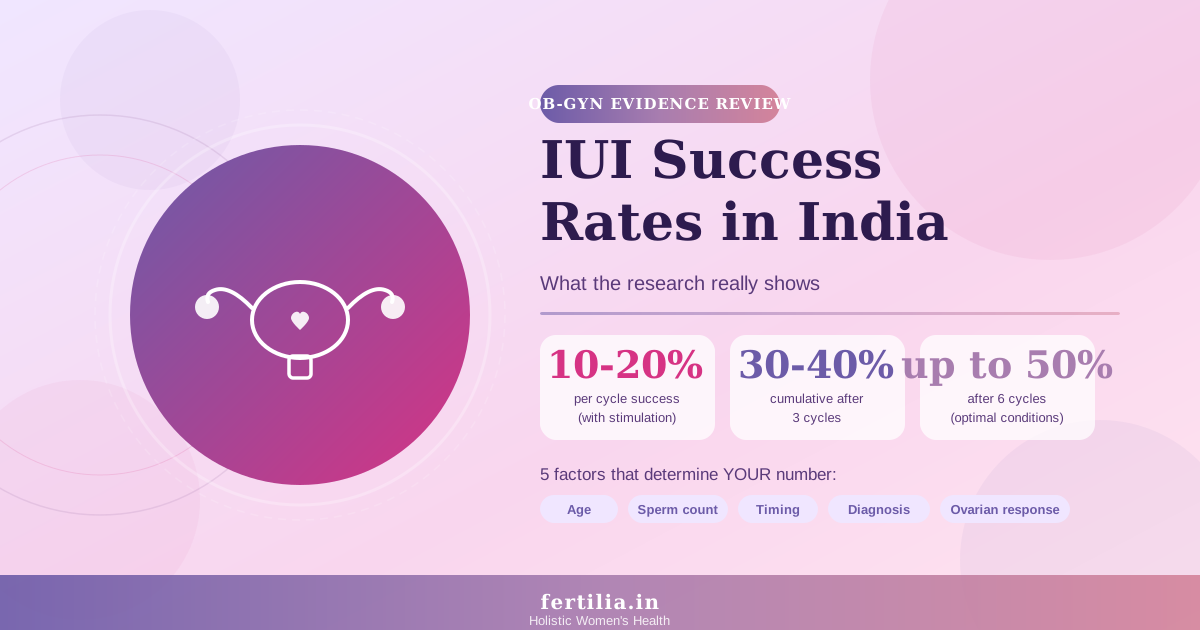
The most widely cited IUI success rate is 10-20% per cycle with ovarian stimulation. Without stimulation medications, a natural (unstimulated) IUI cycle comes in at roughly 8-10%.
These numbers come from large, peer-reviewed studies in journals like Human Reproduction and Fertility and Sterility, tracking thousands of IUI cycles across different patient populations.
But here is what most clinic brochures leave out: the 10-20% is an average that masks significant variation. Depending on your age, sperm parameters, diagnosis, and how well the cycle was monitored, your individual rate could be as high as 25% per cycle, or as low as 5%.
The Cumulative Picture
Single-cycle thinking is the wrong frame for IUI. The data that matters is cumulative:
- After 3 cycles: approximately 30-40% cumulative success
- After 6 cycles: up to 50% in the most favorable groups
Most IUI pregnancies occur within the first three cycles. If three well-monitored, well-timed cycles have not resulted in pregnancy, most fertility specialists will reassess and discuss whether IVF is the better path forward.
This is not a failure of IUI. It is exactly how the treatment is designed: a first-line option for specific diagnoses, not an indefinite protocol.
The 5 Factors That Matter Most
Your IUI success rate is not fixed. These are the factors your doctor will monitor, and in several cases, that you can actively support.
1. Your Age
Age has the single largest effect on IUI outcomes:
- Under 35: approximately 15-20% per cycle
- Age 35-40: approximately 10-12% per cycle
- Over 40: approximately 5-8% per cycle
This reflects the natural decline in egg quality and ovarian reserve over time. It is not a reflection of how hard you have tried or how healthy your lifestyle is. Understanding this helps calibrate expectations and decide how many cycles are reasonable before reassessing.
2. Total Motile Sperm Count After Washing
IUI works by placing washed sperm directly into the uterus, bypassing the cervix. The sperm count that predicts IUI outcomes is not the raw number in your partner’s semen analysis. It is the total motile sperm count (TMSC) after the washing procedure:
- Below 5 million TMSC: success rate drops significantly
- 5-10 million TMSC: reasonable IUI candidate
- Above 10 million TMSC: best outcomes for IUI
If your partner’s semen analysis showed low motility or count, ask your doctor specifically about TMSC after washing. This is the number that actually matters for IUI, not the pre-wash count on the report.
(For a full explanation of semen analysis results, see our guide on what your semen analysis report really means.)
3. Timing and the Trigger Injection
IUI is extremely time-sensitive. The optimal window for the procedure is 34-40 hours after the hCG trigger injection, which replicates the LH surge that induces ovulation.
Clinics that use careful transvaginal ultrasound monitoring to track follicle growth, time the trigger precisely, and confirm ovulation consistently outperform clinics using a fixed-day approach. This monitoring detail makes a measurable difference in outcomes, and it is worth asking your clinic about their specific protocol. If you are self-tracking alongside your clinic’s monitoring (which can help you notice early cycle shifts between visits), our guide on how to track ovulation at home compares the five most reliable methods.
4. Your Diagnosis
Not every fertility diagnosis responds equally to IUI:
- Unexplained infertility: Good candidate. IUI with stimulation is a well-established first step.
- Mild male factor infertility: Good candidate, particularly when TMSC after washing is adequate.
- PCOS with ovulation issues: IUI works well with stimulation to induce ovulation, though monitoring for over-response is essential.
- Blocked fallopian tubes: Not a candidate. At least one tube must be open for IUI to work. An HSG test confirms tubal patency before IUI is started.
- Severe male factor (very low count, poor morphology, azoospermia): IVF with ICSI is typically recommended instead.
Knowing your exact diagnosis is more useful than any population-level average. The question is not “what is the IUI success rate?” but “what is the IUI success rate for my diagnosis, at my age, with these sperm parameters?“
5. Ovarian Response to Stimulation
With ovarian stimulation (Clomiphene, Letrozole, or injectable gonadotropins), the goal is 1-2 dominant follicles. Having 2 follicles improves success slightly compared to 1; having 3 or more raises the risk of multiple pregnancy without proportionally improving live birth rates.
Your doctor will use serial ultrasound monitoring to track follicle development throughout the stimulation phase. On the day of the trigger injection, endometrial thickness should ideally be at least 7mm. Good endometrial lining is a key condition for implantation.
IUI and Your AMH Level
AMH (anti-Mullerian hormone) reflects your ovarian reserve. Low AMH does not make IUI impossible, but it does affect:
- How your ovaries respond to stimulation medications
- How many follicles develop per stimulated cycle
- The overall time horizon for IUI before reassessing
Women with very low AMH may respond poorly to stimulation, producing fewer follicles per cycle. This is one reason some specialists recommend moving to IVF earlier for women with significantly low AMH: IVF retrieves multiple eggs in a single cycle, rather than relying on one follicle at a time over sequential months.
For context on AMH numbers and what they mean for your fertility, see our guide on AMH test cost and results in India.
Preparing for an IUI cycle? Dr. Suganya works with couples before and during IUI cycles to optimize ovulation, improve sperm quality through targeted nutrition, and support endometrial health. A 30-minute consultation can clarify your specific numbers and what to address before your next cycle.
Book a consultation on WhatsApp
What You Can Do Between Cycles
IUI is a medical procedure, but the 28 days between cycles are not passive waiting time. Research consistently shows that nutritional status, body composition, and ovarian health influence IUI outcomes in measurable ways.
For women:
- Folate and B12: Essential for egg maturation and early implantation. Many Indian women are deficient in B12, especially if vegetarian.
- Vitamin D: Low Vitamin D is associated with reduced IUI success rates. India-wide studies confirm widespread Vitamin D deficiency even with sun exposure.
- Weight and insulin sensitivity: Excess weight and insulin resistance both impair ovarian response to stimulation. If PCOS is your diagnosis, managing insulin resistance is one of the highest-leverage steps you can take. (See our post on insulin resistance and PCOS for the specifics.)
- Thyroid function: TSH should ideally be below 2.5 mIU/L for women trying to conceive. An uncontrolled thyroid is a reversible factor that measurably reduces IUI success.
For your partner:
Sperm quality reflects the health cycle from 70-90 days ago. Changes made today affect sperm produced 3 months from now, which means the time between your current and next IUI cycle is a genuine opportunity.
Zinc, selenium, and antioxidants found in dal, sunflower seeds, pumpkin seeds, and dark leafy greens support motility and morphology. Reducing alcohol and eliminating smoking has a direct, documented effect on TMSC.
As a couple:
Couples who approach IUI as a joint preparation consistently report lower anxiety and better adherence to the lifestyle protocols that support outcomes. The research on partner-supported fertility interventions backs this up.
One of our patients had been recommended IUI after a failed follicular study. She shared with us: “Failed follicular study and IUI are other side of the story… We didn’t expect positive results this earlier.” After joining Fertilia’s fertility program to support her health between cycles, she conceived naturally before completing the IUI pathway.
Another patient with PCOD had been advised to consider laparoscopy and IUI. After attending a Fertilia webinar and beginning a structured diet and exercise program, she conceived naturally within one month, without needing the procedures.
These outcomes reflect specific individual circumstances. Your path may look different. What they demonstrate is that the months before and between IUI cycles are not medically neutral.
IUI vs IVF: When to Consider Moving Forward
One of the most common questions after failed IUI cycles is: when should I stop IUI and move to IVF?
The standard clinical guidance is 3-4 well-managed cycles before discussing IVF for most diagnoses. For women over 38, or women with significantly low AMH, some guidelines suggest reassessing after 2-3 cycles, since the time horizon is shorter.
Reasons to consider IVF earlier include:
- A diagnosis that typically requires IVF (blocked tubes, severe male factor, significant endometriosis)
- Poor or absent ovarian response to stimulation in previous IUI cycles
- Three or more IUI cycles with no pregnancy and no clear explanation
- Age-related urgency where monthly cycles are a finite resource
This is a conversation to have with your doctor using your specific cycle data, not a decision based on general timelines. Our guide on IUI vs IVF: when do you really need it walks through the clinical framework in detail, including the specific questions to raise at your next appointment.
What Makes a Clinic’s IUI Success Rate Higher
IUI success rates vary between clinics, and the differences are not random. Higher-performing programs typically have:
- Strict sperm washing protocols that optimize TMSC
- Transvaginal ultrasound monitoring for every stimulated cycle (not a fixed-day approach)
- Individualized stimulation dosing based on AMH and antral follicle count
- Clear criteria for cancelling a cycle when the response is poor
- Honest counselling about when to move from IUI to IVF
When you visit or call a fertility clinic, these are the questions worth asking: How do you monitor my cycle? What TMSC threshold do you require before proceeding? What is your cancellation policy for poor responders?
A clinic’s answer to these questions tells you more about their IUI success rate than any number on their website.
Practical Steps Before Your Next Cycle
If you are preparing for an upcoming IUI cycle or between cycles right now, here is what the evidence supports:
- Know your AMH and antral follicle count (AFC): These guide your doctor’s stimulation dose. If you haven’t tested recently, ask.
- Confirm tubal patency: An HSG or sonohysterography test confirms your tubes are open. IUI cannot succeed if both tubes are blocked.
- Check your thyroid: TSH below 2.5 mIU/L is the target for conception. This is a blood test that can be done and addressed before your next cycle.
- Address insulin resistance: If PCOS is your diagnosis, Metformin or lifestyle-based insulin management improves ovulation quality and IUI outcomes. See our guide on Metformin for PCOS for how this works.
- Review your partner’s sperm prep: Ask specifically about TMSC after washing in previous cycles. If it was low, 3 months of targeted nutrition support can shift it meaningfully.
The goal is not to override your doctor’s treatment plan. It is to show up to each IUI cycle in the best possible physiological state, giving the procedure the best conditions to work.
Ready to prepare for your IUI cycle with expert support? Dr. Suganya works with couples at every stage of fertility treatment, whether you are starting your first cycle or reassessing after multiple attempts.
Chat with Dr. Suganya on WhatsApp
Frequently Asked Questions
What is the IUI success rate per cycle in India? IUI success rates in India are consistent with global data: approximately 10-20% per cycle with ovarian stimulation, and 8-10% for natural (unstimulated) cycles. These averages vary significantly based on the woman’s age, sperm parameters, diagnosis, and quality of cycle monitoring. After 3 cycles, cumulative success reaches approximately 30-40%.
How many IUI cycles should I try before moving to IVF? Most fertility specialists recommend 3-4 IUI cycles before reassessing and discussing IVF, assuming each cycle was properly monitored and timed. For women over 38 or those with low AMH, doctors may suggest moving to IVF after 2-3 cycles to preserve time. The right number depends on your diagnosis, age, and how your ovaries responded to stimulation.
Does IUI hurt? Most women describe IUI as mild to moderate cramping, similar to period pain, during and briefly after the procedure. The procedure itself takes about 5-10 minutes. Lying down for 15-20 minutes afterward is typical protocol. Some women experience no discomfort at all.
Can I do anything to improve my IUI success rate? Yes. Several factors are within your influence: optimizing thyroid function, managing insulin resistance if you have PCOS, correcting Vitamin D and B12 deficiency, maintaining a healthy weight, and following a nutrition plan that supports ovarian health. Your partner’s sperm quality can also improve over 3 months with targeted dietary changes.
What happens if IUI fails? A failed IUI cycle provides useful clinical information. Your doctor will typically review the monitoring data, sperm parameters, and ovarian response before recommending the next step. This review often leads to adjustments in the stimulation protocol, timing, or a decision to move to IVF. It is part of the clinical process, not a dead end.
Is IUI cheaper than IVF in India? Yes. IUI in India typically costs between Rs. 8,000 and Rs. 25,000 per cycle, including monitoring and medications. IVF typically ranges from Rs. 1.5 lakh to Rs. 2.5 lakh per cycle. This cost difference makes IUI a clinically and financially reasonable first step for eligible couples before considering IVF.
Can PCOS affect IUI success? Yes, in two specific ways. First, ovulation is irregular or absent without stimulation in PCOS, so IUI must be combined with ovulation induction medications. Second, women with PCOS can over-respond to stimulation (too many follicles), which raises multiple pregnancy risk and may require cancelling the cycle. Well-monitored PCOS cycles with appropriate dosing achieve IUI success rates comparable to women without PCOS.