Is this implantation bleeding or my period? (Quick answer)
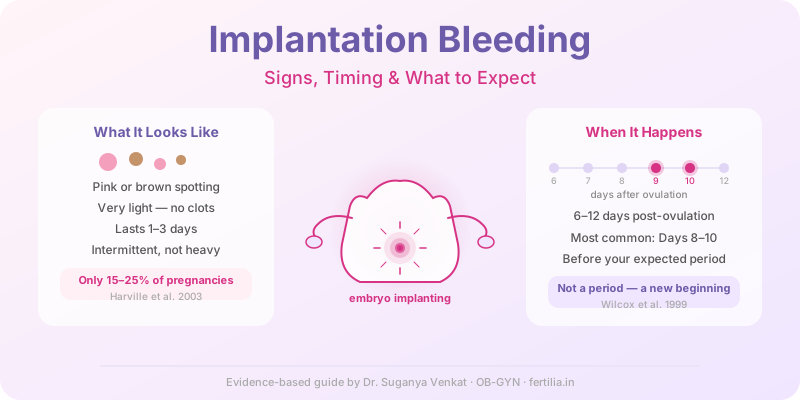
If the spotting is light pink or brown, lasts 1-3 days, has no clots, and appeared 6-12 days after ovulation (before your period is due), it is likely implantation bleeding. If the bleeding is bright red, builds in flow, lasts 4-7 days, and arrives when your period is expected, it is your period. Implantation bleeding is light enough that you won’t need a pad or tampon - it’s usually just a few spots when you wipe. Only 15-25% of pregnant women experience it (Harville et al., 2003), so not seeing it doesn’t mean you’re not pregnant. Wait until the day of your missed period, then take a home pregnancy test with first morning urine for the most reliable result.
You spot something when you wipe. A little pink. Maybe brownish. Your period isn’t due for another week, and your heart does a small skip, could this be it?
If you’re trying to conceive, that moment of noticing unexpected spotting can feel enormous. Is it implantation bleeding? Is it your period arriving early? Should you test?
The good news: implantation bleeding is one of the most recognisable early pregnancy signs once you know what to look for. In this guide I’ll walk you through exactly what it looks like, when it happens, how to tell it apart from your period, and what to do next.
What Is Implantation?
After an egg is fertilised in the fallopian tube, it travels toward the uterus over 3–4 days. It arrives as a blastocyst (a tiny ball of cells) and begins the process of implantation: burrowing into the lining of the uterus (the endometrium) to establish a connection with your blood supply.
This burrowing is what can cause a small amount of bleeding. As the embryo embeds itself into the endometrial lining, it disrupts some of the tiny blood vessels there. That blood makes its way out (slowly, in small amounts) as what we call implantation bleeding.
It is entirely normal. It is not a sign that something is wrong. It is your uterus doing exactly what it is supposed to do.
Research by Wilcox et al. (1999), published in the New England Journal of Medicine, established that implantation occurs most commonly between 8 and 10 days after ovulation, with the range spanning 6 to 12 days. Harville et al. (2003) confirmed in a prospective study that implantation bleeding (defined as spotting around implantation time) is reported by approximately 15–25% of pregnant women: which means the majority of pregnant women do not experience it at all. If you don’t notice any spotting, that is completely normal and does not mean implantation didn’t happen.
What Does Implantation Bleeding Look Like?
This is the most important section for women who are wondering whether what they’re seeing is implantation bleeding or something else. Here are the key characteristics:
Colour
Implantation bleeding is typically pink, light red, or brown: not bright red. The brownish colour happens because the blood takes longer to travel from the uterus to outside your body compared to period blood. Older blood oxidises and turns brown. A pink tinge means the blood is fresher but still in small quantity.
Bright red blood that flows consistently is more characteristic of a period.
Flow
The volume is very light: often just a few spots on your underwear or a faint smear when you wipe. It is not enough to fill a pad or tampon. Many women describe it as barely noticeable, or notice it only when they check.
There are no clots. Period blood can contain small clots, especially on heavier days, implantation bleeding does not.
Duration
Implantation bleeding typically lasts 1–3 days. Some women notice it for only a few hours. It does not progress, it stays light and then stops. A period, by contrast, typically increases in flow over the first 1–2 days before decreasing.
Consistency
Implantation bleeding is intermittent: you might see a little spotting, then nothing, then a faint trace again. It does not have the consistent, building flow of a period.
When Does Implantation Bleeding Happen?
Timing is one of the most reliable ways to distinguish implantation bleeding from a period.
Based on Wilcox et al. (1999), implantation most commonly occurs 6–12 days after ovulation, with the most common window being 8–10 days post-ovulation. If you have a standard 28-day cycle and ovulate around Day 14, this means implantation bleeding would most likely appear between Day 20 and Day 26 of your cycle, roughly 4 to 10 days before your expected period.
If you track your ovulation (using LH strips, basal body temperature, or cervical mucus), you can calculate this window quite precisely. If you don’t currently track ovulation, this is a good reason to start, it gives you so much more information about your cycle. You can learn more about how to track ovulation.
The key distinction: If the bleeding appears right when your period is due and behaves like a period (builds up, is red, lasts 4–7 days), it is almost certainly your period. If it appears several days before your expected period, is light pink or brown, and lasts only 1–3 days, implantation bleeding is a real possibility.
Implantation Bleeding vs Period. The Key Differences
| Feature | Implantation Bleeding | Menstrual Period |
|---|---|---|
| Colour | Pink, light red, or brown | Bright red, deepening over days |
| Flow | Very light, spots only (won’t fill a pad) | Light to heavy; builds up |
| Duration | 1-3 days (often just hours) | 4-7 days typically |
| Amount | A few spots when wiping | Enough to soak pads/tampons |
| Clots | None | Possible, especially on Day 2-3 |
| Pattern | Intermittent, appears and stops | Consistent, progressive flow |
| Timing | 6-12 days after ovulation (before period due) | On expected period date |
| Cramping | Mild, one-sided (if any) | Central, builds in intensity |
| Breast changes | Tenderness may start | Tenderness usually decreasing |
| Temperature | BBT stays elevated (triphasic pattern) | BBT drops as period begins |
| Accompanied by | Possible early pregnancy symptoms | PMS symptoms |
Use this table as a guide, not an absolute rule. Bodies vary, and some women have naturally light periods that can look similar. If you’re unsure, the pregnancy test is always the most reliable answer, and timing matters (more on this below).
Have questions about early pregnancy signs? WhatsApp Dr. Suganya →
Implantation Cramping
Along with bleeding, some women experience what is called implantation cramping, mild discomfort that happens when the embryo embeds into the uterine wall.
What it feels like:
- Mild, dull ache, not sharp or severe
- Often felt on one side (the side where implantation occurred), rather than centrally across the lower abdomen
- May feel more like a gentle pressure or a flicker rather than a true cramp
- Brief, typically lasting a few hours to 1–2 days
How it differs from period cramping: Period cramps are typically felt centrally, across the lower abdomen and sometimes radiating to the lower back, and they build in intensity. They are caused by uterine contractions driven by prostaglandins. Implantation cramping is more localised and considerably milder.
It’s worth noting that not all one-sided pelvic pain is implantation cramping. If you experience sharp, severe one-sided pain: particularly with shoulder tip pain or dizziness, seek medical attention promptly, as this can indicate an ectopic pregnancy. But mild, brief one-sided discomfort around the time of expected implantation, accompanied by light spotting, is reassuring.
Other Early Pregnancy Symptoms That May Appear Together
Implantation is the first event in a cascade of hormonal changes. As the embryo implants and begins producing hCG (human chorionic gonadotropin), your body starts responding. Some women notice very early symptoms even before a positive pregnancy test:
- Breast tenderness or fullness: often described as heavier or more sensitive than pre-period breast changes
- Fatigue: progesterone levels rise sharply after implantation, and many women feel unusually tired
- Mild nausea: typically more noticeable from 6 weeks onwards, but some women feel subtle queasiness earlier
- Increased urination: hCG affects kidney blood flow, prompting more frequent trips to the bathroom
- Bloating: progesterone slows digestion, causing a full or bloated feeling
- Heightened sense of smell: some women notice this very early, before even missing a period
- Mood changes: hormonal shifts affect neurotransmitters; you may feel more emotional or irritable
- A missed period: the most reliable sign, and the trigger for most women to test
These symptoms overlap significantly with premenstrual symptoms, which is why it’s so hard to know for certain before you test. The absence of these symptoms doesn’t rule out pregnancy, and their presence doesn’t confirm it, the test does.
For women over 30 who are actively trying to conceive, understanding these early signs and knowing when to test (and when to seek support) is particularly valuable. See our guide on tips for getting pregnant after 30 for more context.
When to Take a Pregnancy Test
This is one of the most common questions I receive, and the answer is more nuanced than “wait until your missed period” (though that remains the most reliable guidance).
How home pregnancy tests work: They detect hCG in urine. After implantation, hCG levels begin doubling every 48–72 hours. Most standard tests can detect hCG at 25 mIU/mL; early-result tests may detect as low as 10 mIU/mL.
If implantation occurred on Day 8 post-ovulation, hCG may be detectable in urine around Day 12–14 post-ovulation, roughly when your period is due. If implantation occurred later (Day 10–12), hCG may not reach detectable levels until a day or two after your expected period.
My recommendation:
- Wait until the first day of your missed period for the most reliable result
- If you test earlier and see a negative result, test again 2 days later, hCG may simply not be high enough yet
- Test with first morning urine: it is the most concentrated
- A faint line is still a line; hCG is present and detectable
The anxiety of the two-week wait is real. Testing too early can lead to false negatives and unnecessary distress. Give your body the time it needs.
When to See a Doctor
Most early pregnancy symptoms (including implantation bleeding) are completely normal and don’t need urgent attention. But there are some situations where calling your doctor is the right move.
Reach out to your doctor if you notice:
- Heavy bleeding at any point in early pregnancy, soaking a pad in an hour warrants assessment
- Bright red bleeding that continues or increases beyond 3 days, especially if accompanied by cramping
- Sharp, severe one-sided pain, particularly with shoulder tip discomfort or feeling faint, this can indicate an ectopic pregnancy, which needs urgent evaluation
- Fever or chills alongside any bleeding or pelvic pain
- A positive pregnancy test followed by heavy bleeding: this can indicate a very early pregnancy loss (sometimes called a chemical pregnancy), and your doctor can support you through this
Remember: reaching out to a doctor is always an act of self-care, not an overreaction. If something feels off, trust your instincts.
Frequently Asked Questions
Can implantation bleeding happen on the same day as an expected period?
Yes, this is possible. If your luteal phase is on the shorter end, implantation can occur close to when your period would be due. The distinguishing factors remain the same: colour (pink or brown rather than red), very light flow, short duration (1–3 days), and no clots. A pregnancy test will clarify things once enough time has passed for hCG to build up.
I had implantation bleeding but my pregnancy test is negative. What does this mean?
It may simply be too early to test. If implantation just occurred, hCG levels may not yet be high enough to detect. Wait 48–72 hours and retest with first morning urine. Alternatively, what you experienced may have been early spotting from another cause, mid-cycle spotting, cervical sensitivity, or the very beginning of your period. A repeat test and, if needed, a conversation with your doctor will give you clarity.
Is implantation bleeding more common in certain women?
There’s no strong evidence that implantation bleeding is more common in women with particular conditions or cycle types. It appears to be largely individual variation in how the embryo embeds and how the endometrium responds. Some women experience it with every pregnancy; others never do. Neither pattern is a marker of pregnancy health.
Can implantation bleeding be heavy?
No, if bleeding is heavy enough to resemble a period or requires a pad, it is not implantation bleeding. Implantation bleeding is definitively light. Heavy early pregnancy bleeding warrants a conversation with your doctor.
I’m trying to conceive and I’ve never experienced implantation bleeding. Should I be concerned?
Not at all. As noted above, only 15–25% of pregnant women experience implantation bleeding (Harville et al., 2003). The majority of healthy pregnancies proceed with no bleeding whatsoever at implantation. Absence of implantation bleeding says nothing about whether implantation occurred or whether the pregnancy is healthy.
How is implantation bleeding different from a threatened miscarriage?
Both can cause spotting or light bleeding in early pregnancy. The key differences: implantation bleeding occurs before a positive pregnancy test (or very close to when you’d first test), is light pink or brown, and lasts 1–3 days. A threatened miscarriage typically involves bleeding after a confirmed pregnancy, may include cramping, and your doctor will assess it with an ultrasound and hCG blood tests. If you have a confirmed pregnancy and start bleeding, always contact your doctor.
I’m on Day 24 of a 28-day cycle and seeing light pink spotting. Could this be implantation?
Yes, this is a classic implantation bleeding timeline. If you ovulated around Day 14 (typical for a 28-day cycle), Day 24 is 10 days post-ovulation, right in the peak implantation window (8-10 days post-ovulation per Wilcox et al., 1999). If the spotting is light pink or brown, doesn’t fill a pad, and stops within 1-3 days, it could be implantation bleeding. Wait until Day 29 (one day after your expected period) and test with first morning urine.
Can implantation bleeding look like a light period?
Very rarely. In a few cases, implantation bleeding can be slightly heavier than typical spotting, resembling the very first or very last day of a light period. But if the bleeding builds in flow, turns bright red, lasts more than 3 days, or includes clots, it is almost certainly your period, not implantation bleeding. The key distinguishing factor is progression: period bleeding builds up, implantation bleeding stays light and stops.
I had spotting at 8 DPO (days past ovulation). When should I test?
If you spotted at 8 DPO, the earliest you could get a reliable positive is around 11-12 DPO, which is 3-4 days after the spotting. This is because hCG needs time to build to detectable levels (25 mIU/mL for standard tests, 10 mIU/mL for early-result tests). For the most reliable result, wait until 14 DPO (the day your period is due) and use first morning urine. Testing earlier risks a false negative that causes unnecessary anxiety.
You Are Paying Attention. That Already Matters
Noticing the small things, a little spotting, a change in how you feel, a sense that something might be different, is a form of body literacy that serves you well throughout your fertility and pregnancy journey. It means you are engaged with your own health.
Whether that faint pink smear turns into a positive test or not, you are learning your cycle. And that knowledge compounds over time. (And if the test is positive, our pregnancy diet chart covers exactly what to eat in each trimester.)
If you’re actively trying to conceive, whether naturally or working through challenges like PCOS, irregular cycles, or unexplained delays, personalised guidance makes the journey far less overwhelming. Every woman’s situation is different, and the plan that works is the one built around your specific body and history.
💗 Trying to conceive and not sure what your symptoms mean? Dr. Suganya offers personalised consultations for women at every stage of their fertility journey. Start a conversation on WhatsApp, she’ll help you make sense of what your body is telling you.
References
- Wilcox AJ et al. (1999). Timing of sexual intercourse in relation to ovulation, effects on the probability of conception, survival of the pregnancy, and sex of the baby. New England Journal of Medicine. 333(23):1517-21.
- Harville EW et al. (2003). Vaginal bleeding in very early pregnancy. Human Reproduction. 18(9):1944-7.
- Wilcox AJ et al. (1999). Natural limits of pregnancy testing in relation to the expected menstrual period. JAMA. 280(17):1507-10.
- Cole LA (2010). Biological functions of hCG and hCG-related molecules. Reproductive Biology and Endocrinology. 8:102.
- American College of Obstetricians and Gynecologists (ACOG). Early Pregnancy Loss. Practice Bulletin No. 200. Obstet Gynecol. 2018;132(5):e197-e207.