You finally get your beta hCG report back. The lab printout has a number. Below it sits a reference range that spans five orders of magnitude: something like “5 to 100,000 mIU/mL.” You call the clinic. They say the value looks fine. But you still don’t know whether your specific number is good, why it’s different from the number someone in your fertility WhatsApp group got at the same week, or what happens if it doesn’t double.
That uncertainty is exactly what this post addresses.
What Is Beta hCG, and Why Does It Matter?
Human chorionic gonadotropin (hCG) is a hormone produced by the cells that will become the placenta. It begins to be secreted within a day or two of implantation, which typically happens six to ten days after ovulation. (For a closer look at that process, see our guide on Implantation Bleeding: Signs, Timing and What to Expect.)
There are two types of hCG tests:
- Qualitative (urine or blood): Gives a simple positive or negative result. A home pregnancy test is qualitative.
- Quantitative (blood only): Measures the exact amount of hCG in your blood in milli-international units per millilitre (mIU/mL). This is what is called the “beta hCG” or “b hCG” test, and it is what your doctor orders when they need to monitor your pregnancy closely rather than just confirm its presence.
The quantitative test is far more informative, but only when you understand what to look for.
Why One Number Is Almost Never Enough
This is the most important thing to understand about beta hCG: a single measurement, taken once, tells you relatively little.
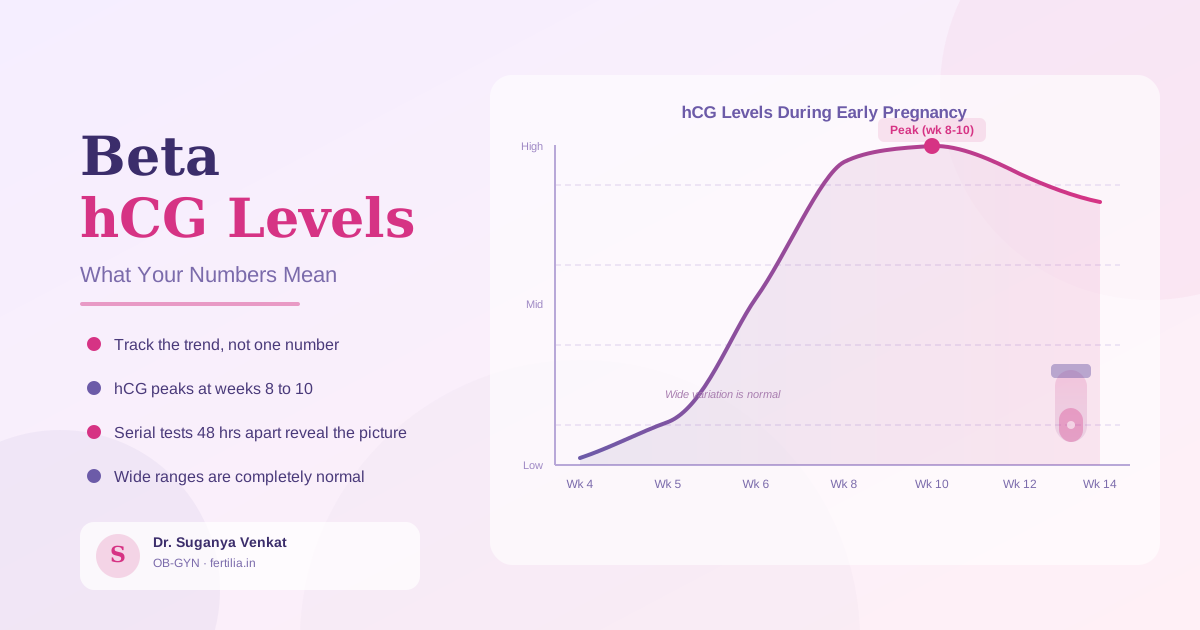
What matters far more is the trend. Is the number rising appropriately? Is it staying flat? Is it falling? Two measurements taken 48 hours apart give your doctor a much clearer picture of how the pregnancy is progressing than any single value can provide.
This is why your doctor will almost always order a repeat beta hCG two days after the first one, especially if your ultrasound is not yet conclusive or if you have any symptoms that need monitoring. If your clinic orders only one test and you feel uncertain about the result, it is entirely reasonable to ask whether a repeat at 48 hours would add clarity.
Beta hCG Levels by Week
The table below shows typical hCG ranges for each stage of early pregnancy, measured in mIU/mL. These are reference ranges, not diagnostic cutoffs. There is wide and entirely normal variation between individual women.
| Weeks from LMP | Typical hCG Range (mIU/mL) |
|---|---|
| 3 to 4 weeks | 9 to 130 |
| 4 to 5 weeks | 75 to 2,600 |
| 5 to 6 weeks | 850 to 20,800 |
| 6 to 7 weeks | 4,000 to 100,200 |
| 7 to 8 weeks | 11,500 to 289,000 |
| 8 to 12 weeks | 18,300 to 137,000 |
| 12 to 16 weeks | 13,300 to 254,000 |
Reference ranges drawn from standard clinical laboratory references and obstetric practice guidelines. Individual lab ranges may differ based on the assay used. Always refer to the range printed on your own report.
hCG peaks somewhere between eight and twelve weeks, then gradually declines and levels off. By the second trimester, a lower hCG level is entirely normal and expected.
Three important caveats about this table:
1. The ranges are wide on purpose. A woman with 500 mIU/mL at five weeks is not in a worse position than someone with 5,000 mIU/mL at the same stage, as long as both values are rising appropriately. Absolute levels vary enormously between healthy pregnancies.
2. Your lab may use slightly different ranges. Reference intervals are set by individual laboratories based on their assay and their local population. Always compare your values to the reference range printed on your own report, not to a number from the internet.
3. Weeks are counted from your last menstrual period, not from conception. If your cycles are irregular, the correlation between your dates and your hCG level may be off by a week or two. This is entirely normal, and your doctor will take your cycle length into account when interpreting results.
The Doubling Rule: What It Means and What It Does Not
You have likely heard that hCG should “double every 48 hours” in early pregnancy. This is a useful shorthand, but the research tells a more nuanced story.
A landmark study by Barnhart and colleagues (published in Obstetrics and Gynecology, 2004) found that in viable intrauterine pregnancies, hCG needs to increase by at least 53 to 66 percent over 48 hours, not necessarily double. An increase of this size is reassuring. A rise that is significantly below this threshold warrants further investigation.
What this means in practice:
- A rise from 200 to 400 mIU/mL in 48 hours (100% increase): reassuring
- A rise from 200 to 320 mIU/mL (60% increase): still within the range seen in viable pregnancies
- A rise from 200 to 220 mIU/mL (10% increase): worth following closely
- A fall in hCG: your doctor needs to assess this with an ultrasound and full clinical context
The key point is that a “less than double” result is not automatically a problem. Your doctor will interpret the rate of rise together with your ultrasound findings and your symptoms, not in isolation.
Also note that the doubling rule applies mainly to early pregnancy, roughly before seven to eight weeks. After eight weeks, hCG naturally begins to slow its rise and then declines, so a slowing rate of increase in the second month of pregnancy is expected, not worrying.
When hCG Numbers Need Closer Attention
The following patterns are ones your doctor will want to investigate further. This section is not meant to alarm you. These are clinical signals that prompt the right follow-up, not automatic confirmations of a problem.
Slow rise (less than 53% in 48 hours)
A slower than expected rise needs to be assessed in context. In early pregnancy before a gestational sac is visible on ultrasound, a slow rise can occasionally indicate a pregnancy in the fallopian tube rather than the uterus (ectopic pregnancy), a pregnancy that is not progressing, or, less commonly, a normal pregnancy with unusual timing. Your doctor will combine the hCG trend with a transvaginal ultrasound to understand what is happening.
Very rapid rise
An unusually rapid rise in hCG, particularly reaching very high levels very quickly, is sometimes seen in molar pregnancies, a rare condition where abnormal placental tissue grows without a viable embryo. Your doctor will check for this with an ultrasound.
Falling hCG after a confirmed pregnancy
A falling level after a pregnancy has been confirmed is something your doctor needs to assess with imaging and clinical review. It does not always mean the same thing, and the clinical response depends on what the ultrasound shows and what symptoms you have.
Plateauing hCG
An hCG level that is not rising or falling but staying flat needs further monitoring. This is another pattern your doctor will interpret alongside the ultrasound picture and your clinical presentation.
In all of these situations, the right next step is a conversation with your doctor, not a Google spiral at midnight. If you need someone to walk through what your specific numbers mean for your situation, see the CTA below.
If you have just received your beta hCG report and you are not sure what the numbers mean for your fertility journey, Dr. Suganya Venkat is available for a personalised consultation.
She works with couples who are trying to conceive naturally, preparing for IUI or IVF, or monitoring early pregnancy after fertility treatment.
WhatsApp Dr. Suganya directly: wa.me/919940270499
How Beta hCG Works Alongside Ultrasound
Beta hCG and ultrasound work together rather than independently. There is a concept called the “discriminatory zone,” which is the hCG level above which a gestational sac should normally be visible on a transvaginal ultrasound in a healthy intrauterine pregnancy. Most clinicians use a discriminatory zone of around 1,500 to 3,000 mIU/mL, though individual labs and institutions set their own thresholds.
If your hCG is above this level and no gestational sac is visible inside the uterus, your doctor will investigate further to rule out an ectopic pregnancy.
If your hCG is below this level, it may simply be too early to see anything on ultrasound, and a repeat scan five to seven days later, once hCG has risen further, will give a clearer picture.
This is why your doctor will often say “let us repeat in a week” when the first ultrasound is inconclusive. It is not because something is wrong. It is because the biology needs a little more time to show itself clearly.
Practical Steps for Women Tracking Beta hCG
Here are the practical steps that make sense when you have a beta hCG result in hand:
Do not compare your numbers with others. The range of hCG in healthy pregnancies is so wide that comparison between individuals is almost never useful. A number from someone in your WhatsApp group at the same week has no bearing on yours.
Ask for serial measurements. If your first result is inconclusive or your ultrasound is too early to be definitive, ask your doctor to schedule a repeat beta hCG 48 hours later. The trend is what matters.
Pair the test with an ultrasound at the right time. An ultrasound done before hCG reaches approximately 1,500 to 2,000 mIU/mL may show nothing inside the uterus, which can be misread as a problem. Talk to your doctor about the right timing for your first scan.
Report symptoms promptly. One-sided pelvic pain, shoulder tip pain, or heavy bleeding in early pregnancy are symptoms that need same-day assessment regardless of what your hCG number shows.
Do not use home pregnancy tests to track levels. Home tests are qualitative, not quantitative. They can appear darker as hCG rises, but they are not a reliable substitute for a blood test. Using them to “monitor” a trend is not clinically accurate.
Write down both values and the time between them. When you go in for a repeat test, bring your first result and note the exact time it was collected. The calculation of percentage rise depends on the time interval being accurate.
Beta hCG After IUI or IVF
If you are tracking beta hCG as part of a fertility treatment cycle, the interpretation is slightly different. After an IUI or embryo transfer, your clinic will typically schedule a beta hCG test 10 to 14 days after the procedure. A positive result at this stage is then confirmed with serial measurements to ensure the rise is appropriate before the first ultrasound is scheduled.
Treatment-related pregnancies are monitored more closely in the early weeks, which means more blood tests and more data points. This is a good thing: you get more information faster, and your clinical team can act quickly if the trend needs attention.
For context on what the fertility treatment pathway looks like, our post on IUI vs IVF: When Do You Really Need It? covers how fertility specialists decide on next steps when natural conception has not happened. If you are still in the planning phase, How to Get Pregnant Fast: Evidence-Based Guide covers timing and lifestyle factors for natural conception. For a real example of what a beta hCG positive looks like after a natural conception journey against the odds, read Deepa’s story, AMH 0.62, multiple failed OI cycles, conceived naturally in 3 months.
FAQ: Beta hCG Questions
What is considered a positive beta hCG level?
Any level above 5 mIU/mL is generally considered a positive result, confirming that hCG-producing pregnancy tissue is present. Values between 5 and 25 mIU/mL are sometimes reported as “borderline,” and your doctor will usually confirm with a repeat test 48 hours later.
Can beta hCG be elevated without a pregnancy?
Yes, in rare circumstances. Very uncommon causes of elevated hCG in a non-pregnant woman include certain tumours (germ cell tumours or gestational trophoblastic disease) and a laboratory phenomenon called “phantom hCG,” caused by a cross-reacting antibody in the blood. If your hCG is consistently elevated with no pregnancy visible on ultrasound, your doctor will investigate further to identify the cause.
How long after implantation can beta hCG be detected in blood?
Implantation typically occurs six to ten days after ovulation. After implantation, hCG becomes detectable in blood within one to two days, and in urine a few days later. The earliest a blood test can reliably confirm pregnancy is around ten to twelve days after ovulation, which corresponds to approximately four weeks from your last menstrual period.
What does “not detected” mean on a beta hCG report?
“Not detected” means the hCG level is below the minimum threshold for your lab’s assay, usually less than 2 to 5 mIU/mL. In someone who has not had a recent pregnancy, this is a normal baseline. If you are testing after a pregnancy loss or treatment cycle, falling to an undetectable level is the expected endpoint: it confirms that hCG-producing tissue is no longer present and your body is returning to its hormonal baseline.
My doctor ordered a qualitative hCG. How is this different from a quantitative test?
A qualitative hCG gives a simple positive or negative. It detects whether hCG is above a certain threshold but does not give you a number. A quantitative (or “beta”) hCG gives the exact level in mIU/mL. Doctors order the quantitative test when they need to monitor how a pregnancy is progressing, not just confirm its presence.
If my hCG doubled perfectly, does that mean everything is fine?
A rising hCG is a very positive sign, but it does not guarantee a healthy intrauterine pregnancy on its own. An ectopic pregnancy can also cause a rising hCG, sometimes at a slower rate than expected. The combination of a rising hCG together with a visible intrauterine gestational sac on ultrasound is what gives the most complete picture of a healthy, progressing pregnancy.
My lab report says “b hCG.” Is this the same test?
Yes. “b hCG,” “beta hCG,” “quantitative hCG,” and “serum hCG” are all names for the same blood test measuring the amount of hCG in your blood. The “beta” refers to the specific subunit of the hormone that these assays measure, which is unique to hCG and not shared with other hormones like LH or FSH.
What to Do With a Result You Don’t Fully Understand
Beta hCG numbers are one piece of a larger clinical picture. The most useful thing you can do with a result you don’t understand is talk to a doctor who can interpret it in the context of your full history: your cycle length, your ultrasound findings, your symptoms, and your fertility timeline.
What these numbers can tell you, when interpreted correctly, is genuinely reassuring. A steadily rising hCG in the first weeks of pregnancy is one of the most reliable early signs that the pregnancy is moving in the right direction. Understanding that, rather than staring at a number in isolation, is the goal.
Dr. Suganya Venkat, OB-GYN with 15+ years of clinical experience, helps women in early pregnancy and those trying to conceive understand exactly where they stand and what their next step should be.
Start the conversation on WhatsApp: wa.me/919940270499
You don’t need to figure this out alone.
Dr. Suganya Venkat is an OB-GYN with 15+ years of clinical experience. DNB OB-GYN (GKNM, Coimbatore) · MD Pathology (CMC Vellore) · MBBS with 5 Gold Medals (SRMC). She consults in Coimbatore and via WhatsApp for women across India.