You receive your progesterone test result. The lab range printed on the report reads 11 to 90 ng/mL for the first trimester. Your value is 18 ng/mL. You are well within range. And yet someone in your fertility WhatsApp group posted 62 ng/mL at the same week, and now you are wondering whether 18 is something to worry about.
It is not. But the fuller explanation of why not is more useful than just that reassurance.
This post covers what progesterone actually does during pregnancy, where it comes from and when, what the reference ranges mean in practice, and what your doctor is and is not looking for when they order this test.
Here is what we will cover:
- What progesterone does and why it matters in early pregnancy
- Where progesterone comes from (and how that changes around week 12)
- Normal progesterone levels by trimester
- What a low reading actually means, and what it does not mean
- When doctors prescribe progesterone supplements in India
- Simple lifestyle factors that support healthy progesterone
What Progesterone Does in Pregnancy
Progesterone is a steroid hormone that plays several roles in establishing and maintaining a pregnancy.
Before conception, progesterone rises after ovulation to prepare the uterine lining (endometrium) for implantation. If a fertilised egg arrives, progesterone continues rising to support that lining. If no egg implants, progesterone drops and the lining sheds as a period.
Once pregnancy begins, progesterone does the following:
Maintains the uterine lining. The endometrium needs continued progesterone support to remain thick and vascular enough to nourish the developing embryo before the placenta takes over.
Prevents premature contractions. Progesterone keeps the uterine muscle relaxed. This is why it is sometimes described as the “pregnancy-maintaining hormone.”
Modulates the immune response. Your body would normally treat an embryo as foreign tissue. Progesterone helps suppress the local immune response so the embryo can implant and grow without being rejected.
Supports cervical mucus. It makes cervical mucus thicker, which reduces the risk of infection ascending into the uterus.
Where Progesterone Comes From: The Corpus Luteum and the Placenta
Understanding the source of progesterone matters because it explains why your levels change so much across the trimesters.
After ovulation, the follicle that released the egg collapses and transforms into a small gland called the corpus luteum. This gland produces progesterone throughout the second half of every menstrual cycle.
When pregnancy occurs, the early placental cells (trophoblast) secrete beta hCG. That beta hCG signal is what keeps the corpus luteum alive and producing progesterone past the point where it would normally stop. (For a full explanation of how hCG works in early pregnancy, see our guide on Beta hCG Levels by Week: Normal Ranges and What Your Result Means.)
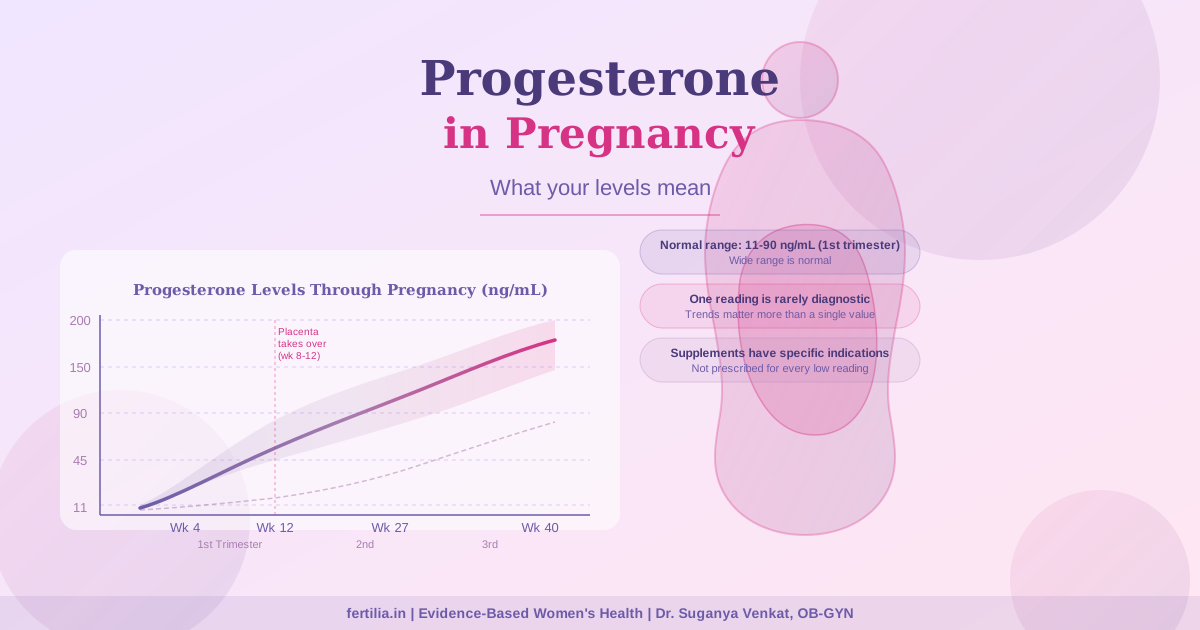
Between weeks 8 and 12, something called the luteal-placental shift occurs. The placenta gradually takes over progesterone production from the corpus luteum. By the end of the first trimester, the placenta is the primary source of progesterone, and the corpus luteum is no longer essential.
This transition is important for one specific reason: before week 8 to 10, any problem with the corpus luteum can affect progesterone levels. After week 12, the placenta is largely self-sufficient, and corpus luteum concerns are no longer relevant. This is why progesterone monitoring is most clinically meaningful in the early first trimester, not the second or third.
Normal Progesterone Levels by Trimester
The table below shows typical progesterone reference ranges during pregnancy. Values are expressed in nanograms per millilitre (ng/mL). Some labs report in nmol/L: multiply ng/mL by 3.18 to convert.
| Trimester | Weeks of Pregnancy | Typical Reference Range |
|---|---|---|
| First trimester | Weeks 1 to 12 | 11 to 90 ng/mL |
| Second trimester | Weeks 13 to 27 | 25 to 90 ng/mL |
| Third trimester | Weeks 28 to 40 | 48 to 200 ng/mL |
Reference ranges drawn from standard obstetric laboratory references. Individual lab ranges vary based on assay method. Always refer to the range on your own report.
Three things to note about this table:
The first-trimester range is extremely wide on purpose. A woman with 18 ng/mL at 7 weeks is not in a worse position than a woman with 65 ng/mL at the same stage, as long as both readings are appropriate for their individual pregnancy progression. The biological variability between healthy pregnancies is large.
Progesterone does not follow a predictable weekly doubling pattern. Unlike beta hCG, which roughly doubles every 48 hours in early pregnancy, progesterone rises more gradually and unevenly. There is no week-by-week expected level to compare yourself to.
Your absolute number matters far less than the context around it. A single value, read in isolation, tells your doctor relatively little. What matters is whether it is appropriate for your gestational age, what your beta hCG is doing, and what the ultrasound shows. Taken together, these three things give a clear picture.
What Low Progesterone Actually Means
“Low progesterone” is a term that gets used loosely, and the clinical reality is more nuanced than the phrase suggests.
Below 5 ng/mL in early pregnancy is a finding that warrants attention. Values this low in the first trimester are associated with non-viable pregnancies, including ectopic pregnancy (where the embryo has implanted outside the uterus) and pregnancies that are failing. Your doctor will order a repeat hCG test and an early ultrasound alongside any progesterone in this range. If you have not yet seen our guide on Ectopic Pregnancy: Signs and What to Expect, it is worth reading if your doctor is monitoring you closely.
Between 5 and 10 ng/mL is a borderline range. Some pregnancies with levels in this range go on to be entirely healthy; others do not. Serial monitoring over several days, alongside hCG trends and an ultrasound, is how your doctor will assess the situation.
Between 10 and 25 ng/mL is a range where many clinicians in India will monitor, and some will prescribe progesterone support as a precaution, particularly if there is any bleeding or a history of previous pregnancy loss. But a reading in this range, without bleeding and with a normally rising hCG, is not evidence of a failing pregnancy.
One critical point: in many cases, a low progesterone reading does not mean the progesterone fell first and then caused a problem. It often means the progesterone fell because the pregnancy was already failing for another reason, most commonly a chromosomal error in the embryo. Supplementing progesterone in those cases does not change the outcome. This is why your doctor looks at the full picture rather than treating a number in isolation.
For more on the most common reason early pregnancies end, see our guide on Miscarriage: Causes, Signs and Recovery.
If you have already experienced an early pregnancy loss and have questions about whether progesterone monitoring or support is right for your next pregnancy, this is exactly the kind of conversation to have with Dr. Suganya directly.
Talk to Dr. Suganya on WhatsApp
When Doctors Prescribe Progesterone Supplements in Pregnancy
Progesterone supplementation is not a universal prescription for any borderline reading. It is used for specific, evidence-supported indications.
After IVF or IUI cycles. This is the most common use of progesterone supplementation in Indian fertility clinics. The hormonal stimulation drugs used in these cycles suppress the corpus luteum’s ability to produce progesterone naturally. Because the corpus luteum is no longer functioning properly, the early post-transfer pregnancy has no natural progesterone support unless it is given externally. Progesterone supplementation in this context is standard of care, not optional.
Threatened miscarriage with a previous pregnancy loss. A landmark study called the PRISM trial (Coomarasamy et al., New England Journal of Medicine, 2019) showed that vaginal progesterone supplementation in women who were bleeding in early pregnancy and had at least one previous pregnancy loss significantly improved live birth rates compared to placebo. This is a specific population: first-trimester bleeding plus prior loss. Not every woman with low progesterone, and not every woman who has had a miscarriage without current bleeding.
Luteal phase deficiency. In some women, the corpus luteum does not produce adequate progesterone after ovulation even in natural cycles. This is confirmed through timed blood tests across a cycle, not a single reading taken in pregnancy.
Recurrent pregnancy loss investigations. Women who have had three or more losses are sometimes placed on progesterone support in subsequent pregnancies while investigations are ongoing, as a precaution.
Types of Progesterone Supplements Available in India
If your doctor recommends progesterone supplementation, you are likely to be prescribed one of these options:
Vaginal micronized progesterone: Brands include Susten 200mg, Utrogestan 200mg, and Cyclogest 400mg. These are suppositories or pessaries inserted vaginally. Absorption is direct and efficient, and vaginal delivery bypasses liver metabolism, which is why this is the preferred route for luteal support in ART cycles. Duphaston (dydrogesterone) is a synthetic progestogen that is also widely prescribed in India, particularly for threatened miscarriage in early pregnancy.
Oral micronized progesterone: Susten oral and Utrogestan oral are available, but vaginal delivery is generally preferred for luteal support because of higher local bioavailability.
Progesterone injections: Progesterone-in-oil intramuscular injections are used in some ART protocols when vaginal suppositories are not adequate or tolerated.
How long do you take them? This depends on the indication. In IVF cycles, supplementation typically continues until weeks 8 to 12, when the placenta has taken over. In threatened miscarriage cases, your doctor will advise based on your specific situation. Do not stop progesterone supplements suddenly without your doctor’s guidance.
Lifestyle Factors That Support Healthy Progesterone
For women who are not yet pregnant and are trying to optimise their hormonal health, certain dietary and lifestyle habits support healthy progesterone levels in the luteal phase.
Zinc: Zinc supports the enzymes involved in progesterone synthesis. Good Indian sources include moong dal, toor dal, rajma, chana, and til (sesame seeds). Pumpkin seeds are also an excellent source.
Vitamin B6: B6 supports corpus luteum function. You will find it in banana, moong sprouts, chickpeas, and whole grains.
Vitamin C: High-dose vitamin C has been studied in relation to luteal function. Amla (Indian gooseberry) is one of the richest natural sources available. Guava and lemon are also excellent.
Magnesium: Magnesium supports the steroidogenesis pathway that produces progesterone. Ragi, banana, til, and dark leafy greens such as palak provide good amounts.
Sleep: Progesterone is part of the body’s stress-regulation system. Poor sleep elevates cortisol, which competes with the same biochemical precursors that progesterone needs. Eight hours of consistent sleep is not optional for hormonal health.
Stress management: Chronic stress raises cortisol, and both cortisol and progesterone are derived from pregnenolone (the same precursor molecule). When the body is under sustained stress, it preferentially channels pregnenolone toward cortisol production. Practices such as yoga, pranayama, and regular outdoor walks help regulate this system.
When to Contact Your Doctor
Most progesterone results in early pregnancy fall within a wide normal range and require only routine monitoring. Contact your doctor if:
- Your progesterone reading is below 10 ng/mL, especially if it is accompanied by any bleeding or pelvic cramping
- You have a history of recurrent pregnancy loss and are currently in the first trimester
- You are undergoing IUI or IVF and have not been placed on luteal support
- Your progesterone is reportedly normal but your beta hCG is not rising as expected (the two tests give a fuller picture together)
If you have concerns about your progesterone levels or want to know whether luteal support is appropriate for your specific history, Dr. Suganya is available for consultations via WhatsApp. Bring your lab reports to the conversation.
Talk to Dr. Suganya on WhatsApp
Frequently Asked Questions
What is a normal progesterone level in the first trimester?
The reference range for the first trimester is 11 to 90 ng/mL. This is an intentionally wide range that reflects normal biological variation between healthy pregnancies. A reading anywhere within this range, including at the lower end, does not indicate a problem if your beta hCG is rising appropriately and your ultrasound is normal. Always compare your result to the specific reference range printed on your lab report, as different assays may use slightly different values.
Can low progesterone cause a miscarriage?
The relationship between low progesterone and miscarriage is more complex than a simple cause-and-effect. In most cases, early pregnancy loss is caused by a chromosomal error in the embryo, which is not preventable with progesterone supplementation. Low progesterone often falls as a consequence of a failing pregnancy rather than being the cause of it. However, in women with documented luteal phase deficiency or those who are bleeding in early pregnancy after a previous loss, progesterone supplementation has shown benefit in well-designed clinical trials.
When does the placenta take over progesterone production?
The luteal-placental shift begins around weeks 8 to 10 and is typically complete by week 12. Before this transition, the corpus luteum is the primary source of progesterone. After it, the placenta takes over. This means that concerns about corpus luteum function are most relevant in the first trimester, and very low progesterone readings in the second or third trimester would be investigated differently.
Should I take Duphaston or progesterone suppositories if my levels look low?
This decision should be made by your doctor based on your complete clinical picture: your progesterone level, your beta hCG trend, your ultrasound findings, your obstetric history, and whether you are experiencing any symptoms. Taking progesterone supplements without a clear indication does not benefit pregnancies that are chromosomally normal, and it can delay the recognition of a pregnancy that is not viable. Please consult your OB-GYN before starting any supplementation.
How often should progesterone be checked during pregnancy?
Progesterone monitoring is not a standard part of routine antenatal care for every pregnancy. It is ordered in specific situations: early pregnancy monitoring after IVF or IUI, evaluation of threatened miscarriage, or investigation of recurrent loss. If your pregnancy is progressing normally, you may not need repeated progesterone tests at all.
My progesterone was 18 ng/mL at 6 weeks. Is that too low?
At 6 weeks of pregnancy, 18 ng/mL is within the first-trimester reference range of 11 to 90 ng/mL. Whether this number is appropriate for your individual pregnancy depends on your beta hCG levels, your ultrasound findings, and whether you have any symptoms. A single value does not give enough information on its own. If your doctor has ordered a repeat test or an early ultrasound, that is the appropriate next step. Comparing your number to values posted by others in online groups is not clinically meaningful.
Dr. Suganya Venkat is an OB-GYN with 15+ years of clinical experience. DNB OB-GYN (GKNM Hospital, Coimbatore) · MD Pathology (CMC Vellore) · MBBS with 5 Gold Medals (SRMC). She consults in Coimbatore and via WhatsApp for women across India.