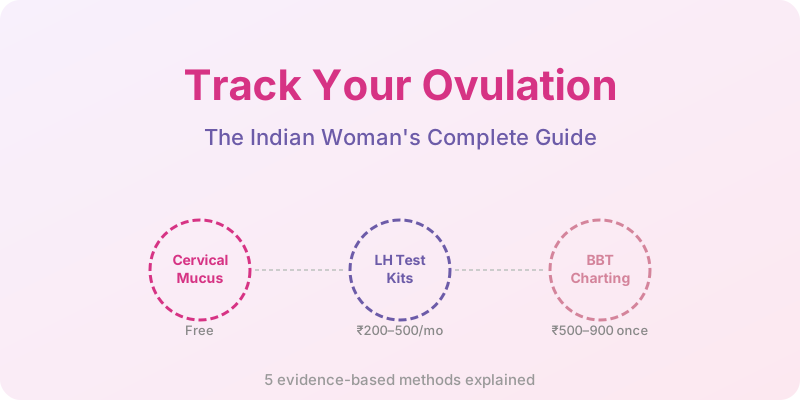
“Am I ovulating?”. This is probably the most common question I hear from women who are trying to conceive.
And the answer is rarely as simple as “Day 14.”
Here’s the truth: most women don’t ovulate on Day 14. Your ovulation day depends on your cycle length, your hormones, your stress levels, even whether you travelled or fell ill that month. A woman with a 32-day cycle likely ovulates around Day 18. A woman with PCOS might ovulate irregularly, or not at all some months.
So how do you actually know when you’re fertile? Not from an app that guesses. Not from a generic calendar. From your own body’s signals, and a few affordable tools that make those signals clear. (Not sure what those signals look like? Our guide on ovulation symptoms covers every physical sign your body gives, before and during ovulation.)
As an OB-GYN with 15+ years of experience, I want to teach you the methods that actually work, what they cost in India, and how to combine them for the best results.
Why Tracking Ovulation Matters
Here’s the biology: you can only get pregnant during a window of about 6 days per cycle: the 5 days before ovulation and the day of ovulation itself (Wilcox et al., 1995, New England Journal of Medicine).
For more on this, read our guide on How to Get Pregnant Fast. The egg survives only 12-24 hours after release. Sperm can survive up to 5 days in fertile cervical mucus. That’s why the days before ovulation are actually your most fertile, the sperm need to be waiting when the egg arrives.
If you’re timing intercourse based on a generic “Day 14” rule, you might be missing your actual fertile window entirely. Studies show that couples who time intercourse to ovulation have significantly higher conception rates: up to 33% per cycle at peak fertility, compared to about 10% with random timing (Dunson et al., 2002, Human Reproduction).
That’s the difference between trying for 3 months and trying for 10.
Method 1: Cervical Mucus Monitoring (Free & Surprisingly Accurate)
This is the method I recommend every woman learn first, because it costs nothing, requires no equipment, and your body is already giving you the signal.
How It Works
Throughout your cycle, your cervical mucus changes in response to oestrogen and progesterone:
- After your period (Days 5-8): Dry or minimal discharge. Not fertile.
- Approaching ovulation (Days 9-12): Sticky, white, or creamy mucus appears. Fertility is building.
- Peak fertility (1-2 days before ovulation): Clear, stretchy, slippery mucus that resembles raw egg white. This is called “spinnbarkeit”: it can stretch 6-10 cm between your fingers without breaking. This is your body’s green light.
- After ovulation: Mucus becomes thick, sticky, or dries up again. Progesterone has taken over.
How Accurate Is It?
A study by Owen (2013) in The Linacre Quarterly found that cervical mucus peak characteristics were identified within ±1 day of the LH surge 78% of the time, and within ±2 days 91% of the time.
That’s remarkably accurate for a free method.
How to Do It
- Check daily: every time you use the bathroom, notice the mucus on toilet paper or check with clean fingers
- Note the colour, stretch, and feel: the key change is from sticky/white → clear/stretchy/slippery
- Your most fertile days are when you see egg-white mucus, plus the day after it disappears
- Have intercourse every 1-2 days during the egg-white mucus phase
What If You Can’t See the Changes?
Some women, especially those with PCOS, on certain medications, or with vaginal infections, may find mucus patterns harder to read. That’s normal. This is where adding a second method helps.
Dr. Suganya’s tip: If your discharge looks the same throughout your cycle, or you see egg-white mucus for more than 5-6 days, it might indicate you’re not ovulating regularly. Bring this up with your gynaecologist.
Method 2: LH Test Kits (The Most Popular Method. And For Good Reason)
LH (Luteinising Hormone) surges 24-36 hours before ovulation. LH test kits (also called OPKs (Ovulation Predictor Kits)) detect this surge in your urine.
How They Work
You dip the test strip in your urine (or hold it in your urine stream). If the test line is as dark as or darker than the control line, your LH is surging, ovulation is likely within 24-36 hours.
How Accurate Are They?
Manufacturers claim 97-99% accuracy in detecting the LH surge (Su et al., 2017, Bioengineering & Translational Medicine). In practice, they’re highly reliable for most women.
However, there are some important caveats:
- Women with PCOS often have elevated baseline LH, which can cause false positives. If you have PCOS, talk to your doctor before relying solely on LH kits.
- The kit tells you ovulation is coming, not that it happened. Sometimes LH can surge without the follicle actually releasing an egg (called LUF. Luteinised Unruptured Follicle). This is uncommon but worth knowing.
- Testing once daily isn’t always enough. The LH surge can be brief (as short as 10 hours). If you test once a day, you might miss it.
When to Start Testing
| Your Cycle Length | Start Testing On |
|---|---|
| 24 days | Day 7 |
| 26 days | Day 9 |
| 28 days | Day 11 |
| 30 days | Day 13 |
| 32 days | Day 15 |
| 35 days | Day 18 |
| Irregular | Day 9 (and continue until positive or Day 25) |
Formula: Cycle length minus 17 = day to start testing.
Best Time to Test
- Between 12 PM and 8 PM: LH typically surges in the early morning but takes a few hours to appear in urine
- Don’t test with first morning urine (unlike pregnancy tests), it may not reflect the current LH level
- Reduce liquid intake for 2 hours before testing so your urine isn’t too diluted
Cost in India
| Product | Price (Approx.) | Strips |
|---|---|---|
| i-Know Ovulation Kit | ₹450-550 | 5 strips |
| Tulip LH Ovulation Kit | ₹400-490 | 10 strips |
| MicroSidd LH Test Kit | ₹250-950 | 5-20 strips |
| Generic LH strips (Amazon) | ₹200-400 | 10-50 strips |
Budget tip: If you have regular cycles and roughly know your ovulation window, 5 strips per cycle is enough. If your cycles are irregular, buy a bulk pack of 20-50 generic strips, they’re just as accurate as branded ones.
Not sure if you're ovulating?
Tracking can feel confusing, especially with irregular cycles or PCOS. Dr. Suganya can review your cycle pattern and tell you exactly what to track and when.
Method 3: Basal Body Temperature (BBT) Charting
BBT is your body’s temperature at complete rest, measured first thing in the morning before you get out of bed, speak, or even reach for your phone.
How It Works
- Before ovulation: Your BBT is lower (typically 36.1-36.4°C)
- After ovulation: Progesterone causes a sustained rise of 0.2-0.5°C (typically 36.5-36.8°C)
- This temperature shift confirms ovulation happened
The rise happens 1-2 days after ovulation, so BBT confirms ovulation but doesn’t predict it in advance.
Why It Still Matters
BBT charting over 2-3 cycles reveals your pattern. Once you see that you consistently ovulate around Day 16 (for example), you can use that pattern combined with mucus and LH kits for the next cycle.
It’s also the only home method that confirms ovulation actually occurred. LH kits show a surge, but BBT proves the egg was released and progesterone is being produced.
How to Do It
- Use a BBT thermometer (reads to 0.01°C, regular thermometers aren’t precise enough)
- Measure at the same time every morning: before getting up, drinking water, or talking
- Record daily on a chart or app: you’re looking for the sustained rise (3+ days of higher temps)
- Be consistent: even 30 minutes difference in timing can affect readings
What Can Throw Off Your BBT?
- Drinking alcohol the night before
- Sleeping less than 3 hours
- Illness or fever
- Waking at a different time
- Sleeping with your mouth open (if using oral measurement)
- Using a fan or AC at a different setting
Cost in India: BBT thermometers cost ₹500-900 on Amazon India (Beurer OT 20 at ~₹820, or generic digital BBT thermometers from ₹500).
Is BBT Alone Reliable?
A study by Su et al. (2017) found that BBT coincided with the LH surge ±1 day in only 22.1% of cycles. That’s why BBT works best as a confirmatory method, not your only method.
Method 4: Ovulation Apps. Helpful But Not Enough Alone
Apps like Flo, Clue, and Ovia are wildly popular. But here’s what most women don’t realise:
Most apps predict ovulation based on a simple algorithm: they take your average cycle length and estimate Day 14 (or whatever the midpoint is). They don’t actually know when YOU are ovulating this month.
When Apps Are Useful
- Tracking your period dates: building a record of cycle length
- Logging your symptoms: mucus, mood, pain, energy
- Charting BBT: some apps (like Fertility Friend) have excellent charting features
- Seeing patterns over time: “I usually get egg-white mucus on Days 13-15”
When Apps Are NOT Useful
- As your only fertility prediction tool: the algorithm is generic
- If your cycles are irregular: the app has no way to predict unpredictable cycles
- If you have PCOS: standard cycle-length algorithms don’t work for anovulatory cycles
Dr. Suganya’s recommendation: Use an app as a recording tool, not a prediction tool. Log your mucus, BBT, and LH results in the app, then use the actual data, not the app’s prediction.
Method 5: Ultrasound Follicular Monitoring (The Gold Standard)
This is what we do in clinical practice when we need to know exactly when ovulation is happening, for IUI timing, IVF, or when home methods aren’t giving clear answers.
How It Works
A transvaginal ultrasound tracks the growth of your ovarian follicle:
- Day 2-3: Baseline scan to check antral follicle count
- Day 9-11: Check follicle growth (a dominant follicle should be visible)
- Day 12-14: Monitor until the follicle reaches 18-24 mm (ready to ovulate)
- Post-ovulation: Confirm follicle collapse (= egg released) and check endometrial thickness
When You Need This
- You’ve been trying for 6+ months with home tracking and no success
- Your cycles are very irregular (>35 days or <21 days)
- You have PCOS and aren’t sure if you’re ovulating
- You’re undergoing medicated cycles (Letrozole, Clomid, or gonadotropins)
- You’ve had false-positive LH tests and want confirmation
Cost in India
Follicular monitoring typically costs ₹500-1,500 per ultrasound, and you’ll need 2-4 scans per cycle. Total: ₹1,000-6,000 per cycle depending on the clinic and city.
The Smart Combination: What I Recommend
No single method is perfect. But combining 2-3 methods gives you the most accurate picture of your fertile window.
If You’re Just Starting Out (First 1-3 Months)
- Cervical mucus (free), learn your body’s signals
- LH test kit (₹200-500/month), confirms the surge
- App (free), log everything
If You’ve Been Trying for 3-6 Months
- Everything above, PLUS
- BBT charting (₹600 one-time), confirm ovulation is happening
- Review your charts with a doctor: patterns tell a story
If You’ve Been Trying for 6+ Months or Have Irregular Cycles
- See a fertility specialist: don’t keep guessing
- Follicular monitoring: get definitive answers
- Blood tests (Day 2 hormones, Day 21 progesterone, AMH for ovarian reserve), check if ovulation is confirmed by progesterone levels
Common Mistakes Women Make When Tracking Ovulation
1. Only Having Intercourse on the Day of the Positive LH Test
The LH surge means ovulation is 24-36 hours away. But sperm need time to reach the fallopian tube. Ideally, have intercourse the day of and the day before a positive LH test. Even better, every 1-2 days during your fertile window.
2. Testing LH with First Morning Urine
Unlike pregnancy tests, LH tests work best with afternoon urine (12-8 PM). Morning urine may not reflect the current LH level since the surge often begins in the early morning hours.
3. Obsessing Over Exact Timing
This is something I see constantly: women so stressed about hitting the “right day” that the stress itself affects ovulation. Cortisol can delay or suppress the LH surge.
The fertile window is 6 days, not 6 hours. If you’re having intercourse every 2-3 days throughout your cycle, you’re already covering it naturally. Tracking helps you optimise, but it shouldn’t replace relaxed, regular intimacy.
4. Relying Entirely on Apps
As discussed above, apps predict based on averages. Your body isn’t average. Use the app to log, not to decide.
5. Ignoring Signs That You’re Not Ovulating
If you never see egg-white mucus, never get a positive LH test, and your BBT chart shows no temperature shift, these are signs you may not be ovulating. Don’t just keep tracking month after month. See a gynaecologist.
Causes of anovulation include PCOS, thyroid disorders, high prolactin, hypothalamic amenorrhoea (from stress, low weight, or excessive exercise), and premature ovarian insufficiency.
Special Situations
Tracking Ovulation with PCOS
PCOS makes ovulation tracking harder because:
- LH may be chronically elevated, causing false-positive OPK results
- Cycles may be very long or absent, so you don’t know when to start testing
- Multiple small follicles may grow but none reach maturity
What to do: Use cervical mucus as your primary method (it’s not affected by baseline LH levels). If you see egg-white mucus, confirm with an LH kit. If you’re unsure, ask your doctor about follicular monitoring.
Tracking Ovulation After Stopping Birth Control
It can take 1-3 months for ovulation to return after stopping hormonal contraception (longer for Depo-Provera injections). During this time:
- Track mucus patterns, they’ll gradually normalise
- Don’t panic if your first few cycles are irregular
- If ovulation hasn’t returned by 3 months (6 months for Depo), see your doctor
Tracking Ovulation After 35
Ovulation tracking is even more important after 35 because:
- Cycles may shorten (less time between period and ovulation)
- Ovulation may become less predictable
- The window for intervention is shorter if there’s a problem
Combine LH kits with BBT for the best results, and don’t wait more than 6 months before seeing a specialist.
Frequently Asked Questions
How many days before your period do you ovulate?
Typically 12-16 days before your next period (this is the luteal phase, which is fairly consistent). If your cycle is 28 days, ovulation is usually around Day 12-16. If your cycle is 35 days, ovulation is usually around Day 19-23.
Can you feel ovulation happening?
About 20% of women feel mittelschmerz: a mild, one-sided lower abdominal pain or twinge during ovulation. Some women also notice light spotting, breast tenderness, or increased libido around ovulation.
Is it possible to ovulate without a period?
Yes, especially after pregnancy, while breastfeeding, or when cycles are just resuming after amenorrhoea. Ovulation happens before the period, so you can ovulate without having had a recent period.
Can stress delay ovulation?
Absolutely. Cortisol (the stress hormone) can directly suppress GnRH, which suppresses LH, which delays or prevents ovulation. This is why many women notice later ovulation during stressful months, and why relaxation isn’t just “nice to have” when trying to conceive.
Do ovulation kits work for everyone?
LH kits work well for most women with regular cycles. They may be less reliable for women with PCOS (elevated baseline LH), women on certain fertility medications, and women approaching menopause (rising LH levels). In these cases, add cervical mucus tracking and consider follicular monitoring.
Which is more accurate. LH kit or BBT?
They measure different things. LH kits predict ovulation (24-36 hours before), while BBT confirms ovulation (1-2 days after). Used together, they’re more accurate than either alone. If you had to pick one, LH kits are more actionable for timing intercourse.
Trying to conceive and feeling lost?
You don't have to figure this out alone. Dr. Suganya can review your cycle, recommend the right tracking method for your situation, and create a personalised plan, whether it's natural conception support or guidance on what tests to get next.
References
- Wilcox AJ, Weinberg CR, Baird DD. Timing of sexual intercourse in relation to ovulation, effects on the probability of conception, survival of the pregnancy, and sex of the baby. N Engl J Med. 1995;333(23):1517-1521.
- Dunson DB, Colombo B, Baird DD. Changes with age in the level and duration of fertility in the menstrual cycle. Hum Reprod. 2002;17(5):1399-1403.
- Owen M. Physiological signs of ovulation and fertility readily observable by women. Linacre Q. 2013;80(1):17-23.
- Su HW, Yi YC, Wei TY, et al. Detection of ovulation, a review of currently available methods. Bioeng Transl Med. 2017;2(3):238-246.
- Wegrzynowicz AK, et al. Current ovulation and luteal phase tracking methods. PMC. 2024.