You are fourteen days into your cycle. Your period has not arrived. You bought a pregnancy test three days ago and it is sitting in your bathroom cabinet. You know you should wait, but the two-week wait feels impossible.
This scenario plays out in millions of homes every month. And the question is always the same: when exactly should I test, and what does the result actually mean?
As an OB-GYN who has guided hundreds of women through this moment, I want to give you the clearest, most evidence-based answer I can. Not the vague “wait for your missed period” that leaves you guessing, but the specific science of how pregnancy tests work, when they will give you an accurate result, and how to interpret every possible line you might see.
What a Home Pregnancy Test Actually Detects
Before timing makes sense, the biology does.
Home pregnancy tests detect human chorionic gonadotropin (hCG), a hormone produced by the trophoblast cells that eventually form the placenta. Your body does not produce hCG unless a fertilised egg has implanted in the uterine lining.
Implantation typically occurs 6 to 12 days after ovulation, with most implantations happening on days 8 to 10 (Wilcox et al., 1999, New England Journal of Medicine). This is why knowing your actual ovulation day matters before you time the test; our guide on how to track ovulation walks through the five most reliable methods. Once the embryo implants, hCG production begins and rises rapidly, roughly doubling every 48 to 72 hours in a healthy early pregnancy.
The test strip in a home pregnancy kit contains antibodies that bind to hCG. When you hold the strip in your urine (or dip it), any hCG present causes a chemical reaction that produces a visible line. No hCG present, no second line.
For more on this, read our guide on Chemical Pregnancy. This is why timing matters so much: if you test before implantation has occurred, there is simply no hCG to detect, regardless of whether you are pregnant.
When Is the Best Time to Take a Pregnancy Test?
The reliable answer: the first day of your missed period
For women with a regular 28-day cycle, this is typically day 28 to 30. By this point, if implantation occurred in the typical window, hCG levels have had enough time to rise to a detectable threshold.
Most standard home pregnancy tests sold in India (MamaCare, i-Can, Prega News) detect hCG at 20 to 25 mIU/mL. A typical urine hCG level on the first day of a missed period, assuming implantation occurred around day 9 post-ovulation, is in the range of 100 to 1,000 mIU/mL, well above the detection threshold.
Testing on day 1 of a missed period gives you a sensitivity of approximately 97% for pregnancy detection (Cole et al., 2011, Clinical Chemistry). This is as reliable as home testing gets.
Can you test earlier?
Yes, with caveats.
Some tests marketed as “early response” or “early detection” claim to detect hCG as low as 6 to 10 mIU/mL, which is about 4 to 5 days before a missed period. In theory, this can detect very early implantation.
In practice, testing this early increases false negatives significantly. If your implantation is on the later end (day 11 or 12), your hCG will not yet be at a detectable level four days before your period. You will see a negative result even though you are pregnant. You may also see a very faint positive that turns negative on repeat testing, which could indicate a very early pregnancy loss (sometimes called a chemical pregnancy).
My clinical recommendation: if you are going to test early, use a sensitive kit, test with first morning urine, and retest in 48 hours if negative. Do not treat a single early negative as definitive.
The best time of day
Morning, specifically your first void of the day.
Over the course of a night, urine becomes concentrated as you do not drink fluids for several hours. This concentration effect means hCG is present at higher levels in your first morning urine than at any other point in the day. Diluted urine (from drinking lots of water, or testing in the afternoon) can drop hCG below the detection threshold even when pregnancy is present.
If you absolutely cannot wait and must test in the afternoon, avoid drinking large amounts of water for at least two hours before testing.
How to Do a Home Pregnancy Test Correctly
The mechanics matter more than most women realise. Errors in technique account for a meaningful proportion of false negatives.
Step 1: Check the expiry date. Pregnancy tests lose sensitivity over time. An expired kit may give a false negative. Always check before opening.
Step 2: Read the insert. Different brands have slightly different instructions, dip time, result window time, and line interpretation. Spend two minutes reading the specific instructions for your kit.
Step 3: Collect first morning urine. You can either urinate directly on the test stick (if it is a midstream type) or collect urine in a clean, dry container and dip the strip. Both methods work equally well when done correctly.
Step 4: Hold the absorbent tip in urine for the correct duration. Most kits specify 5 to 10 seconds for midstream, or 15 to 20 seconds for dip strips. Under-dipping is a common error.
Step 5: Lay the test flat and wait. Do not hold it upright (urine can run the wrong direction). Place it on a clean surface and wait for the result window time, typically 3 to 5 minutes.
Step 6: Read within the result window. Most tests specify results should be read between 3 and 10 minutes. Evaporation lines can appear after 10 minutes and look like faint lines but are not valid positives.
How to Read the Results
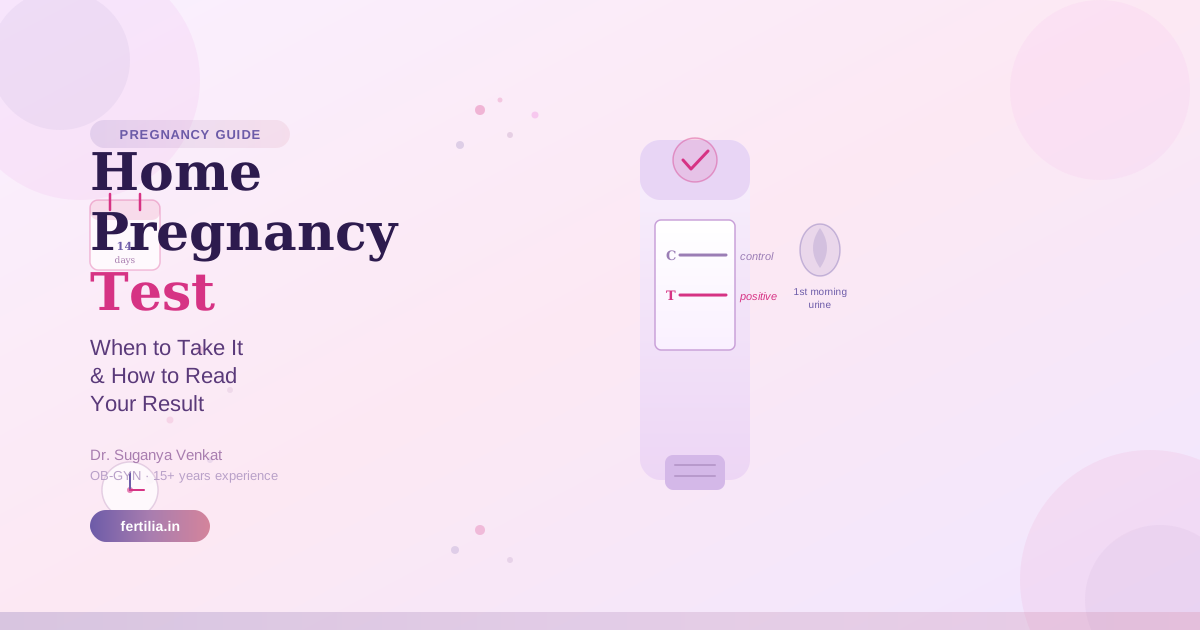
Two lines: positive
Any two lines in the result window indicate a positive test, even if one line is significantly lighter than the other. The control line (C) confirms the test worked correctly. The test line (T) appears whenever hCG is detected, regardless of how faint.
Faint line: still a positive
This confuses more women than anything else. A very faint second line is still a positive result. It does not mean “a little pregnant” or “maybe pregnant.” It means hCG was detected. The line is faint because hCG concentration is low, which is expected in very early pregnancy or when testing a day or two before a missed period.
If you see a faint line, confirm with a retest in 48 hours. You should see a darker line as hCG doubles. A line that fades or disappears on repeat testing warrants a conversation with your doctor about early pregnancy loss.
One line: negative
If only the control line appears and the test window is blank, the result is negative. This means no hCG was detected in your urine at the test’s sensitivity level.
A negative result on day 1 of a missed period does not completely rule out pregnancy. If your period does not arrive in the next 48 to 72 hours, retest. Late implantation or natural variation in cycle length can produce a negative result even when pregnancy has occurred.
No lines or invalid result
If the control line does not appear at all, the test has not worked correctly, regardless of whether a test line is present. This can happen when the kit is expired, wet before use, or the urine did not adequately saturate the strip. Repeat the test with a new kit.
If you have been trying to conceive and are confused by what you are seeing on your test, I am happy to walk you through it. Send me a WhatsApp message and we can talk through your result and next steps together.
WhatsApp Dr. Suganya: wa.me/919940270499
Why Is My Pregnancy Test Negative But My Period Hasn’t Come?
This is one of the most common questions I hear, and it has several explanations.
You tested too early. If your cycle is longer than 28 days, your “day 1 of missed period” may come later than you expect. A woman with a 35-day cycle should not expect her period (or test) until day 35. Testing on day 28 because she counted 28 days is premature.
You have an irregular cycle. Without a regular cycle, predicting your expected period date is difficult. If your periods vary by more than 5 to 7 days, the concept of “missed period” is harder to apply. Tracking ovulation (basal body temperature or LH strips) can help identify your fertile window and give you a more accurate testing date.
Late implantation. As noted above, implantation on day 11 or 12 post-ovulation means hCG may not reach detectable levels until several days after your expected period. A negative result on day 1 of a missed period with late implantation can turn positive within 3 to 5 days.
Diluted urine. Testing in the afternoon after drinking a lot of water can produce a false negative even with a good-quality kit.
Anovulatory cycle. Sometimes your body does not release an egg in a given cycle. Your period may be delayed not because you are pregnant but because ovulation occurred late or not at all. This is common with PCOS, stress, thyroid issues, and significant weight changes.
Ectopic pregnancy. In an ectopic pregnancy, the embryo implants outside the uterus, typically in the fallopian tube. hCG is still produced, so a home pregnancy test can be positive. However, hCG levels may rise more slowly than in a normal intrauterine pregnancy, which can sometimes produce a faint or weakly positive test. If you have a positive test with significant pelvic pain or bleeding, see your doctor promptly. (For more detail, see our post on Ectopic Pregnancy: Signs and What to Expect.)
Understanding Different Indian Pregnancy Test Brands
Several home pregnancy test brands are widely available across Indian pharmacies and online platforms. They differ primarily in their hCG sensitivity threshold.
Prega News (Mankind Pharma): One of the most widely used kits in India. Strip format, detects hCG at 20 to 25 mIU/mL. Reliable at the first day of a missed period.
i-Can (Cipla): Card format with a sample well. Detects hCG at 25 mIU/mL. Straightforward to use, result in 5 minutes.
MamaCare: Strip format. Sensitivity around 25 mIU/mL. Widely available at medical shops.
Clearblue (available in some Indian cities): Digital display rather than lines. Detects hCG at approximately 25 mIU/mL. The digital readout eliminates line-interpretation confusion but does not offer higher accuracy than strip tests.
All these brands perform comparably when used correctly on the first day of a missed period with first morning urine. The brand matters less than technique and timing.
When Should You See a Doctor After a Positive Test?
A positive home pregnancy test is exciting news, and it is also the right time to book an appointment with your OB-GYN or a fertility specialist.
Your first antenatal visit, ideally within 1 to 2 weeks of a positive test, will typically include:
- A blood beta hCG test to confirm pregnancy and establish a baseline level
- Thyroid function testing (TSH), which is critical to check early in pregnancy
- A dating ultrasound (usually 6 to 8 weeks of pregnancy) to confirm the gestational sac is within the uterus and to establish a due date
If you have PCOS, a prior miscarriage, a history of irregular cycles, or are over 35, early confirmation with a doctor is especially important. These situations can benefit from closer monitoring in the first trimester.
For women who have been trying to conceive for more than 6 months (under 35) or more than 3 months (over 35), a positive test is also a moment to discuss your full fertility history and whether any additional investigations are warranted.
After a Positive Test: What Comes Next
A positive home pregnancy test is not a diagnosis on its own. It is the beginning of the confirmation process. Here is what I recommend to my patients:
- Retest the next morning if the first result was very faint, to confirm the line is getting darker.
- Book a blood test (beta hCG) with your doctor to confirm and establish a baseline.
- Start folic acid if you have not already. The recommended dose is 400 to 800 mcg per day and it is most critical in the first 12 weeks. (See our post on Folic Acid in Pregnancy: When to Start and How Much.)
- Avoid harmful exposures proactively: alcohol, smoking, unprescribed medications, raw papaya and raw sprouts in high quantities.
- Do not over-Google symptoms. The first trimester brings a range of symptoms, from nausea and fatigue to mild spotting around implantation. Our guide to Early Pregnancy Symptoms: What to Expect Week by Week covers these in detail.
- Connect with a doctor who will support your full pregnancy. Not just the physical tests, but nutrition, mental health, and preparation for each trimester.
If you would like to talk through your test result or plan your early pregnancy care, reach out directly on WhatsApp.
WhatsApp Dr. Suganya: wa.me/919940270499
Frequently Asked Questions
How early can I take a pregnancy test after a missed period? You can take a test on the very first day your period is due and missed, which gives roughly 97% accuracy. Some sensitive kits allow testing 4 to 5 days before a missed period, but false negatives are more common that early. If your first early test is negative, retest after 48 to 72 hours.
What does a faint line on a pregnancy test mean? A faint line is a positive result. It means the test detected hCG, but at a low concentration. This is normal in very early pregnancy or when testing a day or two before your period is due. Retest in 48 hours and the line should be darker as hCG rises.
Can I take a pregnancy test at night? You can, but morning urine gives the most reliable result because urine is most concentrated after sleeping for several hours. If you test in the afternoon or evening, avoid drinking large amounts of water beforehand and understand the result is slightly less reliable.
Can a pregnancy test be wrong? False positives are extremely rare. They can occur with certain medications (hCG injections used in fertility treatment), rare ovarian tumours, or very recent pregnancy loss where hCG has not yet cleared. False negatives are more common and are usually due to testing too early, diluted urine, or an expired kit.
I got a positive test but then it turned negative. What happened? This may be a chemical pregnancy, which is a very early pregnancy loss that occurs before the pregnancy can be detected on ultrasound. It is more common than many women realise. A chemical pregnancy does not necessarily mean there is a fertility problem. If this happens to you, speak to your doctor. Tracking with blood beta hCG (rather than home tests) after a positive can give clearer information.
How soon after sex can I take a pregnancy test? Not immediately. Fertilisation, if it occurs, happens within 12 to 24 hours of ovulation. Implantation takes another 6 to 12 days. hCG production begins only after implantation. You need to wait at least 10 to 14 days after intercourse during your fertile window before a test can give any meaningful result.
My period is 5 days late and the test is negative. Am I pregnant? Possibly, but a 5-day-late negative test with first morning urine is less likely to be a missed pregnancy if done correctly. More likely causes include late ovulation, an anovulatory cycle (no egg released), stress, or cycle irregularity. PCOS is a common cause of delayed periods with negative tests. If your period does not arrive within another week, see your doctor for a blood test and evaluation.