A common scene in my clinic, repeated almost every week: a parent comes in with a 10-week-old baby who developed a small fever and a tender red spot at the injection site after the last vaccine visit. They are anxious, sometimes apologetic, and almost always ask the same two questions.
“Doctor, was the vaccine too strong for her?”
And, almost in the same breath: “My sister’s baby gets the painless vaccine at the corporate hospital and has no fever at all. Should we switch?”
These two questions usually come from the same place, which is the idea that pain and fever are a measure of how the vaccine is working. The reasoning makes intuitive sense. If the body is reacting visibly, surely the body is being protected more. And if there is no reaction, surely the vaccine has not done much.
I have heard this from grandmothers, from first-time parents, and from family friends who happened to be in the room when the question came up. The reasoning is intuitive. It is also wrong.
This post is the conversation I have with parents in the clinic, written out in full. It covers what the two main schedules (the government Universal Immunisation Programme and the Indian Academy of Pediatrics schedule) actually differ on when it comes to pertussis vaccines, why one produces more visible reactions, why both are effective, and what to do in the 24 to 48 hours after a vaccine visit when your baby is fussy.
For more on this, read our guide on Optional Baby Vaccines in India. If you want the full picture of how the two schedules compare in terms of which diseases they cover and at what ages, my earlier guide on government vs private baby vaccination in India is the place to start.
The Source of the Myth: Two Different Pertussis Vaccines
The “painful vs painless” idea exists because of a real, documented difference between two pertussis (whooping cough) vaccines.
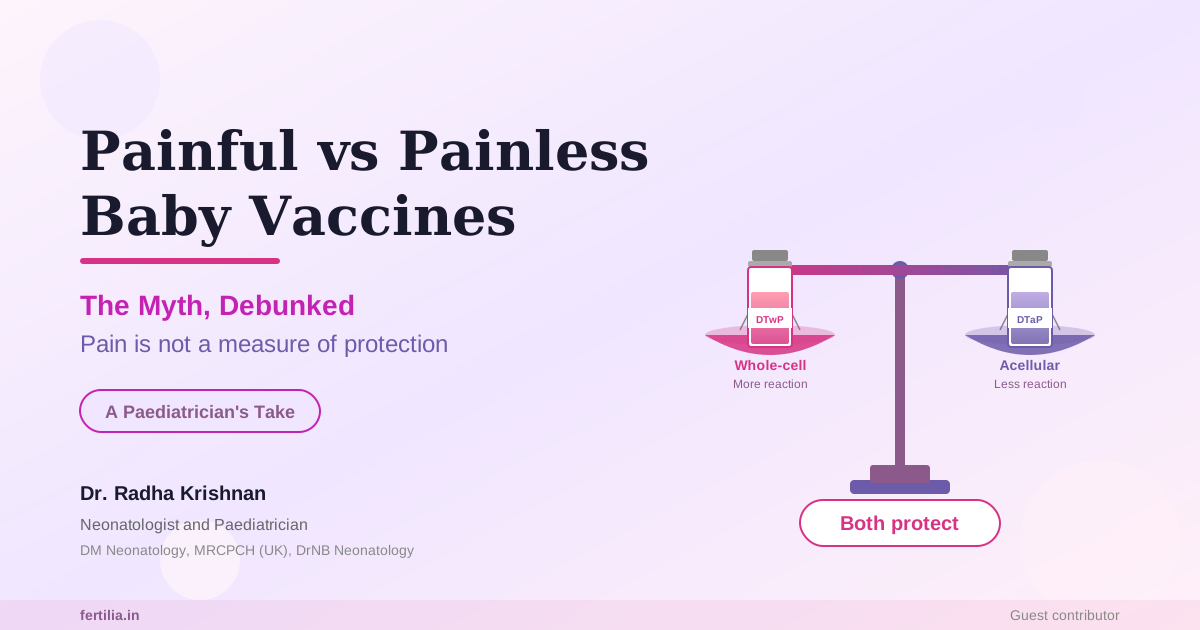
Pertussis is one of the diseases covered in the routine 6, 10, and 14-week vaccination visits. In the government’s Universal Immunisation Programme, the pertussis component is delivered as part of a combination vaccine called DTwP. The “w” stands for whole-cell. The vaccine contains inactivated whole Bordetella pertussis bacteria.
In most private hospitals that follow the Indian Academy of Pediatrics (IAP) schedule, the pertussis component is delivered as DTaP. The “a” stands for acellular. The vaccine contains only specific purified proteins from the bacterium, not the whole organism.
This difference matters in two ways.
First, in reactogenicity. Reactogenicity is the medical word for how much short-term local and systemic response a vaccine produces. Whole-cell DTwP causes:
- More frequent and more pronounced pain and tenderness at the injection site
- Higher rates of redness and swelling
- A higher chance of a low-grade fever in the 24 to 48 hours after the dose
- More fussiness and feeding disturbance
Acellular DTaP causes less of all of these. This is well-documented and not in dispute. If you switch a baby from DTwP to DTaP between visits, parents will usually notice the difference immediately.
Second, in long-term efficacy. This is where the picture gets more interesting, and where the parental intuition turns out to be the opposite of what the evidence shows.
Several large studies over the last 15 years have shown that the protection from acellular DTaP vaccines wanes faster than the protection from whole-cell DTwP vaccines. A landmark study by Klein and colleagues, published in the New England Journal of Medicine in 2012, followed children in California who had received the all-acellular schedule. The data showed that protection against pertussis began to drop within a few years of the primary series, leading to outbreaks in the United States despite high vaccination rates. A follow-up study by Witt and colleagues in Clinical Infectious Diseases in 2013 found very similar patterns.
The IAP took these findings seriously. Its dedicated pertussis position paper, published in Indian Pediatrics in 2013, revised the Academy’s recommendations and proposed whole-cell pertussis vaccines for the primary series of infant vaccination, citing precisely this evidence: faster waning with acellular vaccines, and superior priming with whole-cell (Vashishtha et al., Indian Pediatr 2013;50:1001-9). That paper also allowed acellular vaccines where there was a specific reason, such as a documented severe reaction to a previous whole-cell dose or certain neurological conditions.
It is worth being precise about what the IAP’s current schedule says, because this is where most of the confusion in the clinic sits. The latest IAP-ACVIP immunisation timetable, the 2025 revision published in Indian Pediatrics in 2026, lists the primary series at 6, 10 and 14 weeks as “DTwP/DTaP”, with the explicit note that “DTwP or DTaP may be administered in primary immunization” (Shastri et al., Indian Pediatr 2026;63:311-324).
So the accurate position is a two-part one. The evidence on durability continues to favour whole-cell, which is why the position paper proposed it for the primary series. The current schedule treats both as acceptable options for primary immunisation. A paediatrician who uses DTaP is following the IAP schedule rather than departing from it, and a government centre using DTwP is following the same schedule.
The vaccine that feels gentler is not, by published evidence, the more effective one. The two vaccines build similar peak antibody responses; the difference is how long that protection lasts.
This is the single most useful fact to internalise about the pain question. Both vaccines work. They feel different. Lower reactogenicity is not better immunity.
For more on what to expect physically in the early weeks of new parenthood, including managing your own recovery during the busiest stretch of the vaccination calendar, our postpartum recovery guide for Indian mothers covers the practical side.
What Pain and Fever Mean After a Vaccine
If the amount of reaction is not a measure of efficacy, what is it telling you? It tells you about the formulation of the vaccine and your baby’s individual immune temperament, not about how well the protection is being built.
The immune system has two arms that respond to a vaccine. The first is the surface response: cells near the injection site (macrophages, dendritic cells, mast cells) recognise something unfamiliar and release small signalling molecules called cytokines. These cytokines do two things. Locally, they cause the small blood vessels to dilate, which is what creates the redness and the warmth. They also recruit more immune cells to the area, which is what creates the swelling and the tenderness.
When enough cytokines spill into the general circulation, they reach the hypothalamus in the brain, which is the body’s thermostat. The hypothalamus responds by raising the body’s set-point a degree or two. This is what produces the low-grade fever and fussiness that some babies have for 24 to 48 hours after a vaccine.
The second arm of the response is the deeper memory response. The same antigens that triggered the surface response are also taken up by other immune cells, processed, and shown to B-lymphocytes and T-lymphocytes. These cells generate antibodies and memory cells that will recognise the actual disease if your child encounters it later in life. This is the protection that matters.
Here is the important point: the deeper memory response does not depend on the surface response being visible. A baby can have a strong antibody response without any redness, swelling, or fever. A baby can also have visible redness and a mild fever without that meaning the deeper response is somehow extra-protective.
Whole-cell pertussis happens to engage the surface response more strongly because it contains the whole bacterial body with all of its surface components. Acellular pertussis contains only the few specific proteins that are needed to train the memory response, so the surface engagement is much smaller. The memory response, the part that protects your child from whooping cough, is built either way.
“But My Baby Had No Reaction. Did the Vaccine Even Work?”
This is the mirror image of the first myth and equally common, especially with the modern combination vaccines used in private hospitals.
If your baby received the vaccine at the correct age, from a properly stored vial, given by a trained provider, and showed no visible reaction, the answer is almost certainly that the vaccine worked exactly as designed.
Most of the vaccines used in current private paediatric practice, including acellular pertussis, Hib (Haemophilus influenzae type B), conjugate pneumococcal, inactivated polio, hepatitis B booster doses, and the rotavirus oral vaccine, are formulated specifically to produce minimal surface reaction. This is by design. Pharmaceutical companies have spent decades refining vaccines to retain the immune-training benefit while reducing the things parents find distressing.
A vaccine that causes no visible reaction is a vaccine doing its job quietly. It does not mean the dose was wrong, the vial was bad, or the immunity is incomplete.
If you ever have a specific concern about whether a vaccine was delivered correctly (for example, if the syringe was visibly faulty, the cold chain was clearly broken, or the dose volume looked wrong), discuss it directly with the paediatrician. That is a very different conversation from “but there was no fever.”
Have a specific question about your baby’s reaction to a vaccine, or whether to switch schedules? Message Dr. Suganya’s team on WhatsApp and we will connect you with the right paediatric guidance.
What Reactions Are Normal, and What Should Prompt a Call
Most reactions to routine baby vaccines fall into the “normal and expected” category and resolve in 24 to 48 hours. The IAP and the World Health Organisation both publish guidance on which reactions parents can manage at home and which warrant a phone call to the paediatrician.
Normal post-vaccine reactions (expected, settle on their own):
- Tenderness, redness, or swelling at the injection site that fits within an area smaller than the size of an adult’s palm
- A low-grade fever, defined as a temperature up to 38.5°C, in the 24 to 48 hours after the vaccine
- Mild fussiness, reduced feeding for a few hours, or slightly more sleep than usual
- A small painless lump at the injection site that may persist for a few weeks (common after BCG, completely benign)
These responses do not need treatment beyond simple supportive care. Paracetamol at the dose your paediatrician advised, given only if your baby is uncomfortable rather than as a routine preventive, is appropriate. Extra cuddles, extra feeds, and a calm environment are usually all that is needed.
Reactions that warrant a phone call:
- A fever above 39°C, especially if it persists for more than 48 hours
- Local swelling or redness that extends well beyond the injection site or affects most of the thigh or upper arm
- Persistent high-pitched crying that cannot be settled and continues for more than three hours
- Unusual drowsiness, floppiness, or difficulty waking the baby
- Any rash, particularly if it is widespread or appears in the first hour or two after the dose
- Any sign of breathing difficulty, swelling around the mouth, or change in colour
The last category is rare with routine baby vaccines. The standard practice in most paediatric clinics is to observe the baby for 15 to 20 minutes after the dose, precisely so any immediate reaction can be managed on the spot.
How to Manage the 24 to 48 Hours After a Vaccine
The practical questions parents most often ask are about what to do at home that evening and the next day. Here is what I tell the families in my clinic.
Plan the visit for a time that suits your baby. Many paediatric clinics offer morning slots specifically so that the baby has the rest of the day to settle, and you have a window where the clinic is still open if anything looks unusual. Avoid scheduling immediately before a long travel day or a major family event if you can.
Offer extra feeds. Babies who feed more after a vaccine tend to settle better. If you are breastfeeding, more frequent feeds work well. If you are formula feeding, the usual feed pattern is fine; do not over-feed in an attempt to prevent reaction.
Paracetamol only if needed. Paracetamol (acetaminophen) at the dose your paediatrician has noted in your record book is reasonable if your baby has a fever above 38°C or is clearly uncomfortable. Routine prophylactic paracetamol given before or immediately after vaccines has actually been shown in some studies to slightly reduce the antibody response, so it is not recommended unless there is a specific reason. Give it for symptoms, not as a routine preventive.
Cool compress, not warm. A clean cool cloth held over the injection site for 10 to 15 minutes can help with local swelling and tenderness. Do not massage the site, do not apply any oil or paste, and do not use ice directly on the skin.
Keep the site clean. A normal bath the same evening is completely fine. There is no need to keep the site dry beyond the first hour.
Watch for the patterns above, not for any reaction at all. Your baby is allowed to be fussy for a day. Your baby is allowed to have a small fever. These are not signs that something has gone wrong. The patterns that warrant a phone call are the ones listed in the previous section.
What the Painless Vaccine Costs in India
The question I am asked immediately after the pain question is the money one, and it deserves a straight answer rather than a vague “it depends.” So here are the numbers.
There is one point worth understanding before the tables. You are not buying “a painless injection” as a separate product. The gentler feel comes bundled inside a particular brand of combination vaccine that happens to use acellular pertussis. That is why the price gap looks different depending on which two products you hold side by side.
The honest comparison is between three routes:
| Route | Pertussis type | Cost per dose |
|---|---|---|
| Government hospital or PHC (UIP) | Whole-cell (DTwP) | Free |
| Private clinic, whole-cell brand | Whole-cell (DTwP) | About ₹2,100 to ₹2,400 for a 6-in-1 |
| Private clinic, acellular brand | Acellular (DTaP) | About ₹2,750 to ₹3,200 for a 6-in-1 |
Under the Universal Immunisation Programme, the government supplies the pentavalent vaccine (diphtheria, tetanus, whole-cell pertussis, hepatitis B and Hib) free at the 6, 10 and 14-week visits, along with fractional IPV for polio. The acellular brands are private-market purchases and are not part of routine UIP supply.
Brand by brand
These are pharmacy prices for the syringe itself, verified across Apollo Pharmacy, 1mg, Netmeds and distributor listings in August 2026. Composition for each brand is from the manufacturer’s own product information (Serum Institute, Panacea Biotec, Sanofi, GSK).
| Brand | Pertussis type | Covers | Typical price per dose |
|---|---|---|---|
| Pentavac PFS (Serum Institute) | Whole-cell | 5-in-1: DTP, HepB, Hib | ₹380 to ₹470 |
| Easy Six (Panacea Biotec) | Whole-cell | 6-in-1: DTP, HepB, Hib, IPV | ₹2,065 to ₹2,430 |
| Pentaxim (Sanofi) | Acellular | 5-in-1: DTaP, IPV, Hib. No hepatitis B | ₹2,500 to ₹2,620 |
| Infanrix Hexa (GSK) | Acellular | 6-in-1: DTaP, IPV, HepB, Hib | ₹2,750 to ₹3,400 |
| Hexaxim (Sanofi) | Acellular | 6-in-1: DTaP, IPV, HepB, Hib | ₹2,995 to ₹3,200 |
Comparing like with like, so a 6-in-1 against a 6-in-1, the acellular option runs roughly ₹500 to ₹1,100 more per dose. Across the three primary doses at 6, 10 and 14 weeks, that is about ₹1,500 to ₹3,300 extra, before boosters.
Three things the price list does not show you
The clinic bill is not the syringe price. Consultation, administration and consumables are charged on top, and many paediatric clinics quote a per-visit package rather than itemising the vaccine. Ask for an itemised quote naming the exact brand. That one question removes most of the confusion about why two clinics quote differently for “the same” vaccine.
Pentaxim is not a swap for a 6-in-1. It is the cheapest acellular option on the list, and there is a reason: it contains no hepatitis B component. If your baby is on Pentaxim, hepatitis B has to be covered separately. Comparing its price against Hexaxim or Infanrix Hexa without accounting for that is comparing two different things.
City and chain move these numbers. A metro corporate hospital and a neighbourhood clinic in the same city can differ by several hundred rupees per visit on identical stock. Prices also move with stock and MRP revisions, so treat the ranges above as a guide for the conversation, not as a quote.
One last point, and it is the one I most want parents to take away. The extra money buys a gentler evening. On the published evidence discussed earlier in this post, it does not buy better long-term protection against whooping cough; the durability data point the other way, which is why the IAP’s pertussis position paper proposed whole-cell for the primary series. A family choosing the government schedule for cost reasons is not giving their child a lesser vaccine.
The Practical Takeaway
The “painful vs painless” framing of baby vaccines is one of those folk medical ideas that has the structure of common sense but does not match the data. The truth is more interesting and, I think, more reassuring.
The two main pertussis vaccines used in India (whole-cell DTwP in the government schedule, acellular DTaP in most private hospitals) feel different to receive. The whole-cell vaccine causes more local reaction and a slightly higher chance of fever; the acellular vaccine is gentler. The published evidence on durability, which is what led the IAP’s 2013 pertussis position paper to propose whole-cell for the primary series, favours whole-cell for length of protection. The current IAP schedule accepts either for primary immunisation.
A vaccine that hurts is not “stronger.” A vaccine that does not hurt is not “weaker.” The deeper immune memory, which is what actually protects your child from whooping cough or any other vaccine-preventable disease, is built either way.
The right reason to choose between the two schedules is the wider conversation about which diseases are covered, what the cost structure is for your family, and which clinic you trust for ongoing care. The reaction profile of any single vaccine in the schedule is not, by itself, a useful basis for that decision.
For the full conversation about the government and private schedules, including which vaccines each covers and the practical “hybrid approach” most Indian families end up using, my earlier post walks through the comparison in detail. For other parts of the new-parent journey, our folic acid in pregnancy guide, first trimester guide, and postpartum anxiety guide cover related ground.
Specific questions about a reaction your baby is having, whether a switch in schedule is right for your family, or a general vaccine consultation? Message Dr. Suganya’s team on WhatsApp. We will connect you with the right paediatric guidance.
FAQ
How much does the painless vaccine cost in India?
At a private clinic, an acellular (“painless”) 6-in-1 dose typically costs about ₹2,750 to ₹3,200 for the syringe, against about ₹2,100 to ₹2,400 for a whole-cell 6-in-1. That is roughly ₹500 to ₹1,100 more per dose, or about ₹1,500 to ₹3,300 across the three primary doses at 6, 10 and 14 weeks. Consultation and administration charges are added on top of the syringe price. Prices verified across Apollo Pharmacy, 1mg and Netmeds in August 2026; see the full brand-by-brand table above.
Is the painless vaccine available in government hospitals?
Generally no. Government facilities supply the pentavalent vaccine free under the Universal Immunisation Programme, and that is a whole-cell (DTwP) product. The acellular brands such as Pentaxim, Hexaxim and Infanrix Hexa are private-market purchases. This is not a case of the government offering a cheaper or inferior option: the durability evidence led the IAP’s pertussis position paper to propose whole-cell for the primary infant series, and the current IAP schedule accepts either.
Is the painless vaccine worth the extra cost?
That depends on what you are buying it for. The extra spend reliably buys less soreness and a lower chance of fever in the 24 to 48 hours after the visit, which is a real benefit for some families. It does not buy stronger or longer-lasting protection; the published evidence points the other way on duration. If your baby has had a severe reaction to a previous whole-cell dose, or has a neurological condition where minimising fever matters, there is a specific clinical reason to prefer acellular, and that is a conversation to have with your paediatrician.
Is the vaccine more effective if my baby gets a fever after it?
No. Fever and other visible reactions reflect the surface immune response to the vaccine’s components, not the deeper memory response that builds long-term protection. Babies build effective antibody responses whether or not they develop fever. The IAP’s 2013 pertussis position paper describes how the less reactogenic acellular vaccines show faster waning of protection, but that is a property of the vaccine formulation, not a reading of how any individual baby responded to a given dose.
My niece’s baby gets the “painless” vaccine and our baby gets the regular one. Are we doing something wrong?
No. The difference between the two is mainly the type of pertussis vaccine. The whole-cell pertussis vaccine used in government and most public-private hybrid centres is more reactogenic but, by published evidence, holds its protection for longer. The acellular vaccine used in many private hospitals is gentler but with somewhat faster waning. The IAP’s 2013 pertussis position paper proposed whole-cell for the primary series on that basis, and the current IAP-ACVIP schedule lists either as acceptable for primary immunisation. Both are reasonable choices; neither is “wrong.”
Can I prevent fever by giving paracetamol before the vaccine?
The current paediatric guidance is not to give paracetamol routinely before or immediately after vaccines. Some studies have shown that prophylactic paracetamol can slightly blunt the antibody response. Give paracetamol only if your baby develops a temperature above 38°C or is clearly uncomfortable, at the dose your paediatrician has noted. If you ever forget the dose, call the clinic rather than guessing.
My baby had no reaction at all to the last vaccine visit. Should I be worried the vaccine did not work?
No. Many modern vaccines, particularly those used in private paediatric schedules (Hib, conjugate pneumococcal, inactivated polio, rotavirus, acellular pertussis), are designed to produce minimal surface reaction. A baby who shows no fever and no local tenderness is a baby whose vaccine worked exactly as it was designed to. Antibody response does not require visible reaction.
My baby cried for two hours after the vaccine, then settled. Is that normal?
Yes, this is within the range of normal post-vaccine fussiness, especially after the 6, 10, or 14-week visits when multiple vaccines are given in one session. Most babies settle within two to three hours with extra cuddles, extra feeds, and patience. Persistent high-pitched crying that does not settle for more than three hours, or a fever above 39°C, is the threshold for calling the paediatrician.
Is it safe to bathe my baby on the same day as a vaccine?
Yes. A normal bath the same evening, with mild soap and lukewarm water, is completely safe. Avoid soap directly on the injection site for the first day. Do not apply any oils, pastes, or traditional remedies to the site; let it heal on its own.
When should I call the doctor about a vaccine reaction?
Call your paediatrician if your baby has:
- A fever above 39°C, or any fever lasting more than 48 hours
- Local swelling or redness extending well beyond the injection site
- Persistent high-pitched crying for more than three hours that cannot be settled
- Unusual drowsiness or floppiness, or difficulty waking
- Any widespread rash, especially in the first few hours after the dose
- Any breathing difficulty or swelling around the face or mouth
The last is rare with routine baby vaccines but is the reason most clinics ask you to wait 15 to 20 minutes after the dose before leaving.