A common scene in my clinic at the 9-month or 12-month vaccination visit: a parent asks if there are any other vaccines we should consider. They have heard about Japanese Encephalitis from a cousin in Bangalore. A friend’s child got the meningococcal vaccine before going to boarding school. The grandfather is travelling to Kenya for a wedding next year and someone mentioned yellow fever.
The list of “optional” vaccines feels long, the names are unfamiliar, and the costs vary widely. Parents understandably want a clear answer: yes or no.
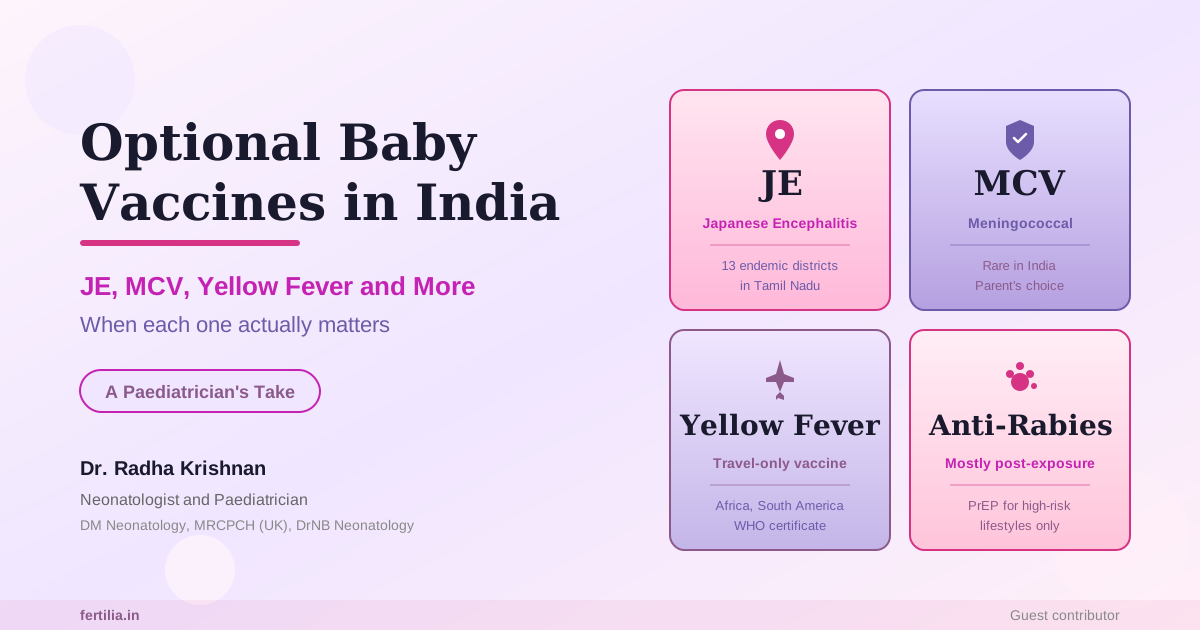
For most families, the answer sits somewhere in between. The four vaccines that sit outside the routine Indian paediatric schedules (Japanese Encephalitis, meningococcal, yellow fever, and anti-rabies) are each worth a focused conversation rather than a blanket yes or no. The right decision depends on where you live, where your child might travel in the next decade, what is in your household, and what feels manageable for your family.
This post walks through each of them the way I walk through them in the clinic. It is the long-form version of the conversation that often gets compressed into the last five minutes of a paediatric visit.
If you have not yet read about how the broader Indian vaccination schedules work, my earlier guide on government vs private baby vaccination in India covers the foundations. The follow-up post on painful vs painless vaccines addresses the other question parents bring up most often.
What “Optional” Actually Means
In Indian paediatric practice, vaccines fall broadly into three groups.
The first group is the Universal Immunisation Programme (UIP) schedule, provided free at government hospitals. It covers BCG, OPV, DPT, hepatitis B, Hib, measles, MR, JE in endemic districts, rotavirus, and PCV. These are the vaccines a child is recommended to receive regardless of family circumstance.
The second group is the Indian Academy of Pediatrics (IAP) schedule, followed by most private paediatricians. It includes all UIP vaccines plus typhoid, influenza, hepatitis A, MMR, varicella (chickenpox), and a few additional doses at slightly different intervals.
The third group is what most people mean by “optional.” These are vaccines that are not part of the routine schedule for every child but become relevant in specific situations: geographic risk, travel, occupational or environmental exposure, or a particular high-risk medical history. The IAP’s Advisory Committee on Vaccines and Immunization Practices (ACVIP) lists these vaccines in a separate “special situations” category, with criteria for when each should be considered (ACVIP Recommended Immunization Schedule 2023, Indian Pediatr 2024;61:113-125; carried forward in the 2025 revision).
The label “optional” can mislead parents into thinking the vaccine is less important. The more accurate framing is that the recommendation is conditional rather than universal. Some children will benefit from these vaccines as much as they benefit from any routine dose. Other children will reasonably never need them. The decision is about your family’s specific profile.
Japanese Encephalitis (JE) Vaccine
Japanese encephalitis is a viral brain infection transmitted by mosquitoes, particularly the Culex species that breeds in rice paddies and stagnant water around livestock. The disease is uncommon overall, but when it occurs in a child it carries a serious outlook: roughly 20 to 30 percent of clinically apparent cases are fatal, and a significant fraction of survivors are left with long-term neurological consequences (WHO 2024 fact sheet on Japanese encephalitis).
The geography of JE is what makes it interesting for Indian families. The disease is concentrated in specific endemic zones rather than distributed evenly across the country. The Tamil Nadu state Health Department lists 13 districts as endemic where the government provides JE vaccine free under the routine programme: Perambalur, Tiruvallur, Tiruvannamalai, Villupuram, Cuddalore, Ariyalur, Thiruvarur, Thanjavur, Pudukottai, Tiruchirappalli, Madurai, Virudhunagar, and Karur (source: tnhealth.tn.gov.in, Directorate of Public Health and Preventive Medicine). The southern coastal belt (Thoothukudi, Tirunelveli, Kanyakumari) is not classified as endemic, and the vaccine is not routinely provided through government channels in those districts.
Most of north India is considered endemic. Kerala generally is not. Selected districts in Karnataka and Andhra Pradesh are endemic; others in those same states are not. The IAP’s ACVIP schedule (2023, published in Indian Pediatrics in 2024) recommends JE vaccine for all children residing in or travelling to endemic areas, with a two-dose primary schedule using the live attenuated SA-14-14-2 vaccine.
Here is the practical point. In my private practice, I usually give JE vaccine to every baby, regardless of which district the family currently lives in. The reason is not geographic alarmism. It is that a child’s future travel and life profile is genuinely hard to predict.
A baby born in Coimbatore today might attend boarding school in Tamil Nadu’s central districts, take a college admission in Vellore (in Vellore district, near JE-endemic zones), accept a job in Bangalore (Karnataka has endemic districts), visit relatives in north India, or do a postgraduate posting in eastern India where JE is widespread. The vaccine is inexpensive, has an excellent safety profile, and provides protection that lasts for many years. The cost-benefit calculation for a one-time inclusion in the schedule is straightforward, especially compared with the consequences of a single clinical case.
If you live in an endemic district, the government provides the vaccine free, and there is no reasonable argument to skip it. If you live outside an endemic district and the private vaccine is being offered, the decision is more a question of how predictable your family’s geographic trajectory feels over the next twenty years. For families who travel frequently within India, who have relatives in endemic zones, or who simply want to remove one future decision from the list, including JE in the schedule is reasonable.
Meningococcal Vaccine
Meningococcal meningitis is caused by Neisseria meningitidis, a bacterium that lives in the back of the throat in a small percentage of healthy people. In most carriers it causes no symptoms. In rare cases it crosses into the bloodstream and the cerebrospinal fluid, where it can cause overwhelming sepsis or meningitis within hours.
The reason meningococcal disease attracts attention out of proportion to its frequency is its speed. A child can go from feeling unwell in the morning to being critically ill by evening. Fatality rates remain in the range of 10 to 15 percent even with prompt treatment (CDC 2024 meningococcal disease overview), and survivors can be left with hearing loss, neurological deficits, or amputations following severe sepsis.
The good news is that meningococcal disease is rare in India. Indian surveillance data and ACVIP guidance both note that the disease incidence here is much lower than in parts of Africa (the “meningitis belt”), parts of the Middle East (where outbreaks have occurred around the Hajj), and certain European and US settings where college-dormitory outbreaks are documented.
The IAP ACVIP position is that meningococcal vaccine is not routinely recommended for every Indian child. It is recommended in specific situations:
- Children with anatomical or functional asplenia (including sickle cell disease)
- Children with complement component deficiencies or persistent complement pathway issues
- Children with HIV
- Children planning international travel to high-risk regions (sub-Saharan Africa’s “meningitis belt” during dry season, Hajj pilgrimage entry to Saudi Arabia, or specific outbreak areas)
- Adolescents planning to stay in college dormitories in countries with documented outbreak risk
- Laboratory personnel who handle N. meningitidis cultures (a niche but real category)
For families outside these categories, the vaccine is a parental choice. The conjugate vaccine MCV4 (covering serogroups A, C, W, Y), available in India under brand names such as Menactra and Nimenrix, costs in the range of ₹4,000 to ₹6,000 per dose in the private sector (verified in May 2026 across multiple Indian paediatric vaccination centres; brand and clinic variation applies). The primary schedule is typically two doses for younger children, with a booster recommended later, so the total cost adds up.
What I usually tell parents in the clinic is this. The disease is rare in India, and the vaccine is not in the routine schedule for good evidence-based reasons. But meningococcal disease is also one of the few infections that can move from “my child has a fever” to a paediatric ICU admission within twelve hours. If a family feels strongly about adding this layer of protection, and the cost is manageable, the vaccine is safe and effective. If a family decides not to add it, they are not making an irresponsible choice; they are making the choice the IAP itself makes for the general paediatric population.
The right move is a single, calm conversation with your paediatrician where you cover your child’s specific risk factors and your family’s situation. Either decision after that conversation is defensible.
Have a specific question about whether your family should add Japanese Encephalitis, meningococcal, or any other optional vaccine? Message Dr. Suganya’s team on WhatsApp and we will connect you with paediatric guidance for your situation.
Yellow Fever Vaccine
Yellow fever is a viral disease transmitted by mosquitoes, endemic in parts of sub-Saharan Africa and tropical South America. It is not present in India. The vaccine becomes relevant for one specific reason: international travel.
A long list of countries require proof of yellow fever vaccination for entry, particularly travellers arriving from yellow-fever-endemic countries. The International Certificate of Vaccination or Prophylaxis (the “yellow card”) is the official document recognised at immigration counters globally. The WHO maintains the current list of yellow fever risk countries and vaccination requirements.
For Indian families, yellow fever vaccination matters in the following situations:
- Travel to many African countries (including Kenya, Tanzania, Uganda, Nigeria, Ghana, Ethiopia, the Democratic Republic of Congo, and many others)
- Travel to certain South American countries (including Brazil, Bolivia, Peru, and parts of Argentina)
- Transit through certain airports in yellow-fever-endemic regions where the certificate is checked
The vaccine is a single dose, provides protection that the WHO now recognises as lifelong (no booster needed under current International Health Regulations, updated in 2016), and must be given at a yellow-fever-authorised vaccination centre in India that can issue the international certificate.
The age threshold matters. The yellow fever vaccine is generally given from 9 months of age (older for some specific guidelines), so very young infants travelling to risk areas should have their travel plans discussed with a paediatrician well in advance.
If your family has no immediate or planned travel to yellow-fever-endemic countries, this vaccine has no routine role. If you do have such travel planned, build in at least four to six weeks before departure to receive the vaccine, because the certificate becomes valid only ten days after the dose.
Anti-Rabies Vaccine
Rabies is one of the few infectious diseases that, once symptomatic, is essentially always fatal. India accounts for a substantial share of the global rabies burden, largely from dog bites, with smaller contributions from other animal exposures.
The good news is that rabies is fully preventable when post-exposure prophylaxis (PEP) is given correctly and promptly after a suspected exposure. PEP consists of wound care plus a series of anti-rabies vaccine doses, and in higher-risk exposures, the addition of human rabies immunoglobulin. The WHO essentially-modern PEP protocols, when followed, have an excellent record.
The conversation in paediatric clinics is usually about two related but different things.
Post-exposure prophylaxis is straightforward and not really a “choice.” Any time a child has a suspected exposure to a potentially rabid animal (dog, cat, monkey, bat, fox, jackal), wound care and the anti-rabies vaccine series are essential, given promptly. This is not optional and not a discussion topic. It is what you do.
Pre-exposure prophylaxis (PrEP) is the part that comes up as an optional vaccine. A pre-exposure series, given before any bite or exposure, simplifies the response if a future bite happens (fewer doses needed for PEP, and immunoglobulin is generally not required for a previously vaccinated child). The Indian National Action Plan for Dog Mediated Rabies Elimination (NAPRE 2030) recognises pre-exposure prophylaxis as appropriate for higher-risk populations.
Pre-exposure rabies vaccination is reasonable to consider for children whose lifestyle puts them at higher than average risk of animal exposure:
- Children in households with multiple unvaccinated pets, especially in rural settings
- Children whose parents work with animals (veterinarians, livestock workers, animal-shelter staff)
- Children living in rural areas with significant free-roaming dog populations and limited rapid access to a hospital for post-exposure care
- Children planning extended travel to areas with high rabies burden and limited medical access
For an urban Indian family with no significant animal contact and reasonable access to a hospital in case of a bite, pre-exposure rabies vaccination is generally not necessary. The post-exposure protocol works, and seeking it promptly is the actionable behaviour to know about. What matters more for these families is to teach the child to report any animal bite or scratch immediately, even a minor-looking one, and to know which hospital nearby stocks anti-rabies vaccine and immunoglobulin.
Cholera and Typhoid Considerations
Cholera vaccine is available in India (oral cholera vaccine, given in two doses) but is largely reserved for outbreak settings, travel to high-burden cholera areas, and specific public health responses. For the routine paediatric schedule, it is not part of either the UIP or the standard IAP recommendation.
Typhoid vaccine, while technically “optional” in the sense that it is not in the UIP schedule, is included in the IAP schedule and given routinely to most children in private paediatric practice. Typhoid is common enough in India, and the vaccine is sufficiently safe and effective, that it usually does not enter the “optional” conversation in the same way the others do. If your child is on the IAP schedule, typhoid is included.
How to Decide for Your Family
Here is the framework I use when parents ask which of these optional vaccines to add.
Japanese Encephalitis. If you live in an endemic district, get it through the government schedule. If you live outside an endemic district but your family’s geographic future is uncertain (likely college or job in endemic zones, frequent travel within India, relatives in endemic areas), include it in the private schedule. The cost is modest, the safety profile is good, and the decision is once-and-done.
Meningococcal. If your child has one of the specific high-risk medical conditions listed earlier, the vaccine is genuinely recommended. If not, the decision is a parental call. Have a single focused conversation with your paediatrician about cost and your family’s specific situation, then decide either way without second-guessing.
Yellow fever. Only relevant if international travel to endemic regions is planned. Build in lead time for the certificate to become valid.
Anti-rabies (pre-exposure). Worth considering for genuinely higher-risk lifestyles (rural living, animal-handling occupations, multiple unvaccinated household pets, limited hospital access). For urban families with average exposure, focus instead on knowing the post-exposure protocol and the nearest hospital that stocks the vaccine.
Cholera and travel-specific vaccines. Consider only if travelling to outbreak areas or under specific public health guidance.
The principle behind all of this is that “optional” does not mean “unimportant.” It means that the right answer depends on the specifics of your family, and that a brief, focused conversation with your paediatrician is the way to arrive at it. There is no badge for adding every vaccine on the list, and no failure in declining one after a thoughtful conversation.
For broader new-parent topics, our postpartum recovery guide, first trimester guide, and folic acid in pregnancy guide cover the surrounding ground.
Want to talk through which optional vaccines actually make sense for your child and your family’s situation? Message Dr. Suganya’s team on WhatsApp and we will connect you with the right paediatric guidance.
FAQ
Should every baby in India get the Japanese Encephalitis vaccine?
If you live in one of the JE-endemic districts (in Tamil Nadu, the 13 districts include Perambalur, Tiruvallur, Tiruvannamalai, Villupuram, Cuddalore, Ariyalur, Thiruvarur, Thanjavur, Pudukottai, Tiruchirappalli, Madurai, Virudhunagar, and Karur), the government provides the vaccine free and it is recommended. If you live outside an endemic district, the vaccine is available through the private schedule. Many private paediatricians include it for every child because future travel patterns are hard to predict. The cost is modest and the safety profile is good, so for most families it is a reasonable inclusion.
Why is the meningococcal vaccine not part of the routine Indian schedule?
The IAP’s position is based on disease prevalence in India. Meningococcal meningitis is rare here compared with countries that include it in their routine schedules (parts of Africa, certain European countries). When the IAP weighs the rarity of the disease against the cost of universal vaccination, they recommend reserving meningococcal vaccine for higher-risk groups (children with certain immune system or anatomical conditions, international travellers to risk regions, college students in dormitories abroad) rather than every child. Families who want to add it as additional protection can do so; the vaccine is safe and effective.
How much does the meningococcal vaccine cost in India?
The conjugate meningococcal vaccine MCV4 (covering serogroups A, C, W, Y), available under brand names such as Menactra and Nimenrix, costs in the range of ₹4,000 to ₹6,000 per dose in the private sector (May 2026, with variation across brands and clinics). The standard schedule typically involves a primary series plus a booster, so the total cost over a few years adds up. Check with your paediatrician for the current price at your clinic.
Do we need the yellow fever vaccine if we are not travelling abroad?
No. Yellow fever is not present in India and the vaccine has no domestic role. It becomes relevant only if a child is travelling to certain countries in Africa or South America that require proof of vaccination at entry, or transiting through certain airports where the certificate is checked. The WHO yellow fever vaccination certificate is the official document. If such travel is planned, schedule the vaccine at an authorised centre at least four to six weeks before departure, because the certificate becomes valid ten days after the dose.
Should we give our child pre-exposure rabies vaccination?
Pre-exposure rabies vaccination is reasonable to consider if your child has higher than average exposure to animals: rural living with free-roaming dogs and limited rapid hospital access, parents working with animals professionally, multiple unvaccinated household pets, or planned extended travel to high-risk areas. For most urban Indian families with average pet and animal exposure, what matters more is knowing the post-exposure protocol: clean any bite or scratch wound thoroughly with soap and water, seek the anti-rabies vaccine series at a hospital promptly, and know in advance which nearby hospital stocks both the vaccine and human rabies immunoglobulin.
My baby is healthy and not travelling. Do we need any of these optional vaccines?
For a child living in a non-endemic area, with no planned international travel, no significant animal exposure beyond routine pet contact, and no specific medical risk factors, the routine IAP schedule covers the major protection needs. Adding JE is often still reasonable because of uncertainty about future travel within India. Meningococcal, yellow fever, and pre-exposure rabies are not routinely necessary for this profile. The right framing is that “optional” vaccines respond to specific risks; if those risks are not present, you are not missing anything essential.
How do I decide between adding more optional vaccines or sticking to the routine schedule?
The most useful approach is a single focused conversation with your paediatrician at the 9-month or 12-month visit, where you cover four things: your family’s likely geographic trajectory over the next decade, any planned international travel, any specific medical or environmental risk factors for your child, and your family’s budget for additional vaccines. Based on that conversation, decide on each optional vaccine individually rather than as a yes-or-no for the whole category. A good paediatrician will explain the cost-benefit for your specific situation without pressuring you toward “more is better.”