The surgery is behind you.
Your baby is here, you have been stitched closed, and someone has placed a cup of hospital food in front of you that you probably did not eat. What comes next is a recovery journey that is different from a vaginal delivery, lasts roughly six to eight weeks in the early phase, and has its own milestones, its own practical questions, and a few surprises that are worth knowing in advance.
This guide covers C-section recovery week by week, from the first hours in the recovery room through the three-month mark when your scar has fully matured. It is part of our complete post-delivery care guide for Indian mothers, which covers the full postpartum period across both delivery types.
Here is what this post covers:
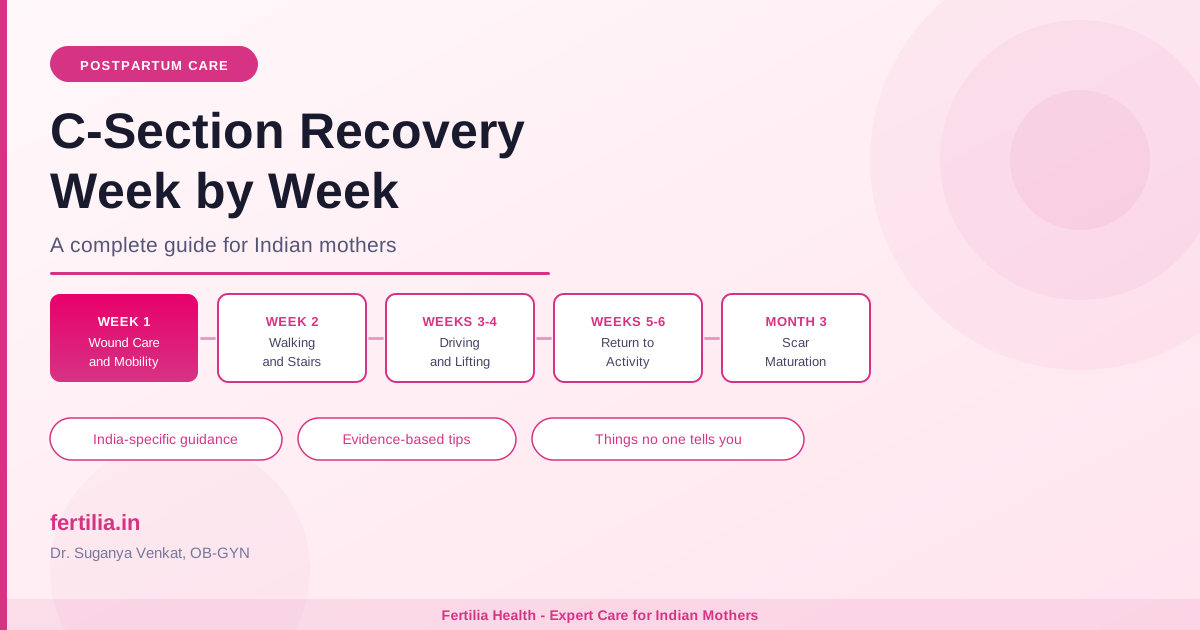
- Week 1: wound care, first steps, and managing pain
- Week 2: walking confidently, climbing stairs, and showering normally
- Week 3 to 4: driving, lifting limits, and returning to light daily tasks
- Week 5 to 6: exercise clearance and the 6-week review
- Month 3: scar maturation and scar massage
- Things nobody tells you: numbness, shelf tissue, and when intimacy is safe
- India-specific guidance: saree, squat toilets, joint family dynamics, and the belt question
- Nutrition that supports tissue healing
- When to call your doctor
This post covers recovery after the surgery. If you have not yet delivered and want to understand the procedure itself, the C-section: what to expect guide covers that in detail.
The First 24 Hours: Recovery Room to Maternity Ward
Before the week-by-week timeline begins, the first 24 hours deserve their own section.
You will spend a couple of hours in the recovery room immediately after the procedure, being monitored for blood pressure, oxygen saturation, and bleeding. Spinal anaesthesia typically wears off over 2 to 4 hours. As sensation returns to your legs, you may feel tingling, heaviness, or an ache at the incision site. This is expected.
Your urinary catheter will usually stay in place for 12 to 24 hours after surgery and will be removed once the nursing team confirms you can stand and walk a short distance.
Early oral intake is now standard practice after caesarean in most good hospitals. You will be encouraged to sip water and clear fluids within a few hours, and to eat light food once nausea has settled. Evidence from randomised trials supports early feeding after caesarean, with shorter hospital stays and faster return of bowel function compared to prolonged fasting (Guo et al., BJOG, 2015). If your hospital still insists on a full 24-hour fast after an uncomplicated C-section, it is reasonable to ask whether early feeding is an option.
Week 1: Wound Care, Pain, and Those First Steps
Managing pain
Pain in Week 1 is real and expected. The incision goes through seven layers of tissue, and the abdominal muscles are retracted during surgery. A paracetamol and ibuprofen combination, scheduled at regular intervals rather than taken only when pain peaks, is the standard approach in most Indian hospitals. Do not wait until pain becomes severe before taking your next dose. Staying ahead of pain makes breathing deeply easier, which matters for avoiding post-surgical chest complications.
NICE NG192 (Caesarean birth, 2021), which replaced the older CG132, recommends a step-down analgesic approach: regular paracetamol plus a non-steroidal anti-inflammatory, with opioids reserved for breakthrough pain. Most women are off prescription-strength pain relief by Day 5 to 7.
Moving for the first time
The single most important thing you can do in Week 1 is get out of bed and walk, even if it feels impossible. Early ambulation after caesarean reduces the risk of deep vein thrombosis, supports bowel recovery, and is associated with better pain control within 48 hours. Evidence from multiple studies, including meta-analyses reviewed in ACOG guidelines, consistently supports early mobilisation after abdominal surgery.
You will need help the first time. A nurse will guide you to the edge of the bed, have you sit for a moment, breathe, and then stand. The first standing moment often feels alarming. Hold your belly lightly with a folded towel or your hand for added support. Walk 10 steps. Come back. This short walk matters.
By Day 3 to 4, most women can walk the hospital corridor independently. By Day 5 to 7, most are discharged home.
Wound care at home
When you leave hospital, your incision is either covered with a sterile dressing or left open to air, depending on your surgeon’s approach. Both are acceptable. Key points:
- Keep the incision clean and dry. Pat dry after bathing. Do not rub.
- Avoid submerging the incision (no baths, no swimming) for the first 4 weeks.
- Wear loose cotton underwear that sits clearly above or below the incision line, not across it.
- Watch for signs of infection: increasing redness, warmth, thick or foul-smelling discharge, fever above 38 degrees C, or pain that worsens after Day 3. Pain should be gradually improving each day, not getting worse. For a full guide on what to watch for, read postpartum warning signs: when to call your doctor.
Dissolvable sutures are standard in most Indian hospitals and disappear on their own over 2 to 4 weeks. Non-dissolvable sutures are removed at the 7-day clinic check. Do not attempt to remove sutures at home.
Blood clot prevention
You will receive compression stockings in hospital and may be given low-molecular-weight heparin injections, particularly if you had risk factors for thromboembolism. Some women go home with a short course of daily injections. This is standard post-surgical care. Keep moving. Short, frequent walks inside the house reduce clot risk far more than one long rest period.
Week 2: Walking, Stairs, and Getting Steadier
By the second week, confidence with walking improves noticeably. Pain has moved from acute to a dull ache or tightness at the incision. Many families send relatives home this week, and round-the-clock support reduces. Give yourself permission to do less than you think you should.
Stairs
There is no absolute rule against climbing stairs in Week 2, but take them slowly and with support for the first few attempts. Step with one foot, bring the other to meet it, pause, and repeat. Hold the rail. Your core is not yet reliable and your balance may feel slightly off.
In a joint family where the bedroom is on a different floor from the kitchen, the practical guidance is: limit stair use to 2 to 3 times a day in Week 2. Let someone else carry anything heavier than the baby. By Week 3, most women can use stairs normally but without rushing.
Driving
Do not drive in Week 2. This is not primarily about the incision. It is about reaction time. Emergency braking requires instant core engagement, which is compromised for the first three weeks. RCOG patient information recommends waiting until you can perform an emergency stop without hesitation and are no longer taking opioid pain relief. For most women, this falls between Weeks 3 and 5. Check with your doctor before returning to driving.
Bowel function
Constipation is very common after C-section, partly because of pain medication slowing bowel transit and partly because many women are nervous to strain. Drink plenty of water. Eat ragi, sabzi, dal, and fibre-rich foods. A stool softener prescribed by your doctor is helpful if bowel movements remain difficult at the end of Week 1. Do not force a bowel movement.
Week 3 to 4: Driving, Light Lifting, and Daily Life
The third and fourth week mark a meaningful shift. Energy starts to return in small increments. The constant ache at the incision settles into occasional discomfort.
Lifting limits
Avoid lifting anything heavier than your baby for the first four weeks. This is not about the incision tearing open. It is about giving the fascial layers time to regain their holding capacity. The rectus abdominis was separated (not cut) during surgery, and fascia takes longer to regain strength than skin takes to close.
After Week 4, begin to lift slightly heavier objects using a proper squat-lift technique: bend at the hips and knees, keep the item close to your body, and do not jerk upward. Avoid lifting anything heavier than a medium shopping bag before the 6-week check.
Light cooking
By Week 3 to 4, most women can stand at the kitchen counter for short periods. Plan meals that do not require prolonged standing. Let others carry heavy cooking vessels. In the Indian kitchen specifically, lifting a full vessel of pressure-cooked dal, a large water pot, or a wok full of rice is too much before the 6-week mark.
Joint family dynamics
In a joint family, Week 3 to 4 is often when the expectation builds that you should be “back to normal.” You are not. You had major abdominal surgery four weeks ago. The internal healing timeline is 6 to 8 weeks minimum, and the visible skin healing tells you nothing about how far internal repair has progressed. You can sit with the family, nurse the baby, attend to the baby’s needs, and do light tasks. Bending to the floor, squatting at the pooja area, carrying pots, or standing for a long cooking session are still not appropriate at this stage.
Week 5 to 6: Return to Exercise and the 6-Week Review
Exercise clearance
ACOG notes that most women who have had a C-section can return to exercise at the 6-week check, provided recovery has been uncomplicated and the clinician clears them (ACOG Postpartum Care FAQ, 2020). The 6-week mark is a milestone, not a switch. The right progression is: pelvic floor and breathing exercises from Week 1, gentle walking building through Weeks 2 to 4, and structured exercise beginning at Week 6 to 8 with a graded programme.
Core work needs a specific note. Before starting sit-ups, crunches, or abdominal exercises, diastasis recti (abdominal muscle separation) should be assessed. Most women who deliver by C-section have some degree of diastasis after 9 months of pregnancy. Starting unsupported core work before this is assessed can worsen the separation. The diastasis recti guide walks through the self-check, and the postpartum exercises by week guide has a separate C-section track that builds from breathing through to full strength safely.
Pelvic floor
C-section mothers sometimes assume pelvic floor work is only for women who delivered vaginally. This is not correct. The weight of pregnancy over 9 months weakens the pelvic floor regardless of delivery mode. Start gentle Kegel exercises from Week 1 (even in the hospital bed) and continue through the postpartum period.
The 6-week review
Book your 6-week postpartum appointment at or before discharge. Your surgeon or OB-GYN will assess the incision, discuss contraception, clear you for exercise and return to full activity, and screen for postpartum depression. This appointment matters. Do not skip it.
Month 3: Scar Maturation
The scar you see at 6 weeks is not your final scar. C-section scars go through a remodelling process that takes 6 to 12 months. By the 3-month mark, the structural integrity of the repair is well established, though colour and texture continue to evolve.
How the scar changes over time:
Weeks 2 to 3: Pink or red, slightly raised, tender to touch. Week 6: Redness fading. The scar may still feel firm. Some women notice itching as nerve endings regenerate. Month 3: The scar typically becomes flatter and lighter, moving from pink toward a pale silver or skin-tone line. Month 6 to 12: Final colour settles. Most low-transverse (bikini-line) C-section scars are barely visible in typical clothing.
Scar massage
From around 6 to 8 weeks (once the skin is fully healed with no open areas), gentle scar massage can help with mobility and reduce scar thickness. Use a small amount of coconut oil or plain moisturiser. Place two fingers on the scar, press gently until you feel slight resistance, and move the skin up, down, left, and right. Two to three minutes, five days a week. This breaks up adhesions between the scar and the tissue layers underneath.
If your scar feels stuck to the layer beneath it, or if you feel a pulling sensation deep to the scar when you stand upright or stretch backwards, scar massage is particularly useful.
Keloid and hypertrophic scars
A small proportion of women form a thickened scar rather than a flat, pale line. This is more common in women with darker skin tones, and genetic tendency plays a role. If your scar is growing beyond the original wound margins, remains persistently red and raised at 6 months, or feels itchy and hard, mention it to your surgeon. Silicone gel sheets used consistently for 3 to 6 months have the strongest published evidence for reducing hypertrophic scar formation (Gold et al., Dermatologic Surgery, 2014). Topical steroids and intralesional steroid injection are second-line options.
Things Nobody Tells You
This section covers aspects of C-section recovery that often come up in clinic but are rarely included in discharge paperwork.
Numbness and altered sensation around the scar
The nerve fibres supplying the skin above the incision are cut during surgery. In the weeks and months after delivery, many women notice a band of numbness, tingling, or hypersensitivity just above the scar line. This is normal and expected. It resolves gradually as nerve fibres regenerate, a process that takes 3 to 12 months. For some women, a small area of altered sensation remains permanently. Scar massage from 6 to 8 weeks onwards supports nerve recovery in the superficial tissue.
The shelf above the scar
Many women notice that skin and fatty tissue just above the C-section scar forms a small fold or overhang. This happens because the incision scar anchors the skin layer to the fascia underneath, and the fat above the scar has nothing pulling it down. The tissue above bulges slightly relative to the tissue below. This can persist even in women who return to their pre-pregnancy weight, and it is not a sign of incomplete healing.
For more on this, read our guide on C-Section Scar. Consistent scar massage and targeted core work can reduce this over time. For more on postpartum abdominal changes and the timeline for belly healing, the postpartum belly guide covers this in detail.
When intimacy is safe
Standard guidance is to wait until the 6-week review before resuming penetrative sex, and for most women that is the right timing. The more important criteria are: your incision is fully healed with no open areas, lochia has stopped, and you feel physically and emotionally ready. There is no clock you are expected to meet.
Postpartum changes to vaginal tissue, lubrication, and libido are common regardless of delivery mode. They are related to the drop in oestrogen, particularly during breastfeeding. A water-based lubricant helps with comfort. If penetrative sex remains painful at 3 months, mention it to your doctor. The postpartum depression guide also covers the emotional and relationship dimension of the postpartum period, which deserves as much attention as the physical recovery.
India-Specific Guidance
Saree and clothing on the incision
The concern about wearing a saree in early postpartum is the waistband. When draped in the traditional style, the saree petticoat drawstring or elastic sits precisely where the C-section incision is. In Weeks 1 to 4, this is uncomfortable and can irritate the healing wound.
Practical alternatives: loose cotton salwar or pyjama bottoms that sit clearly above or below the incision. If a saree is necessary for a specific occasion (naming ceremony, religious function), drape it higher on the waist so the waistband clears the scar, and keep the occasion short. By Week 6 to 8, most women find the incision is comfortable enough to tolerate a normal saree waistband.
Squat toilets
Squatting requires deep knee flexion, hip flexion, and core engagement, all of which are difficult in the first 2 to 4 weeks after C-section. If your home has only squat toilets, plan for this. A Western-style seat adapter that converts a squat pan to a seated position is available at most Indian pharmacies and online for a few hundred rupees. If that is not possible, use a low step stool on either side for partial support and come to a partial squat rather than a full one.
Postpartum belt use
Many Indian families arrive with a postpartum belt on the day of discharge. The evidence is more nuanced than the enthusiasm. For C-section mothers, a soft abdominal binder can reduce pain and improve confidence with movement in the first 2 to 4 weeks (Cheifetz et al., Physiotherapy Canada, 2010). However, wearing a belt does not close diastasis recti and does not “push the uterus back.” Wearing it tightly 24 hours a day for months has no additional benefit.
The balanced guidance: a comfortable, breathable belt for Weeks 1 to 4 can help. It should sit comfortably, not dig in. Remove it when lying down or sleeping. Gradually phase it out as your core returns. For a full evidence review of the belt question, read postpartum belt after delivery: does it actually help?.
Getting up from the floor
Sitting cross-legged on the floor, common during prayers and family meals, is best avoided for the first 4 to 6 weeks because getting up requires full core engagement. If floor sitting is necessary for a brief occasion in Week 3 to 4, use a low backrest or lean against a wall. To get back up: roll to one side, push up with your arms, and avoid crunching straight forward from a lying position. This same technique applies when getting out of bed.
Nutrition for Recovery
The C-section incision is a surgical wound that needs the same nutritional support as any tissue repair. Protein, iron, and hydration are the practical priorities.
Protein: Include dal, moong dal, curd (dahi), paneer, eggs, or chicken at every meal. Wound healing is protein-dependent, and traditional postpartum diets are often heavy on rice, ghee, and sweets but lighter on the protein component. Dal at every meal is the simplest way to address this.
Iron: Blood loss during C-section averages 500 to 1000 mL, higher than vaginal delivery. Most women leave the operating theatre with haemoglobin at the lower end. Iron-rich foods support recovery: ragi (excellent for both iron and calcium), dates, green leafy vegetables, rajma, chana, and sesame seeds (til). The after delivery food guide has a full list arranged by Indian meal patterns.
Fluids and digestion: Ajwain water (carom seed water) is a traditional Indian postpartum drink that supports digestion and reduces post-surgical bloating. Bring 1 teaspoon of ajwain seeds to a boil in 2 cups of water, steep for 5 minutes, strain, and drink warm twice daily. It is safe during breastfeeding and genuinely helpful for the bowel sluggishness that follows abdominal surgery.
Calcium: Breastfeeding draws calcium from the mother’s stores. Ragi, til, and dahi are the most calcium-dense Indian foods for this purpose and are appropriate throughout the postpartum period.
Ghee: A moderate amount of ghee in food is fine and supports absorption of fat-soluble vitamins. Two teaspoons per day in cooking is a reasonable amount.
If you have questions about your specific recovery diet or how to balance healing nutrition with breastfeeding, message Dr. Suganya on WhatsApp. A personalised review of your diet and recovery typically takes about 15 minutes.
When to Call Your Doctor
Recovery is usually smooth and gradual. Contact your doctor or hospital promptly if you notice any of these:
- Fever above 38 degrees C (100.4 F), especially with chills
- Increasing pain or swelling at the incision after Day 3 (pain should be improving day by day, not worsening)
- Discharge from the incision that is cloudy, thick, or has an unpleasant smell
- Heavy vaginal bleeding after Day 5 (soaking more than one pad per hour)
- Calf pain, swelling, or redness in one leg
- Severe headache with vision changes
- Persistent low mood, not wanting to care for the baby, or feeling disconnected (these symptoms need prompt attention, not waiting)
Your surgical team and your OB-GYN are the right first contact for these concerns. There is no question too small to ask. For a comprehensive guide to urgent and non-urgent postpartum symptoms, read postpartum warning signs: when to call your doctor.
Frequently Asked Questions
How long does C-section recovery take?
Most women feel significantly better by Weeks 5 to 6 and are cleared for full activity at the 6-week review. Internal healing of the fascial layers takes 3 to 6 months, and scar maturation continues for up to 12 months. The 6-week check is a milestone, not a finish line.
When can I drive after a C-section?
RCOG patient information recommends waiting until you can perform an emergency stop without hesitation and are no longer taking opioid pain relief. For most women, this is between Weeks 3 and 5. Check with your doctor before returning to driving.
Can I climb stairs after a C-section?
Yes, with care. In hospital, assisted stair use is typically possible around Day 4 to 5. At home in Weeks 2 to 3, slow and supported stair use is fine. Normal independent stair use usually returns by Week 3 to 4.
Is it normal for my C-section scar to feel numb?
Yes. The nerve fibres supplying the skin above the scar are cut during surgery and regenerate slowly over 3 to 12 months. A band of numbness, tingling, or altered sensation above the scar is very common and does not indicate that anything has gone wrong. Gentle scar massage from 6 to 8 weeks onwards supports nerve recovery.
What is the fold of skin above my C-section scar?
The skin fold just above the scar forms because the incision anchors the skin layer to the fascia below, and the fat above the scar has no corresponding downward pull. It is not a sign of incomplete healing or excess weight. Scar massage and core strengthening reduce it over time. The postpartum belly guide explains the timeline for these abdominal changes in more detail.
Can I use a postpartum belt after C-section?
A soft abdominal binder can reduce pain and improve mobility in Weeks 1 to 4. It should be comfortable, not be worn while sleeping, and be gradually phased out as your core strengthens. It does not close diastasis recti or reposition organs. For more detail, read postpartum belt after delivery: does it actually help?.
When can I start exercising after a C-section?
Breathing and pelvic floor exercises can start in Week 1. Gentle walking builds through Weeks 2 to 4. Structured fitness work begins at Week 6 to 8 after clearance at your postpartum review, following a graded programme. The postpartum exercises by week guide has a specific C-section track. Avoid sit-ups, crunches, and heavy lifting until diastasis recti has been checked.
Your Recovery, Your Pace
C-section recovery follows a predictable sequence: skin heals first, then fascia, then full functional strength returns. No amount of determination or family pressure changes the biological timeline, and trying to rush it risks setbacks.
Give yourself the first six weeks. Rest when the baby sleeps. Let someone else carry the heavy vessels. Accept help with the stairs. Eat your dal and ragi and ajwain water. Walk a little every day. Each week, there is a little more ease.
If at any point you are unsure whether what you are experiencing is expected, or if you have a specific question about your own recovery, message Dr. Suganya on WhatsApp. For the complete postpartum nutrition and recovery resource, visit the Postpartum Care Guide. For week-by-week support through your recovery, see Dr. Suganya’s Postpartum Recovery program.