The question every new mother reaches sooner or later is not whether to exercise. It is what to do, when to start, and whether the plan changes if you had a C-section.
This post gives you a week-by-week programme with two tracks: one for normal delivery and one for C-section recovery. Both tracks start in the same place, the first day after delivery, and both build progressively toward full-strength return. The difference is in pace and timing, not in destination. This is the same week-by-week pace Dr. Suganya Venkat, an OB-GYN with over 15 years of experience, uses with new mothers in Fertilia’s online postpartum program.
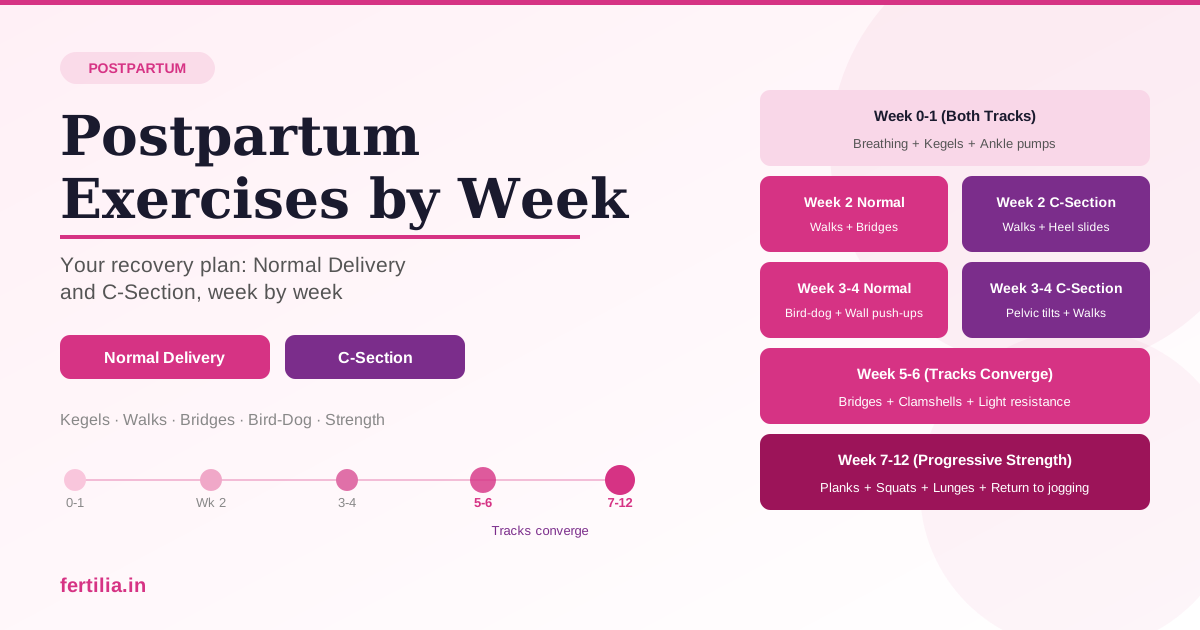
The whole programme on one screen:
- Day 1 to 7, both tracks: diaphragmatic breathing, pelvic floor contractions, ankle pumps.
- Week 2 to 4: short walks and heel slides for everyone; the normal-delivery track adds glute bridges, bird-dog and wall push-ups; the C-section track stays with walking, heel slides and seated pelvic tilts.
- Week 5 to 6: the tracks converge on bridges, clamshells and light resistance.
- Week 7 to 12: progressive strength return, with direct core work only after the diastasis self-check.
Each block below tells you what to do, how many, and the signals that mean pause. For the broader question of when it is safe to start at all, our post on postpartum exercise: when to start and what is safe covers that foundation; C-section mothers should read this alongside the C-section recovery week-by-week guide for wound care and daily-life restrictions, and both sit inside the complete postpartum recovery guide for Indian mothers.
Before You Begin: What the Research Supports
ACOG Committee Opinion No. 804 (2020, acog.org) states that after an uncomplicated delivery, physical activity can be resumed gradually as soon as it is medically safe, depending on the mode of delivery and any complications; there is no fixed waiting period that applies to everyone. For most women, gentle movement begins within the first 24 to 48 hours, starting with pelvic floor contractions and diaphragmatic breathing.
International guidelines summarised by Evenson and colleagues (Obstetrical and Gynecological Survey, 2014, PMID 25112589) agree that a gradual return to aerobic and resistance training after delivery is safe and does not interfere with breastfeeding, provided intensity is matched to the stage of recovery.
One consideration that applies to both tracks is diastasis recti, the separation of the two rectus abdominis muscle bellies along the midline. In a Norwegian cohort of 300 first-time mothers, Sperstad and colleagues (British Journal of Sports Medicine, 2016, PMID 27324871) found it in 60% of women at six weeks postpartum, defined as a palpable gap of two finger-widths or more, falling to 45% at six months and 33% at twelve months; most of it was mild, and women with and without it reported the same amount of back and pelvic pain a year on. Standard postnatal physiotherapy practice is to defer sit-ups, bicycle crunches and full planks until the midline can take load without the tissue doming forward; whether a given exercise widens or narrows the gap in the moment turns out to vary by exercise and by week, which is why the self-check matters more than any blanket rule. Before progressing to core strengthening past Week 4, do the self-check described in our diastasis recti guide.
How to Use This Programme
Each section below shows what is appropriate in that time window, with exercises for the Normal Delivery track and the C-Section track listed separately where they differ.
A few principles apply throughout:
- Start where you are, not where you were. If a movement causes pain, pulling at the scar or episiotomy site, leaking urine, or pelvic pressure, it is not the right movement for this week.
- Sleep deprivation changes capacity. A week when the baby has not settled is not the week to push into the next phase.
- The progression is a guide, not a schedule. Some women move faster; some need more time at one stage. Both are fine.
- Keep the printable version handy. The Normal Delivery Postpartum Care resource page has the downloadable care plan this programme sits inside.
- Your gynaecologist or physiotherapist has more information than any article. Use this as a framework to bring into your postpartum checkup conversation.
Week 0 to 1: Both Tracks
Both the Normal Delivery and C-Section tracks start in the same place. These exercises require no equipment and can be done lying in bed.
Diaphragmatic Breathing
Lie on your back or side. Breathe in through the nose so that your belly rises gently. Breathe out slowly through the mouth and feel the belly fall. On the exhale, gently draw the lower belly inward as if you are pulling your navel toward your spine. The motion is gentle, not a hard suck-in.
This activates the deep transversus abdominis and coordinates it with the pelvic floor and diaphragm. It is the foundation everything else builds on. Do 5 to 10 slow breaths, two or three times a day.
Pelvic Floor Contractions (Kegel Exercises After Delivery)
For both delivery types, kegel exercises after delivery can begin within the first 24 to 48 hours, once the catheter is removed for C-section mothers. In practice, mothers who start gentle pelvic floor work in the first days tend to regain bladder control sooner than those who wait for the six-week check, and starting early builds the habit before the baby’s routine crowds it out.
Lie comfortably. Breathe out slowly. On the exhale, gently lift and squeeze the pelvic floor muscles, as if you are stopping the flow of urine and stopping the passing of gas at the same time. Hold for 3 to 5 seconds, then release fully. The release is as important as the contraction. Many women hold tension without fully letting go.
Start with 8 to 10 repetitions, twice a day. If you had perineal stitches, contractions may feel tender at first. That is expected. If you notice sharp pain, wait another day or two and try again gently.
Ankle Pumps and Foot Circles
Point and flex the feet slowly, then circle the ankles in each direction. Do 10 to 15 repetitions every hour if you are spending most of the time in bed. This keeps circulation moving and reduces the risk of blood clots, which is particularly relevant in the first 48 to 72 hours after C-section.
Pause and contact your doctor if: Calf pain or swelling of one leg more than the other, chest pain, or sudden breathlessness. These are signals to seek medical attention rather than to rest and wait.
Week 2: Walking and Gentle Activation
Both Tracks: Short Walks
By the start of Week 2, most women can begin short indoor walks. For Normal Delivery, aim for 5 to 10 minutes twice a day and build by 2 to 3 minutes every few days. For C-Section, keep walks to 5 minutes and prioritise upright posture rather than pace. Walking with a slight stoop to protect the wound places additional strain on the lower back and is worth consciously correcting.
Both Tracks: Heel Slides
Lie on your back with knees bent. Breathe out. On the exhale, slowly slide one heel along the mat until the leg is almost straight, then slide it back. Keep the lower back flat on the mat throughout. This works the deep hip flexors and core stabilisers without loading the incision or perineum. Do 8 to 10 per side, once or twice a day.
Normal Delivery Track Only: Glute Bridges
Lie on your back, knees bent, feet flat. Breathe out and, on the exhale, press through the feet and lift the hips until the body forms a straight line from knees to shoulders. Squeeze the glutes at the top. Hold for 2 to 3 seconds. Breathe in as you lower slowly.
Glute bridges restore posterior chain strength, support the pelvic floor from below, and reduce the lower back strain that commonly builds from breastfeeding postures. Start with 8 to 10 repetitions.
C-section mothers stay with walking, heel slides, and pelvic floor work this week. The abdominal wall has been cut through multiple layers, and adding bridge loading this early can strain the healing fascia; our C-section scar healing timeline covers what normal healing looks like week by week. A common third-week report is a mother who felt fine walking in Week 2 and then feels the scar “pulling” the first time she carries the baby up a flight of stairs. That pull is the fascia being asked for more than it can give yet, not a wound opening, and the answer is to drop back to flat walking for a few days rather than push through.
Pause the session if: Increased redness or discharge at the wound or episiotomy site, urine leaking during exercise, pelvic heaviness or pressure after the session, or pain that lasts longer than 30 minutes after stopping.
Week 3 to 4: Building Stability
Both Tracks: Continued Walking
Gradually increase walking duration. By Week 4, most Normal Delivery women can walk 20 to 30 minutes comfortably. C-section mothers aim for 15 to 20 minutes by the end of Week 4, maintaining an upright posture. A mild pulling sensation at the scar is common; sharp or worsening pain is a reason to reduce pace and duration.
Normal Delivery Track: Bird-Dog
Come to hands and knees in a table-top position. Breathe in. On the exhale, slowly extend the right arm and left leg simultaneously, keeping the spine neutral. Do not let the hips rotate or the lower back sag. Hold for 2 to 3 seconds, then return slowly. Alternate sides.
This trains the deep stabilisers of the lumbar spine without loading the pelvic floor directly. Start with 5 to 6 repetitions per side and work up to 10.
Normal Delivery Track: Wall Push-Ups
Stand facing a wall, hands at shoulder height, about arm’s length from the wall. Keeping the body in a straight line, bend the elbows to bring the chest toward the wall, then push back. This is a closed-chain upper body exercise that also works the core and shoulder stability. It is far safer at this stage than floor push-ups, which load the abdominal wall considerably more. Do 10 to 12 repetitions.
C-Section Track: Gentle Seated Pelvic Tilts
C-section mothers continue with Kegels, heel slides, and walking this week. You can also add seated pelvic tilts: sit upright on a firm chair, tuck the pelvis under (flatten the lower back) and release slowly. This mobilises the lumbar spine and coordinates the core without any direct incision loading. Do 10 to 12 repetitions.
The abdominal wall layers need time to regain tensile strength. There is no benefit to rushing the C-section track.
Pause the session if: Sharp pain at the incision during movement, any worsening of bleeding, or pain that intensifies over the course of a session rather than staying stable.
Week 5 to 6: The Tracks Converge
By Weeks 5 to 6, both Normal Delivery and C-Section mothers can work toward a shared programme, provided recovery has been uncomplicated. This is also approximately when most women have their postpartum checkup. Use that appointment to confirm you are cleared to progress.
Both Tracks: Glute Bridges
C-section mothers begin glute bridges now. Normal Delivery mothers can progress to a single-leg variation: extend one leg and bridge on the supporting leg. This increases glute loading without increasing abdominal pressure.
Both Tracks: Clamshells
Lie on your side with knees bent and hips stacked. Keeping the feet together, rotate the top knee open like a clamshell. This works the hip abductors (gluteus medius), which tend to weaken during pregnancy and contribute to knee and hip pain as activity increases. Do 12 to 15 repetitions per side.
Both Tracks: Light Resistance
If you have light resistance bands or 0.5 to 1 kg weights at home, they can be incorporated for seated bicep curls or banded clamshells. For most new mothers, bodyweight is more than enough resistance at this stage. There is no need to purchase equipment.
A Note on Exercises to Reduce Tummy After C-Section
Many women arrive at this stage asking specifically about exercises to reduce tummy after C-section. The glute bridges, clamshells, and progressive core work from Week 5 onwards are the appropriate starting point. However, visible abdominal changes take longer than six weeks and depend on diastasis recti healing, core restoration, and uterine involution. For a detailed explanation of what is actually happening to the postpartum belly, see our post on why the postpartum belly stays and how to heal it.
Pause the session if: Coning or doming of the midline when you exert effort (a possible sign of diastasis recti that warrants assessment), involuntary urine leakage, or pelvic pain during or after exercise.
Week 7 to 12: Progressive Strength Return
If you are at Week 7 or beyond with no complications and have been cleared at your postpartum check, the goal is a gradual return to full-function strength. Three phases work well for most women:
Phase A (Weeks 7 to 9): Add a modified forearm plank or wall plank. Continue bridges and bird-dog. Introduce bodyweight squats. Extend daily walks to 30 to 45 minutes.
Phase B (Weeks 9 to 10, overlapping as you tolerate): Add a full floor push-up (skip this if diastasis recti is still clinically significant at the midline). Sumo squats. Reverse lunges. Light resistance band rows and pulls.
Phase C (Weeks 10 to 12 and beyond): Return to jogging is the last step, not a Week 10 default. For most mothers after an uncomplicated normal delivery it starts from Week 12, with a walk-run programme, and only once you can walk briskly for 30 minutes with no leaking, no pelvic heaviness and no pain; C-section mothers usually reach that point a little later, depending on how the scar has matured. If any of those three signals appear, go back a phase.
Yoga is an excellent complement and many mothers find it easier to maintain than structured gym sessions with a newborn at home. Our postpartum yoga guide covers 8 poses that pair well with this programme.
Lower back pain is common in this phase, especially for women who have spent long hours in breastfeeding positions. If it is limiting your progress, see our post on back pain after delivery: causes and relief exercises before moving forward.
Pause the session if: Pelvic floor symptoms return (leaking, heaviness, prolapse sensation), sharp joint pain, or symptoms from an earlier stage that you thought had resolved.
A Note on Core Exercises Specifically
The most common mistake in postpartum recovery is progressing to sit-ups, crunches, or bicycle exercises before the core is ready. These movements increase intra-abdominal pressure significantly and, if diastasis recti is still present, push the tissue forward rather than building strength.
Before adding any direct abdominal exercise beyond what is listed above, do the self-check described in the diastasis recti guide. If you feel a gap wider than two finger-widths at the midline when you lift your head slightly while lying on your back, stay with the gentle core activations in this programme and get a pelvic floor physiotherapist to assess you. Outside the metros that is often not possible locally, which is why Fertilia’s Postpartum Recovery program includes a consulting pelvic floor physiotherapist, Dr. Maitri Daga, over video call; in the meantime, breathing, pelvic floor contractions, heel slides and walking are safe to continue on your own.
This applies to a large proportion of new mothers. In the Sperstad cohort above it narrowed in most women over the first year, though a third still had a mild gap at twelve months, so the aim of targeted loading is a midline that holds load without doming, not a gap of zero. It is a structural reality to work with, not a complication to worry about.
The India-Specific Context
A few points that are especially relevant for Indian families:
Floor activities: Traditional Indian homes often involve floor-sitting for feeding, oil baths for the baby, and sleeping on low mattresses. Getting up and down from the floor repeatedly is itself a functional movement challenge. For the first few weeks, use a wall or furniture for support when lowering and rising. By Week 5 to 6, unassisted floor-to-stand is a practical marker of core and leg strength returning.
The 40-day rest tradition: In many South Indian families, new mothers observe a 40-day rest period. The exercises in the first four weeks of this programme are designed to be compatible with this tradition. Pelvic floor work, breathing, and short walks are gentle enough not to violate the spirit of rest while still preventing the deconditioning and circulation concerns that come with complete immobility.
Household work as movement: From Week 6 onwards, activities such as standing while cooking, carrying the baby in an upright position, and light sweeping are appropriate additions to daily life. They do not replace a structured programme, but they count as functional movement. The reverse problem is at least as common: a mother told by the household to be back at the stove and the mopping by Week 2, well before her body is ready for sustained standing and bending. If that is your situation, the honest line to offer the family is that the programme above is her work for the first six weeks, and the housework will still be there in Week 7.
If you would like a personalised plan, or if you are unsure which track to follow given your specific delivery circumstances, send Dr. Suganya a message on WhatsApp with a brief description of your delivery type and which week you are at. Most questions resolve in a single conversation.
Frequently Asked Questions
When can I start exercising after a normal delivery?
Pelvic floor contractions and diaphragmatic breathing can begin within the first 24 to 48 hours. Short walks and gentle leg exercises are appropriate by Day 3 to 5 if there are no complications. A return to more structured exercises after delivery builds from Week 2 onwards as described in this programme.
When can I start exercises after a C-section?
Pelvic floor contractions and ankle pumps can start from Day 1 after the catheter is removed. Short walks begin in the first week. The C-section track keeps the first four weeks focused on walking, pelvic floor work, and gentle floor exercises, with gradual progression from Week 5 to 6 when the abdominal wall has had adequate time to begin healing.
Are kegel exercises after delivery safe even with stitches?
Yes, in the vast majority of cases. Pelvic floor contractions actively support perineal healing by increasing blood flow to the area and preventing the pelvic floor from becoming completely inactive. If the contractions cause sharp pain in the first 24 to 48 hours, wait another day and try again gently. Gentle contractions do not pull on perineal stitches; if you feel a sharp tug rather than tenderness, stop and mention it at your check-up.
Will postpartum exercises reduce my tummy?
Core exercises in this programme support the recovery of the abdominal muscles and help reduce diastasis recti over time. However, the appearance of the postpartum belly is primarily determined by the linea alba (the connective tissue between the abdominal muscles), residual uterine size, and skin laxity, not by how quickly you begin exercising. Progressive, appropriate exercises support the process; they do not fast-forward it.
What exercises should I avoid after delivery?
In the first six weeks, avoid sit-ups, crunches, bicycle exercises, full planks, and any movement that causes coning or doming at the midline. These increase intra-abdominal pressure and can widen diastasis recti. High-impact activities (jogging, jumping) should wait until at least 10 to 12 weeks.
Can I follow the same programme after twins or a complicated delivery?
Twins, instrumental delivery, significant perineal trauma, or a complicated recovery all mean the pace should be slowed. Start from Week 0 to 1 and progress based on how your body responds rather than calendar dates. Your gynaecologist’s guidance is especially useful in these situations.
What do the “pause if” signals actually mean, practically?
Stop the exercise and rest the session. If the signal is chest pain, breathlessness, heavy bleeding, or wound pain that worsens, contact your doctor before resuming. General soreness or mild fatigue: reduce repetitions the next day and monitor.
Your Recovery, Your Pace
Postpartum exercise is not about returning to what you could do before pregnancy. It is about rebuilding from the ground up: following what your body can do this week and adding more when it is ready.
The two-track programme above is the progression most women can follow safely. It is backed by ACOG guidelines, postpartum physiotherapy research, and clinical experience across a range of delivery types and recovery speeds. Both tracks meet in the same place: progressive, functional strength by Week 12 and beyond.
If you have questions about whether your recovery is on track, whether you are ready to progress, or whether your diastasis recti needs specific attention, message Dr. Suganya on WhatsApp; for a guided week-by-week plan with the pelvic floor physiotherapist included, that conversation is also the way into her Postpartum Recovery program.