If your discharge summary says “IUCD inserted”, you may still have questions: which device is it, will your periods change, and when should it be replaced? Ask the inserting team for the device name, insertion date and replacement date. Keep that record somewhere you can find it later.
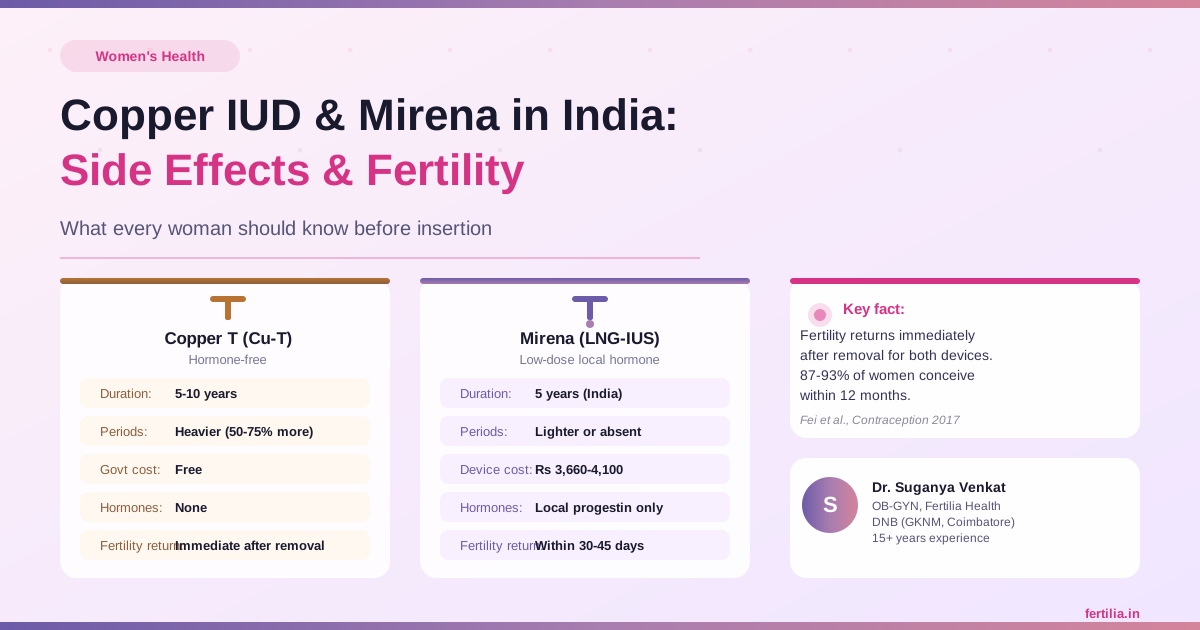
Copper T price in India: it is free through public family-planning services. Private hospitals should give you an itemised quote; there is no verified nationwide procedure tariff in this guide. For the 52 mg hormonal-IUD formulation used in Mirena, the NPPA ceiling is Rs 4,202.06 before applicable GST, with insertion charges separate (sources checked 13 September 2026).
Copper T is hormone-free. Mirena releases levonorgestrel and can also reduce heavy menstrual bleeding. The useful comparison includes the full appointment cost, your bleeding pattern and your plans for pregnancy.
This guide explains costs, side effects, insertion and fertility after removal. If you are deciding between devices, our IUD choice guide matches those differences to common health concerns.
The Two Main Intrauterine Devices Available in India
Both are small devices placed inside the uterus by a trained healthcare professional. According to the WHO IUD fact sheet, fewer than one woman in 100 becomes pregnant in the first year with either type. Both are reversible. Neither protects against sexually transmitted infections; condoms are still important when there is a risk of exposure.
Copper T (copper IUD): Copper interferes with sperm movement and fertilisation. The device contains no hormone and does not work by suppressing ovulation. It can change your bleeding pattern even though it is hormone-free.
Mirena (52 mg levonorgestrel intrauterine system): It thickens cervical mucus, inhibits sperm and thins the uterine lining. Its contraceptive action is mainly local, but levonorgestrel also reaches the bloodstream. Ovulation continues in many users; Mirena does not depend on stopping every ovulation. These mechanisms and systemic exposure are described in Bayer’s prescribing information, sections 12.1-12.3. That document is the US label, not proof of Indian licensing.
What the Copper T Does to Your Periods
Periods may become heavier, longer or more crampy, particularly during the first three to six months. Spotting can also occur. These changes often decrease with continued use, but not everyone has the same experience. This is the pattern described in the CDC’s 2024 Selected Practice Recommendations, rather than a fixed percentage increase in blood loss for every woman.
If your periods are already heavy or you have known anaemia, tell your clinician before choosing a device. A hormonal IUD may suit you better because it usually reduces bleeding. Copper IUD use is not automatically ruled out by iron-deficiency anaemia: the CDC’s 2024 eligibility guidance classifies it as generally usable, with individual assessment.
Routine ferritin testing before insertion and again at six months is not a requirement for every IUD user. The CDC’s 2024 guidance does not require routine haemoglobin measurement to start an IUD. Your doctor may arrange a blood count or iron tests if your symptoms, bleeding or history warrant them.
A hormone-free device does not mean every symptom must be unrelated to contraception. Pain or troublesome bleeding can affect wellbeing and sex. If something changes after insertion, discuss it rather than being told that an effect is impossible.
What Mirena Does to Your Periods
Spotting and irregular bleeding are common during the first three to six months. Over time, bleeding usually becomes lighter; some women stop bleeding altogether. Heavy or prolonged bleeding is uncommon with ongoing LNG-IUD use, according to the CDC’s 2024 recommendations.
Approximately 20% of Mirena users develop absent periods by one year, as reported in Bayer’s clinical-trial information, section 5.8. This reflects a thin uterine lining; blood is not collecting inside. The absence of periods itself usually needs no treatment. An abrupt change from an established pattern, pregnancy symptoms or new pain may still call for a pregnancy test and assessment.
Local action does not mean no hormonal side effects. Headache, acne, breast discomfort and mood symptoms are reported with Mirena. Ovarian cysts can occur and often resolve without treatment; persistent pelvic pain needs assessment. The prescribing information, sections 5.7 and 6.1, describes these effects. A symptom report alone does not prove the device caused it, but it deserves to be taken seriously.
Insertion: What to Expect
Insertion is usually a short outpatient procedure at a healthcare facility. A speculum is used to see the cervix, and the device is passed through it into the uterus. Pain varies considerably: some women feel brief cramps, while others find it painful. You can ask the clinician to pause or stop.
Agree on a pain-management plan before the appointment. The CDC’s 2024 recommendations say that topical lidocaine or a paracervical local-anaesthetic block may help. Misoprostol is not recommended routinely, though it may be useful after a recent failed insertion. Do not assume a tablet taken beforehand will make insertion painless or self-prescribe one for this purpose.
The evidence for oral pain medicines is mixed. A Cochrane review found that most NSAIDs did not reduce insertion pain; some preparations and interventions helped in particular study groups (Lopez et al., Cochrane Database of Systematic Reviews, 2015, PMID 26222246). That does not establish naproxen as the best choice for every woman.
Cramping and some bleeding can follow insertion. Increasing pain, fever or very heavy bleeding should be assessed, not dismissed as adjustment. The first period does not have to be heavier with both device types.
WhatsApp Dr. Suganya for an online discussion of your contraceptive options. Fertilia consultations are by video call or phone, pan-India; insertion, removal and examination must be arranged with a local trained clinician. Urgent symptoms need local care rather than waiting for a WhatsApp reply.
How Long Do They Last?
Copper T: India’s National Health Mission family-planning booklet, 2022 lists Cu IUCD 380A for 10 years and Cu IUCD 375 for 5 years. Both are public-programme options. Do not infer which one you received from whether the hospital was government or private.
Mirena: Confirm the replacement date against the current Indian package insert for the device supplied and the reason it is being used. We could not verify a current publicly accessible Indian prescribing document at this review, so we do not claim a fixed Indian licence duration. For comparison only, Bayer’s US label specifies 8 years for contraception and 5 years for heavy menstrual bleeding. Those US durations are not instructions to extend an Indian device’s planned replacement date.
Ask the inserting service to check your device card or records if the model or date is unclear. Ultrasound can assess location when clinically needed, but should not replace the insertion record as your source for the product and replacement schedule.
Either device can be removed at your request before its replacement date. If you do not want pregnancy, discuss recent sex and the next contraceptive method before removal so there is no gap in protection.
Indian Costs: Government vs Private
Sources checked 13 September 2026. A device-only price and the bill for insertion are different costs.
| Option | What the source establishes | What to ask locally |
|---|---|---|
| Copper T through public family-planning services | The NHM booklet lists copper IUCDs and says available programme methods are provided free through public services | Which device is available, where insertion is offered and what follow-up is arranged |
| Copper T at a private hospital | There is no verified nationwide private insertion tariff in this guide | Request an itemised quote for the device, consultation, insertion, pain relief and any indicated tests |
| 52 mg levonorgestrel hormone-releasing IUD, the formulation used in Mirena | Rs 4,202.06 per IUD, excluding applicable GST, is the ceiling in NPPA S.O. 1575(E), 25 March 2026, row 365, effective 1 April 2026 | Check the pack MRP and invoice; ask separately about insertion and other service charges |
The NPPA figure is a formulation-level device ceiling, not a guaranteed Mirena retail price or an all-inclusive procedure fee. This guide does not quote an unsupported national private-hospital total.
Public-hospital availability needs a local check. The National List of Essential Medicines 2022, section 18.2.2 includes a 52 mg levonorgestrel hormone-releasing IUD at tertiary-care level. That listing does not establish current stock, free provision or the Mirena brand at any particular government hospital. Ask the hospital’s gynaecology department about availability and charges before buying a device.
Fertility Return After Removal
You can become pregnant soon after either device is removed. The WHO IUD fact sheet states that fertility returns immediately and that IUDs do not cause infertility. No routine waiting period is needed solely because you used an IUD.
Follow-up research supports this. A Norwegian copper-IUD cohort found no evidence that prior use impaired fertility (Hov et al., Contraception, 2007, PMID 17241835). A comparative study found no statistically significant difference in conception after removal of an LNG-IUD versus a copper device (Andersson et al., Contraception, 1992, PMID 1493717).
That means the contraceptive effect ends, not that pregnancy is guaranteed in the first cycle. Age, ovulation, sperm factors and other health conditions still matter. You do not need to wait for a first period before pregnancy is possible.
If pregnancy is your next goal, our guide to trying to conceive naturally covers preparation and timing. Dr. Suganya Venkat’s Fertility program offers online support for couples who need a personalised plan; it is not a requirement after routine IUD removal.
Red Flags to Know After Insertion
Most women use an IUD without a serious complication. Knowing where to seek help makes the uncommon problems easier to manage.
- Seek urgent local medical care for severe or worsening lower-abdominal pain, fever, foul-smelling discharge or very heavy bleeding, especially with dizziness or fainting.
- A positive pregnancy test needs prompt assessment, including checking the pregnancy’s location. IUDs lower the overall chance of pregnancy, including ectopic pregnancy, but an ectopic pregnancy must be excluded if pregnancy occurs with a device in place. Do not remove it yourself.
- If strings seem missing or different, or you feel the device itself, use condoms or avoid sex until its position is checked. Seek advice promptly about whether emergency contraception is needed after recent sex. Missing strings do not automatically mean expulsion; they may have drawn up inside.
- A new bleeding change after months of stability deserves a review. Pregnancy, infection, displacement or another uterine condition may need to be checked before attributing it to the IUD.
Pelvic infection after insertion is uncommon; risk is higher soon after insertion when an untreated infection is present. STI screening depends on your risk and can often be done on the insertion day. Active gonorrhoea, chlamydia or purulent cervicitis should be treated before insertion. These recommendations and pregnancy-with-IUD management are covered in the CDC’s 2024 guidance.
Perforation of the uterine wall and expulsion are uncommon but recognised risks. Bayer’s safety information, sections 5.5-5.6, notes that perforation may not be recognised immediately and that breastfeeding or recent childbirth affects risk. Tell your clinician when you delivered and whether you are breastfeeding when planning insertion.
Follow the inserting service’s aftercare plan. India’s NHM booklet advises a follow-up visit at six weeks or after the first menstrual cycle, whichever is earlier. In contrast, the CDC’s 2024 recommendations do not require routine follow-up for every healthy user. Neither is a reason to skip an appointment arranged by your clinician or required by your product instructions. A scheduled visit does not automatically require ultrasound; a scan at six weeks or six months is not a universal requirement for every asymptomatic user.
Copper T vs Mirena: Which Is Right for You?
Copper T may suit you if you want hormone-free contraception, your bleeding is manageable and public-programme access matters to your budget.
Mirena may suit you if you need contraception and would also benefit from lighter periods. A clinician should assess unexplained heavy bleeding first. The CDC’s eligibility guidance also identifies situations where choice changes, such as current breast cancer, for which an LNG-IUD should not be used.
For other methods, our birth-control pill guide discusses pill-related considerations. If you need help after unprotected sex, the emergency-contraceptive pill guide explains that separate, time-sensitive option.
WhatsApp Dr. Suganya if you would like to talk through your choice over an online consultation. Bring your bleeding history, current medicines and any previous device records; your local clinician can then arrange the examination and procedure.
Frequently Asked Questions
Does the copper T cause infertility? No evidence shows that previous copper-IUD use causes infertility. Fertility can return immediately after removal, according to the WHO IUD fact sheet. It does not protect against STIs, which need their own prevention and treatment.
How painful is the insertion of a copper T or Mirena? Pain varies, and it should not be minimised. Ask about a local-anaesthetic option and agree that you can pause or stop. The CDC’s 2024 guidance supports an individual pain plan rather than promising a painless procedure after a tablet.
Can I get the copper T or Mirena if I have never had a baby? Yes. Not having given birth does not rule out either device. The CDC’s 2024 eligibility table places both in category 2 for nulliparous users, meaning benefits generally outweigh risks. Your clinician still checks your individual suitability.
What happens if I get pregnant with an IUD in place? Contact a local doctor promptly to confirm where the pregnancy is. If the strings are accessible, clinician removal is generally advised because leaving the IUD increases pregnancy complications. Do not attempt removal yourself. Severe pain, fainting or heavy bleeding requires emergency care; see the CDC pregnancy-with-IUD guidance.
Will I know if my copper T has moved or come out? Not always. If strings change, the device is felt, or new pain or bleeding develops, arrange a check and use backup contraception meanwhile. An examination and, when indicated, ultrasound can assess location. A routine scan is not needed simply because six months have passed.
Will Mirena affect my mood or weight? Some users report mood changes; the hormone does reach the bloodstream despite its mainly local action. Weight changes have many possible causes, so they should not automatically be attributed to or dismissed because of an IUD. Discuss persistent symptoms and your options with your clinician; Bayer’s adverse-reaction information includes mood symptoms.
Can I use a copper T or Mirena as emergency contraception? A copper IUD can be inserted within five days of unprotected sex for emergency contraception, as described by WHO. Do not assume Mirena is interchangeable for this purpose: the CDC’s 2024 recommendations list the copper device as the IUD emergency option. Seek timely local advice rather than waiting for a routine appointment.
What are the common side effects of the Copper T? Heavier or longer periods, cramping and spotting, especially early in use. They often lessen, but troublesome bleeding is a reason to discuss treatment or switching. A routine ferritin schedule is not required for everyone; tests depend on your symptoms and history.
Is Mirena the same as Copper T? No. Copper T is hormone-free and may increase bleeding. Mirena releases levonorgestrel and usually reduces bleeding over time. Both provide highly effective reversible contraception, but their side effects, device durations and costs differ.