If you have just taken i-Pill or Unwanted-72, it is understandable to watch every cramp or spot of blood and wonder whether it worked. Symptoms cannot answer that question. What helps is knowing when the sex happened, when you took the tablet, and when a pregnancy test can give you a useful result.
If you need emergency contraception now: take action as soon as possible, not the next morning. Do not wait days for a pregnancy test to become reliable after recent sex. If your period was already late or there was earlier unprotected sex, tell a pharmacist or local clinician promptly so testing and emergency contraception can be considered together. A positive test needs pregnancy care, not another emergency pill.
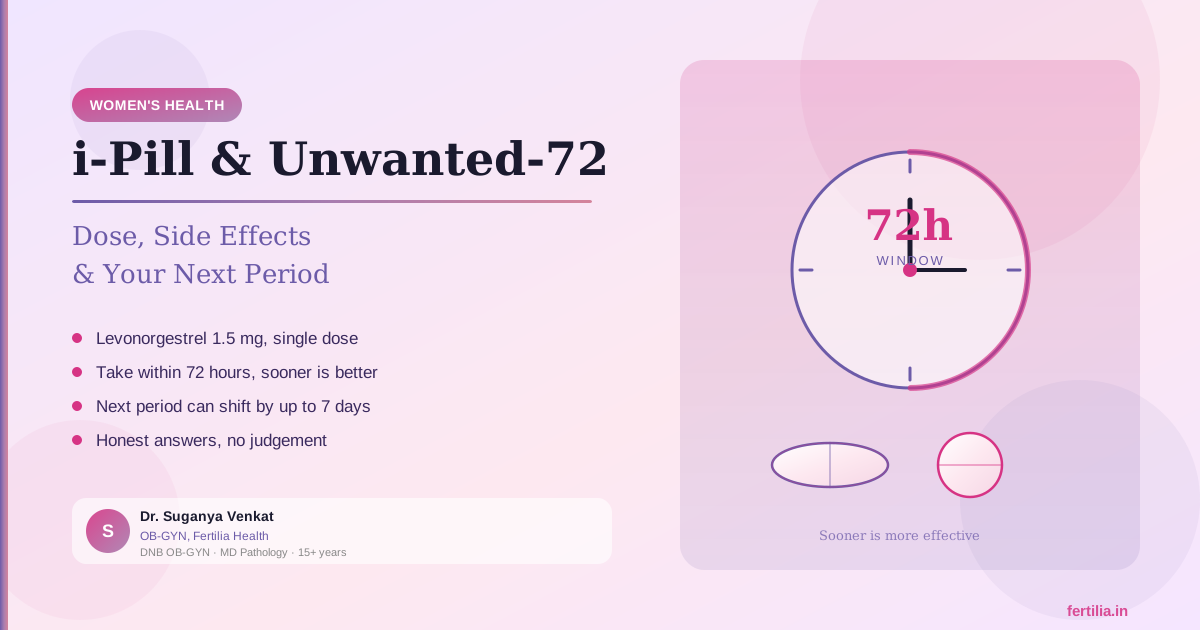
Quick answers: the single-tablet emergency versions of both brands contain levonorgestrel 1.5 mg. Nausea, mild cramps, spotting and an earlier or later period can follow. Symptoms cannot tell you whether the pill worked. Test if your period is more than seven days late, and plan a test 21 days after the latest unprotected sex if bleeding is absent, unusual or hard to interpret.
This guide explains the dose, the difference between the brands, vomiting, side effects, your next period and what to do after another episode of unprotected sex. The timing advice draws on CDC’s 2024 recommendations and pregnancy-assessment guidance, checked on 13 September 2026.
What Is in the Pill
The single-tablet emergency versions of i-Pill and Unwanted-72 contain levonorgestrel 1.5 mg. i-Pill is marketed by Piramal Pharma; Unwanted-72 is a Mankind brand. The NPPA’s brand/composition table lists both at this strength, and Piramal’s Wellify product page and pack image identify its emergency tablet. The NPPA document is a historical composition reference, not a current price quote.
For this formulation, the usual dose is one 1.5 mg tablet once, taken as soon as possible. This matches the WHO levonorgestrel regimen. Do not take both brands together for the same episode just because you are worried. Exceptions such as vomiting or interacting medicines need the specific advice below.
Check the medicine name, strength, expiry date and instructions on your own pack. i-pill Daily and Unwanted-21 are regular contraceptive products, not interchangeable one-tablet emergency doses. Unwanted-Kit is different again. Mankind’s official product list distinguishes Unwanted-72 (levonorgestrel), Unwanted-21 (a combined pill) and Unwanted-Kit (mifepristone plus misoprostol). Do not choose by the word “Unwanted” alone.
Side Effects: What to Expect, and What Is Normal
Possible short-term effects include nausea, headache, tiredness, mild cramps and irregular bleeding or spotting. Some people notice few or no symptoms. Mild effects usually settle without specific treatment, but there is no fixed deadline by which everyone must feel normal. The WHO fact sheet and FSRH guideline describe these effects.
Rest if needed and avoid driving while dizzy. Persistent, worsening or difficult-to-manage symptoms deserve medical advice. Having side effects does not prove the pill worked; having none does not mean it failed.
If you vomit after the tablet
If you vomit within two hours, take a replacement dose as soon as possible, as advised by WHO. CDC’s 2024 guidance uses a longer threshold: repeat the dose if vomiting occurs within three hours.
If vomiting happened between two and three hours, contact a pharmacist or clinician promptly about a replacement; do not assume the tablet was fully absorbed. Explain which product you took and the time of vomiting. If you keep vomiting, seek help rather than repeatedly redosing yourself. A clinician can consider an anti-nausea medicine or a copper IUD if suitable.
Symptoms that need local assessment
Severe or worsening abdominal pain, fainting, or heavy bleeding with weakness needs urgent local assessment. Sudden intense pain or collapse needs emergency care. One-sided lower abdominal pain, shoulder-tip pain or unusual bleeding when pregnancy is possible also needs prompt assessment, even without a positive test. Levonorgestrel emergency contraception reduces the overall risk of ectopic pregnancy by reducing pregnancy risk, according to FSRH. The warning matters if a pregnancy occurs despite the pill. These symptoms can indicate an ectopic pregnancy, as explained in NHS symptom guidance. Do not dismiss them as an ordinary pill reaction or wait for a WhatsApp reply.
For non-urgent questions after taking the tablet, you can WhatsApp Dr. Suganya Venkat. She is an OB-GYN with 15+ years of experience and consults online through Fertilia. Local urgent care takes priority over booking a consultation.
What to Expect From Your Next Period
Your next period may come earlier or later, and its flow may differ. Most women menstruate within seven days of the expected date after levonorgestrel, but a longer delay can occur. Seven days is a testing trigger, not a maximum possible side effect. See FSRH’s menstrual-disturbance guidance.
Spotting may be pill-related rather than a normal period. Bleeding alone cannot confirm that pregnancy was prevented. Do not use spotting to reset your testing plan.
When to take a pregnancy test
- Test if your period is more than seven days late, unusually light, or you have pregnancy symptoms. You can test from the first missed day; you do not have to wait seven days if concerned.
- Plan a home test 21 days after the most recent unprotected sex, particularly if bleeding is absent, unusual or hard to interpret, or you have started hormonal contraception. Count from the sex, not from the tablet or spotting.
- If you tested earlier and it was negative, repeat at the 21-day point to check that episode. Any further unprotected sex creates a new testing date and may need emergency contraception again.
- If the test is negative but the period remains absent, repeat after a few days and speak to a clinician if a second test is negative and there is still no period. A positive result needs pregnancy care; more emergency pills will not help.
These steps combine FSRH follow-up guidance with NHS pregnancy-test instructions. Follow the test kit’s instructions. First-morning urine is not mandatory for every test.
What if my period was already late before the emergency pill?
Tell the pharmacist or clinician about earlier sex and your last normal period. If there was unprotected sex more than 21 days ago without a normal period since, FSRH recommends a pregnancy test before oral emergency contraception. An immediately available test can identify a pregnancy from that earlier episode.
However, a negative test today cannot exclude pregnancy from sex in the past few days. Do not wait days for that recent episode to become detectable before seeking emergency contraception. CDC says routine testing is unnecessary for everyone and advises considering emergency contraception after recent unprotected sex. Arrange timely assessment rather than treating “last period over five weeks ago” as an automatic reason to postpone care.
Price and Availability Check (2026)
Prices checked on 13 September 2026:
| Product | What could be verified directly |
|---|---|
| i-Pill emergency tablet | Piramal’s Wellify listing displayed ₹75.35 including taxes for one tablet, but marked it sold out. This is a displayed seller price, not a promise of stock or a nationwide MRP. |
| Unwanted-72 | A current, pack-specific manufacturer price could not be verified. Check the MRP on the actual pack and the pharmacy’s selling price. |
A lower online price is not useful if delivery misses the treatment window. Ask a nearby pharmacist or public family-planning service about what is available now. The NHM community-health-officer booklet includes emergency pills in community family-planning provision; that does not guarantee stock at every outlet.
What to Do If Your Chemist Has Only One Brand
If the available pack is the correct levonorgestrel 1.5 mg emergency tablet, do not delay solely to find the other brand. The active medicine and intended regimen are the same. Ask the pharmacist to confirm any unfamiliar product rather than assume that every similarly named pack has identical instructions.
A two-tablet pack may contain 0.75 mg per tablet, not 1.5 mg each. Follow its instructions with the pharmacist; do not guess a dose from the number of tablets. Ulipristal acetate is a different emergency contraceptive, with different instructions for restarting hormonal contraception. It should not be added to levonorgestrel on your own.
How It Works (And What It Does Not Do)
Levonorgestrel mainly prevents or delays ovulation, the release of an egg. Oral emergency contraception is unlikely to work after ovulation, so a period-tracking app cannot guarantee that taking it was enough. Cycle dates do not identify ovulation precisely.
It does not end an established pregnancy and is not an abortion medicine. Available evidence has not shown harm to a pregnancy from accidental levonorgestrel emergency-pill exposure. It also does not harm future fertility or delay its return. These points are covered in the WHO fact sheet and FSRH emergency-contraception guideline, amended July 2023.
It does not protect sex later in the cycle or prevent sexually transmitted infections (STIs). Use condoms for subsequent sex, including after taking the tablet.
The 72-Hour Window, and Why Sooner Is Better
Piramal’s Indian i-Pill instructions say to take it within 72 hours of unprotected sex, with earlier use preferable. “Morning-after pill” does not mean you should wait until morning.
There is no dependable hour-by-hour percentage that predicts whether it will work for you. In Piaggio and colleagues’ pooled analysis of four trials, Contraception, 2011 (PMID 21664508), pregnancy odds on days two to four were not significantly different from day one, while they increased on day five. That does not make waiting advisable: ovulation timing and the circumstances of the sex still matter.
More than 72 hours have passed? Contact a local clinician promptly; do not assume there are no options. International guidance describes emergency contraception within five days, but levonorgestrel becomes less dependable later. CDC 2024 finds ulipristal more effective than levonorgestrel on days three to five. Its local availability and suitability need checking; these are not Indian brand-label instructions.
A copper IUD, fitted by a trained local provider within the appropriate window, is the most effective emergency option and can stay in place for ongoing contraception. WHO reports effectiveness above 99% when inserted within five days. Tell the clinician about every episode of unprotected sex, not only the latest one: eligibility and insertion timing need assessment. Even if more than five days have passed, seek advice because ovulation-based timing can sometimes allow insertion under CDC guidance.
Our copper-IUD guide explains insertion and period changes if you are considering this option. Fertilia provides online advice, not IUD insertion or an emergency service. Do not wait for a routine video appointment to obtain time-sensitive care locally.
Repeat Use: How Often Is Too Often
Levonorgestrel emergency contraception can be offered again after another episode of unprotected sex in the same cycle. There is no evidence-based “once a year” allowance. WHO reports no known general health risks from repeated use, although menstrual irregularities can increase; FSRH explicitly allows repeat levonorgestrel after further unprotected sex.
Frequent use can make bleeding less predictable. If you have significant medical conditions or are using it frequently, discuss a suitable regular method. You can do that without being denied emergency contraception when it is needed now.
Do not take another tablet just because there was no spotting. Another episode of unprotected sex, vomiting soon after dosing, and interacting medicines are different situations with different advice.
A Note on Drug Interactions
Tell the pharmacist about all medicines and supplements used in the past four weeks, including some epilepsy medicines such as carbamazepine or phenytoin, tuberculosis medicines such as rifampicin, certain HIV medicines and St John’s wort. These examples are not a complete interaction check.
Enzyme-inducing medicines can reduce levonorgestrel levels. The UK MHRA’s interaction guidance prefers a copper IUD in this situation. If it is unsuitable or unavailable, a clinician may recommend an adjusted levonorgestrel dose; do not improvise by mixing brands or doubling tablets. Ulipristal is not a straightforward substitute with these medicines either.
Higher body weight may also reduce oral emergency-pill effectiveness, especially levonorgestrel. CDC describes this uncertainty. Ask promptly about the most effective available option, including a copper IUD; body weight is not a reason to deny or delay emergency contraception.
Breastfeeding and Existing Health Conditions
Breastfeeding usually does not need to stop after one levonorgestrel emergency dose. NHS Specialist Pharmacy Service guidance says no interruption is necessary; its recommendations apply to healthy, full-term infants. If your baby is premature or unwell, ask for individual advice. Routine expressing and discarding milk is not required for the usual situation.
If you recently gave birth, tell the clinician how many days it has been and how you are feeding. Postpartum timing changes whether emergency contraception is needed and which options are suitable. Do not assume that absent periods alone prevent pregnancy.
A single levonorgestrel emergency dose has different eligibility considerations from a daily oestrogen-containing pill. Smoking, migraine or breastfeeding should not automatically exclude someone from emergency contraception. Tell the pharmacist about your medical history and any medicine allergies so they can check the appropriate option promptly. NHS eligibility guidance explains that someone unable to use regular combined pills may still be able to use an emergency pill.
When to Switch to a Regular Method
You can discuss regular contraception at any time, without reaching a certain number of emergency pills first. Condoms, daily pills, IUDs, implants and injections suit different priorities. Our India contraceptive-method comparison covers effectiveness, access and fertility-return considerations.
After levonorgestrel, suitable regular hormonal contraception can usually be started or resumed immediately. CDC’s post-emergency-pill advice recommends condoms or avoiding sex for seven days. Continue condoms if you have not established an effective regular method; they also reduce STI risk. Follow the particular method’s instructions, including pregnancy testing.
After ulipristal, the hormonal restart schedule differs, so make sure the clinician knows which emergency pill you took. Do not apply levonorgestrel instructions to another medicine.
If you want an IUD for ongoing contraception, our Mirena-versus-copper-T choice guide explains how existing period symptoms, preferences and costs affect the decision. Placement requires a trained local provider.
Frequently Asked Questions
Is i-Pill or Unwanted-72 better?
The single-tablet emergency versions contain the same medicine at the same dose: levonorgestrel 1.5 mg. Neither brand name guarantees success. Check the pack and take the appropriate product promptly rather than delaying to switch brands.
My period is six days late after Unwanted-72. Should I wait?
You can test now because the period is already missed. If fewer than 21 days have passed since the latest unprotected sex, repeat at 21 days if the result is negative. A delayed period can be a pill effect, but delay alone cannot rule pregnancy in or out.
Does spotting mean the pill worked?
No. Spotting can follow the medicine, and bleeding does not reliably exclude pregnancy. Keep your testing date based on the latest unprotected sex, particularly if this bleeding is lighter or different from your usual period.
Can I take it twice in the same month?
It can be offered again for a new episode of unprotected sex. It is not a routine second dose for the original episode. Tell the pharmacist what you already took, especially if it was ulipristal rather than levonorgestrel.
I vomited an hour later. Do I need another tablet?
Yes, repeat the levonorgestrel dose promptly. If vomiting continues, get medical or pharmacy help. For vomiting between two and three hours, the guidance differs; contact a professional promptly because CDC recommends a replacement within three hours.
Will this affect my ability to get pregnant later?
Emergency contraception does not harm future fertility. It also does not provide continuing protection: pregnancy is possible after later unprotected sex. Choose ongoing contraception if you do not want a pregnancy now.
Can I breastfeed after taking it?
For a single levonorgestrel dose and a healthy, full-term baby, breastfeeding can continue without interruption. A premature or unwell infant warrants individual advice.
For a non-urgent discussion of period changes or a regular method that suits you, book an online consultation with Dr. Suganya on WhatsApp. If emergency contraception is needed today or you have severe symptoms, seek local care now rather than wait for our reply.