One of the hardest conversations I have in clinic is with a woman who has had two pregnancy losses and been told, “It is just bad luck, try again.” The reassurance is well-intentioned. But it leaves her with no answers and no plan. When the third pregnancy begins, she is not hopeful. She is braced.
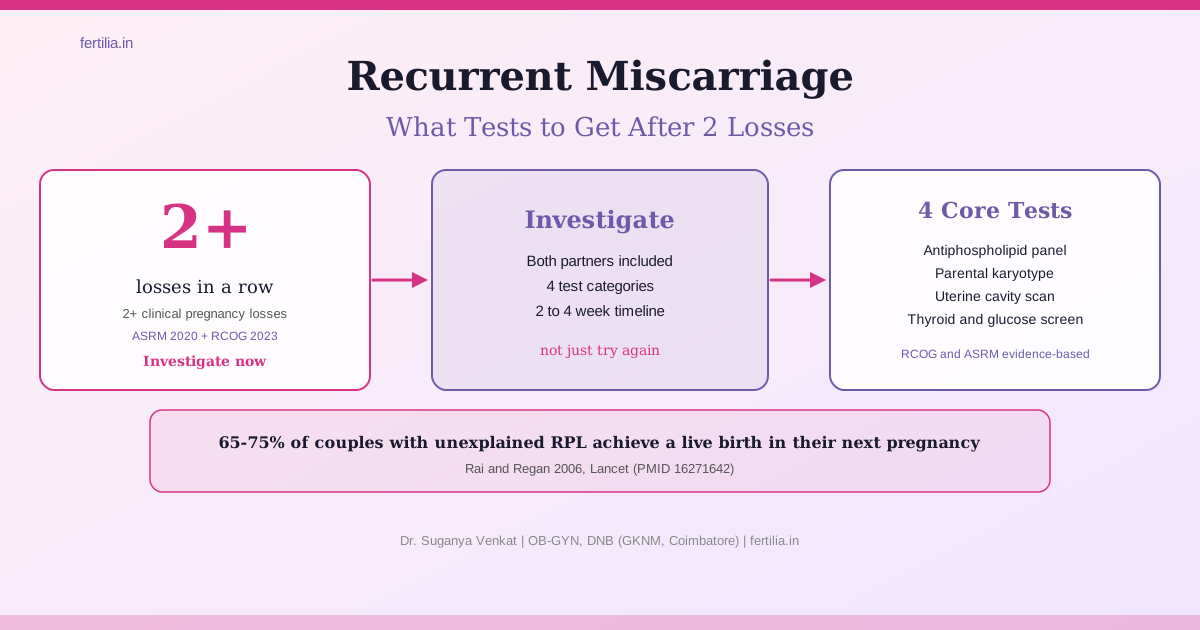
Two losses are not just bad luck. Two documented clinical pregnancy losses are the threshold at which medical guidelines in India and worldwide recommend a structured investigation. This post walks you through exactly what that investigation looks like: what tests to do, what they look for, and what the results mean for your next pregnancy.
Two Losses: When Investigation Begins
A recurrent pregnancy loss (RPL) is defined as two or more clinical pregnancy losses. A “clinical” pregnancy means a pregnancy confirmed by ultrasound or histology, not just a faint positive test line that disappeared before a scan. An early loss of that second kind, where a test turns positive and then a period arrives before anything is visible on a scan, is called a chemical pregnancy, and a single one is common and is not counted toward a recurrent-loss diagnosis. The American Society for Reproductive Medicine (ASRM 2020 Practice Committee Opinion) and the Royal College of Obstetricians and Gynaecologists (RCOG Green-top Guideline 17) both use this two-loss threshold.
Why not wait for three? The older three-loss guideline was based on the idea that two losses might still be coincidental. Newer evidence and clinical practice have shifted. Two losses in a couple trying to conceive is not a coincidence any doctor is comfortable ignoring. The emotional cost of a third unexplained loss, when a workup could have identified something treatable, is too high.
About 1-2% of couples trying to conceive experience recurrent pregnancy loss (Rai and Regan 2006, Lancet, PMID 16905025). This is distinct from sporadic miscarriage, which affects roughly 15% of recognized pregnancies and is usually a one-time chromosomal event in that particular embryo. If you want to understand the general causes and recovery from a single miscarriage, see our complete guide to miscarriage causes, signs and recovery. This post is specifically about what happens after the second loss.
The 4-Part Investigation
The workup for recurrent pregnancy loss has four components. Most blood results come back within one to two weeks. A uterine assessment adds another week or two. The whole workup takes about three to four weeks and most of it can run in parallel.
1. Antiphospholipid Antibody Panel
This is the most important test in the workup because it is the most actionable. If the result is positive, there is an effective treatment that substantially reduces the risk of another loss.
Antiphospholipid syndrome (APS) is an autoimmune condition where the body produces antibodies that interfere with the formation and maintenance of the placenta in early pregnancy. It is found in approximately 15-20% of women with recurrent pregnancy loss.
The panel tests for three antibodies:
- Lupus anticoagulant (LA)
- Anticardiolipin antibodies (aCL), both IgG and IgM
- Anti-beta-2-glycoprotein I antibodies (anti-B2GPI), both IgG and IgM
One important detail: a positive result on a single test occasion can be a false positive, for example from a temporary infection. The diagnosis of APS is only confirmed when the same antibody tests positive on two separate occasions at least 12 weeks apart. If your first panel is positive, you will need a repeat test before the diagnosis is confirmed.
Treatment when confirmed: Low-dose aspirin (75-100mg daily, starting from a positive pregnancy test) combined with low molecular weight heparin (LMWH, typically enoxaparin) starting once a heartbeat is confirmed by scan. A Cochrane meta-analysis (Empson 2005, Cochrane Database CD002859) found that this combination reduces the subsequent miscarriage rate in APS from approximately 54% without treatment to around 25-29%. This is one of the most evidence-backed treatments in the entire field of recurrent pregnancy loss.
In India: The full antiphospholipid panel is available at pathology labs including SRL, Metropolis, Apollo Diagnostics, and NABL-accredited hospital labs. The full three-antibody panel costs approximately Rs.2,500-5,000 depending on the lab and city. Ask specifically for the three-antibody panel, not just “antiphospholipid antibodies,” because individual labs sometimes only report one or two of the components if you do not specify.
2. Parental Karyotype
Both partners should have a blood test to check their chromosomal structure. This is called a karyotype.
Roughly 3-5% of couples with recurrent pregnancy loss have a chromosomal rearrangement in one partner, typically a balanced translocation. In a balanced translocation, two chromosomal segments are swapped between chromosomes, but no genetic material is lost. The carrier is completely healthy and may never know about it. However, when that person’s eggs or sperm are formed, some can carry an unbalanced version of the rearrangement: the right chromosomal content for a translation carrier, but the wrong content for a developing embryo. These unbalanced embryos are the ones that miscarry.
Knowing this changes the options available to you. A clinical geneticist can advise on whether natural conception with prenatal genetic testing (chorionic villus sampling or amniocentesis) makes sense, or whether IVF with preimplantation genetic testing for structural rearrangements (PGT-SR) offers a meaningful improvement in outcomes. Many couples with balanced translocations still conceive naturally and have healthy children. The karyotype result does not mean you need IVF. It means you have more complete information for your choices.
In India: Karyotyping is available at genetic testing labs including MedGenome, Strand Life Sciences, and hospital-based genetic pathology departments. Cost is approximately Rs.3,000-6,000 per person (both partners tested separately). Turnaround is typically 2-3 weeks.
3. Uterine Cavity Assessment
A structural abnormality inside the uterine cavity is found in roughly 10-15% of women with recurrent pregnancy loss (Saravelos 2008, Human Reproduction Update, PMID 18539641). The most common finding is a uterine septum (a fibrous band that partially divides the cavity from the top), which has the strongest association with early pregnancy loss of all the uterine anomalies.
Other findings that can contribute include submucous fibroids (fibroids that grow into the cavity), endometrial polyps, and intrauterine adhesions (also called Asherman’s syndrome), which can develop after a previous curettage or infection.
A routine transvaginal ultrasound often misses these findings, particularly a septum or mild adhesions. The options for better assessment are:
- Saline infusion sonography (SIS): A thin catheter fills the uterine cavity with saline during a transvaginal scan. This creates contrast that makes the interior of the uterus visible. It is well tolerated and takes about 15 minutes.
- 3D transvaginal ultrasound: When available, gives a good view of the uterine outline and can differentiate a septum from a bicornuate uterus (two conditions that look similar on a standard scan but have different implications).
- Hysteroscopy: The gold standard. A thin camera enters the uterus directly and gives a direct view of the cavity. The advantage is that it both diagnoses and treats in the same procedure. If a septum is found, the surgeon can resect it immediately. If polyps are present, they can be removed.
Hysteroscopic septum resection significantly improves live birth rates in subsequent pregnancies for women with a septate uterus (Saravelos 2010 Human Reproduction Update). This is a well-established procedure, done as a day case under anaesthesia, and most women return to full activity within a week.
In India: Diagnostic hysteroscopy is available at most gynaecology centres and fertility clinics in larger cities. Cost for diagnostic plus operative hysteroscopy is typically Rs.15,000-35,000 depending on the centre and what is found.
4. Thyroid Function and Metabolic Screen
Thyroid function: TSH is the key value. For women with a history of recurrent pregnancy loss, most guidelines including the RCOG 2023 update and the ESHRE RPL guideline recommend an optimal TSH of below 2.5 mIU/L before and during early pregnancy. Even a TSH in the 2.5-4.0 mIU/L range, which is technically within many labs’ reference ranges, is associated with a higher risk of early pregnancy loss in women with RPL. If your TSH is above 2.5, this is manageable with levothyroxine, and your gynaecologist or endocrinologist can guide the dose.
Anti-TPO antibodies: Women who test positive for thyroid peroxidase antibodies have a higher risk of miscarriage even when their TSH is normal. The evidence for whether treatment with levothyroxine in antibody-positive but TSH-normal women reduces miscarriage is still evolving (Thangaratinam S et al., BMJ, 2011, PMID 21558126). The result is worth knowing regardless, so you and your doctor can monitor thyroid function closely throughout the pregnancy.
Fasting glucose and HbA1c: Poorly controlled diabetes significantly increases miscarriage risk. Many women in India have undiagnosed pre-diabetes or type 2 diabetes by their late twenties and thirties. A fasting blood glucose and HbA1c takes five minutes and costs under Rs.500. If the result is abnormal, addressing blood sugar control before the next conception is important both for reducing miscarriage risk and for the pregnancy itself.
If you have previously been diagnosed with pre-diabetes or type 2 diabetes, the gestational diabetes guide and insulin resistance and PCOS are useful reading alongside your specialist’s guidance.
Ready to understand your investigation results and plan your next steps? Reach out directly:
She sees patients with recurrent pregnancy loss as part of her regular fertility clinic and can help you understand what your test results mean in the context of your full history.
What Is Not on the List
Knowing what you do not need is as useful as knowing what you do.
Routine thrombophilia screening (factor V Leiden, prothrombin gene mutation, protein C and S deficiency, antithrombin deficiency) is not recommended for routine RPL investigation. The ESHRE recurrent pregnancy loss guideline (update 2022) suggests not screening for hereditary thrombophilia unless in the context of research, or in women who have additional risk factors for thrombophilia, on the grounds that the association between recurrent loss and hereditary thrombophilia is absent or weak at best. Multiple randomized trials, including a large trial published in the New England Journal of Medicine (Kaandorp 2010 NEJM), showed that low molecular weight heparin does not improve live birth rates in thrombophilia-positive RPL couples compared to placebo. Testing without a clear treatment benefit does not help.
Extensive immune testing (natural killer cell assays, cytokine panels, HLA compatibility testing) is also not recommended for routine clinical use (RCOG 2023, ESHRE 2022). These tests are offered by some private clinics. The evidence that they guide effective treatment is currently insufficient. If a clinic recommends these as a first step, it is reasonable to ask which guideline supports the recommendation.
Progesterone supplementation: From the PRISM trial (Coomarasamy 2019, New England Journal of Medicine) and the PROMISE trial, there is modest evidence that vaginal progesterone in the first trimester may reduce subsequent loss in women with a history of at least one miscarriage and unexplained bleeding in the current pregnancy. This is a discussion to have with your doctor for the next pregnancy, not a test to do now.
After the Results: What Happens Next
Most couples who go through this workup fall into one of two groups.
The first group has a finding: antiphospholipid antibodies confirmed, a chromosomal translocation, a uterine septum, or a thyroid abnormality. For each of these, there is a specific, evidence-based next step. Treatment does not guarantee a successful pregnancy, but it meaningfully shifts the odds.
The second group has a normal workup. This is actually the most common outcome. Even after a thorough investigation, 50-60% of RPL cases remain unexplained. If this is your result, it is not a failure of the testing. It means none of the identifiable causes are present. And this group does not have a poor prognosis. A study by Rai and Regan (2006, Lancet) followed couples with unexplained RPL and found live birth rates of 65-75% in subsequent pregnancies, with supportive care alone.
Supportive care in subsequent pregnancies for unexplained RPL includes: early pregnancy scans to confirm viability (usually at 6-7 weeks), close monitoring of beta-hCG levels if there is any uncertainty, and access to your doctor’s contact for questions. The complete fertility workup guide explains how these investigations fit into the broader picture of your reproductive health.
When all investigations are complete and the results point toward IVF with PGT-A (preimplantation genetic testing for aneuploidy, particularly when age or egg quality is a factor alongside RPL), the OB-GYN decision framework for IVF walks through the decision in detail.
The India Context
The complete RPL workup is accessible in most Indian cities. Here is a realistic cost picture:
| Test | Approximate Cost |
|---|---|
| Antiphospholipid panel (full 3-antibody) | Rs.2,500-5,000 |
| Karyotype (per person, both partners) | Rs.3,000-6,000 each |
| Thyroid panel (TSH + anti-TPO) | Rs.500-1,200 |
| Fasting glucose + HbA1c | Rs.300-600 |
| Saline infusion sonography | Rs.1,500-3,000 |
| Diagnostic + operative hysteroscopy (if needed) | Rs.15,000-35,000 |
The blood tests alone come to approximately Rs.10,000-15,000 for both partners. This is a fraction of the cost of an IVF cycle and far less than the emotional cost of another unexplained loss.
One thing that comes up often in Indian families is the pressure to “just try again, the next one will be fine.” This advice comes from love. It is also, in the context of two documented losses, incomplete. The investigation does not delay trying again. Blood tests take one or two days. The karyotype takes two to three weeks. A uterine scan or hysteroscopy can be timed for the cycle where you are not actively trying. Most couples can complete the workup within one regular menstrual cycle.
For folate supplementation during this period, see the post on folate vs folic acid in pregnancy. Women with a history of recurrent pregnancy loss, particularly if MTHFR variants are found on testing, often benefit from the methylfolate form rather than standard folic acid.
Frequently Asked Questions
My doctor said to wait until three miscarriages before investigating. Is that still the right approach?
The three-miscarriage guideline is outdated. Both ASRM (2020 Practice Committee Opinion) and RCOG (Green-top Guideline 17, updated 2023) now define recurrent pregnancy loss as two or more clinical losses and recommend investigation at that threshold. If your current doctor is following the older guideline, it is entirely appropriate to ask for a referral to a specialist who follows current guidance, or to seek a second opinion from a fertility specialist or reproductive medicine unit.
For more on this, read our guide on When to Get a Second Opinion for Fertility or PCOS. Do both partners need to be tested?
Yes. The karyotype (chromosomal analysis) is done for both partners, because a balanced translocation can be in either partner’s chromosomes. The antiphospholipid panel, thyroid tests, and glucose tests are done on the woman, as these relate to her immune response and metabolic environment during pregnancy. Semen analysis is also worth repeating if it has not been done recently, because sperm DNA fragmentation is increasingly recognized as a contributor to early pregnancy loss.
For more on this, read our guide on Sperm DNA Fragmentation (DFI). Can I start trying to conceive while the investigation is ongoing?
For most tests, yes. Blood tests for the antiphospholipid panel and karyotype do not require you to pause trying. The caveat: if the antiphospholipid panel comes back positive, you will want to wait for confirmation (the second test at 12 weeks) before starting treatment, and it is important to have that treatment plan in place before the next positive pregnancy test. For the uterine cavity assessment, saline sonography or hysteroscopy is typically done in the first half of the cycle (before ovulation) in a non-conception cycle.
What if everything comes back normal?
A normal workup is actually the most common outcome, even in couples with three or more losses. This does not mean the losses were random bad luck in a dismissive sense. It means that the currently detectable causes are not present in your case. The live birth rate in subsequent pregnancies with unexplained RPL and supportive care is 65-75% (Rai and Regan 2006, Lancet). Your doctor may recommend low-dose aspirin empirically in the next pregnancy even with a normal panel, as it has a very low risk profile and some observational data supporting its use in unexplained RPL. This is a conversation to have before the next positive test.
Will a finding mean I need IVF?
Not necessarily. A uterine septum can be corrected hysteroscopically and you can conceive naturally afterward. An antiphospholipid antibody diagnosis is treated with aspirin and heparin in a natural pregnancy. A thyroid abnormality is corrected with medication before conception. A chromosomal translocation in one partner is the finding most likely to lead to an IVF discussion, specifically IVF with PGT-SR, but many balanced translocation carriers still have successful natural pregnancies. The IVF decision framework discusses when IVF genuinely changes the outcome versus when it does not.
How long should I wait between the investigation and trying again?
For blood test results alone (no structural finding, no abnormality requiring treatment), there is no need to wait. For women undergoing hysteroscopic surgery, the typical recommendation is to wait one to two cycles before trying, to allow the endometrium to heal fully. Your operating surgeon will give you a specific recommendation based on what was done.
Is there anything I should be eating or doing during this period?
Standard preconception nutrition applies: folate supplementation (400-500 mcg minimum, or methylfolate if MTHFR is a factor), vitamin D if you are deficient (check your level, most Indian women are), and a balanced Indian diet with adequate protein, iron, and calcium. For India-specific guidance, see the egg quality and lifestyle guide. There is no special diet proven to prevent miscarriage, but optimising nutrition and reducing modifiable stressors on the body is always worthwhile before pregnancy.
Two losses deserve answers. A structured four-part investigation (antiphospholipid panel, parental karyotype, uterine cavity assessment, thyroid and metabolic screen) is where those answers come from. For most couples, the workup is completed within a single menstrual cycle and provides either a clear finding to address or the reassurance that the most common identifiable causes are not present.
Either way, you are no longer walking into the next pregnancy without a plan.
Message Dr. Suganya Venkat on WhatsApp to discuss your specific situation. She works with couples experiencing recurrent pregnancy loss as part of her regular fertility practice, and the conversation can begin at any point in your investigation. Her Fertility program supports couples through recurrent loss with a full-picture plan.
For the complete fertility diagnostic picture, the honest fertility workup guide is a useful companion to this post, covering AMH, Day-21 progesterone, AFC, and the full hormonal panel alongside the RPL-specific investigation.