
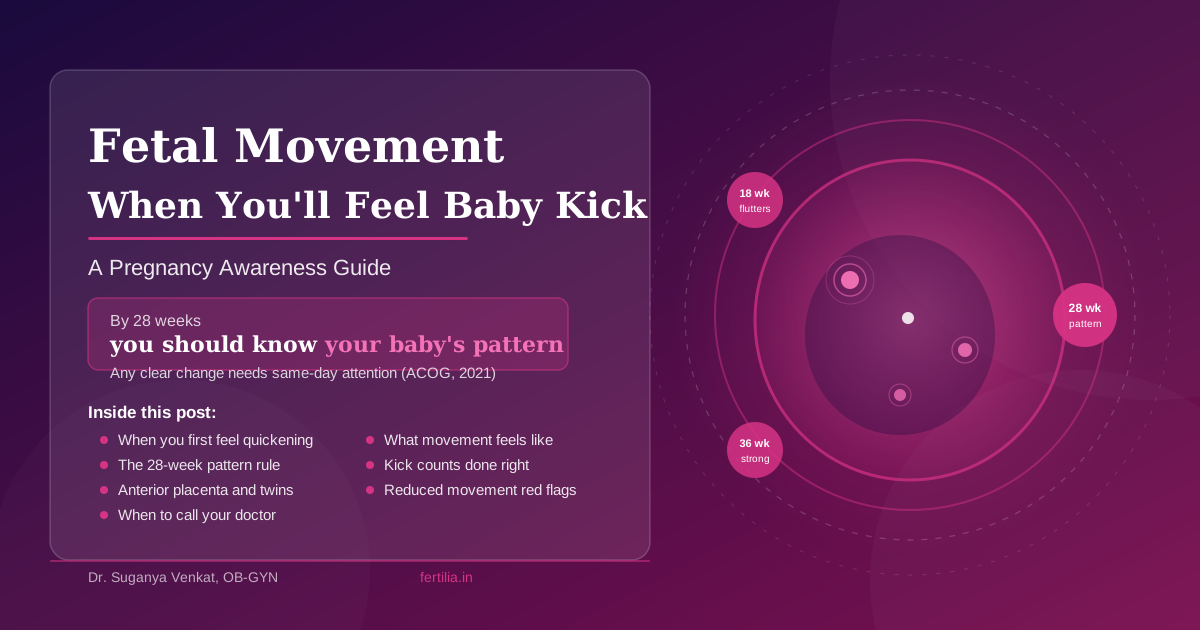
The first time you feel your baby move is one of the quietest, most private moments of pregnancy. Many women describe it as a flutter, a bubble, a fish flicking inside, something so small they aren’t sure it really happened. Then it happens again, and slowly the doubt turns into recognition.
Fetal movement is one of the few signals a baby can send their mother directly. It is also one of the most reliable everyday markers of a healthy pregnancy. In my clinic, two patterns come up again and again: women who worry they are not feeling enough movement when their pregnancy is actually progressing normally, and women who sense a real change in their baby’s pattern but hesitate to call because they don’t want to “trouble” anyone. Both situations deserve clear, evidence-based guidance. I’m Dr. Suganya Venkat, an OB-GYN with 15+ years of experience, and if your baby’s pattern ever changes in a way that worries you, I would rather you reach out over a video consultation than sit with the worry alone.
This post covers:
- When you can expect to first feel your baby move
- What movement feels like at each stage of pregnancy
- The pattern you should recognise by 28 weeks
- Kick counts, who they are for, and how to do them properly
- Reduced movement as a red flag, and what to do
- Anterior placenta, twins, and other situations that affect what you feel
- When to call your doctor, with no apology needed
When Will I First Feel My Baby Move?
The medical term for first felt movements is quickening. The timing varies more than most women expect.
If this is your first pregnancy: Most first-time mothers feel quickening between 18 and 22 weeks. Some feel it as early as 16 weeks, some not until 24 weeks. All of this is within the normal range.
If you have been pregnant before: Second-time and later mothers usually feel movement earlier, often around 16 to 18 weeks. This is partly because the abdominal wall is already stretched and partly because you recognise the sensation faster, having felt it before. Research by Hijazi and East (2009, Current Women’s Health Reviews) confirms this earlier-perception pattern in multiparous women.
The baby is moving long before you can feel it. Ultrasound studies show fetal movement begins as early as 7 to 8 weeks. By 12 to 14 weeks, the baby is moving regularly. You simply cannot feel these movements yet because the baby is still small and surrounded by amniotic fluid and uterine muscle. The movements have to become strong enough to push against the uterine wall before your sensory nerves can register them.
If you are past 22 weeks and have not yet felt anything, mention it at your next antenatal visit. In most cases it is a placental position issue (covered below) rather than a problem with the baby, but a quick check confirms this.
What Movement Feels Like at Each Stage
The character of fetal movement changes dramatically across pregnancy. Knowing what to expect at each stage helps you tell ordinary changes from real ones.
16 to 20 weeks (early second trimester)
Soft flutters. Many women describe it as gas bubbles, popcorn popping, or a small fish flicking inside. It can be hard to distinguish from digestive sensations at this stage. Movements are irregular and you may go a whole day without noticing them, especially when you are busy or active. This is normal.
20 to 24 weeks
Movements become more recognisable. The flutters give way to gentle nudges, swirls, and small kicks. You may start to notice that the baby is more active at certain times of day, often in the evening, after meals, or when you are lying down. The baby is also responsive to your voice, music, and other sounds.
24 to 28 weeks
Movements get stronger and more frequent. You may now feel jabs, rolls, and clear kicks. Other people may be able to feel them too with a hand on your belly. The baby has periods of activity and periods of rest (sleep cycles last 20 to 40 minutes in utero), so don’t be alarmed by quiet stretches between busy ones.
28 to 32 weeks
By 28 weeks, your baby has established a movement pattern that you should be able to recognise as yours. This is the most important transition point in fetal movement awareness. The pattern is unique to your baby. Some babies are very active, with bursts every few minutes during their awake periods. Others are calmer, with longer rest cycles. Both are normal. What matters is that the pattern is consistent for your baby.
32 to 36 weeks
Movements peak in intensity. The baby is now large enough that kicks can be sharp and surprising. You may see your belly move from the outside, especially when the baby stretches against the abdominal wall. Movements feel more like rolls and stretches than the rapid flutters of earlier weeks because there is less room to manoeuvre.
36 weeks to delivery
A common worry: “My baby seems to be moving less in the last few weeks.” Research on this is nuanced. The type of movement changes (less rolling, more pushing against your ribs or pelvis as the baby engages), but the overall pattern of activity should remain similar to what you have known since 28 weeks. The American College of Obstetricians and Gynecologists (ACOG Practice Bulletin 229, 2021) explicitly states that fetal movement should not decrease in the final weeks of pregnancy. If you notice a clear reduction in your baby’s usual pattern at any point, including the last weeks, contact your doctor the same day.
The 28-Week Rule: Knowing Your Baby’s Pattern
If there is one thing to take away from this post, it is this: by 28 weeks, you should know your baby’s usual pattern. Not the movements of a textbook baby. Your baby.
What does “knowing the pattern” mean in practice? You should have a sense of:
- When during the day your baby tends to be most active (often evening, often after meals)
- Roughly how often you feel movement during their awake periods
- What their resting stretches feel like (usually 20 to 40 minutes of quiet)
- Whether they respond to specific triggers (cold drink, lying on your left side, music)
You do not need to write any of this down. You just need to know it well enough that a clear departure from the pattern would be obvious.
Kick Counts: Who Should Do Them, and How
“Kick counting” is a structured way of monitoring fetal movement. There has been some change in how the evidence supports it.
The traditional method (Moore and Piacquadio, 1989, American Journal of Obstetrics and Gynecology) is the count-to-10 approach. You lie on your left side at a time of day when your baby is usually active, focus on the movements, and count until you reach 10 distinct movements. Most healthy babies reach 10 movements within 2 hours. If you do not feel 10 movements in 2 hours, contact your doctor that day.
What the research has clarified: A Cochrane review by Mangesi and colleagues (2015) examined whether routine kick counting in all pregnancies prevents stillbirth. The conclusion was that there is not strong enough evidence to recommend universal formal kick counting for every pregnant woman. This led to a shift in guidance: rather than asking every woman to count to 10 every day, modern guidelines (ACOG Practice Bulletin 229, 2021; RCOG Green-top Guideline 57) focus on maternal awareness of any subjective decrease from her own usual pattern.
What this means for you:
- You do not need to count to 10 every day if your pregnancy is uncomplicated and your baby’s pattern is reassuring.
- You do need to be aware of what your baby’s usual pattern feels like.
- If at any point you sense the pattern has reduced, then the count-to-10 method is the right tool. Lie on your left side, focus, and count.
- If you reach 10 movements in less than 2 hours, that is reassuring for this episode. Continue normal awareness afterwards.
- If you do not reach 10 movements in 2 hours, or if the movements feel weaker than usual, contact your doctor the same day. Do not wait until your next scheduled visit.
Women with risk factors who benefit most from regular kick counts: previous pregnancy loss, gestational diabetes, gestational hypertension or pre-eclampsia, intrauterine growth restriction, advanced maternal age, multiple pregnancy, reduced fetal movement at any earlier point in this pregnancy, or any other reason your doctor has flagged this pregnancy as needing extra surveillance.
If you have one of these risk factors, I recommend a daily count at the time of day your baby is usually most active. It takes 10 to 20 minutes, and it gives you a reliable baseline to notice changes against.
Reduced Fetal Movement: The Single Most Important Red Flag
This is the section every pregnant woman should read carefully.
Reduced fetal movement is the single most important warning sign a baby can give you that something may be wrong. It is associated with stillbirth, growth restriction, placental insufficiency, and other conditions where same-day evaluation makes a meaningful difference.
The AFFIRM trial (Norman, Heazell and colleagues, 2018, The Lancet) was a large cluster-randomised study across 33 UK maternity units examining whether raising awareness of reduced fetal movement, combined with a structured assessment protocol, would reduce stillbirth. The intervention did not show a statistically significant overall reduction at the trial level, but the data confirmed something important: reduced fetal movement is a real clinical signal, and it deserves a proper assessment every time it is reported, not a phone reassurance.
A proper assessment for reduced movement at any point after 28 weeks includes:
- A focused history (when did the pattern change, what is the change, any other symptoms)
- A clinical examination
- A cardiotocograph (CTG / non-stress test) lasting at least 20 to 30 minutes
- An ultrasound scan for growth, amniotic fluid, and Doppler if indicated
If you call your doctor or hospital and are reassured over the phone without these steps, this is below the current standard. You are entitled to ask for an in-person check. In the Indian context, where private practice patterns vary, this is the practical line to hold: reduced movement is a same-day in-person assessment, not a phone call.
What “reduced” means:
- A clear, sustained reduction from your baby’s usual pattern
- Fewer than 10 movements in 2 hours during a focused count
- Weaker movements that you have to concentrate harder than usual to feel
- A change in the type of movement (e.g., your normally active baby is having only slow rolls instead of kicks)
Important nuance: Babies do have busy days and quiet days. A single 30-minute stretch of unusual quiet, especially during typical sleep hours, is not the same thing as a sustained change in pattern. The signal you are watching for is a clear departure from what is normal for your baby, not a single quiet hour.
If you are uncertain, sit down with a glass of cold water or a small snack, lie on your left side, focus, and count. If you reach 10 movements in 30 to 60 minutes, that is reassuring and you can continue. If not, call.
Why You Might Feel Less Movement (Even When Baby Is Fine)
Several normal situations affect how much movement you feel. Recognising these helps you tell ordinary changes from real ones.
Anterior placenta. If your placenta is on the front wall of the uterus (anterior), it sits between the baby and your abdominal wall. The placenta cushions movement, so you feel less of it, especially in the second trimester. Most women with anterior placentas start feeling clear movements by 22 to 24 weeks rather than 18 to 20 weeks. By the third trimester, the difference fades because the baby is large and strong enough to be felt through the placental cushion. If you are unsure of your placental position, your 20-week anomaly scan report will state it.
For more on this, read our guide on Anomaly Scan (TIFFA). You are busy or active. When you are walking, working, or moving about, the rocking motion can soothe the baby to sleep, and you are less likely to notice movements anyway. This is why we ask you to lie still on your left side when checking movement. The baby wakes up, and you can pay attention.
Time of day. Most babies have predictable active and quiet periods. If you are checking during their usual rest time, you will feel less. If you are unsure whether a quiet period is unusual, wait an hour and then check actively at a time you know they are usually moving.
A meal or sugary drink can wake the baby. A cold drink (water with a little jaggery, nimbu pani, or a small fruit) often triggers movement within 10 to 20 minutes. This is a useful informal check, but a negative response (no movement after a snack) is a reason to call, not a reason to keep waiting.
Twin pregnancy. With twins, the pattern is more complex because each baby has its own sleep-wake cycle. You may feel near-continuous movement from one or the other, but the same principle applies: any clear sustained reduction from your usual perceived pattern needs assessment.
What This Means for You: A Practical Approach
Pregnancy involves a lot of advice, and “monitor fetal movement” can feel vague. Here is a practical, week-by-week structure that uses what the evidence supports.
Before 18 weeks: Do not expect to feel anything yet. Don’t waste anxiety on this stretch.
18 to 24 weeks (or up to 26 weeks for first pregnancies, or with anterior placenta): Notice the first flutters. Movements are irregular and easy to miss. No counting needed.
24 to 28 weeks: Movements become clearer. Pay attention to when your baby tends to be active. Start to learn your pattern.
28 weeks onward: You should know your baby’s pattern. You do not need to count daily unless you have a risk factor or your doctor has advised it. Be aware of the pattern. If anything changes clearly, lie down on your left side, focus, and count. If you do not reach 10 movements in 2 hours, or if movements feel weaker, call.
At every antenatal visit from 28 weeks: Your doctor should ask about your baby’s movement. If they do not, mention it yourself. This is part of standard third-trimester care.
If you would like a personal review of your pregnancy and what to expect at each stage, I am happy to walk you through it.
For the broader picture of nutrition, antenatal visits, exercise, and warning signs across all of pregnancy, our evidence-based guide to a healthy pregnancy is a useful companion read. For week-by-week milestones, see our pregnancy week by week guide for Indian women. Our free pregnancy guide resource covers the trimester-wise essentials in one downloadable document.
When You Should Always Call: Red Flags
Call your doctor or go to your nearest hospital the same day if any of these apply after 28 weeks:
- You have not felt your baby move for several hours during what is normally an active time
- You feel a clear, sustained reduction in movement compared to your usual pattern
- After lying on your left side and focusing for 2 hours, you have counted fewer than 10 movements
- Movements feel noticeably weaker or different than usual
- Reduced movement is happening alongside any of: severe headache, vision changes, swelling in the face or hands, abdominal pain, bleeding, or fluid loss
- You “just feel something is different” (maternal instinct is a legitimate clinical reason to be checked)
You will never be told off for coming in. The check takes 30 to 45 minutes and gives you direct reassurance.
For other warning signs in pregnancy, see our guide to gestational hypertension and placenta previa, both of which can present alongside changes in fetal activity.
Frequently Asked Questions
When will I feel my baby move for the first time?
Most first-time mothers feel their baby move between 18 and 22 weeks. If you have been pregnant before, you may feel it as early as 16 to 18 weeks. The baby has been moving since 7 to 8 weeks but those movements are too small to feel until the baby is bigger and stronger. If you are past 22 weeks and have not yet felt anything, mention it at your next visit. The most common reason is an anterior placenta, which is not a problem but does delay perception.
How many kicks per hour are normal?
There is no single “normal” number. Babies have active and rest periods, and patterns vary widely. The useful benchmark is 10 movements in 2 hours when you are lying on your left side and focusing. Most healthy babies reach this in 30 to 60 minutes. The most important measure is your own baby’s pattern from 28 weeks onward, not a fixed number per hour.
What does an anterior placenta mean for feeling movement?
An anterior placenta sits on the front wall of the uterus, between the baby and your abdominal wall. It cushions movement, so first-time perception is often delayed by 2 to 4 weeks compared to a posterior placenta. By the third trimester, the baby is large enough that movement is felt clearly through the placenta. Your 20-week anomaly scan report will tell you your placental position. An anterior placenta is a normal variation, not a complication. For everything else it affects, and the one situation worth watching, see our full guide to anterior placenta and what it means.
Can I do anything to make my baby move?
Yes, several gentle triggers help. Lie on your left side, drink a glass of cold water or have a small snack (a piece of fruit or some nimbu pani works well), and focus quietly for 10 to 20 minutes. Many babies respond to a sudden temperature or sugar change with a burst of movement. If you do not get a response within an hour at a time your baby is usually active, call your doctor.
Is it normal for movements to slow down in the last few weeks?
The character of movement changes (less rolling, more pushing because there is less room), but the overall pattern of activity should not noticeably reduce. ACOG Practice Bulletin 229 (2021) is explicit on this: fetal movement should not decrease in the final weeks of pregnancy. Any clear reduction at any point after 28 weeks, including the last weeks, is a same-day call to your doctor.
Do I need to count my baby’s kicks every day?
Not necessarily. Current guidance (ACOG, RCOG) is that women with uncomplicated pregnancies who are aware of their baby’s usual pattern do not need formal daily kick counting. Awareness is enough. Daily kick counts are specifically recommended for women with risk factors such as previous pregnancy loss, gestational diabetes, gestational hypertension, growth restriction, or any pregnancy your doctor has identified as needing extra surveillance.
What if I am told over the phone “it’s probably fine, wait and see”?
A genuine assessment for reduced fetal movement after 28 weeks includes a non-stress test (CTG) and a clinical check. Phone reassurance alone, without these steps, is not the current standard. You are entitled to ask for an in-person check, and a good clinic will offer it without you having to push. If your usual provider cannot see you the same day, going to the nearest maternity hospital with a CTG facility is the right call. The reassurance of a normal CTG is worth a small inconvenience.
A Note on Trusting Yourself
Through 15 years of practice, I have learned something simple. Mothers who come in saying “I just feel something is different” are right more often than the medical world used to assume. The mother is the only person who knows what her baby’s normal pattern feels like. When she senses a change, that is a clinical observation, not anxiety.
If you ever feel uncertain, please call. The point of antenatal care is to give you a clear route to a quick check whenever you need one. There is no such thing as a wasted visit when it comes to your baby’s wellbeing.
Tracking your baby’s movements is one part of antenatal care; the full picture sits inside Dr. Suganya’s Pregnancy Care program.