If you’re trying to get pregnant after 30, or you’ve crossed 35 and started Googling “tips for getting pregnant”, you’ve probably been hit with terrifying statistics. The internet makes it sound like your fertility falls off a cliff the moment you blow out those candles.
Here’s the truth: the science is far more nuanced (and far more hopeful) than the headlines suggest.
As an OB-GYN who has helped hundreds of women conceive naturally in their mid-30s and beyond, I want to walk you through what the research actually says, separate the facts from the fear, and give you a clear action plan.
Table of Contents
- The Real Numbers: What Actually Happens After 35
- What About Miscarriage Risk After 35?
- Where Did the “35 Cliff” Myth Come From?
- Egg Quality vs Egg Quantity
- What AMH Really Tells You (and What It Doesn’t)
- 5 Evidence-Based Steps to Improve Fertility After 35
- When to Seek Help
- The Indian Context: Cultural Pressure and Real Options
- FAQ
The Real Numbers: What Actually Happens After 35 {#the-real-numbers}
Let’s start with data, not fear.
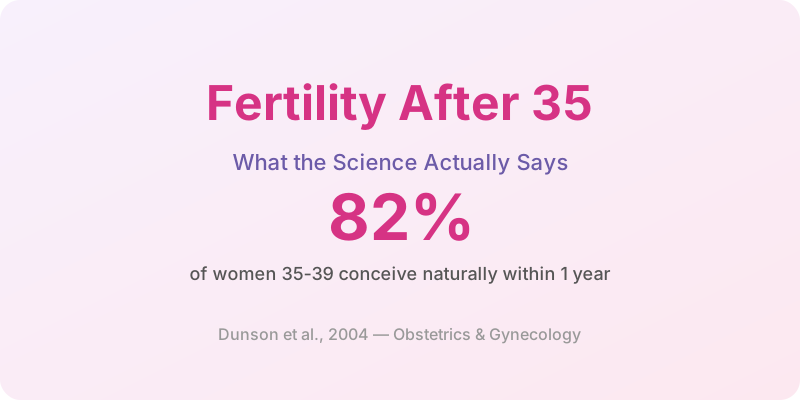
A landmark study published in Obstetrics & Gynecology (Dunson et al., 2004) tracked women’s natural conception rates by age:
| Age Group | Chance of Conceiving Within 1 Year |
|---|---|
| 27-29 | 86% |
| 30-34 | 86% |
| 35-39 | 82% |
| 40-44 | ~50-60% |
Read that again: 82% of women aged 35-39 conceive naturally within one year of trying. That’s a 4% drop from women in their early 30s, not the catastrophic decline you’ve been led to believe.
The decline is real. But it’s gradual, not a cliff.
What Does Decline Actually Look Like?
- Per-cycle conception rate at 30: ~20-25%
- Per-cycle conception rate at 35: ~15-20%
- Per-cycle conception rate at 40: ~5-10%
Each month, your probability is a little lower. But over 6-12 months of trying, the cumulative odds remain very much in your favour through your late 30s.
💬 Worried about your fertility after 35? Every woman’s situation is different. Talk to Dr. Suganya Venkat on WhatsApp for a personalised assessment.
What About Miscarriage Risk After 35? {#miscarriage-risk}
This is the second number women worry about, and it deserves the same honesty as the conception numbers. Miscarriage risk does rise with age, mostly because a higher proportion of older eggs carry chromosomal errors. But the message most women carry is darker than the clinic reality: the large majority of pregnancies after 35 are healthy and continue to term.
Here is the approximate risk of miscarriage in recognised pregnancies, drawn from ACOG’s Early Pregnancy Loss guidance (Practice Bulletin No. 200) and the largest registry study to date (Magnus et al., BMJ 2019, over 421,000 pregnancies):
| Age | Approx. miscarriage risk | Put another way |
|---|---|---|
| Under 35 | about 10 to 15% | roughly 6 to 9 in 10 pregnancies continue |
| 35 to 39 | about 20% | roughly 4 in 5 pregnancies continue |
| 40 to 44 | about 35 to 40% | the majority still continue, but the risk is real |
| 45 and over | over 50% | the conversation shifts toward egg quality and, for some, donor eggs |
Two honest points sit underneath these numbers. First, the rise is gradual through the late 30s and steeper after 40, the same shape as the conception numbers, not a cliff at 35. Second, most age-related miscarriage is caused by random chromosomal errors in a particular egg, not by anything you did or failed to do. That is precisely why the preconception work that helps most is the 90-day egg-quality window described below, and why a single early loss is rarely a reason to lose hope for the next cycle.
Where Did the “35 Cliff” Myth Come From? {#where-did-the-myth-come-from}
This is genuinely shocking: the widely-cited fertility statistics that terrify millions of women are based on French birth records from the 1600s-1800s.
A 2004 paper by Henri Leridon used historical demographic data, women who had no birth control, no modern nutrition, no healthcare, to model fertility decline. These numbers were then popularised by the American Society for Reproductive Medicine and repeated endlessly in media.
Modern studies paint a very different picture:
- Rothman et al. (2013) in Fertility and Sterility: Women aged 35-40 who had intercourse during their fertile window had a 78% chance of conceiving within a year
- Wesselink et al. (2017) in American Journal of Epidemiology: Among women actively trying, the difference between 28-year-olds and 35-year-olds was modest
The “35 cliff” is a statistical artefact from pre-modern data, not a reflection of what healthy, well-nourished women experience today.
That said, the decline after 40 is real and more significant. The window doesn’t close at 35, but being proactive matters more as you move through your late 30s. Women in their late 30s may also want to familiarise themselves with the perimenopause symptoms to be aware of, perimenopause can begin earlier than most women expect, sometimes in the early 40s.
Egg Quality vs Egg Quantity {#egg-quality-vs-quantity}
This is the distinction most women miss:
Egg quantity (ovarian reserve) does decline with age. You’re born with ~1-2 million eggs, and by 35 you may have ~100,000. By 40, ~25,000. These numbers sound scary, but you only need one good egg to conceive.
Egg quality is what actually matters for conception and healthy pregnancy. Egg quality refers to chromosomal normalcy, whether the egg has the correct 23 chromosomes for a healthy embryo.
| Factor | What It Means | Can You Improve It? |
|---|---|---|
| Egg quantity | Total eggs remaining | No. This is fixed |
| Egg quality | Chromosomal health of eggs | Yes. lifestyle significantly impacts this |
Here’s the empowering part: egg quality is influenced by the 90-day maturation window before ovulation. Every egg goes through a ~90-day development process before it’s released. During those 90 days, your nutrition, sleep, stress levels, blood flow, and oxidative stress all affect the quality of that egg.
This is why a 3-month preconception protocol: what we do at Fertilia, can meaningfully improve outcomes even after 35.
What AMH Really Tells You (and What It Doesn’t) {#what-amh-really-tells-you}
AMH (Anti-Müllerian Hormone) is often the first test women over 35 get, and often the source of the most panic.
What AMH measures: The size of your remaining egg pool (ovarian reserve).
What AMH does NOT measure: Your ability to conceive naturally.
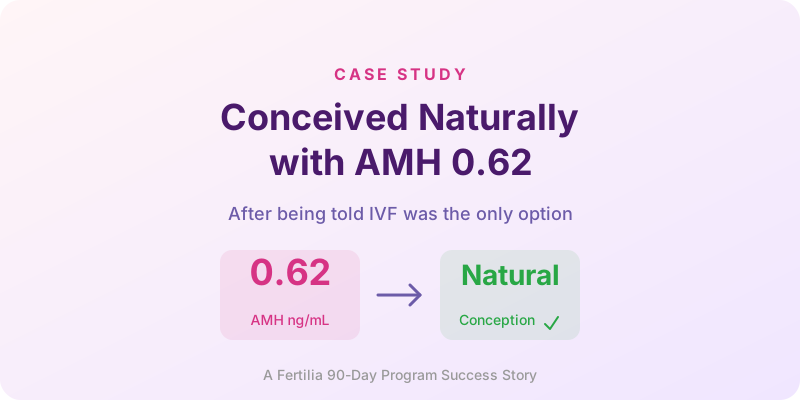
A study in JAMA (Steiner et al., 2017) followed 750 women aged 30-44 with low AMH values. Their finding: women with low AMH had no statistically significant reduction in natural conception rates compared to women with normal AMH.
Read that again. Low AMH ≠ low fertility.
AMH is useful for:
- Predicting response to IVF stimulation
- Understanding how many eggs can be retrieved
- Giving a rough timeline of menopause
AMH is NOT useful for:
- Predicting whether you’ll conceive naturally
- Telling you to “hurry up”
- Measuring egg quality
If your doctor looked at your AMH and said “you need to hurry” or “you should go straight to IVF”, get a second opinion. Many women with low AMH conceive naturally with the right support.
For more on this, read our guide on PCOS After 35.
5 Evidence-Based Steps to Improve Fertility After 35 {#five-steps}
1. Optimise Your Egg Quality Window (90 Days)
Since eggs take ~90 days to mature, what you do in the 3 months before trying matters enormously.
CoQ10 (Ubiquinol): 200-600mg daily. CoQ10 supports mitochondrial function in eggs, critical for chromosomal normalcy. A study in Aging Cell (Ben-Meir et al., 2015) showed CoQ10 supplementation reversed age-related egg quality decline in animal models.
Vitamin D: Get tested. If below 30 ng/mL, supplement 1000-4000 IU daily. A meta-analysis in Human Reproduction found Vitamin D deficiency is associated with 40% lower fertility treatment success rates.
Folate (Methylfolate): 400-800 mcg daily. Critical for DNA synthesis and preventing neural tube defects. Start at least 3 months before conception.
2. Eat for Egg Health
The Mediterranean diet pattern has the strongest evidence for fertility. A study in Human Reproduction (Vujkovic et al., 2010) found that women following a Mediterranean-style diet had 40% higher odds of pregnancy through fertility treatment.
Indian-friendly fertility foods:
- Ragi porridge: rich in calcium and iron
- Dal + rice: complete protein for hormone production
- Curd/dahi: probiotics support gut-hormone axis
- Haldi/turmeric: anti-inflammatory, supports egg quality
- Til/sesame seeds: rich in zinc and selenium
- Ghee in moderation: supports fat-soluble vitamin absorption
- Drumstick leaves (moringa): iron and folate powerhouse
Avoid: Excess refined sugar, maida, processed foods, excessive caffeine (limit to 200mg/day, roughly two small tumblers of filter coffee or three cups of tea). (Once you do conceive, our trimester-wise pregnancy diet chart covers exactly what to eat at each stage.)
3. Prioritise Sleep
This is underrated. Your circadian rhythm directly controls reproductive hormones.
- Melatonin (your sleep hormone) is also a powerful antioxidant that protects eggs from oxidative damage
- Women who sleep <6 hours have significantly lower fertility compared to those sleeping 7-8 hours (Kloss et al., 2015)
- Night shift work is associated with menstrual irregularity and reduced fertility
Target: 7-8 hours, consistent timing, dark room, no screens 30 minutes before bed.
4. Manage Stress Intelligently
Cortisol (stress hormone) directly suppresses GnRH, the hormone that triggers ovulation. Chronic stress can delay or prevent ovulation.
A study at Boston IVF (Domar et al., 2011) found that women who participated in a mind-body fertility program had significantly higher pregnancy rates than controls.
What works:
- 10-minute daily meditation or pranayama
- Walking 30 minutes daily (not intense HIIT, that can raise cortisol)
- Reducing work stress where possible (easier said than done, but measurable impact)
- Social connection, isolation worsens stress hormones
5. Track Your Cycle. But Don’t Obsess
Knowing your fertile window is valuable. Obsessing over every temperature reading is counterproductive.
- Use cervical mucus tracking (most reliable natural sign)
- OPK strips 2x daily from cycle day 10-16
- Intercourse every 1-2 days during fertile window
- Stop tracking if it’s causing anxiety, stress harms fertility more than imperfect timing
💬 Want a personalised fertility plan for your age and situation? Dr. Suganya Venkat’s 90-day Fertility program creates customised protocols based on your bloodwork, history, and goals. Start a conversation on WhatsApp, no pressure, just clarity.
When to Seek Help {#when-to-seek-help}
General guidelines:
| Your Age | See a Specialist If |
|---|---|
| Under 35 | Not conceived after 12 months of well-timed intercourse |
| 35-39 | Not conceived after 6 months |
| 40+ | After 3 months, or ideally before you start trying |
Important: “Seek help” doesn’t mean “start IVF.” It means get a proper evaluation, hormonal panel, ultrasound, semen analysis for your partner, thyroid check. Often, simple interventions (correcting Vitamin D deficiency, treating subclinical hypothyroidism, lifestyle changes) are enough.
At Fertilia, many women who were told they need IVF conceive naturally after 2-3 months of targeted lifestyle changes. Not every time, but far more often than most women expect.
The Indian Context: Cultural Pressure and Real Options {#indian-context}
Let’s address the elephant in the room.
In India, the pressure to conceive (especially after 30) comes from every direction. Parents, in-laws, aunties, colleagues, the lady at the temple. “Why are you waiting?” “Isn’t it getting late?” “My cousin’s daughter had twins at 25.”
This pressure:
- Creates anxiety (which directly harms fertility)
- Pushes women into unnecessary IVF cycles (India’s IVF industry is booming, not always for the right reasons)
- Makes women feel broken when they’re perfectly healthy
- Ignores that many Indian women are marrying and choosing to conceive later, and that’s completely valid
What I tell my patients:
- 35 is not a deadline
- Your body’s timeline matters more than society’s opinion
- Getting evaluated early (even before you start trying) gives you data and removes fear
- Lifestyle preparation for 3 months before trying is the single most impactful thing you can do
- You are not “late”. You are informed and prepared
FAQ {#faq}
Is it safe to have a baby after 35?
Yes. While there are slightly increased risks (gestational diabetes, preeclampsia, chromosomal abnormalities), the vast majority of women over 35 have healthy pregnancies and healthy babies. With proper monitoring and care, outcomes are excellent.
Does fertility really drop sharply at 35?
No. The decline is gradual through the 30s, getting pregnant after 30, 33, or even 37 is very much achievable. The sharp drop typically happens after 40-42. The “35 cliff” is based on outdated historical data.
Should I freeze my eggs at 35?
Egg freezing is a reasonable option if you’re certain you won’t try to conceive for several more years. However, it’s expensive, invasive, and not a guarantee. If you’re planning to try within 1-2 years, focus on lifestyle optimisation instead.
My AMH is low. Does that mean I can’t conceive?
No. AMH reflects egg quantity, not quality. The JAMA 2017 study showed no significant difference in natural conception rates between women with low vs normal AMH. Don’t panic, get a full evaluation.
How long should I try naturally before considering IVF?
If you’re 35-39, try for 6 months with well-timed intercourse and lifestyle optimisation. If no conception, get a full evaluation. IVF is one option, but often not the first step needed.
What supplements should I take after 35?
The core evidence-based supplements: Methylfolate (400-800 mcg), Vitamin D (based on blood levels), CoQ10/Ubiquinol (200-600mg), and Omega-3 (DHA). Always consult your doctor before starting supplements.
Dr. Suganya Venkat is an OB-GYN with 15+ years of clinical experience and founder of Fertilia, a holistic women’s health platform helping women conceive naturally through evidence-based lifestyle programs.
Related Reading
- AMH Test Cost in India 2026: Price, Results & Meaning, understanding your egg reserve is especially important after 30
- How to Get Pregnant Fast: Evidence-Based Guide, conception timing, nutrition and lifestyle steps for natural conception
- How to Boost Fertility Naturally, evidence-based steps to improve your chances
- How to Track Ovulation: Indian Woman’s Guide, timing matters more as you get older
- IUI vs IVF: When Do You Really Need It?, understanding your options
- Thyroid and Fertility: The Connection, thyroid issues become more common after 35