Many of you will recognise yourself somewhere in this story. Maybe not every single part of it, but enough of it to make you stop and quietly think, yes, that was me too. And that is exactly why this needed to be written.
Some struggles don’t arrive with a bang. They don’t announce themselves at the door. They come quietly, over years, settling into the corners of your mind so slowly that you don’t even notice when they made themselves at home.
For many women, the complicated relationship with their body didn’t begin in adulthood. It didn’t begin with a diagnosis, a diet gone wrong, or a single hurtful comment. It began much, much earlier. And it began in the most ordinary of places.
Where It All Often Begins: Childhood
Maybe you were a naturally lean child once, active, playful, running around without a single thought about your body. But somewhere in those early years, concerns around eating quietly entered the picture. Perhaps a parent worried you weren’t eating enough. Or maybe it wasn’t anything anyone did at all. Sometimes it’s simply in the body, written into genetics before you were old enough to understand what that meant. Either way, it all came from a place beyond your control. Nobody meant harm. Nobody imagined that something so ordinary would one day feel so emotionally large.
But slowly, the body changed. Not suddenly. Not dramatically. Just gradually enough that nobody really noticed when things shifted, until one day, without any clear explanation, you realised you had somehow become “the bigger girl.”
And here is the part that is so easy to overlook: nobody around you knew any different either. Concepts like a balanced plate, portion awareness, macronutrients: these were simply not part of most of our homes growing up. Food was made every day, served generously, and eaten together. That was the language of care. Nobody was counting anything. Nobody was reading labels. A good meal meant a full plate, and a full plate was expected to be finished without wasting food. There were no conversations about what a balanced dinner looked like. No one explained that rice and dal and a vegetable and a small sweet could all coexist without guilt. The idea of eating mindfully, of understanding how food moves through the body, of knowing that sleep and stress quietly influence weight: none of this was dinner table conversation. It wasn’t anyone’s fault. It simply wasn’t in the room.
So the body changed, and nobody had the language to understand why. And without that language, the only explanation that seemed to make sense, the one that quietly filled the silence, was the most unkind one of all: maybe I am just not doing something right.
The Things Children Carry
Children notice things far earlier than adults imagine. Nobody may have sat you down and told you directly that your body was different. But you saw the comparisons anyway.
A relative, at a family gathering, complimenting a sibling. Someone saying, “She carries herself so nicely,” while you stood quietly nearby, pretending not to care. Nobody meant to hurt you. But children have a strange way of tucking small moments inside themselves and carrying them for years.
And so, without anyone spelling it out, a message begins to settle somewhere deep inside: Maybe something about me is not quite enough.
Somewhere, a memory is coming back right now. The annual day costume that felt wrong on your body, the group photograph you quietly hated, the moment someone laughed and you laughed too because it hurt less that way, or perhaps the day shopping stopped feeling exciting and started feeling like a test you kept failing.
School quietly becomes a place of heightened body awareness. PT class feels awkward. Annual day rehearsals feel uncomfortable. Even something as simple as a photograph starts carrying emotional weight. You begin standing behind others. You angle yourself differently. You smile, but somewhere inside, you feel like you’re hiding.
Trial rooms stop being about what you like and start being about what hides you best. You stop asking, “Do I love this?” and start asking, “Will this make me look smaller?” Mirrors become something to avoid. Sizes start to feel personal.
College, Work, and Everything Between
College arrives, and the thoughts don’t disappear. If anything, they grow louder. There are more people now. More social situations. More comparisons. You watch other women wear clothes effortlessly, move through the world comfortably, take up space without apologising for it. And somewhere inside, you quietly wonder: Why does everything feel so much harder for me?
Even simple things begin to carry more weight than they should. Sitting in a crowded room. Attending a function. Meeting new people. Every interaction gets layered with unspoken questions: Did they notice? Did they judge me? Did they see my body before they saw me?
And this is what so many people fail to understand about obesity. They see the weight. They do not see the years of quiet, invisible emotional exhaustion attached to it.
Because somewhere along this journey, food stops being just food. After a hard day, it feels soothing. After an argument, it feels familiar. Loneliness feels quieter with something comforting in your hands. Food becomes one of the few things that asks nothing of you, doesn’t compare you, doesn’t judge you, doesn’t find you lacking. It simply is.
Then comes work. And for many women, the next chapter brings something that looks like independence: a career, a salary, a life of your own. And in many ways, it is. But work also brings its own quiet weight. The long hours. The commute. The pressure to perform, to prove, to be constantly available. And for some, something even more draining than the workload itself: the feeling of being watched too closely, managed too tightly, questioned too often.
By the time you get home, you’re not just physically tired. You’re emotionally depleted in a way that’s hard to explain to anyone who hasn’t felt it. The kind of tired that doesn’t go away with sleep. Where your body is present but your mind is still at your desk, replaying a comment your manager made, rehearsing a response you never gave.
And in that exhaustion, old patterns return. Food, the one thing that has never judged you, never set impossible targets, never questioned your every move, is there. Familiar. Comforting. A small pocket of peace in a day that offered very little of it.
When stress lives in the body long enough, the body changes. Not because of weakness, but because it is doing exactly what it was built to do: hold on, adapt, survive.
Sleep suffers. Stress builds. Weight settles in new places and doesn’t budge the way it once did. And none of the old advice (“eat less, move more, just be more disciplined”) accounts for any of this. It doesn’t account for the fact that you were already running on empty long before you opened the fridge.
Marriage, Fertility, and More Questions
And then comes the chapter that so many women in our culture know all too well: the search for a match. For some, this is where the pressure around weight becomes impossible to ignore for the first time. Because suddenly it isn’t just family comments at gatherings. It is alliances. It is photographs being sent. It is someone else’s family making a quiet judgement about your worth based on how you look in a single picture.
Some women crash-dieted before every meeting. Starved themselves before photographs were taken. Wore certain colours, certain cuts, certain things that “slimmed them down,” not for themselves, but to be acceptable enough for a stranger’s approval. The goal wasn’t health. It was to clear a bar that nobody had been transparent enough to even name out loud.
And for some, even that wasn’t enough. Alliances that quietly moved on. Matches that didn’t proceed. Rejections that were never explained directly, but where the silence said everything. Nobody told you it was because of your weight. But somewhere inside, you wondered. And that wondering settled into the body like a stone.
The message, once again, felt the same: as you are, you are not quite enough.
Life moves forward the way it always does. Marriage eventually happens. And once it does, a new layer of pressure arrives, quieter at first, then louder. Health conversations increase. Comments become more frequent. And then comes the conversation about children. Conception. Doctor visits. Family expectations.
Slowly, everything circles back to one thing again: weight.
“You should reduce first.” “Maybe this is the issue.” “Things will happen once the weight comes down.”
For someone who has spent years quietly blaming herself, these words don’t land neutrally. They land heavily. Because deep inside, that guilt was already there, has always been there, and these words just confirm what you feared: that your body is the problem. That you are the problem.
If this part of the story sounds familiar, and you want someone who will listen without judgement, Dr. Suganya and our team are here to talk.
The Cycle of Crash Diets
This is often where the exhausting cycle truly begins. Crash diets. Meal skipping. Detoxes. Random advice from the internet. Cutting rice entirely. Surviving on salads. Extreme calorie deficits. Trying harder. Punishing harder.
And somewhere in between, there is always another beginning.
“From Monday, I’ll start seriously.” “From next month, I’ll be disciplined.” “This New Year, things will finally change.”
Sometimes the promise comes from you. Sometimes it quietly comes from family: comments disguised as concern, reminders before weddings, festivals, fertility journeys, or even casual conversations at home.
And so every January becomes another silent contract with yourself. Another resolution. Another restart. Another promise that this time you will finally become the version of yourself everyone, including you, feels is acceptable.
Some women begin researching fat reduction treatments and quick fixes, not out of laziness, but because after years of feeling uncomfortable in your own skin, desperation can start sounding like hope.
And sometimes, it works. The scale moves. Clothes fit differently. Compliments begin pouring in. People notice. Life feels like it might finally be changing.
But here is what nobody talks about enough: what happens next.
The body changes, but the fear stays.
Suddenly, one extra spoon of rice feels terrifying. Missing a workout feels like failure. Eating out creates guilt. The weighing scale quietly begins controlling your emotions. Food stops feeling natural. It becomes mathematics. Calculation. Control. Fear disguised as discipline.
And when life eventually makes that level of restriction unsustainable, the weight slowly begins returning. And with it comes something that isn’t just disappointment. It’s heartbreak. Not because of a number, but because it feels, once again, like proof that you are not enough.
And then it starts all over again. Another Monday. Another month. Another promise to start fresh.
What Changes When the Approach Changes
After guiding hundreds of women through their health journeys at Fertilia, I can tell you this: the issue was almost never a lack of effort. Most women who come to us have already tried hard, often harder than anyone around them realises. Diets, restrictions, workouts, treatments, and repeated restarts.
What changes for many is not just the number on the scale, but their relationship with food, routines, mindset, and health itself.
Here is what some of them have shared in their own words.
Every message below is a real patient message, published with the patient’s consent. Names and identifying details have been removed to protect privacy.
“My relationship with food has improved”
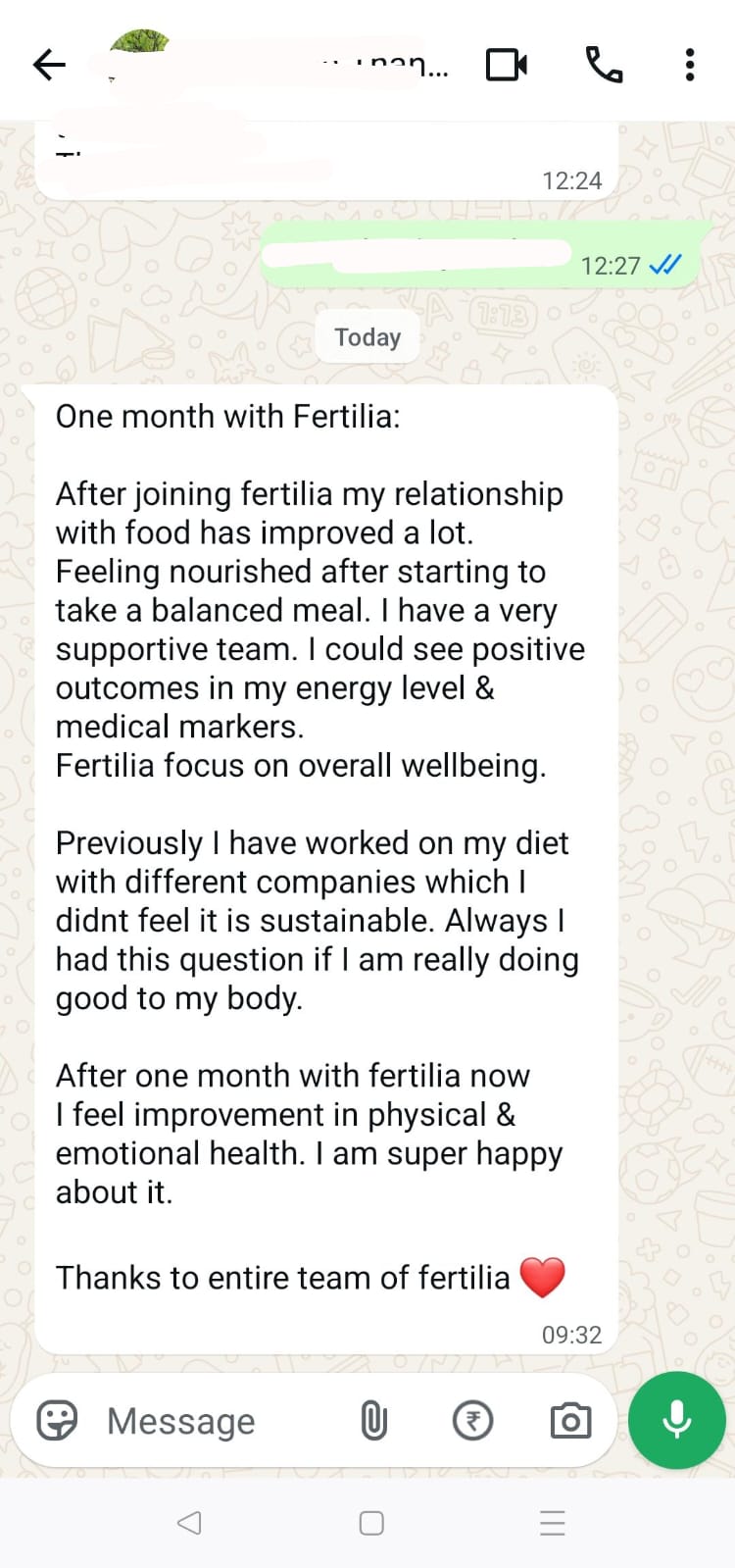
This message came from a woman who had tried diets with multiple companies before and never found them sustainable. After just one month with Fertilia, she noticed changes in both her physical and emotional health.
“I was always on hunger with the old diet”
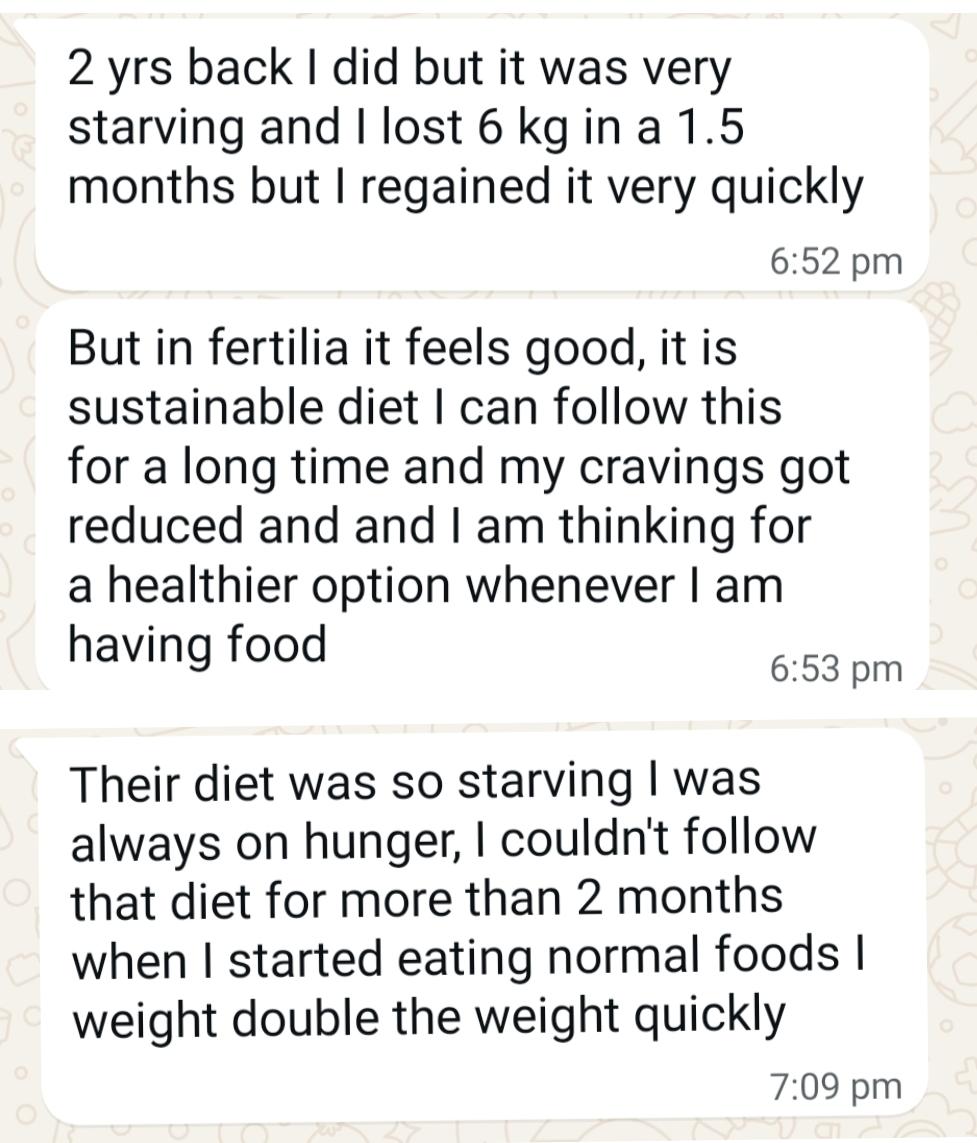
Two years ago, she lost 6 kg in 1.5 months on a starvation diet. She regained it all. At Fertilia, the same woman says her cravings have reduced and she can actually follow this long term, because nobody is asking her to starve.
“More than weight loss, I am more confident now”
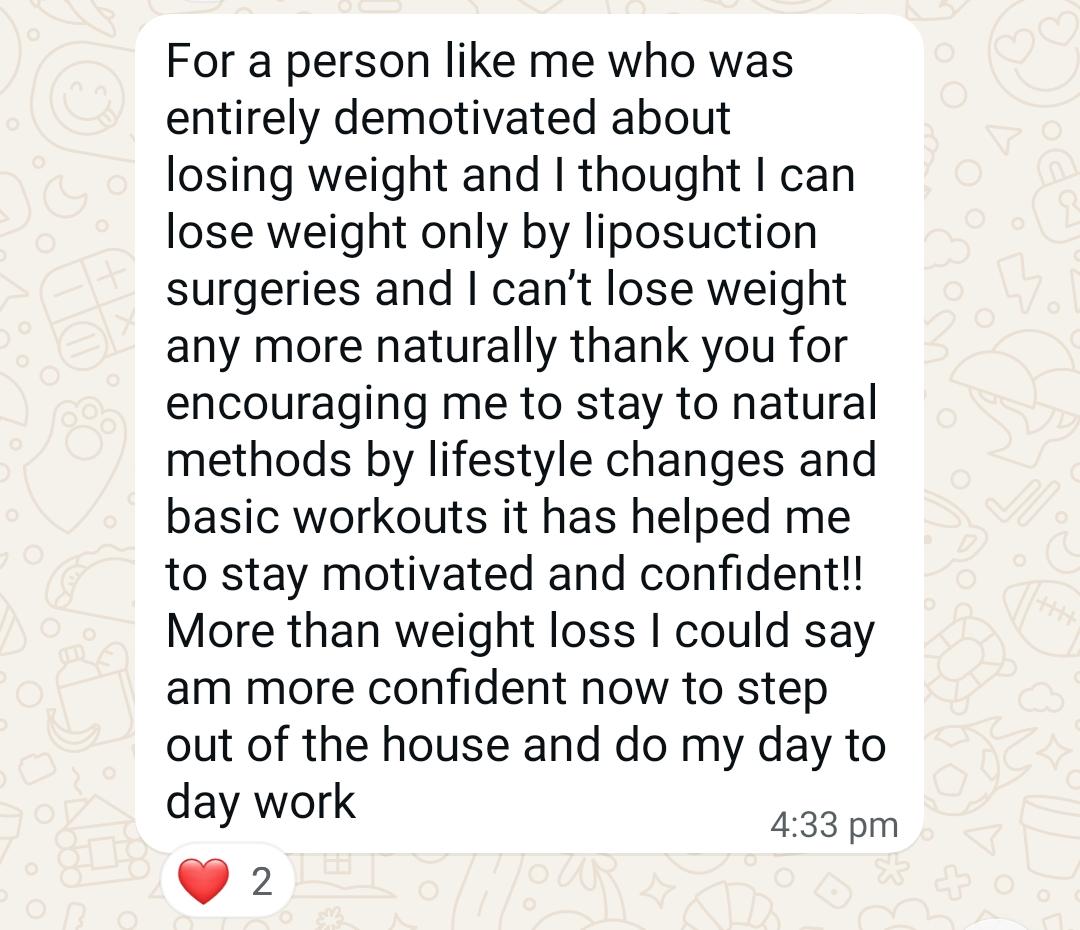
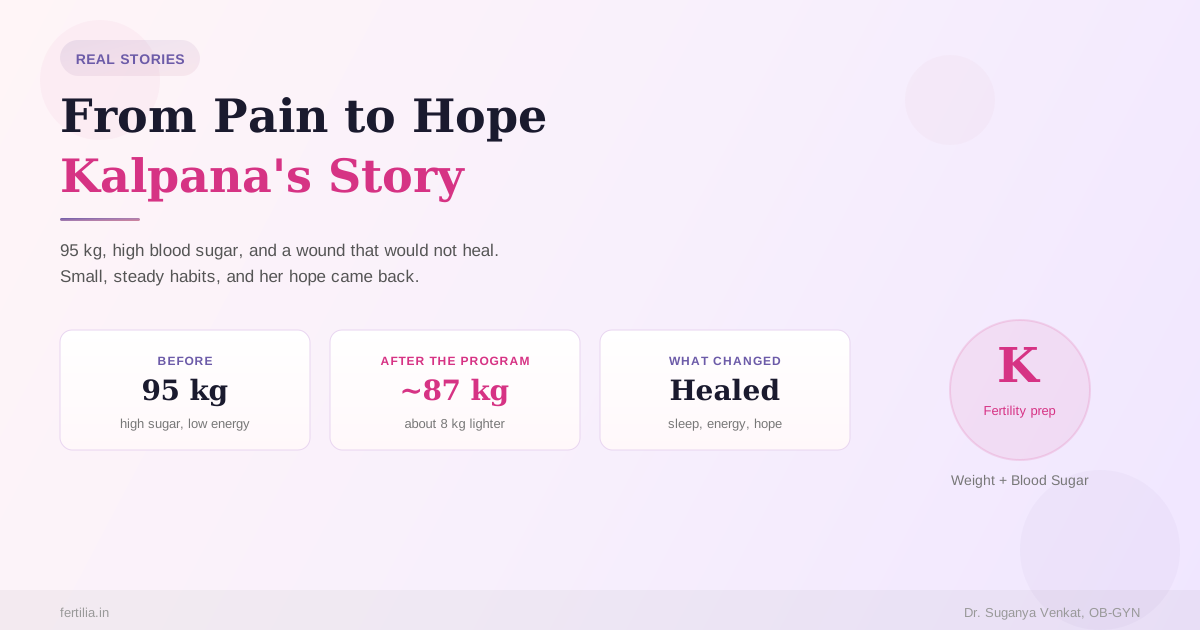
This woman had given up. She believed liposuction was her only option. Today, through lifestyle changes and basic workouts, she says the biggest shift was not weight, it was confidence. She can step out of the house and do her daily work without that old heaviness following her.
“The program has transformed my approach to health”
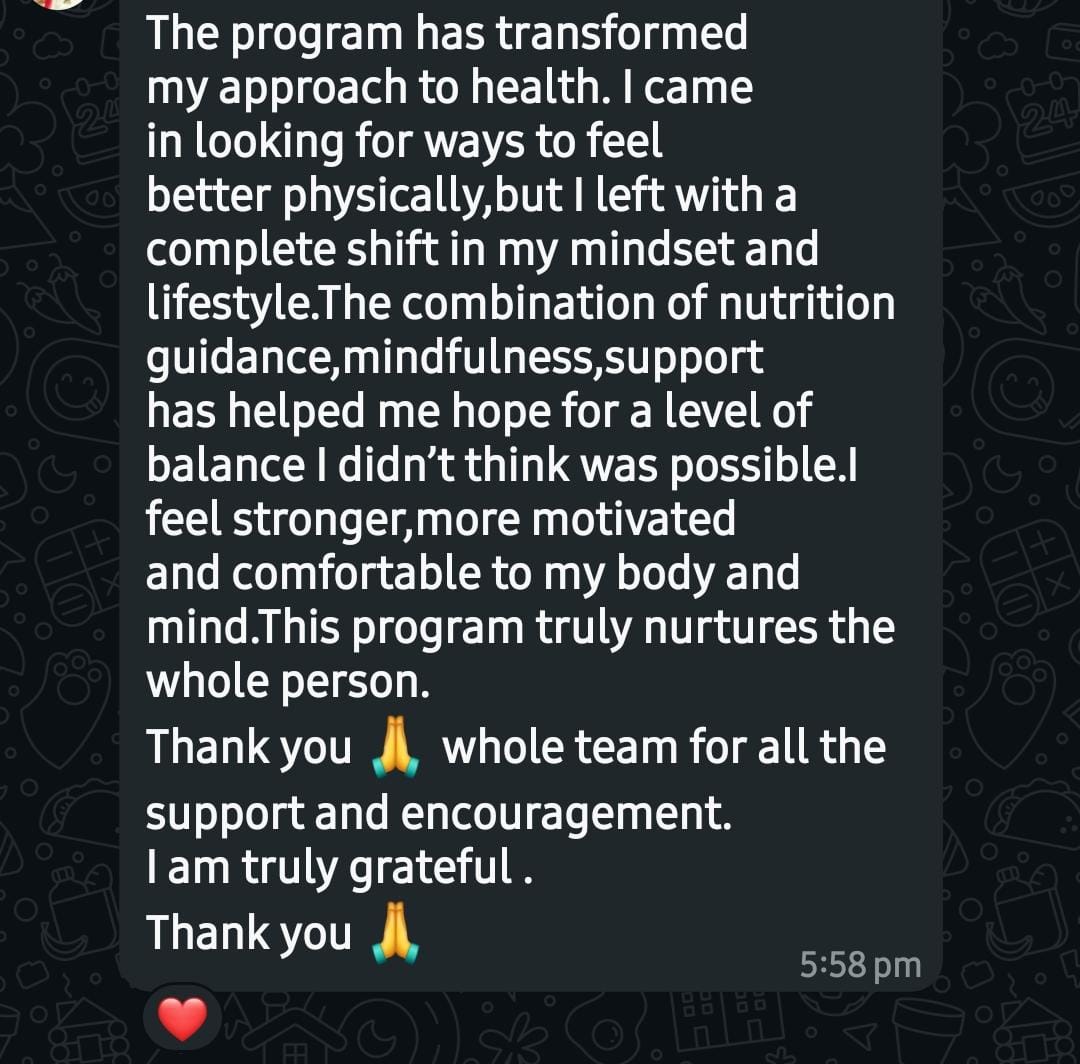
She came looking for ways to feel better physically. She left with a complete shift in mindset and lifestyle. The combination of nutrition, mindfulness, and support gave her a level of balance she didn’t think was possible.
“My experience at Fertilia was truly transformative”
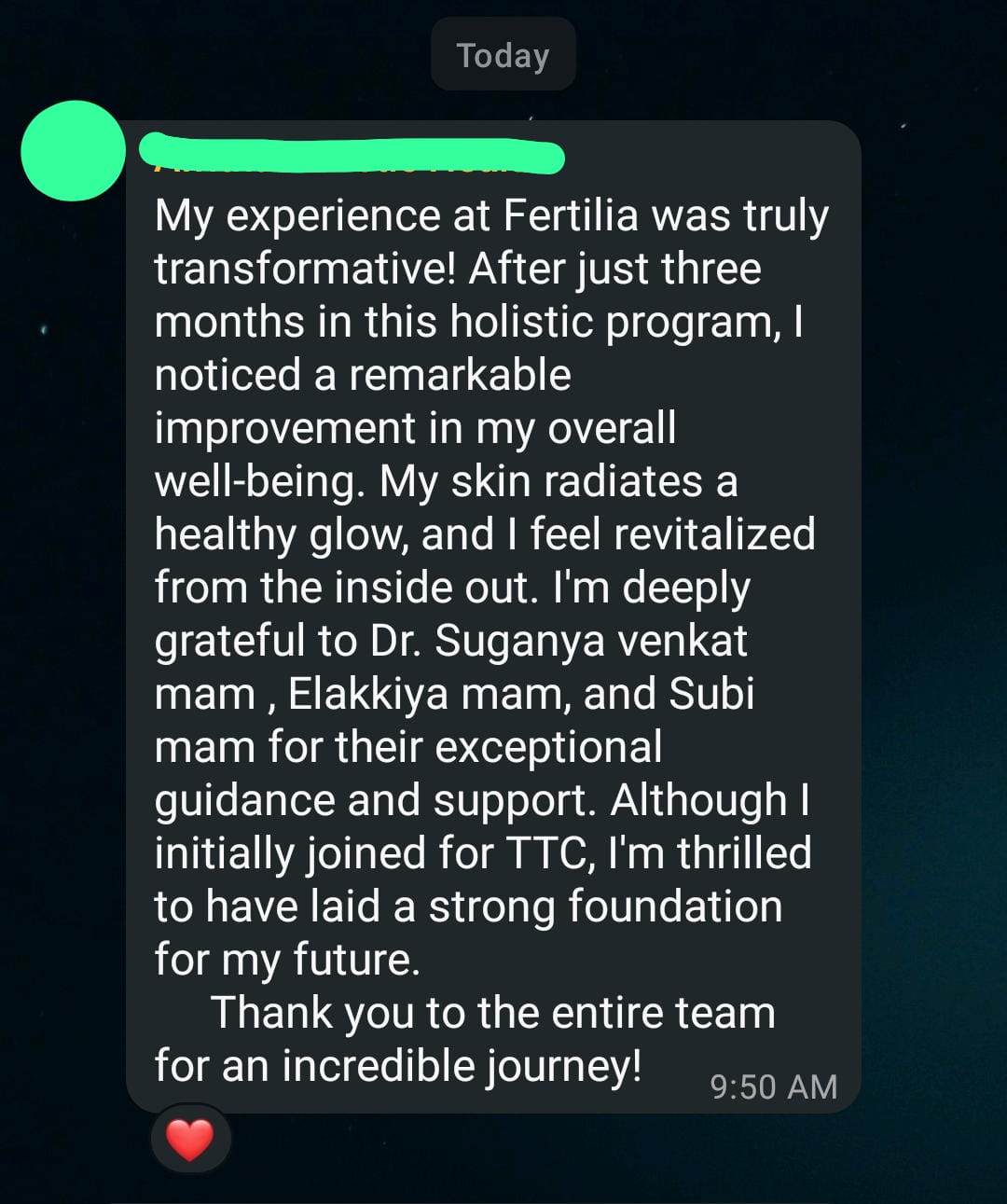
She joined for TTC (trying to conceive), not weight loss. But after three months in the program, her skin, energy, and overall wellbeing had improved so much that she felt she had laid a strong foundation for everything ahead.
“Weight reduction without starving or fasting”
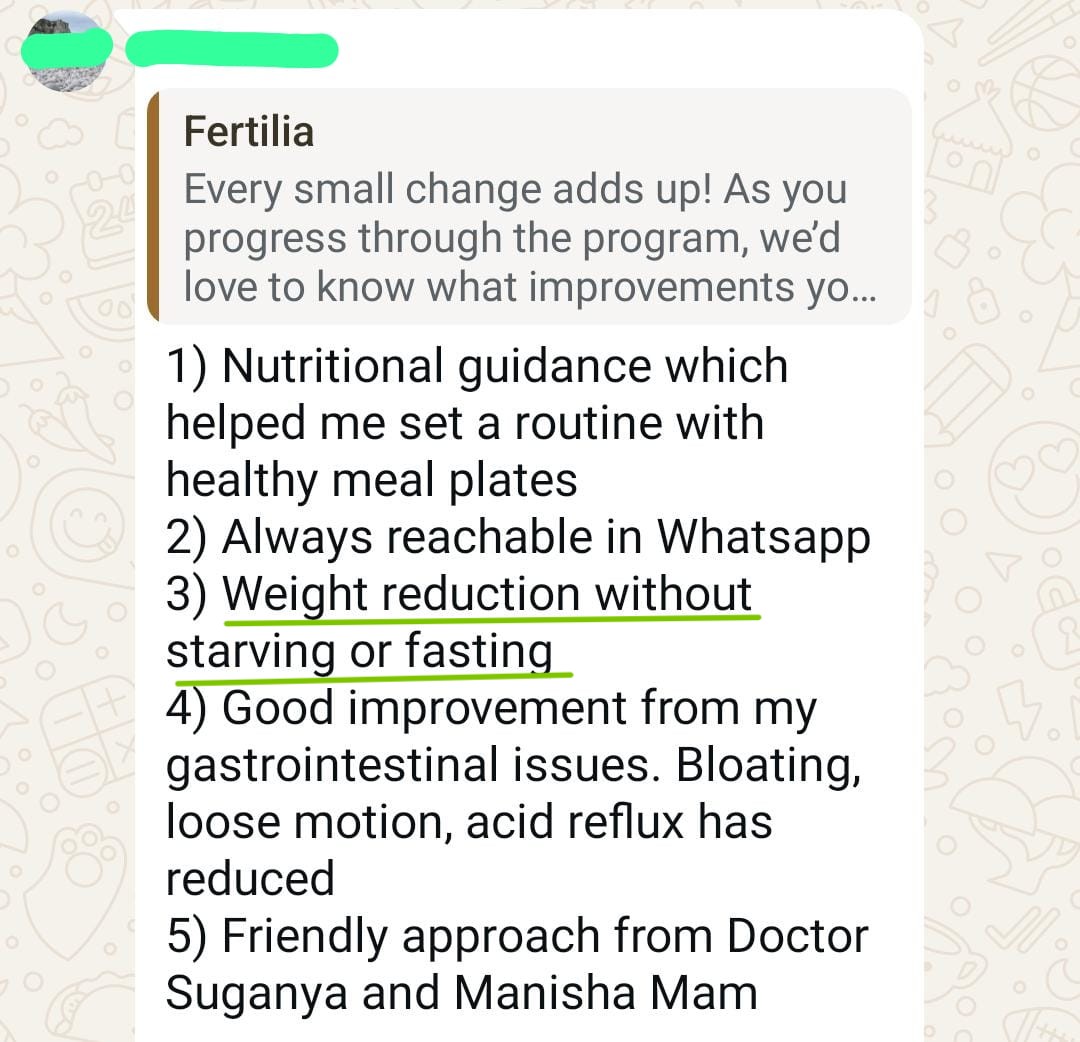
When asked what stood out, she listed five things: nutritional guidance that helped her build a routine, the team being always reachable on WhatsApp, weight reduction without starving or fasting, improvement in her gastrointestinal issues (bloating, loose motion, acid reflux), and the friendly approach from Dr. Suganya and Manisha.
“I’ve gone from 58 to 54 kg in a healthy, sustainable way”
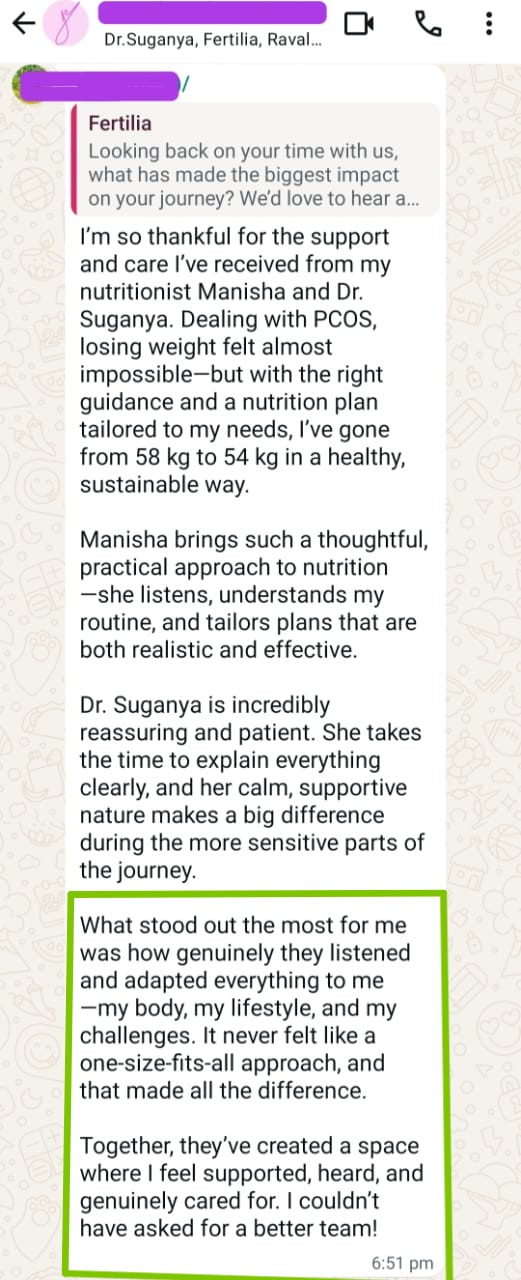
Dealing with PCOS, she felt losing weight was almost impossible. But with the right guidance and a nutrition plan tailored to her needs, she went from 58 kg to 54 kg. It never felt like a one-size-fits-all approach, and that made all the difference.
“Everything happened naturally because of your guidance”
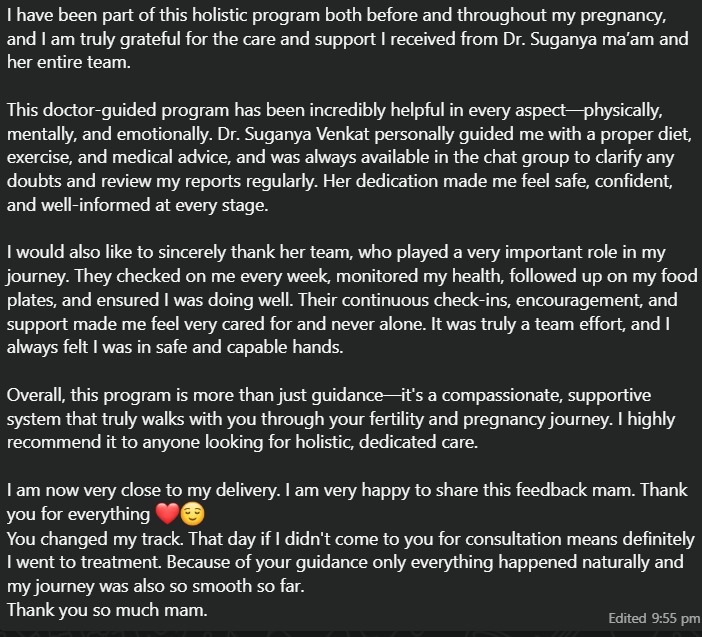
She was part of the program both before and throughout her pregnancy. Now close to delivery, she says: “That day if I didn’t come to you for consultation, I definitely went to treatment. Because of your guidance, everything happened naturally and my journey was also so smooth so far.”
“Our body weight is reducing gradually”
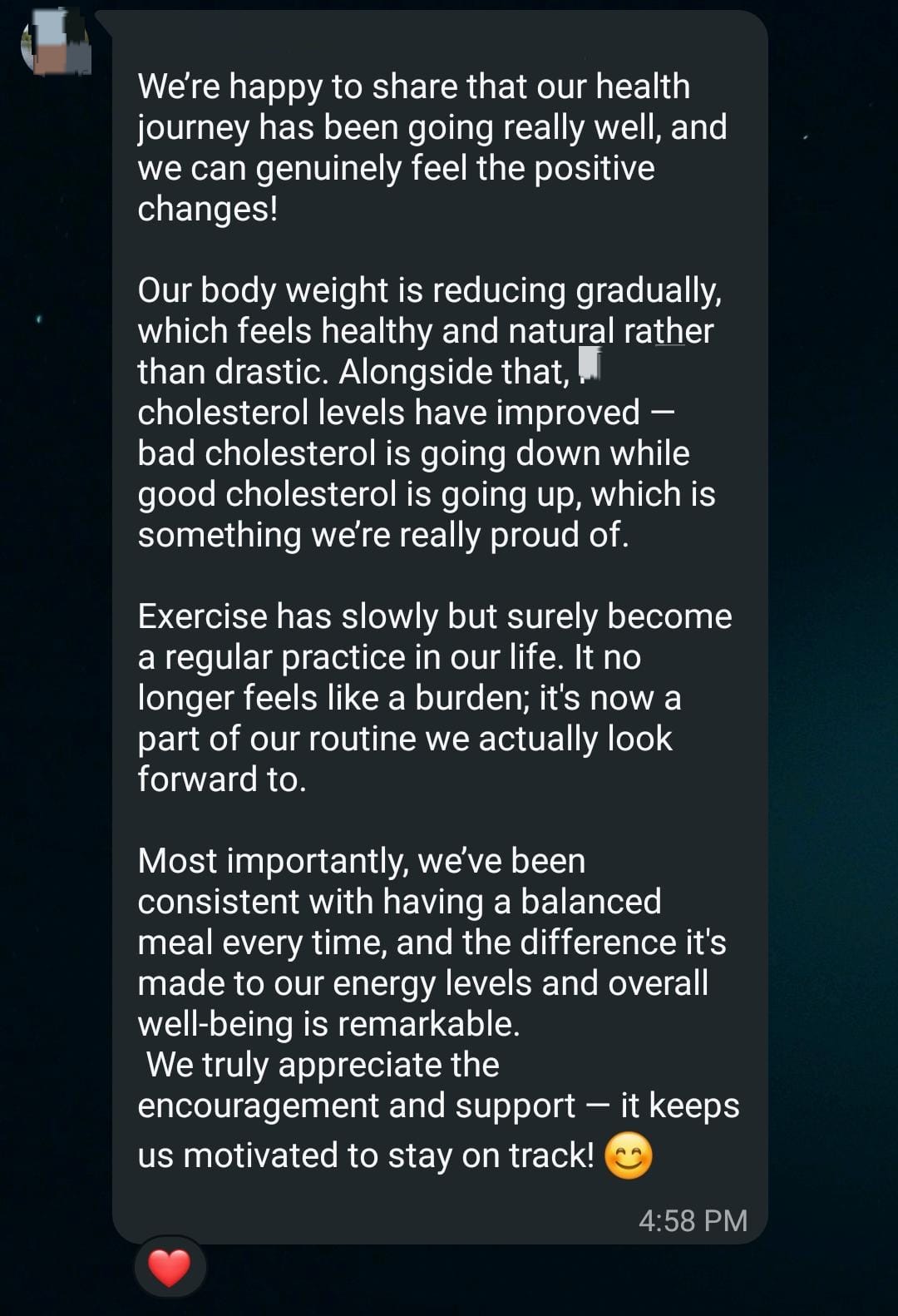
This one came from a couple doing the program together. Their weight is reducing gradually, cholesterol levels have improved, exercise has become something they actually look forward to, and balanced meals have changed their energy levels.
“I have not been this fit in a very long time”
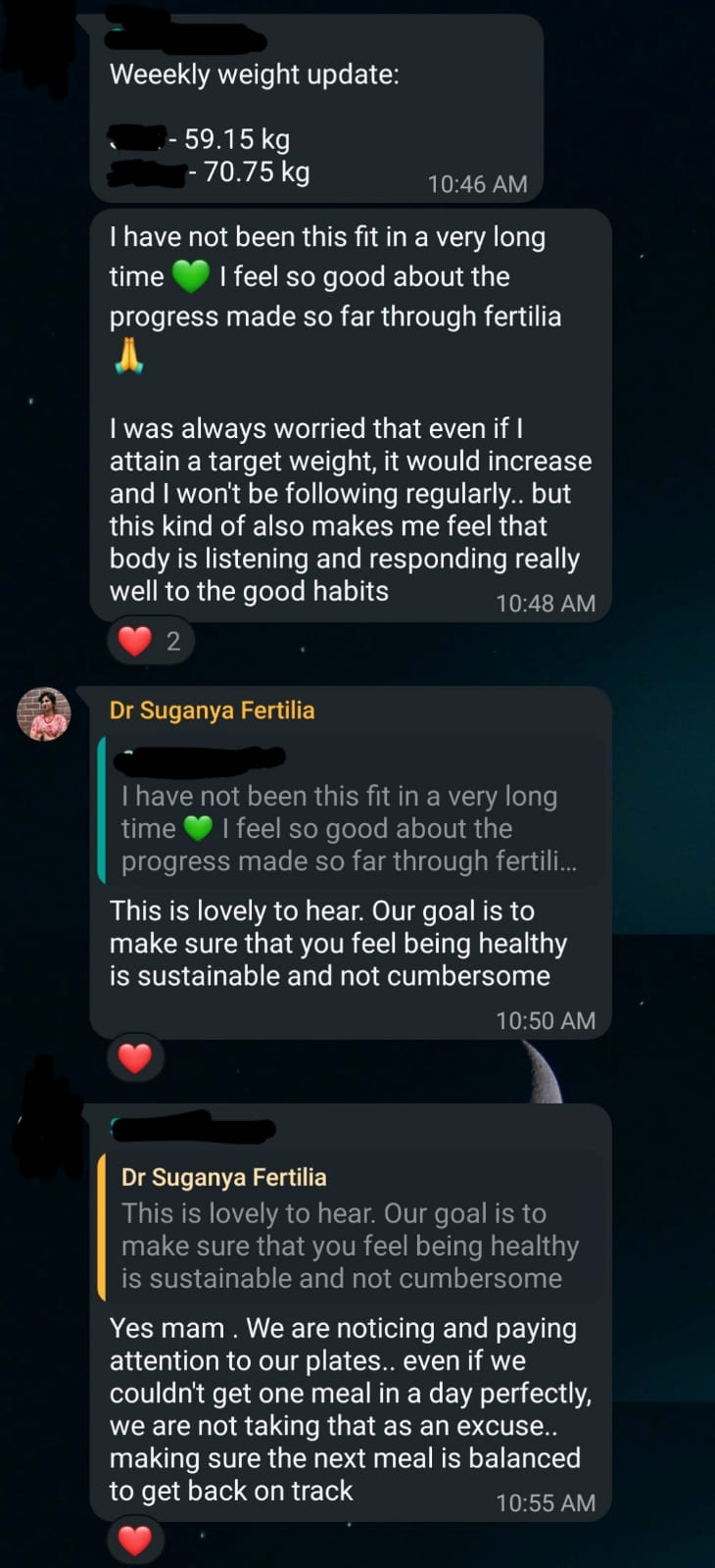
She was always worried that even if she reached her target, the weight would come back. Now her body is listening and responding to the good habits. And Dr. Suganya’s reply captures what this whole article is about: “Our goal is to make sure that you feel being healthy is sustainable and not cumbersome.”
These are not transformation stories measured in kilograms alone. They are stories of women who stopped fighting their bodies and started understanding them.
Before Another Month Begins
Maybe that is what this month of May, through No Diet Day, has tried to remind us.
It does not mean ignoring health or eating without balance. It also does not mean stopping exercise or deciding that health no longer matters. Instead, it is a reminder to step away from extreme dieting, guilt after eating, and the feeling that every Monday has to be a complete restart.
Health does not always have to come from strict food rules or unrealistic weekly targets. It can start with small changes that actually fit into your everyday life: eating food that still feels familiar and practical for your home routine, working out in a way that suits what your body actually needs, and having emotional support and guidance to help you stay motivated and consistent along the way.
At Fertilia, this is something we strongly believe in: understanding your body better from the root cause rather than following vague plans or temporary fixes. Looking at what your body actually needs, through the right nutrition, emotional wellness, medical understanding, and practical guidance that feels realistic for your everyday life.
So before another month begins, maybe just pause for a moment and ask yourself: Am I choosing something that will actually fit into my life, or am I starting another plan that I already know I’ll follow for two or three days before things get busy and I end up back where I started?
If any of this felt a little too familiar, or if you have gone through something similar and are still carrying things that are hard to put into words, please know that you are not alone. A lot of women feel this way after trying so many things and still feeling confused about what will actually work long term.
And if you feel like you need support, guidance, or simply a more realistic way to approach health, we are here to help, in a way that feels practical and manageable for your real life.
Because sometimes, it is not just physical weight. There is emotional weight too, things you have been carrying quietly for a long time.
A Note from Dr. Suganya
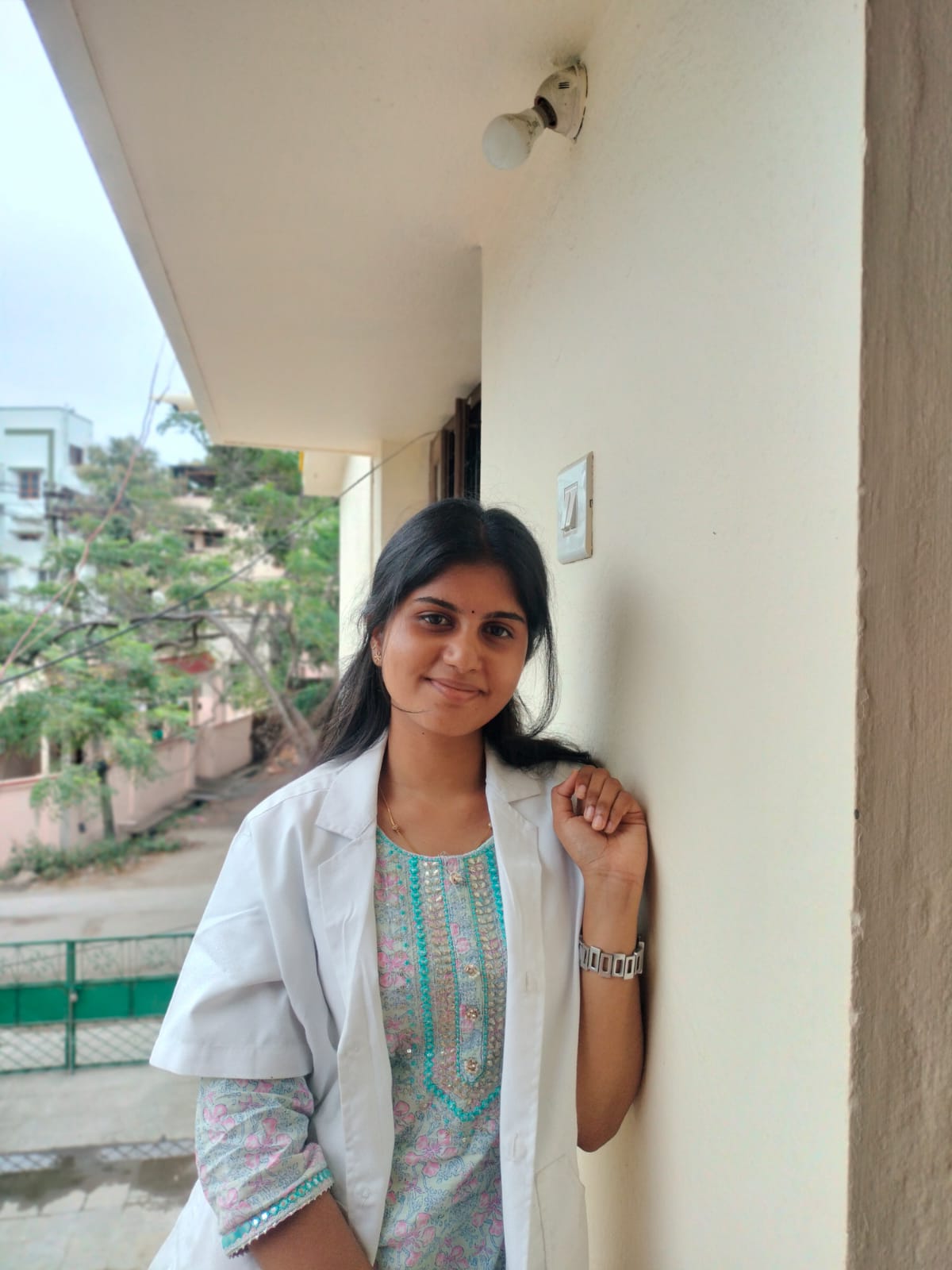
This article is written by nutritionist Manisha Maheswari of Fertilia. With her experience of guiding hundreds of women through their health journeys, being part of so many women’s stories has given her these insights and deep thoughts about the mental journey of a person trying to lose weight.
Losing weight is not only about the number on the scale. It is about how they feel from the inside, how much insecurity remains after stopping a diet, how much guilt follows every meal that wasn’t “perfect.” Manisha has touched upon all of these areas with honesty and sensitivity.
I truly appreciate her heartfelt sharing of her experiences in guiding so many women. She is a caring and genuine person who does not focus only on diet but on the overall mental and physical state. She has helped countless women with regularising cycles, getting pregnant, losing weight sustainably, and most of all, helping them make a healthy lifestyle enjoyable and not a fear-based one.
We call her “Manisha the Magician.”
Dr. Suganya Venkat, OB-GYN, 15+ years experience
Frequently Asked Questions
Is this article saying diets don’t work at all?
No. The article is not anti-diet. It is against extreme, unsustainable dieting that leads to cycles of restriction and rebound. A well-planned, balanced eating approach that fits your real life is very different from a crash diet. The point is that lasting health comes from understanding your body, not punishing it.
I have PCOS. Is weight loss different for me?
Yes. PCOS makes weight loss harder because of how the condition affects the way your body processes food and stores energy. A generic diet plan often doesn’t account for this. That is why a personalised approach, one that looks at your specific patterns, is important.
Can emotional eating be addressed without therapy?
Awareness is the first step. Many women at Fertilia find that simply having a supportive team (nutritionist, wellness coach, and doctor) who check in regularly helps them break the pattern of eating as a response to stress. In cases where deeper emotional support is needed, we also work with mental health professionals.
How is Fertilia’s approach different from other diet plans?
Fertilia does not hand you a meal chart and leave you alone. It is a 90-day program where your nutritionist, wellness coach, and doctor work together. The focus is on building a sustainable routine: balanced meals with familiar Indian foods, gentle movement, sleep, stress management, and regular check-ins. There is no calorie counting, no food shaming, and no Monday restarts.
What if I’ve tried everything and nothing has worked?
That is actually the most common thing women say when they first reach out to us. The fact that previous approaches didn’t last does not mean something is wrong with you. It usually means the approach didn’t account for your full picture: your medical history, your daily routine, your mental state, and what is actually realistic for your life. Reach out to us on WhatsApp and let’s start with a conversation.
Is this program only for women trying to conceive?
No. While many women come to Fertilia for fertility support, a significant number join specifically for PCOS management, weight management, or overall health improvement. The holistic approach benefits all of these goals.
How do I get started?
The simplest way is to send a WhatsApp message to Dr. Suganya. She will personally understand your situation and guide you on the best next step. The initial consultation is just Rs. 399. That next step is often Dr. Suganya’s 90-day Weight Loss program, built around your full picture rather than the scale.