A woman messages me from Toronto. Normal weight, eats carefully, runs three times a week. Her periods come every 45 to 60 days, she is tired in a way sleep does not fix, and there is a faint darkening at the back of her neck. Her doctor there was kind and thorough, ran some tests, and told her things looked broadly fine, maybe lose a couple of kilos. She writes to me because something still does not add up. She is not imagining it.
This is one of the most common conversations I have with Indian women abroad, and it comes down to a single idea that gets missed: PCOS does not look the same in an Indian body as it does in a textbook built around Western patients. Understanding why is genuinely freeing, because it explains years of feeling unseen, and it points straight at what helps.
This guide covers why PCOS shows up differently in Indian and South Asian women, what the evidence actually says, and why it matters even more when you are living abroad with a doctor who, through no fault of their own, is reading you against the wrong baseline.
PCOS is one syndrome, with drivers. For Indian women, insulin usually leads
First, a clarification that matters. PCOS (recently also named PMOS, polyendocrine metabolic ovarian syndrome) is not several different diseases. It is one syndrome with several underlying drivers: insulin resistance, inflammation, stress and adrenal androgens, and sometimes a rebound after stopping the pill. Different women have different mixes.
For a large majority of Indian women, the driver doing the most work is insulin resistance: the body makes plenty of insulin, but the cells respond to it sluggishly, so insulin levels run high. That extra insulin nudges the ovaries to make more androgens, which is what disturbs ovulation and drives the irregular cycles, the acne, the unwanted hair. Insulin resistance is central to PCOS for most women who have it (Dunaif, Endocr Rev 1997, PMID 9408743), and the link is felt more sharply in South Asian bodies.
This is why so much of our work is not about the ovaries directly. It is about the insulin signal underneath them.
The thin-fat pattern: why the scale and the BMI mislead
Here is the part Western charts were not built to catch.
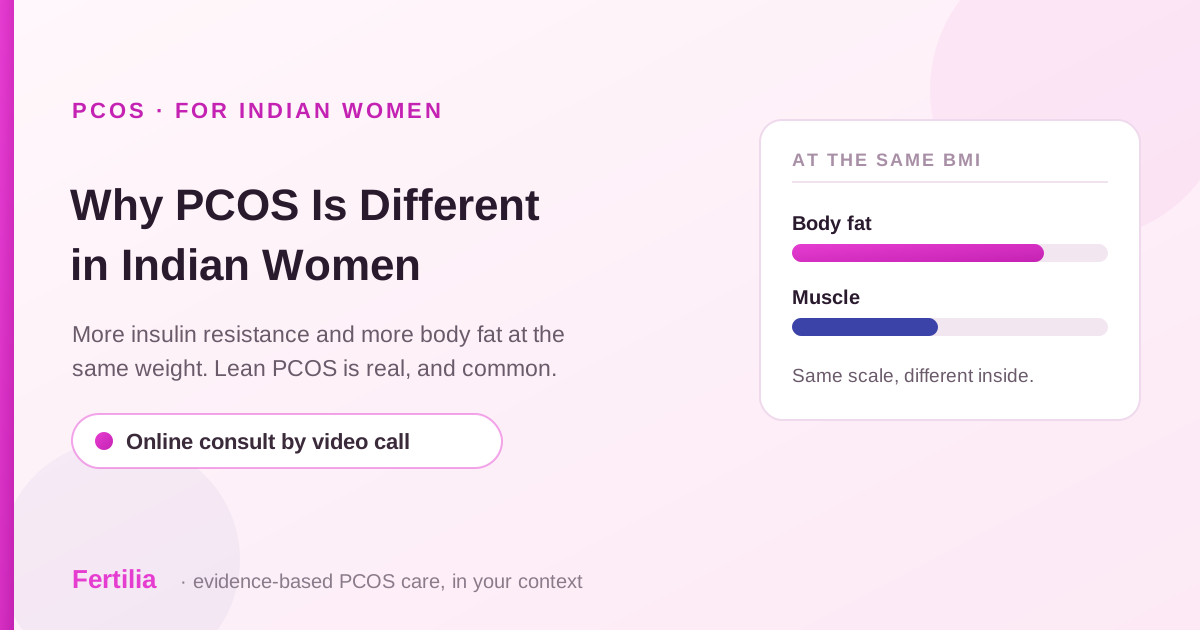
At the same BMI, Indian and South Asian women carry more body fat and less muscle than white women, and more of that fat sits centrally, around the organs. Researchers call this the thin-fat pattern, first described in Indian newborns who were light in weight but already had relatively high body fat (Yajnik CS et al., Int J Obes 2003, the Pune Maternal Nutrition Study). South Asians show greater insulin resistance than white people at the same body weight, and often without the visible obesity that Western medicine treats as the warning sign (McKeigue PM et al., Lancet 1991, PMID 1671422).
What this means in practice:
- A number on the scale that reads “normal” can sit on top of a body composition that is anything but, which is why lean PCOS is common in Indian women. The cycles can be just as disturbed at 55 kg as at 85 kg.
- Standard BMI cutoffs miss this. The WHO recommends lower BMI action points for Asians (overweight from 23, rather than 25) precisely because metabolic risk starts earlier in our bodies (WHO Expert Consultation, Lancet 2004, PMID 14726171).
- A dark, velvety patch at the back of the neck or the underarms, called acanthosis nigricans, is a visible sign of high insulin. In one large South Asian PCOS study it was present in nearly two-thirds of women (Kumarapeli V et al., Sri Lanka). It is your skin telling you about your insulin.
So if you have been told your PCOS is “mild” because your weight is fine, that label may be measuring the wrong thing.
What the numbers say about Indian and South Asian women
The picture from the research is consistent:
- PCOS is common. Worldwide it affects roughly 8 to 13 percent of women. In a 2024 national study of nearly 9,000 Indian women, prevalence was 19.6 percent by Rotterdam criteria, around 1 in 5, with most of those women also showing metabolic changes like dyslipidaemia (JAMA Network Open, 2024).
- The metabolic load runs higher. South Asian women with PCOS tend to show more insulin resistance and a higher rate of metabolic syndrome than white women with the same diagnosis, even when ovarian appearance is similar (Mani H et al., Clin Endocrinol 2015). In the Sri Lankan cohort, metabolic syndrome was present in about 30 percent of women with PCOS, against about 6 percent of women without it.
- It starts earlier and at a lower weight. South Asians develop insulin resistance and type 2 diabetes younger and at a lower BMI than Western populations, a pattern that traces back to that same thin-fat body composition.
None of this is meant to alarm you. It is meant to explain why your experience has felt different from the leaflets, and to make the case that the right lever, insulin, is well within reach.
Message Dr. Suganya on WhatsApp to talk through your cycles, your reports, and what your body is actually telling you.
Why this gap gets wider when you live abroad
Your doctor abroad is not doing anything wrong. They are using the standard reference ranges and BMI cutoffs they were trained on, and for the population those were built around, that is reasonable care. The trouble is that those defaults can quietly under-read an Indian body:
- A normal BMI reads as reassurance, so the metabolic question may never get asked.
- “Lose a little weight and come back” is hard to act on when your weight is already normal, and it can leave you feeling like the problem is your effort rather than the picture.
- Lab ranges and the threshold for calling something significant are set against a different baseline, so a borderline result that matters for you can be waved through.
This is exactly the layer I add, working alongside your local doctor, not instead of them. They handle your diagnosis, scans and any prescriptions where you live. I read your cycles, your insulin picture and your reports through a South-Asian lens, and we build a plan around an Indian kitchen and your real life. If you want the logistics of how that works across borders, see how to consult an Indian gynaecologist from abroad.
What helps: the same roots, addressed early
The encouraging part is that the driver we are talking about, insulin resistance, is one of the most responsive things in all of medicine. You do not need an exotic protocol. You need the ordinary levers applied properly and consistently:
- Eat in a way that steadies insulin, built on the food you already cook: protein at every meal (dal, curd, paneer, eggs, fish, chicken), fibre and vegetables first, whole grains like ragi and millets in place of refined white rice and maida, and not skipping meals. For the full plan, see our PCOS diet chart.
- Move in a way that builds muscle, because muscle is where insulin gets used. Walking after meals plus a little strength work does more for insulin than long, punishing cardio.
- Protect sleep and manage stress, since both feed insulin resistance and androgens.
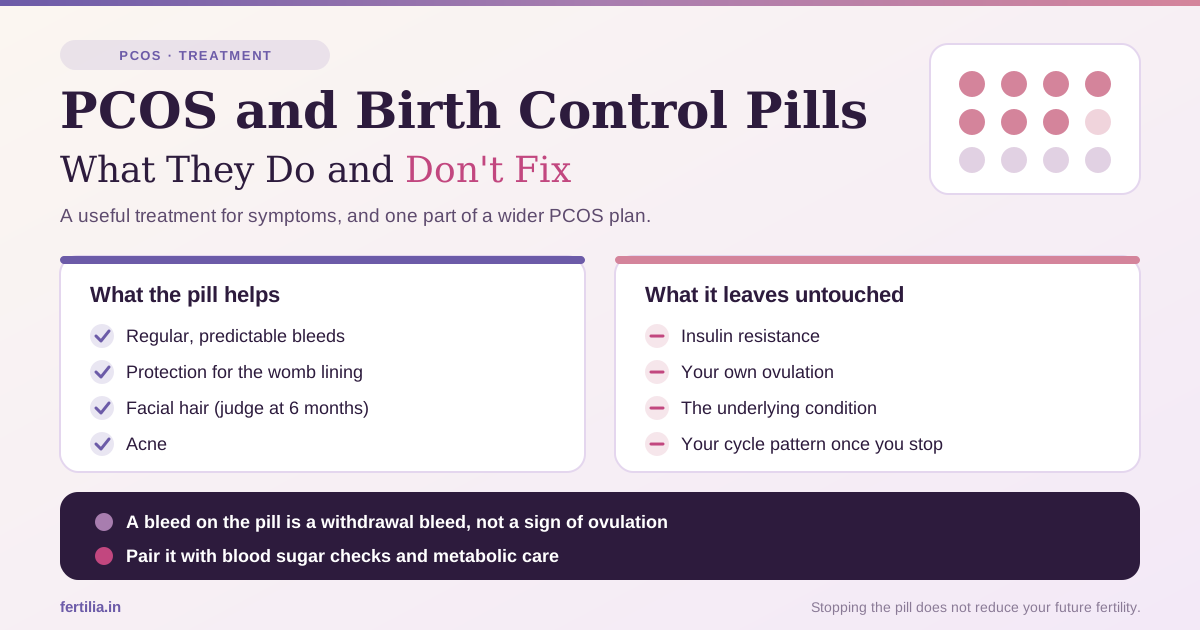
- Treat the root, not just the cycle. A withdrawal-bleed tablet brings a period; it does not touch the insulin underneath. To understand that mechanism, read our guide on insulin resistance and PCOS, and on that dark-neck sign, acanthosis nigricans.
Done steadily, this is what brings cycles back, lifts the energy, settles the skin, and protects you from the longer-term metabolic risks, whatever the scale says.
A short checklist if this sounds like you
- Do not let a normal BMI close the conversation. Ask about insulin and metabolic markers, not just weight.
- Look at the back of your neck and underarms. A velvety darkening is a clue worth taking seriously.
- Get the right picture, not a single number. Cycles, androgens, thyroid (TSH), vitamin D and B12, and a fasting insulin or glucose tell a fuller story together.
- Address insulin, not just the period. That is the lever that changes the trajectory.
For more on this, read our guide on PCOS and Thyroid. 5. Get a reading in your context before you accept “it is mild” or “just lose weight.” A South-Asian-aware second opinion is worth a great deal.
Frequently asked questions
Can I have PCOS if my weight is normal? Yes. Lean PCOS is common in Indian women. At the same BMI, Indian and South Asian bodies tend to carry more body fat and more insulin resistance than the populations Western charts were built around, so cycles can be disturbed even at a normal weight. A normal BMI does not rule PCOS out.
Why do Indian women get more insulin resistance with PCOS? It traces back to body composition. The thin-fat pattern, more body fat and less muscle at the same weight with more central fat, makes South Asian bodies more insulin resistant earlier and at a lower BMI (Yajnik 2003; McKeigue 1991). Since insulin resistance is the main driver of PCOS for most women, the syndrome lands harder.
My doctor abroad said my PCOS is mild because my weight is fine. Is that right? Your weight being fine is good news, but BMI alone can under-read an Indian body. The WHO uses lower BMI cutoffs for Asians for exactly this reason. It is worth looking at your insulin and metabolic picture, not only the scale, before deciding how mild it is. This is something to explore with your local doctor, with a South-Asian-aware reading alongside.
Does this mean I will get diabetes? No. It means insulin is worth paying attention to early, which is empowering, not frightening. Insulin resistance responds very well to everyday changes in food, movement and sleep, and addressing it early is one of the best things you can do for both your cycles and your long-term health.
What is the dark patch on my neck? That velvety darkening, acanthosis nigricans, is a visible sign of high insulin. It is common in South Asian women with PCOS and tends to lighten as insulin resistance improves with lifestyle work.
Is the treatment different for Indian women? The principles are the same, but the emphasis shifts to insulin and to a plan built on Indian food and an Indian routine. The biggest difference is recognising the pattern in the first place, so the right lever gets pulled instead of being missed because the scale looked fine.
If you are an Indian woman abroad and PCOS has never quite fit the explanations you have been given, there is a reason, and there is a clear way forward. Dr. Suganya consults online, pan-India and across the diaspora, by video call, alongside the doctor you already see. You can read how it works from the USA, Canada or the UAE, explore the 90-day PCOS program, or start a conversation on WhatsApp. Understanding your own body in the right context changes everything that comes next.