A woman once called our clinic from an emergency room in Chennai, her voice tight with pain, asking if what she was feeling could just be “a bad cyst.” She had sudden, severe pain on one side of her lower abdomen that had come on in minutes, not hours, along with nausea so intense she had already vomited twice. She had a known ovarian cyst that her last scan called “small and simple.” She was scared to sound dramatic. She was right to call.
What she was describing turned out to be ovarian torsion, a true gynaecological emergency where the ovary twists on the tissue that carries its blood supply. It is not common, but it is not rare either, and it is one of the few things in gynaecology where hours genuinely matter. I’m Dr. Suganya Venkat, an OB-GYN with over 15 years of experience, and I want you to know exactly what this looks like, why it can be missed even on a good ultrasound, and what fertility looks like afterward, so that if this is ever you, you act fast instead of waiting it out.
What this post covers
- What ovarian torsion actually is and why it happens
- Who is most at risk, including the specific link to IVF
- The symptoms that should send you to an emergency room, not a WhatsApp group
- Why a “normal” ultrasound does not rule it out
- What surgery involves and why doctors detorse first, decide later
- Fertility and future pregnancy after torsion, including after losing one ovary
- What to do if this happens to you
What ovarian torsion is
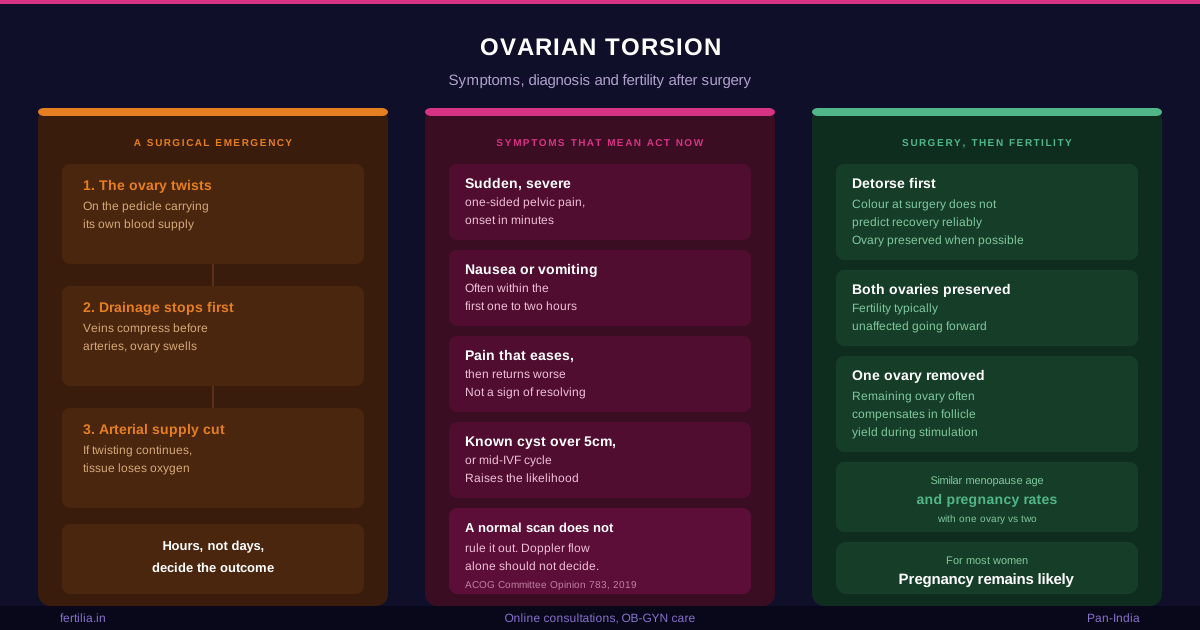
The ovary is held in place by ligaments and a blood supply that runs through a stalk called the ovarian pedicle. Ovarian torsion happens when the ovary, and often the adjacent fallopian tube, rotates around that pedicle. As the vessels twist, venous and lymphatic drainage is cut off first, causing the ovary to swell. If the twisting continues or tightens, arterial blood supply is cut off too, and the ovarian tissue starts to lose oxygen.
This is why torsion is treated as a true emergency rather than something to monitor. Left untwisted, the ovary can lose its blood supply entirely, and tissue that goes without oxygen for long enough does not recover. The clock that matters here is measured in hours, not days.
Torsion can be complete, where the ovary twists a full 360 degrees or more, or partial, where it twists less and the blood supply is only partly compromised. Partial torsion can produce pain that comes and goes, which is exactly what makes it easy to dismiss as “just cramps” or “probably gas.”
Who is at risk
Torsion needs something to make the ovary heavier or more mobile than usual, so it has somewhere to swing from.
An existing ovarian cyst, especially a large or heavy one. A five-year surgical review of 81 confirmed torsion cases at a tertiary centre in South India found that most women had a pre-existing ovarian mass larger than 5cm, and dermoid cysts (also called mature cystic teratomas) are a particularly common culprit because they can contain fat, hair, and tissue that make one side of the ovary heavier than the other (Gupta et al., Journal of Obstetrics and Gynaecology of India, 2020, PMID 32476769). A functional cyst that forms after ovulation can do the same thing, usually resolving on its own, but occasionally providing enough extra weight to torse.
IVF and ovarian stimulation, particularly with OHSS. Fertility medication deliberately grows multiple follicles at once, and an ovary carrying many enlarged follicles is heavier and more prone to twisting than a normal ovary. This risk is highest in the two weeks after egg retrieval, when the ovaries are at their largest, and it climbs further if ovarian hyperstimulation syndrome (OHSS) develops. In a ten-year review of surgically confirmed torsion cases, OHSS was identified as the underlying risk factor in 12.2% of cases (White & Stella, Emergency Medicine Australasia, 2005, PMID 15953224). If you’re mid-IVF cycle or just had a retrieval and develop sudden one-sided pain, this is not a symptom to wait out. For more on recognising OHSS itself, see our guide to OHSS after IVF.
Pregnancy. The corpus luteum cyst that supports early pregnancy, along with the general loosening of pelvic ligaments that pregnancy causes, both raise torsion risk, particularly in the first trimester.
Being young, with naturally mobile ovaries. Torsion is disproportionately common in the reproductive years, and in adolescents it can happen even without a cyst present at all, because a young, highly mobile ovary needs less of a trigger.
Having had torsion before. Once one ovary has torsed, the other carries a somewhat higher lifetime risk, partly because whatever made the ligaments lax on one side is often present on both.
The symptoms that should send you to an emergency room
The single most consistent symptom across nearly every study on torsion is sudden, severe, one-sided lower abdominal or pelvic pain. Not a pain that built gradually over a day. Sudden.
Alongside the pain, most women also have:
- Nausea and vomiting, often within the first hour or two
- A pain that may come in waves if this is partial or intermittent torsion, easing and then returning, which some women initially mistake for the cyst simply resolving
- Tenderness on one side when the lower abdomen is pressed
- Sometimes a low-grade fever as inflammation sets in, though this is a later sign
What torsion usually does not come with: heavy vaginal bleeding, a positive pregnancy test complication like a ruptured ectopic (though both should be ruled out), or gradually worsening period-type cramping. If you already track your cycle and this pain feels categorically different, sharper, more sudden, more one-sided, trust that instinct.
The intermittent pattern is the most dangerous part of this condition, because it can trick you into thinking things are improving. A partially torsed ovary can twist and briefly untwist on its own, giving a few hours of relief before the pain returns, often worse. If you’ve had a sudden, severe one-sided pain that eased and then came back, that is not reassurance. That is a reason to go to an emergency room, not to wait for the next episode.
Why a “normal” scan does not rule it out
This is the part women are rarely told, and it matters enormously. A transvaginal ultrasound with Doppler flow is the standard first imaging test when torsion is suspected, and reduced or absent blood flow on Doppler is a strong supporting sign. But normal blood flow on Doppler does not exclude torsion.
The ovary has a dual blood supply, from the ovarian artery and from the uterine artery, and in intermittent or partial torsion, or torsion that has briefly untwisted between episodes, flow can look deceptively normal on the scan performed at that moment. The American College of Obstetricians and Gynecologists addresses this directly in its committee opinion on adnexal torsion: there are no clinical or imaging criteria sufficient to confirm the diagnosis before surgery, and Doppler flow alone should not guide the decision of whether to operate (ACOG Committee Opinion No. 783, Obstetrics & Gynecology, 2019, PMID 31348225). Torsion is, in the end, a surgical diagnosis: the only way to know for certain is to look.
This is precisely why, if your symptoms strongly suggest torsion, a doctor may recommend diagnostic laparoscopy even when your scan comes back reassuring. The scan was still worth doing, it simply has limits this condition is specifically good at slipping past, and a delayed diagnosis while waiting for imaging to “confirm” something imaging cannot reliably confirm is one of the clearest ways ovarian tissue is lost. A comparison of torsion management in children found that girls with suspected ovarian torsion waited two and a half times longer for diagnostic imaging and nearly three times longer to reach the operating room than boys with suspected testicular torsion, a condition managed far more urgently, and the gonadal salvage rate was significantly worse for ovarian torsion as a direct result, 14.4% versus 30.3% (Piper et al., Journal of Pediatric Surgery, 2012, PMID 23164000). That gap points to the same fix either way: treat sudden, severe, one-sided pain in the ovary with the same urgency as its better-known counterpart.
If you’re unsure right now
If you have a known ovarian cyst and you are unsure whether new pain is something to sit with or something to act on immediately, that uncertainty is exactly what a quick conversation resolves. You can reach out to Dr. Suganya Venkat over WhatsApp at Fertilia, entirely online, and get direction on whether this needs an emergency room tonight or can wait for a scheduled scan. When in doubt with sudden, severe, one-sided pain, the safer answer is always the emergency room first, this conversation after.
What surgery involves
Once torsion is confirmed or strongly suspected, the standard of care is prompt laparoscopic surgery to untwist, or detorse, the ovary and restore its blood supply. This is usually done through small keyhole incisions rather than open surgery, and the goal in almost every case is to preserve the ovary, not remove it.
Here is the detail that surprises most women: the ovary’s appearance at the time of surgery, even if it looks dark blue, purple, or black, does not reliably predict whether it will recover. Tissue that looks severely compromised in the moment can often regain a normal blood supply and function once it is untwisted, because much of that dark colour reflects venous congestion, blood pooling because it cannot drain, rather than tissue that is already dead. ACOG’s guidance is explicit on this point: a minimally invasive approach with detorsion is recommended regardless of the ovary’s appearance, and a surgeon should not remove a torsed ovary unless oophorectomy is truly unavoidable, such as when severely necrotic tissue is falling apart on its own (ACOG Committee Opinion No. 783, PMID 31348225). “Detorse first, decide later” is the modern standard, replacing an older reflex to remove anything that looked dead on sight.
If there is an underlying cyst causing the extra weight, your surgeon may remove just the cyst (a cystectomy) at the same sitting, while conserving the ovary itself. Oophorectomy, removing the ovary entirely, is reserved for the minority of cases where the tissue truly cannot be salvaged, most commonly when diagnosis and surgery were significantly delayed.
Fertility and pregnancy after ovarian torsion
This is usually the question underneath every other question, and the answer depends on what happened in surgery.
If the ovary was successfully detorsed and preserved, which is the outcome in most cases when surgery happens promptly, ovarian function is typically preserved along with it. The ovary continues to ovulate, contribute hormones, and function as part of your fertility going forward. There is no evidence that a successfully detorsed ovary behaves differently in future cycles or future IVF stimulation than an ovary that was never torsed.
If one ovary had to be removed, you are left with a single ovary, and this is a more common situation in gynaecology than people realise, arising from torsion, endometriomas, or other surgery. A systematic review comparing women after unilateral oophorectomy with women who kept both ovaries found similar age at menopause and similar clinical pregnancy rates between the two groups, though the remaining ovary carries a smaller total reserve, a difference in quantity, not quality, of the eggs it produces (Gasparri et al., Geburtshilfe und Frauenheilkunde, 2021, PMID 33692594). A study specifically looking at IVF stimulation in women with one ovary found the remaining ovary compensates by recruiting more follicles per cycle than it would if both ovaries were doing the job, essentially working harder to make up part of the gap (Khan et al., Fertility and Sterility, 2014, PMID 24355047).
That said, the evidence here is mixed, and the fuller picture is worth having. A large multicentre cohort study of IVF outcomes found live birth rates were meaningfully lower per cycle in women with a history of unilateral oophorectomy compared with women with two intact ovaries, alongside fewer oocytes retrieved on average (Lind et al., Human Reproduction, 2018). Most women in this situation do still conceive, but if you need IVF, your fertility specialist may plan for a slightly different response to stimulation, sometimes with an adjusted protocol or realistic expectations on oocyte numbers per cycle. This is the kind of nuance worth discussing directly rather than assuming either the best or worst case.
Natural conception after torsion, with either one or two functioning ovaries, follows the same principles as fertility for any woman: regular ovulation from the remaining or preserved ovarian tissue is what matters, and one healthy ovary ovulating consistently is entirely capable of a normal pregnancy on its own timeline. If your periods return to a regular pattern after recovery, that is a good sign that ovulation has resumed.
If you’re recovering from torsion surgery and want a clearer sense of what your specific findings mean for trying to conceive, this is exactly the kind of conversation worth having directly with a doctor who has your operative notes, rather than trying to interpret them alone. You can talk it through with Dr. Suganya Venkat over a video consultation at Fertilia, and Fertilia works with women across India, entirely online, through video and phone.
What to do if this happens to you
- Sudden, severe, one-sided pelvic or lower abdominal pain, especially with nausea or vomiting: go to an emergency room. Do not wait to see if it passes, and do not treat it as a WhatsApp-group question first.
- If the pain eases and then returns, that is not reassurance. Intermittent pain is a known pattern of partial torsion, not a sign it is resolving.
- If you know you have an ovarian cyst, especially one over 5cm, or you’re currently in an IVF stimulation cycle, keep this possibility in mind rather than assuming any new pain is “just the cyst” or “just the injections.”
- A normal ultrasound does not fully rule out torsion. If your symptoms are strongly suggestive and pain continues, ask directly whether diagnostic laparoscopy should be considered, especially if you’re being sent home without a clear alternative explanation.
- After surgery, ask your surgeon specifically what was done, detorsion alone, detorsion with cystectomy, or oophorectomy, and whether the ovary looked viable at the end of the procedure. This detail shapes what your fertility conversation should look like afterward.
Frequently asked questions
Can ovarian torsion happen without a cyst? Yes, though it’s less common in adults. In adolescents and young women, torsion can occur in an ovary with no cyst or mass at all, simply because the ovary and its supporting ligaments are naturally more mobile at that age. In adults, some degree of underlying cyst or enlarged ovary is present in most cases.
How long can an ovary survive torsion before permanent damage occurs? There is no single universal cut-off, and it depends on whether the torsion is complete or partial, and how tightly the vessels have twisted. What the evidence is consistent about is direction: earlier detorsion gives a meaningfully better chance of saving the ovary, and delays measured in many hours to days are associated with lower salvage rates. This is why sudden, severe pain warrants same-day emergency evaluation, not a wait-and-see approach.
Is ovarian torsion the same as a ruptured ovarian cyst? No, and the distinction matters for how they’re managed, though both can cause sudden severe one-sided pain and both need urgent evaluation. A ruptured cyst is a burst that releases fluid or blood into the pelvis; torsion is the ovary twisting on its blood supply. Both are diagnosed by a doctor examining you and often confirmed by ultrasound, sometimes surgery. If you want to understand rupture on its own, our guide to a ruptured ovarian cyst covers that specifically.
Does having had ovarian torsion once mean it will happen again? The ovary that was successfully treated does not have an inherently higher chance of torsing again once it’s back to a normal size and position. However, if you have an underlying tendency toward cysts, or the remaining ovary has similar anatomy, there is a somewhat higher lifetime risk on the other side than in the general population, which is one more reason any sudden one-sided pain deserves prompt attention regardless of which side it’s on.
Can I still get pregnant with only one ovary after torsion? Yes. Most women with one functioning ovary conceive, whether naturally or with fertility treatment, and having one healthy, ovulating ovary is generally sufficient for a normal pregnancy. If you do need IVF, your specialist may adjust your stimulation protocol to account for a smaller total egg reserve, and that conversation is worth having directly rather than assuming a fixed outcome either way.
How is ovarian torsion different from PCOS pain or a regular ovarian cyst? PCOS itself does not typically cause acute, sudden severe pain, it involves multiple small follicles and a hormonal pattern, not a torsion risk on its own. A simple ovarian cyst, if it stays small, often causes no pain at all or mild, gradual discomfort. What distinguishes torsion is the suddenness and severity: pain that comes on sharply, over minutes, on one side, often with vomiting. If you’re trying to understand ovarian cysts more broadly, our guide on when an ovarian cyst needs attention walks through that difference in more detail.
What does an ovarian cyst on ultrasound have to do with torsion risk? Not every cyst raises torsion risk meaningfully, most small, simple cysts do not. Size and type matter more than the presence of a cyst alone: larger cysts, and specifically dermoid cysts, which can be uneven in weight, are the ones most associated with torsion in the research. If you’ve just had a scan and want help understanding what your specific report means, our guide to reading an ovarian cyst ultrasound report explains what the different findings indicate.
A final word
Ovarian torsion is frightening precisely because it moves fast and can be genuinely hard to diagnose with certainty before surgery. But the outcomes here are good when women act on sudden, severe, one-sided pain instead of waiting it out, and modern surgical practice leans heavily toward saving the ovary, not removing it, even when it looks alarming in the moment. If you take one thing from this: sudden pain that is severe and one-sided is not something to sit with. Get seen the same day.
If you’ve been through this and have questions about what it means for your fertility going forward, or you have a cyst you’re keeping an eye on and want a clearer sense of your personal risk, you can reach Dr. Suganya Venkat and the Fertilia team over WhatsApp, online, across India, whenever you’re ready.